Bridge Loans Explained

What Are Asset Based Bridge Loans? (Quick Explanation for Investors)

Asset based bridge loans are short-term real estate loans where approval is primarily based on the value of the property rather than the borrower’s income, tax returns, or credit history.

These loans are designed for situations where speed and flexibility are critical. Instead of evaluating employment records, lenders focus on the real estate collateral, loan-to-value ratio, and the borrower’s exit strategy.

Asset based bridge loans are typically used for:

  • Time-sensitive property acquisitions
  • Distressed or off-market real estate deals
  • Development site purchases
  • Short-term refinancing or liquidity events
  • Distressed situations 
  • Releasing equity before a sale closes
  • Business related expenses 

Because underwriting focuses on the asset, these loans can often close in 10–14 business days (or less), compared with 45–60 days for many traditional lenders.

For investors who cannot wait for bank underwriting cycles, asset based bridge loans allow capital to move at the same pace as the real estate opportunity.

Why Do Investors Use Asset Based Bridge Loans Instead of Bank Financing?

Investors use asset based bridge loans when traditional bank financing is too slow or documentation requirements are too restrictive.

Banks typically require:

  • Multiple years of tax returns
  • Detailed income verification
  • Debt-to-income analysis
  • Extensive credit history review

Asset based bridge loans simplify the process by focusing on three core factors:

  1. Property value
  2. Loan-to-value ratio
  3. Exit strategy

For global investors, this approach is especially helpful because many foreign national borrowers do not have U.S. credit history or domestic tax returns.

The flexibility of asset based bridge loans allows investors to act quickly while arranging long-term financing later.

For example, many borrowers later refinance into long-term programs such as DSCR loans, which qualify based on property income rather than personal income.


Learn more about this type of financing in the America Mortgages guide to DSCR loans.

What Are the Best Uses for Asset Based Bridge Loans?

The best uses for asset based bridge loans involve situations where speed, flexibility, or unconventional borrower profiles make traditional loans difficult.

Below are the most common investor scenarios.

1. Acquiring Distressed or Time-Sensitive Real Estate

Asset based bridge loans allow investors to close quickly on properties that require fast transactions. Often viewed “same as cash”. 

In competitive markets, distressed sellers or off-market opportunities often require closing within two weeks.

Because asset based bridge loans evaluate the property rather than the borrower’s tax returns, they allow investors to compete with cash buyers.

This is particularly valuable in major markets such as Miami, Los Angeles, Austin, and New York where real estate opportunities can disappear quickly.

2. Financing Renovations and Value-Add Investments

Asset based bridge loans are frequently used to purchase and renovate properties before refinancing into long-term financing.

Investors may acquire properties that require:

  • Renovation
  • Tenant stabilization
  • Property repositioning

Once improvements are completed and rental income increases, investors often refinance into longer-term financing structures.

This strategy allows investors to capture value appreciation before locking into permanent loans.

3. Development Site Acquisition

Developers often use asset based bridge loans to secure land before construction financing becomes available.

Traditional construction lenders usually require:

  • Final architectural plans
  • Permits and entitlements
  • Pre-sales or lease commitments

Asset based bridge loans provide interim capital so developers can acquire land while preparing full construction financing packages.

4. Accessing Liquidity Without Selling Property

Asset based bridge loans allow investors to unlock equity from real estate without selling their assets.

Investors frequently hold significant capital in property portfolios but require liquidity for:

  • Releasing equity before the sale of a property 
  • Portfolio expansion
  • International ventures

Bridge loans allow them to access capital quickly while maintaining ownership of valuable real estate assets.

5. High Net Worth (HNW) Liquidity Solution

Asset based bridge loans allow HNW investors to unlock equity from real estate without selling their assets.

High-net-worth investors frequently hold significant capital in real estate but require liquidity for:

  • Business opportunity 
  • Expansion of their business
  • Business acquisition 

Why wait to monetize what you own? Bridge loans convert real estate equity into immediate ammunition — fast capital, full control, no dilution.

How Do Asset Based Bridge Loans Qualify Borrowers?

Asset based bridge loans qualify borrowers primarily using property value and exit strategy rather than personal income verification.

Instead of traditional underwriting, lenders evaluate the following components.

Property Value and Market Strength

The property is the most important element of underwriting.

Lenders analyze:

  • Market location
  • Comparable property sales
  • Liquidity in the local real estate market
  • Appraised value or broker valuation

This evaluation determines the maximum loan amount.

For reference, investors can review broader U.S. housing market trends through sources such as the National Association of Realtors, which publishes regular real estate market data.

Loan-to-Value Ratio

Most asset based bridge loans are structured at up to 75 percent loan-to-value (LTV).

For development or renovation projects, lenders may consider:

  • Current property value
  • After-repair value (ARV)
  • After-development value (ADV)

This helps determine the risk profile of the transaction.

Exit Strategy

Every asset based bridge loan must have a clear exit plan.

Typical exit strategies include:

  • Refinancing into permanent mortgage financing
  • Selling the property after stabilization
  • Transitioning into construction financing
  • Consolidating assets into portfolio loans

Without a credible exit strategy, most bridge lenders will not proceed with financing.

Real Investor Case Studies Using Asset Based Bridge Loans

Below are two examples illustrating how investors use asset based bridge loans to move quickly on U.S. real estate opportunities when traditional financing is too slow or restrictive.

Case Study 1: Off-Market Hotel Acquisition in Florida

A private investment group based in Toronto identified an off-market boutique hotel in Key West, Florida that the owner needed to sell quickly due to a partnership dispute. The seller required a closing within roughly two weeks, which immediately ruled out most traditional lenders because commercial underwriting often takes several weeks and requires extensive financial documentation.

The investors secured an asset based bridge loan covering approximately 70 percent of the property value, allowing them to close before competing buyers could arrange financing. After acquiring the property, the group upgraded several units and repositioned the hotel to target higher nightly rates. Within a year, the stabilized property qualified for long-term commercial financing, allowing the investors to refinance the bridge loan and retain a significantly more valuable hospitality asset.

Case Study 2: Portfolio Expansion Through Bridge Financing

An experienced investor based in Dubai owned several stabilized rental properties across Phoenix, Arizona and Dallas, Texas. When two multifamily opportunities became available at the same time, the investor needed a fast way to secure both properties without selling existing assets or waiting for traditional loan approvals.

The investor used asset based bridge loans by leveraging equity from properties already held in the portfolio. Because the loans were structured around real estate value rather than income documentation, the financing was approved quickly and both acquisitions closed within weeks. After the properties reached stabilized occupancy, the investor refinanced the bridge loans into long-term portfolio financing, expanding the rental portfolio while preserving ownership of the original assets.

Case Study 3: The London Takeover

A London-based UHNW entrepreneur faced a narrow window to buy out his business partner and claim full control of his company. Traditional lenders demanded months of cross-border verification. Liquidating assets meant catastrophic tax exposure.

His weapon? A Los Angeles property—underleveraged, overperforming, ignored.

America Mortgages moved in 14 days. 60% LTV. Asset-only valuation. No income scrutiny. No jurisdiction delays.

Partner out. Empire secured. California asset untouched.

Bridge financing doesn’t wait for permission—it weaponizes equity.

Who Typically Uses Asset Based Bridge Loans?

Searching for bridge loans USA, real estate bridge financing, or asset-based lending? You’re not alone, and you’re in the right place. America Mortgages specializes in fast bridge loans for real estate investors who refuse to let traditional banking slow them down.

Foreign National Investors Seeking U.S. Real Estate Loans

International buyers acquiring investment property in America face a wall: no U.S. credit history, no domestic tax documentation, endless rejection. Our foreign national mortgage loans and asset-based bridge financing eliminate these barriers. Qualify on property value and exit strategy only—buy U.S. real estate without SSN or ITIN.

U.S. Expats & Overseas Americans

Living abroad? Earning internationally? Traditional lenders can’t comprehend your profile. We specialize in expat mortgage financing and cross-border bridge loans—structuring international borrower loans that turn global complexity into closed deals.

Professional Real Estate Investors & Developers

Fix and flip loans. Rental property acquisition financing. Commercial real estate bridge loans. Speed wins. While banks crawl through income verification, our no-doc bridge loans and stated income real estate loans let you close in 10-14 days—securing off-market deals and distressed property acquisitions before competition mobilizes.

High-Net-Worth Individuals & UHNW Investors

Asset-rich, cash-flow complex? We deliver high-net-worth (HNW) mortgage solutions and liquidity without selling assets. Unlock equity from investment property through portfolio bridge loans—no capital gains tax triggers, no dilution, just immediate capital deployment.

The America Mortgages Difference: AI-Powered, Asset-Focused, Velocity-Driven

Whether you need short-term real estate financing, fast property loans, international investor mortgages, or bridge loans for rental properties—we eliminate friction. No income verification. No employment checks. No DTI restrictions.

Property value. Exit strategy. Execution.

How Asset Based Bridge Loans Fit Into a Long-Term Investment Strategy

Asset based bridge loans are rarely permanent financing. They are tactical tools used to capture opportunities quickly.

Most investors use bridge financing as the first step in a broader strategy that may include:

  • Refinancing into long-term mortgage loans
  • Selling the property after improvements
  • Transitioning into construction financing
  • Expanding into larger property portfolios

By bridging the gap between acquisition and permanent financing, asset based bridge loans allow investors to move quickly while still planning for long-term capital structures.

Why America Mortgages Is Positioned to Deliver Asset Based Bridge Loans at Scale

While competitors rely on single-source funding, America Mortgages unleashes unmatched global capital firepower through our parent company Global Mortgage Group, a Singapore based industry titan in worldwide asset-based lending.

This alliance transforms your financing advantage:

Global Liquidity, Local Execution

Access U.S. bridge loans PLUS international funding sources—a dual-channel capital engine no standalone lender can match. More liquidity means better rates, higher LTVs, and faster approvals.

Flexible Underwriting Powered by AI

Our asset-based lending algorithms bypass rigid DTI requirements and income verification. We underwrite the property and exit strategy—not your tax returns. Complex financial profile? Global income? No U.S. credit? Approved.

Velocity That Wins Deals

Traditional lenders: 45-60 days. Hard money: expensive. America Mortgages: 10-14 days—because our global funding network eliminates bottlenecks. Time-sensitive acquisition? Off-market opportunity? You close first.

Cheaper Capital, Bigger Margins

Global competition for your loan drives down pricing. Lower bridge loan rates. Reduced origination costs. Your real estate ROI improves immediately.

The Global Capital Edge: Scale, Speed, Certainty

Asset-based bridge loans demand speed, capital flexibility, and real estate underwriting expertise. Most traditional lenders depend on single credit lines or limited funding partners, crippling their ability to structure large or time-sensitive transactions.

As part of Global Mortgage Group, America Mortgages taps institutional capital across Asia, Europe, and the United States. These multi-continent capital relationships enable us to structure bridge loans rapidly and scale seamlessly from $1 million cashout refinance to transactions exceeding $100 million.

Because underwriting focuses exclusively on the real estate asset, financing is streamlined versus traditional bank lending. No personal tax returns. No employment verification. No U.S. credit history required.

America Mortgages Bridge Loan Terms

FeatureSpecification
Loan Size$1 million to $200 million+
Loan Terms6 to 36 months
Loan-to-ValueUp to ~75%
Interest StructureInterest-only or rolled-up payments
Closing Speed10–14 business days
RecourseNon-recourse available for qualified borrowers

These aggressive bridge loan terms empower investors, developers, and international buyers to strike immediately when time-sensitive U.S. real estate opportunities emerge.

The Bottom Line

Searching for best bridge loan lenders USA, fast asset-based financing, large commercial bridge loans, or international investor real estate loans? America Mortgages isn’t another lender, we’re a global capital ecosystem engineered for elite real estate operators who demand speed, scale, flexibility, and pricing power.

Frequently Asked Questions

Q1: What is an asset based bridge loan?

A: An asset based bridge loan is a short-term loan secured primarily by the value of a property rather than the borrower’s income. These loans are designed for investors who need fast financing for acquisitions, refinances, or development opportunities. The lender focuses on the property value and the borrower’s exit strategy.

Q2: How fast can asset based bridge loans close?

A: Most asset based bridge loans close within 10 to 14 business days, depending on the complexity of the transaction. Because underwriting focuses on the property rather than tax returns and employment documentation, the approval process is typically much faster than traditional bank financing.

Q3: What loan amounts are available for asset based bridge loans?

A: Asset based bridge loans typically start at $1 million and can scale well beyond $100 million, depending on the property value and transaction structure. Large transactions exceeding tens of millions of dollars are common in major real estate markets.

Q4: Do foreign nationals qualify for asset based bridge loans?

A: Yes. Many lenders offer asset based bridge loans to foreign nationals without requiring U.S. credit history. Instead, lenders review the property value, the borrower’s experience, and the planned exit strategy.

Q5: What interest rates apply to asset based bridge loans?

A: Interest rates for asset based bridge loans are typically higher than traditional mortgages because they are short-term and flexible. Rates depend on factors such as property type, loan-to-value ratio, and market conditions.

Q6: What is a typical loan-to-value ratio for asset based bridge loans?

A: Most asset based bridge loans are structured between 60 percent and 75 percent loan-to-value. Lower LTV ratios may qualify for more favorable terms depending on the borrower and property profile.

Q7: Can investors refinance asset based bridge loans?

A: Yes. Many investors refinance asset based bridge loans into long-term financing once the property is stabilized. This is common after renovations, tenant stabilization, or development progress.

Q8: Are asset based bridge loans available for development projects?

A: Yes. Asset based bridge loans are often used to acquire development sites before construction financing becomes available. Developers use bridge loans to secure land while preparing project plans and permits.

Q9: Are asset based bridge loans only for commercial real estate?

A: No. Asset based bridge loans can finance multiple property types including multifamily, commercial, development land, and high-value residential real estate. The key factor is the value and liquidity of the property used as collateral.

Right Time to Refinance for Real Estate Investors

Everyone wants to time the market perfectly: the lowest rate, the highest valuation, the ideal moment to act. But in real estate, waiting for the mythical “perfect” time often means missing the profitable time.

So when is the right time to refinance?

Historically, it is the moment interest rates begin drifting downward, but before the market realizes it. And, according to recent Finimize data, that shift is already underway. Equity release refinancing applications in the U.S. have jumped significantly, even as purchase demand slips. That is the earliest sign of a rate cycle turning.

Why refinancing early matters more than refinancing perfectly

Investors who wait for the bottom rarely capture it.

By the time rates hit a headline-grabbing low:

• Buyers flood back into the market

• Bidding wars return

• Inventory tightens

• Prices accelerate

A $300,000 property can quickly become a $380,000 property. This completely erases any additional savings you hoped to achieve by waiting another 0.25% in rate movement.

Refinancing when rates start falling, not when they bottom out, is what gives sophisticated investors the advantage.

Refinancing now allows you to release equity while prices are still relatively low

In many U.S. markets, prices have softened or stabilized, creating a rare moment where:

• Rates are easing

• Values are not yet inflated

• Competition is still quiet

This combination does not last long.

Refinancing now lets investors potentially pull out six figures of equity before the market turns and values rise again. That liquidity becomes your competitive weapon. Your tool or secret weapon for building a U.S. real estate portfolio.

Use the cash to buy additional investment property before the next wave of price increases

Smart investors do not refinance only to lower their payment. They refinance to multiply their portfolio.

With equity released today, you can:

• Acquire a second (or third) U.S. investment property with no LTV limitations or restrictions

• Move quickly on distressed or off-market listings

• Enter fast-growing markets before values rebound, gaining instant equity once rates are slashed and prices move

• Leverage current prices rather than future, higher ones

This is how global investors scale: refinancing one asset to buy two, three or more.

Why foreign nationals and U.S. expats are acting now

Traditional lenders still require U.S. tax returns, W-2 income, and U.S. credit history. Most global investors do not meet those requirements, which is why refinancing used to feel impossible. Until now…

America Mortgages changed the game for foreign investors and U.S. expats.

AM Cash-Out Refinance Loan Program: Built for Investors Who Want to Reinvest Quickly

Key Loan Highlights

• No Personal Income Required

Perfect for foreign nationals and U.S. expats with global income and cash-flowing properties.

• No U.S. Credit History Needed

We underwrite using common-sense underwriting principles based on the property, and not the borrower’s passport.

• Loan Amounts Starting from US$100,000

Ideal for pulling liquidity without selling the property or using funds to purchase multiple properties without limitations of LTV, allowing our clients to build U.S. portfolios.

• Loan-to-Value (LTV)

Up to 80% for U.S. citizens

Up to 75% for foreign nationals

• Closing Time: 30 to 45 Days

Fast enough to capture emerging opportunities.

• Amortizing or Interest-Only Options

Choose the structure that maximizes cash flow.

Fixed-rate loan programs are available regardless of the borrower’s age.

Regardless of whether you’re 19 or 99, take advantage of the longest amortization period available.

These programs give America Mortgages’ investors the freedom to refinance and reinvest strategically at the exact moment the market favours action.

The right time to refinance is when rates start falling, not when the headlines arrive.

There is no doubt, we are in that window now.

Rates are easing, prices are still attractive, and competition has not returned in force.

Refinancing today gives you:

• A lower rate heading into the next cycle

• Cash-out equity to expand your portfolio

• The ability to secure undervalued properties while they still exist

Waiting does not reduce risk. It reduces opportunity.

Refinance now. Buy more while prices are still low. Position yourself ahead of the next appreciation wave, not behind it.

Ready to refinance, pull equity, and scale your U.S. property portfolio?

America Mortgages can structure the fastest, simplest path from a single investment property to a multi-property strategy with our Cash-Out Refinance solutions.

If you’re ready to scale a U.S. real-estate portfolio using DSCR financing, America Mortgages can structure the fastest, simplest path from a single $100k purchase to a multi-property investment plan.

Contact: [email protected]

Website: www.americamortgages.com

Speak to a U.S. Loan Expert 24 hours a day / 7 days a week: +1 845-583-0830

Need help getting started? Use our 24/7 online booking tool to schedule a free, no-obligation consultation with a licensed U.S. mortgage advisor.

International Mortgage USA

SINGAPORE, October 27, 2022 /EINPresswire.com/ — America Mortgages, the world’s leading international mortgage brokerage, focusing on U.S. mortgage financing for non-resident investors, today announced the addition of a new Mortgage Loan Program that allows real estate investors to qualify using no ratio underwriting. This mortgage program for international investors features both fixed and adjustable rate mortgages (ARM), competitive rates, high LTV/LVR and loan amounts up to $5 million.

America Mortgages’ new No Ratio mortgage program can be used for investment properties in all 50 states. International borrowers can use credit from their home country to qualify.

Robert Chadwick, CEO of America Mortgages states “What makes this program very unique is that the borrower does not need to provide personal income documentation or rental income. Unlike underwriting requirements for conventional or standard non-QM mortgage loans that rely upon the information contained in tax returns, pay statements, rental income or various other ways to document income, America Mortgages’ no-ratio mortgages rely upon a borrower’s credit and overall financial profile. Self-employed borrowers find the relaxed documentation requirements of a no-ratio mortgage ideal, but it could also prove to be convenient for a salaried borrower with additional income that cannot be readily documented.” He goes on to state “This is a perfect loan program for all real estate investors when a conventional mortgage loan is not an option, and as there are no AUM requirements this is a perfect loan for our private banking clients.”

Although rental rates have increased at a much faster pace than mortgage interest rates, often borrowers have a difficult time qualifying using the standard DSCR formula where the loan qualifies on the projected rental income of the property. This is a perfect substitute for when DSCR or conventional income qualifying loans are not an option. America Mortgages’ No-Ratio loan allows a quick, viable and very aggressive loan option.

“We constantly strive to curate the best U.S. mortgage loan options for our global clients.” Stated Nick Worthing, VP of retail lending for America Mortgages. “As the market changes, we need to be fast, nimble and resilient. That is what keeps our company as the leader in U.S. mortgage financing for foreign national and U.S. expat investors”.

Some of the featured benefits of America Mortgages’ no-ratio mortgage include:

· Aggressive loan-to-value ratio (LTV) as high as 80% for both foreign nationals and U.S. Expats
· No tax returns or income verification
· No U.S. credit required
· Foreign passports allowed
· Investment property only
· Loans up to $5,000,000 or higher in some cases
· Loans available in all 50 states
· No restrictions on cash-out financing
· Interest-only terms available
· Approval within 72 hours

For more information on America Mortgages’ No-Ration U.S. Mortgage loan program, contact [email protected].

About America Mortgages and Global Mortgage Group

Founded in 2018, Global Mortgage Group PTE LTD [GMG], and headquartered in Singapore, is a full-service global mortgage financing firm offering mortgages for investment purposes in The United States, Australia, Canada, United Kingdom, Germany, France, Spain, Singapore, Hong Kong, Philippines, Thailand, Japan to name a few. For more information, visit www.gmg.asia or call +65 9773-0273.

Founded in 2019, America Mortgages, Inc. is a wholly-owned subsidiary of Global Mortgage Group PTE LTD [GMG]. America Mortgages headquartered in San Antonio, TX, with representation in 12 different countries, is dedicated to providing U.S. mortgage options for non-resident Foreign Nationals and U.S. Expats. 100% of America Mortgages [AM] clients are living and working outside of the U.S. Both GMG and AM focus on building quality, long-term relationships with its partners such as Private Banks, EAM, Family Offices, Realtors and other mortgage broker located around the world by offering a wide variety of mortgage loan programs focused on specific markets with an exceptional client experience.

For more information, visit www.americamortgages.com or call +1 830-217-6608.

Robert Chadwick
America Mortgages. Inc
+65 8430 1541
[email protected]
Visit us on social media:
Facebook
Twitter
LinkedIn
Other

U.S. Housing Boom

The pandemic and rising level of inflation have birthed a global housing boom. This spike prompted U.S. property investors to invest in a second home and building their real estate investment portfolios. Sophisticated U.S. real estate investors can foresee that rental prices will steadily increase along with rates. The question is; how exactly are they pulling this off? By releasing their equity for existing realestate! 

It’s safe to say that this trend began in last year’s second quarter. As per stats from Black Knight, Inc., that period saw the most significant quarterly volume in cash-out refinances in over a decade, with U.S. homeowners withdrawing $63 billion in equity from their homes. 

It’s tricky to identify the exact number of U.S. real estate owners cashing out from their current properties to purchase more. However, this pool has both experienced real estate tycoons and beginner investors hoping to become the next thriving generation of lessors. 

What Are The Chances Of Success? 

Of course, releasing equity to invest in a second home or investment may seem somewhat risky, especially for a first-timer, but this is not necessarily a doomed endeavour if you play your cards right. In fact, cash-out refinances have enabled countless non-resident and U.S. expat property investors to grow exponentially within a limited period. A majority of those who sunk that money into rentals now bring in thousands of dollars in rent. 

The thing is, interest rates have increased all across the nation. As a result, many first-time buyers cannot afford to purchase homes due to high mortgage rates, so they are forced to settle for rentals until the housing market becomes friendlier. With the soaring demand for these properties, landlords have no option but to push up rents. Therefore, you are likely to make huge profits from your rental property, which might even pave the way for you to purchase more. 

As you contemplate buying a second home or investment in the U.S. through releasing equity from your existing property, do your homework. Don’t make any purchase decision before you know exactly what you are getting yourself into by remortgaging. For example, what are the costs involved, and how do they measure against the potential proceeds from your new property or the expenses you will incur to take the best care of it? If these sound daunting, fret not, this is where America Mortgages comes in! Consult our team of expert mortgage advisors tohelp you judge if you are making the right choice. 100% of our clients are living abroad. As the global leader in this market, we know how to navigate through this process better than anyone. 

If becoming a U.S. real estate investor is on your bucket list this year and you own U.S. real estate, releasing your equity could be the fastest path to get you there. Yes, this could easily be a holiday home for you and your loved ones, or a buy-to-let and boost your monthly income. 

America Mortgages’ ONLY focus is to provide U.S. mortgage financing to foreign nationals and U.S. expats looking to buy, refinance or release equity for U.S. property. We offer the most comprehensive loan programs for international real estate investors. Ready to release equity to purchase your U.S. home?

Ready to release equity to purchase your second U.S. home? Speak to us today to find out more! [email protected]

Mortgages for U.S. Real Estate

With inexpensive funding and various tax advantages, everyone should take advantage of the benefits of a mortgage when investing in U.S. real estate regardless of the loan size. However, why do the wealthy often find it increasingly difficult to obtain mortgage financing without AUM?

With a portfolio of assets worth millions of dollars, one may assume that securing credit would be a straightforward task for a high net worth (HNW) individual. Unfortunately, the reality can be quite different especially if you’re a foreign national or U.S. Expat.

The unique nature of a HNW’s wealth – their income, investments, and liquidity – puts this group of people at a surprisingly high risk of being turned away by conventional banks unless they are willing to deposit a significant amount of funds for the bank to manage. This is certainly true in the mortgage market, and what’s more, it is an issue that has become more prevalent post-Covid.

American Mortgages has a dedicated HNW Team that focuses on mortgage solutions for foreign nationals and U.S. expatriate clients.

“As a company, our focus is finding solutions that go beyond what Private Banks can offer was the cornerstone of why this has been so successful. Our goal is to be a viable solutions provider and a trusted partner for the private banks and their clients. None of our loans require AUM, hence there are no funds taken away from their current investments or portfolio.”

– Robert Chadwick, co-founder of Global Mortgage Group and America Mortgages.

America Mortgages HNW mortgage loans have a multitude of options when it comes to qualifying for a large mortgage loans regardless of the passport you hold.

1. Asset Depletion – a surprisingly simple way to establish your income. AM Liquid Portfolio uses a unique view on “asset depletion” to qualify HNW clients using their investment portfolio without an encumbrance or pledge of assets. Essentially, all of your assets are entered into a calculation, and a final number is churned out. The final number is then used as the income to qualify. In most cases, as long as the income is sufficient, no other person’s income documentation is required. This makes an often complicated and tedious process simple, transparent, and painless.

2. Debt Service Coverage – When it comes to HNW borrowers, one of the most overlooked and misunderstood loan programs is debt service coverage. HNW borrowers tend to own multiple properties in various asset classes. If the property is used as a rental, then there may not be any requirement to go through the tedious process of providing and verifying personal income. Again, as HNW borrowers tend to have very complicated tax returns, this is a straightforward way to show the borrower’s debt serviceability.

Debt service coverage ratio– or DSCR – is a metric that measures the borrower’s ability to service or repay the annual debt service compared to the amount of net operating income (NOI) the property generates. DSCR indicates whether a property is generating enough income to pay the mortgage. For real estate investors, lenders use the debt service coverage ratio as a measurement to determine the maximum loan amount.

3. Bridge/Asset Based Lending – With Covid still in play, it’s not uncommon for investors to experience a temporary liquidity event. Rather than selling their property, they are using their real estate to release equity. Asset-based lending is an option for both residential (non-owner-occupied) and commercial properties.

Simply stated, HNW bridge loans are used for residential and commercial investment property when more traditional institutional financing sources may not be available. Due to temporary liquidity, many borrowers have capital needs that traditional sources often can’t meet. For example, a borrower purchases property out of bankruptcy or foreclosure and needs to close quickly “same as cash” before long term financing can be arrange.

4. Simplified Income – HNW borrowers often have personal and business tax returns, which are complicated. The complexity of these returns often turns into an administrative nightmare for the borrower when dealing with a mortgage lender. What makes America Mortgages unique is the fact that 100% of our clients are living and working outside of the U.S. We are dealing with HNW clients from Shanghai to Sydney. Simply put, translations and understanding tax codes, deductions, net income, etc., is painful.

America Mortgages HNW Simplified Income documentation is just that. We do not require years or, in some cases, decades of tax returns, P&L, A&L, bank statements, etc. We take an often complicated process and simplify it; 1. If you’re self-employed, we will request a letter from your accountant stating the last two years’ income and current YTD. 2. If you’re employed, then a letter from your employer on company letterhead stating your last two years’ income and current YTD is sufficient. Yes, it’s that simple and painless.

As 100% of our clients are either Foreign Nationals or U.S. Expats, we understand the intricacies and complexities of this type of lending for our borrowers. It’s as simple as that. Our HNW loan programs are structured to meet our client’s requirements. Providing competitive pricing with the assurance that your loan will close is our only focus, and no one does it better.

[email protected]

www.americamortgages.com

America Mortgages - U.S. Residential Property Investment

America Mortgages introduces….

In our never-ending crusade to acquaint and educate the world of the investment opportunities in U.S. residential real estate and the ease of securing financing, we launch “The Deep Dive Series.” We investigate major themes, dispel major misconceptions in the U.S. real estate market, and use data to confirm our thesis.

Over the next 5 weeks, we will publish a series of reports on the following theme:

Making a case for U.S. Residential Property Investment.

  • Week 1 – “Cheap as Chips”
  • We compare at the relative affordability of the major U.S. real estate investment cities vs. major global cities.
  • Week 2 – “It’s not Apples to Apples.
  • We look at the relative income potential of U.S. real estate investment cities vs. major global cities.
  • Week 3 – “Let’s Look Under the Hood
  • We investigate what drives property prices and why these factors are more constructive in the major U.S. real estate investment cities vs. major global cities.

“Cheap as Chips”

This week is Part 1 of our Deep Dive Series where we look at the Relative Affordability of the major U.S. investment destinations compared to major cities in the world.

When investors look at where they should buy real estate, most will typically choose where they live. This is rational because you know the market, the financing landscape and can physically see the property at any time.

However, if the assumption is to earn the highest risk-adjusted return for an investment property, then it would be irrational to not explore all real estate investment opportunities that could offer you the highest return.

Of course, as a primary home, there are other considerations to motivate a homeowner, such as not worrying about a “roof over your head.”

This is particularly true in Asia and ingrained in the culture, but in many countries like Germany and France, homeownership hovers around 50-60% vs. say Singapore, where homeownership is over 90% (admittedly the highest in the world).

When buying anything, you look at the absolute price of the asset and the associated costs (which include mortgage rates, stamp duties, taxes, etc.), what you can afford, adjusted for the risk (to include research time), its income potential and lastly what you think the asset will be priced in the future.

Let’s start with the price and cost of U.S. real estate vs. major global cities. 

We compare datasets from 2 sample groups.

1. Major global cities:

TorontoVancouverLondonSydneyMelbourne
ShanghaiBeijingHong KongSingapore

2. Top U.S. residential real estate investment destinations:

New York NYMiami FLOrlando FLFt Lauderdale FLFt Worth TX
San Antonio TXAustin TXDallas TXHouston TXSeattle WA
Chicago ILLos Angeles CASan Fran CASan Jose CAAtlanta GA
Portland ORLas Vegas NV

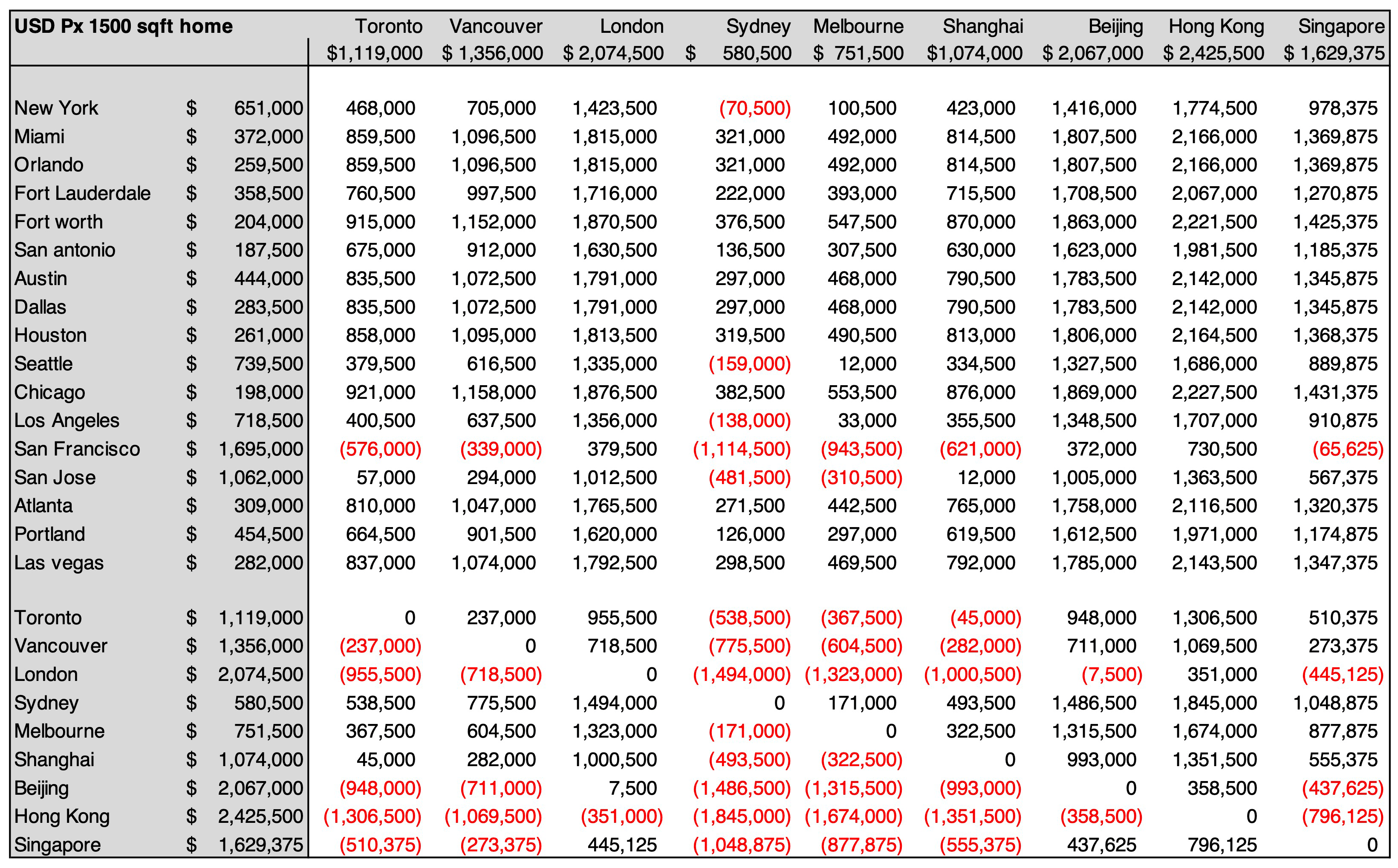
If we look at the major global cities where majority of our clients live, we will find that the affordability of a 1500 sq. ft house is really low.

AM Affordability Index*

*Our proprietary index includes factors such as, taxes, pension contributions, debt repayment, inflation, currency and others.

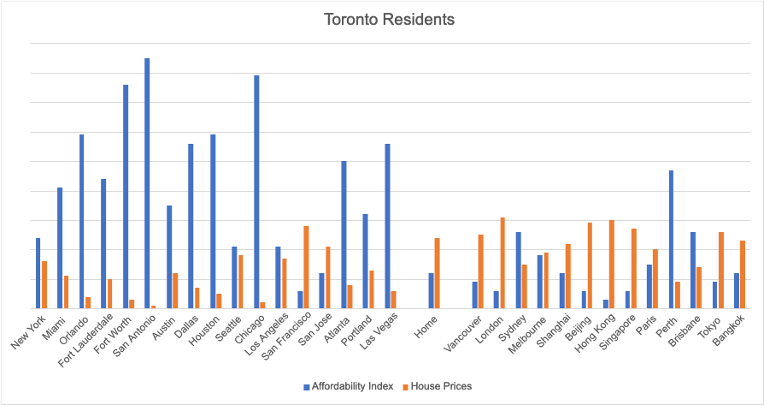
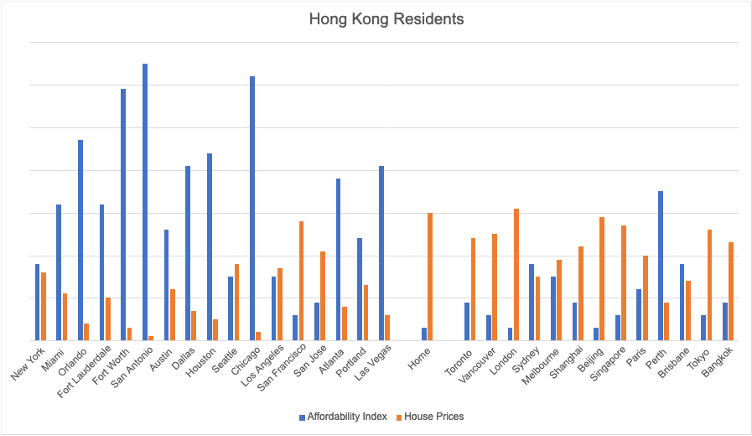
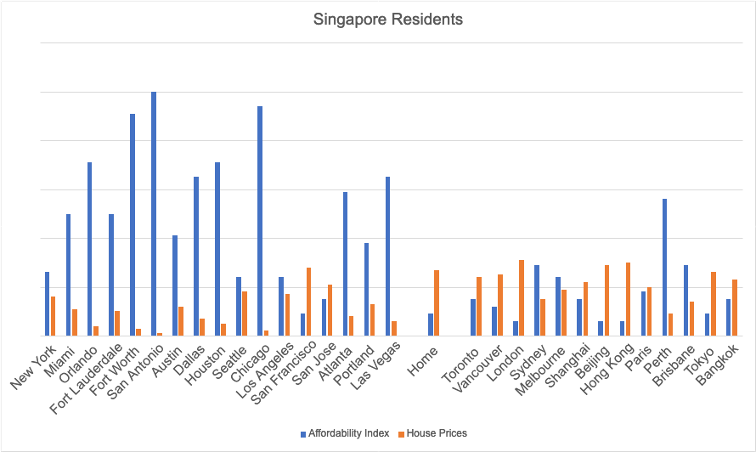
Using our proprietary AM Index, 0 represents a house that is very unaffordable and 100 represents a house that is very affordable.  Affordability only ranges from 0 – 24 in our client’s home cities.

Now, looking at the data for popular investment destinations in the U.S. for real estate investors. We see that the average affordability is drastically higher. This is particularly so for San Antonio, Chicago, and Fort Worth.

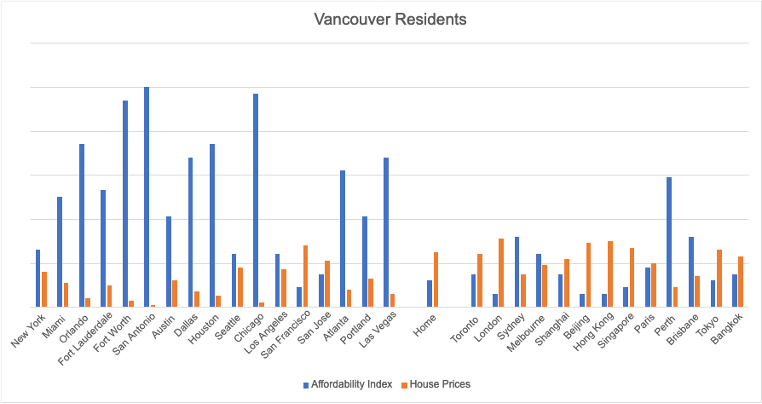
For example, if you live and work in Vancouver and earn the median income, the affordability index of 1500 sq. ft house in your city is at a meagre 12. However, the affordability index of a same-sized house in Fort Worth is at a whopping 94!

Read – if you live in Vancouver, buying a Fort Worth Texas investment property is 8x “more affordable” than back home!

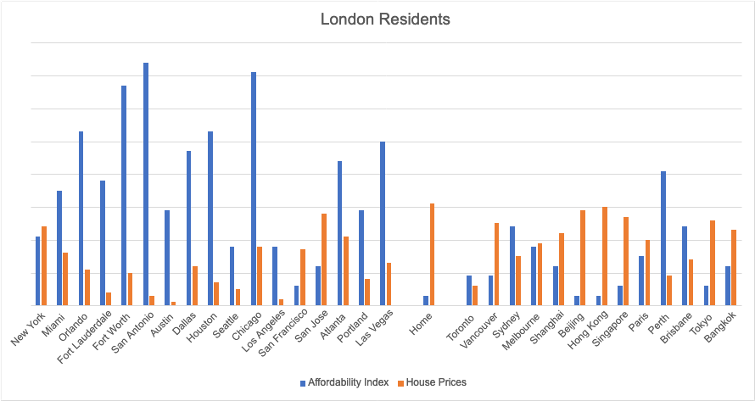
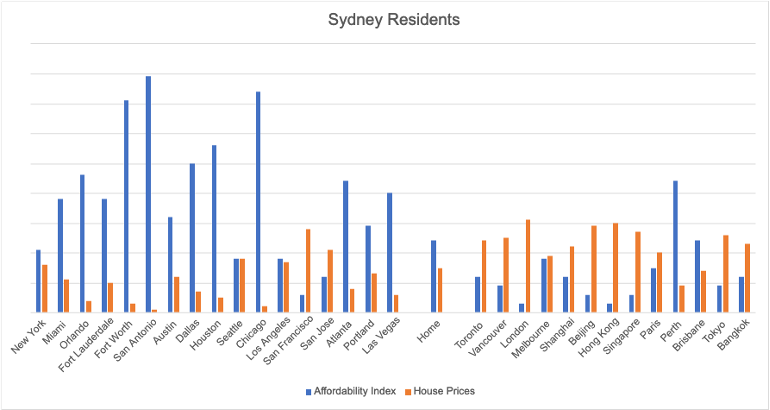
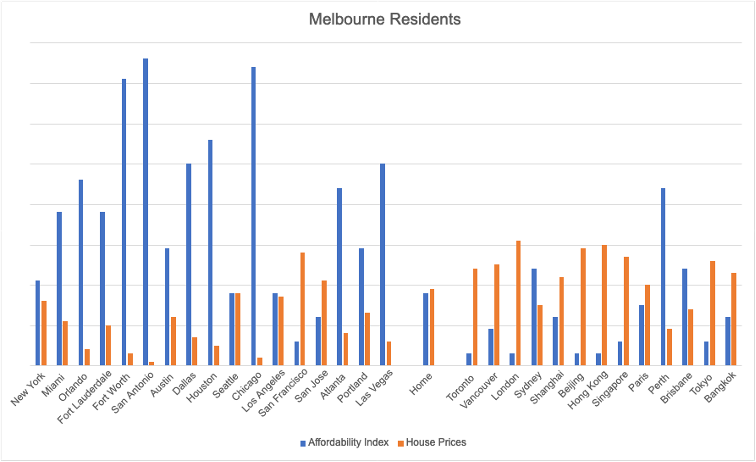
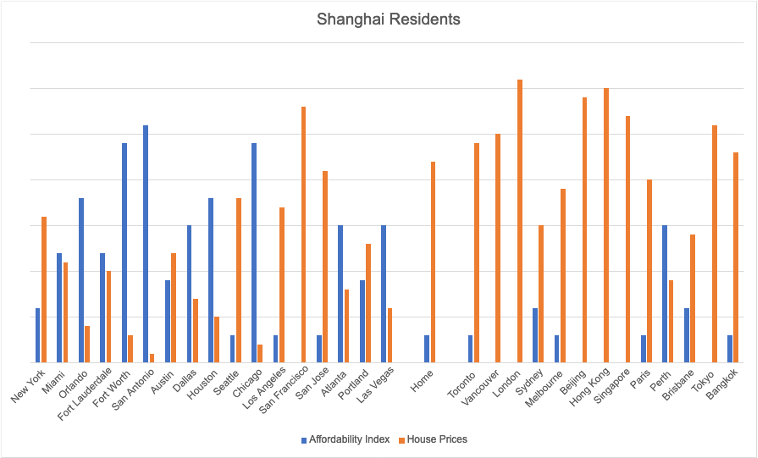
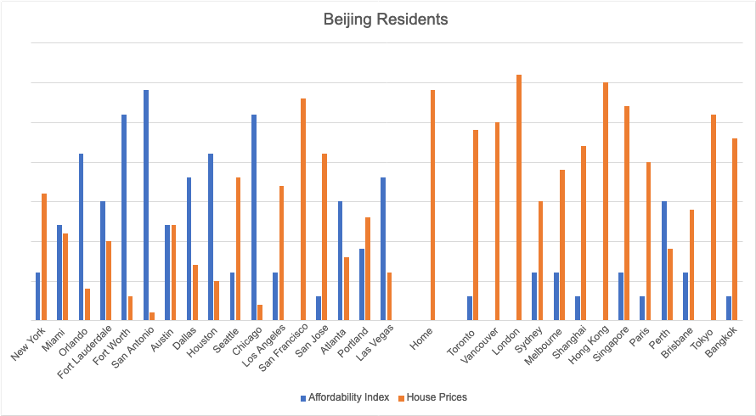
You will see this graphically in the following charts, and the results are very clear and obvious.

Solely based on affordability, when purchasing property for investment income, you should always consider Chicago, San Antonio, Fort Worth, and almost never San Francisco.

Now, we know there are many other considerations when buying property besides just being cheap and affordable – like historical price appreciation vs. future price expectations, net rental yield, ease of securing financing, friction costs of doing the research – all of which we will discuss in our upcoming reports.

In summary, when deciding where to invest next, it’s best to get out of your comfort zone and be open-minded to the opportunities.

There are other cities in the world that you can consider aside from your home country, but we argue the best cities for real estate investments are in the U.S.

Hopefully, Part 1 of our Deep Dive Series has showed you that U.S. properties are more affordable that you think. In fact, they could be up to twelve times more affordable than your own city, e.g. Hong Kong residents buying in Chicago!

Next week, we will illustrate the net income potential of U.S. real estate investment cities vs. major global cities, i.e. how much you can earn from renting after financing costs… the results will shock you!

Still not convinced?

Supporting Charts

Price Differences between Major Global Cites and U.S. Residential Real Estate Investment Destinations:

Supporting Charts - Price Differences between
Toronto Residents Chart
Vancouver Residents Chart
London Residents Chart
Sydney Residents Chart
Melbourne Residents Chart
Shanghai Residents Chart
Beijing Residents Chart
Hong Kong Residents Chart
Singapore Residents Chart

Stay tuned for next week!

www.americamortgages.com

Clients are from Canada

While America Mortgages has clients from most countries globally, Canada by far is where most of our clients come from.

This is consistent with public information released by the National Association of Realtors; in year-ended March 2020, Canadian’s purchased $9.5B of U.S. residential real estate!

If we assume an average home price of $500,000, that equates to a staggering 19,000 home purchases!

As the top U.S. mortgage specialist specifically focused only on Expats and Foreign Nationals living in Canada, the customer data we have would be considered as the best representation of “real” demand.

In this article, we wanted to dig a little deeper into where they are buying and why.

Here is our data over the past 12 months for Canadian buyers:

  • – Loans funded: 137
  • – Average loan amount: $460,000
  • – Client location: Ontario 52%, Vancouver 33%, Edmonton 5%, Montreal 3%, Others 7%
  • – Top 3 purchase locations: Orlando, FL; Atlanta, GA; Charlotte, NC

Orlando, Florida

Orlando is a natural fit for Canadians, especially those living in Ontario. They share the same time zone, and it’s only a 3-hour flight from Toronto to Orlando. It’s no secret that winters in Canada (and especially Toronto) can be long and harsh, which is why many choose to buy second homes in Florida to escape the cold. Of course, Orlando’s reputation for being an affordable location with social and economic benefits also helps with its popularity. The average home price in Orlando is $293,000 vs C$870,000 for an average home in Toronto. With tourism and job market growth in leisure and hospitality at their highs, it’s no wonder Forbes ranked Orlando as their #1 Best Place to Buy a House 3 years in a row.

Atlanta, Georgia

Atlanta ticks many boxes and is an underappreciated place for many but offers great value for those looking to take advantage of the recent demographic shift inwards for coastal cities. A little unknown fact is that the Atlanta International Airport is the busiest airport in the world, with over 110 million passengers a year! Beijing #2 at 100 million passengers (2019). Let that sink in a little. A city of 500,000 people has the world’s busiest airport. That is because geographically, it’s perfectly located as a travel hub and hence a growing trend for companies to expand their headquarters there – like Google and Blackrock. Meanwhile, the population growing by 12.18% in the last 8 years – 111% faster than the national average of 5.76%. That also means the area’s annual job growth has risen to the rate of 2.15%. Affordability is a key driver for many real estate investors looking for a strong rental yield. The median purchase price of a 3 bedroom single family home at only $190,000, 15% lower than the national average of $222,000.

Charlotte, North Carolina

Charlotte is not an obvious choice to own property in, but digging a little deeper, we found that it has been one of the best cities to own real estate over the past 10 years. The supply of homes is at a 17 year low, 8 years of home price increases with no signs of slowing down. Another fact that surprises many is that Charlotte has the second-most banking assets after New York City, with Bank of America and Wells Fargo having their regional headquarters there. Meanwhile, CNBC recognizes Charlotte as the third-best city in the country to start a business.

It was also surprising to find out from our clients in Canada that Toronto was only a 2-hour direct flight from Charlotte!

How America Mortgages can help…

Unlike a traditional bank, which can only show you their own bank programs, which are by definition rigid and hard to qualify for, we are a solutions provider. We understand your requirements and suggest several loan options that best suit your requirements; this could be from banks or wholesale lenders, which are unknown by many accounts for 70% of the mortgage lending market. For example, if you are an entrepreneur, you can almost assume you would not be able to qualify for a bank loan. The trouble is banks will drag this on for 3-4 months before rejecting your loan. Our Loan Officers are all experts working with Foreign National and Overseas Expat clients – that is all we do! When you tell us your requirements, we already know from our database of 150 U.S. lender programs that best suits your needs. (Also see Can a Canadian Buy a House in the USA?)

For more details, please visit us at www.americamortgages.com

advisor mortgage group

In today’s low-inventory housing market, real estate investors are looking for any way to get an advantage over the other buyers when putting in an offer on a property.

Part of that strategy is not to buy in cash. If you have the means, an all-cash offer is a great way to fast-track a deal. A seller, more often than not, will consider a cash deal over a mortgage. The deal’s success isn’t reliant on a lender’s approval following an appraisal, and you’ll own the home outright after the transaction with no mortgage.

“With two similar offers, all cash or financing, it’s likely that an all-cash offer would be the most attractive and less risky to the seller and seller’s agent.”

“For Non-U.S. citizens, cash transactions make up a majority of Real Estate investments due to what is perceived as the lack of access to consistent and affordable financing options. However, that is not true any longer. Our focus is being able to provide competitive, viable, and easy access to U.S. mortgage loans for non-U.S. citizens. And we’ve done it to perfection.”Donald Klip

BUT EVEN IF YOU HAVE ENOUGH LIQUID ASSETS TO PURCHASE A HOME WITHOUT A LOAN, IS IT ALWAYS A GOOD IDEA?

Here are several reasons not to buy a home with cash:

LIQUIDITY, LIQUIDITY, LIQUIDITY

You always hear the axiom in Real Estate – Location, location, location, and although that may be true, it’s not wise to purchase a home with cash if you have only just enough liquidity to pay for it. Liquidity issues at some point in time affect everyone.

The inability to move currency across borders to cover large expenses could also be a factor. It’s essential, especially as a non-U.S. citizen, to have access to available funds for any number of unexpected needs, from a new roof to other large repair expenses.
You may even want to have enough funds on stand-by to sustain the mortgage if the property goes un-rented.

ACCESS TO SOLID FOREIGN NATIONAL MORTGAGES ARE AVAILABLE

With a down payment of 30 percent or more for a foreign national mortgage loan, you don’t have to worry about additional mortgage insurance when it comes to a standard U.S. conventional loan. With a lower LTV (loan-to-value), a lower interest rate will normally be available due to the lower risk lenders perceive that you’ll default on the loan.

For the younger generations looking to invest in a market that doesn’t have a huge sticker shock, acceptable yields, and stable appreciation, obtaining a mortgage is a smart move.

“Unlike their parents and grandparents, Millennials in Asia are more comfortable with taking on a mortgage loan,” says Donald Klip. He notes the younger generations’ familiarity with the U.S. credit market from either extensive travel or schooling makes taking on debt an easier choice than for older generations that have built up Real Estate wealth over time but may not be accustomed to having mortgage loans.

Although interest rates may be on the rise, they remain low compared to previous decades. With 30% down, the rates are still favorable and fixed for periods of 5, 7, 10, or 30 years. America Mortgages is currently offering fixed-rate mortgages at slightly over 6% without verifying income, U.S. credit, or residency. Compare that to the 1980s, when a foreign national mortgage loan was almost impossible to obtain, and mortgage rates were at an all-time high of 18%, there is no question on why you should leverage up.

MORE BANG FOR YOUR BUCK

Even if you’re looking to buy an investment property outside a pricey metro area such as NYC, San Francisco, Washington DC, or L.A., and if you have enough funds to pay outright, you’re likely sitting on a sizeable amount of capital. However, the decision isn’t necessarily between buying a property outright or keeping money earning very little in the bank. Consider other forms of investment to grow your wealth. Use those funds and your cash to “leverage up” by purchasing more than one investment property, increasing your portfolio and holdings quicker.

YOU’LL MISS OUT ON POTENTIAL TAX BREAKS

Although we suggest discussing any potential tax benefits with your tax advisor, most homeowners with a mortgage receive a tax benefit on the interest paid to the lender. The larger the mortgage, the bigger the benefit, increasing the yield potential of your investment.

ALWAYS WEIGH THE PROS AND CONS

In an extremely competitive Real Estate market, an all-cash offer can provide the edge you need to get the seller to consider your offer more seriously than others. Often your offer may not be the highest, but the seller knows an all-cash off will make the closing process easier.

If you want to obtain financing, keep in mind that the seller may consider an offer that allows for easier financing. Often larger down payments and smaller mortgages will also be considered easier to close mortgages as it’s less risky for the lender.

“We do it all day, every day. It’s not difficult if you know the terrain and have the right relationships, and in most cases, we can find a U.S. mortgage loan for every non-U.S. Citizen or Expat client. Most U.S.-based mortgage lenders look at a borrower’s U.S. credit history to determine their ability to repay a mortgage loan.

However, at America Mortgages, we understand that as a non-U.S. citizen, you normally don’t have a U.S. credit, and often can’t show income in a manner in which the lender will approve.If a borrower was attempting to search this for themselves, be prepared. Finding a lender in the U.S. to understand your situation becomes time-consuming, frustrating and often unobtainable, not to mention staying up late at night in Asia to answer questions or provide documents. Our job is simple; to understand the complexity of analyzing risk, calculating foreign income, and alternative sources of acceptable credit verification to find our client the best possible loan.”Donald Klip

If you’re a non-U.S. citizen looking to invest in U.S. Real Estate, we recommend sending America Mortgages an enquiry. Who knows, you may be on your way to Real Estate investing before you know it.

For more information, please contact [email protected].

Hong Kong Migration Wave

Is It Time to Invest in Overseas Real Estate?

America Mortgages (www.americamortgages.com) is Asia’s only overseas mortgage company with Direct Bank Programs for Foreign Nationals and Overseas Expat to purchase or refinance residential property in the U.S.

I am a Hong Kong citizen and what’s happening now is heart-breaking to watch unfold. Hong Kong’s cultural identity, fortitude, and integrity are all being tested, and regardless of whose side you are on, one thing cannot be disputed – Hong Kong is not the same as it once was.

Previous Migration Trends

Hong Kong is no stranger to phases of migration. Starting in 1967 and lasting almost 10 years, social instability was wide-spread, with riots all over the small island city. Many Hong Kong citizens moved to South East Asia, South Africa, and even as far away as South Africa. Towards the end of 1984, when the “Handover” to China from the U.K. was officially signed, it was the beginning of the largest outbound migration Hong Kong has ever seen. At the time, the U.K. government did not offer passports to those born in Hong Kong as it once did. Then just a few years after, in 1989, the Tiananmen Square event happened, and Hong Kong citizens migrated en-masse, primarily to Commonwealth countries such as Canada, Australia, and New Zealand and, to a lesser extent, the U.S.

The Numbers Were Staggering!

Some estimate total emigration was up to 1 million during this period, with the peak between 1988 – 1994 at 330,000. That is about 20% of the entire population of Hong Kong in the 90s!
Other research shows that an estimated US$4.2billion of outbound investment flowed to Canada during this period.

Why Is This Time Different?

What is different this time around is that back then, the “Handover” was relatively uneventful, and most Hong Kong-born emigrants returned home, a phenomenon known as “香港回流潮” or Hong Kong Returning Tidal Flow.

Fast-forward 20 years to today, and the landscape is very different. Every conversation with friends, colleagues, and family, Every news channel, Every newspaper – it all revolves around the protests. Hong Kong is emotional, it’s tense, and its energy is visceral. We now have a small glimpse into what the future may be like, and it’s different from the landscape during the Handover.

Folks Are Looking To Move!

Hong Kong has the most expensive property prices globally, and the market has increased consistently for 30 years with a few pullbacks – Asian Currency Crisis 1997, SARS 2003, G.F.C. 2008, to name a few. Meanwhile, the H.K.D. is pegged to the USD, so being able to cash out your Hong Kong property to purchase homes in the U.S. is starting to make a lot of sense. It’s already happening.

YearNumber of P.R.’s Issued to H.K. Citizens
20161,360
20171,360
20181,525

Other Destinations

Canada issued permanent residency for Hong Kong Citizens:

  • – San Francisco: home prices fall first time in 7 years
  • – Manhattan: Slowest 1Q sales since 2008
  • – Vancouver: down 9.6% from its peak in June 2018
  • – London: down 20% from its peak in 2014
  • – Sydney: down 15% from the peak in July 2017

Case Study: U.S.A.

The reasons why the U.S. attracts the most Foreign Purchases of Investment Property:

– Education – “Something for Everyone”
Most universities in the world. The U.S. has approximately 5,300 colleges and universities in the world vs. 2,600 globally.
That is a staggering 20% of all colleges and universities in the world!

– Evidence Supported
Top Foreign Buyers in the U.S. in 2019: China $13.4bn
Top Destination (more below): Florida (20%); California (12%); Texas (10%), Arizona (5%), New Jersey (4%)

Rental Yield

The U.S. has some of the highest investment yields globally.

Here is just a small sample in (no particular order):

LocationRental YieldHome Value Increase
Arlington, Texas7.5%10.3%
Columbus, Ohio7.9%9.2%
Las Vegas, Nevada5.3%15.9%
San Antonio, Texas6.4%8%
Orlando, Florida5.7%10.7%

** Did you know Orlando is the most searched city in America for Chinese real estate investors?

Since June 15, 2019, America Mortgages has seen a steady increase in loan inquiries from Hong Kong, with about 70% of them in the process of an actual home purchase!

LocationEnquiriesLoan Processing
U.S.1210
U.K.85
Canada87
Australia63
Japan64

Hong Kong is an amazing city, and it has provided so much, for so many, for so long.

However, Hong Kong, just like any other country, is not immune to domestic turmoil, and you have to wonder if this current Migration Wave is different from the others?

“There is nothing wrong with being prudent and diversifying your investments aboard.”America Mortgages Partners

America Mortgages has bank loan programs that are easy to qualify for. We can close loans in 30 days with many loan programs not requiring any income proof or the need to leave Hong Kong. Overseas Expats and Foreign Nationals to Purchase or Refinance.

For more information, please contact [email protected].