
Professional investor overlooking a large residential housing development with multiple apartment buildings, townhomes, and construction cranes during sunset in a modern U.S. city | Bridge Loans explained.

Large housing developments often require funding before long-term financing is available. Bridge loans help foreign national investors secure U.S. real estate quickly, cover short-term funding gaps, and keep projects moving without unnecessary delays. This makes them a practical option for time-sensitive development opportunities.

For many international buyers, securing funds for a large development can be more challenging than finding the right property. Understanding U.S. bridge loans helps explain how short-term funding works, while bridge loans simplified provides a clear overview of when this type of loan may be the right choice for a development project.

Every development project is different, and choosing the right funding strategy is an important first step. Whether you are buying land or investing in a large residential community, America Mortgages is here to help you move forward with confidence.

Professional investor overlooking a large residential housing development with multiple apartment buildings, townhomes, and construction cranes during sunset in a modern U.S. city.

How Can Bridge Loans Help Foreign National Investors Finance Large Housing Developments?

Bridge loans help foreign national investors secure large housing developments without waiting for long-term financing. They provide fast access to funds for buying land, acquiring residential projects, or covering early development costs. As a result, investors can move quickly when valuable opportunities become available and keep their projects on schedule.

Key benefits for large housing developments:

  • Purchase land or residential developments before another buyer.
  • Access funds faster than many traditional loan options.
  • Cover early project costs, including deposits and pre-construction expenses.
  • Keep construction plans moving while arranging permanent financing.
  • A bridging loan for property development can provide short-term funding while you arrange a long-term loan.

In many cases, acting quickly can help investors secure better opportunities. Sellers and developers often prefer buyers who can complete transactions without long delays. Therefore, short-term funding can make the purchase process more flexible while giving investors extra time to arrange permanent financing.

For foreign national investors, timing can make a big difference. The right funding solution gives you more time to complete your purchase, prepare your development, and move to long-term financing without putting your investment plans on hold.

What Should You Prepare Before Applying for a Bridge Loan?

Before applying for a bridge loan, gather the financial and property documents your lender needs. This helps speed up the review process. It also reduces delays and gives the lender a clear understanding of your project, financial position, and repayment plan.

DocumentWhy It Is Important
Passport or government-issued IDConfirms your identity.
Property purchase agreementProvides details about the property you plan to buy.
Development or business planExplains your project’s goals, timeline, and estimated costs.
Proof of available fundsShows your down payment or available cash reserves.
Asset and bank statementsHelps lenders review your financial position.
Exit strategyExplains how you plan to repay the loan, such as refinancing or selling the property.

First, check that all your documents are complete and up to date. This makes the review process faster. It also helps prevent unnecessary delays. As a result, your application can move forward more smoothly.

Next, review the lender’s requirements before you apply. This helps you prepare the right information from the start. If you want to understand how lenders evaluate property-backed financing, asset-based bridge loans explained provide helpful information before you begin the application process.

How Do Bridge Loans Compare with Traditional Development Financing?

Bridge loans provide fast, short-term funding when time is important. In contrast, traditional development financing is designed for long-term projects and usually takes longer to approve. Therefore, many investors use a bridge loan first and then switch to long-term financing once the project is ready.
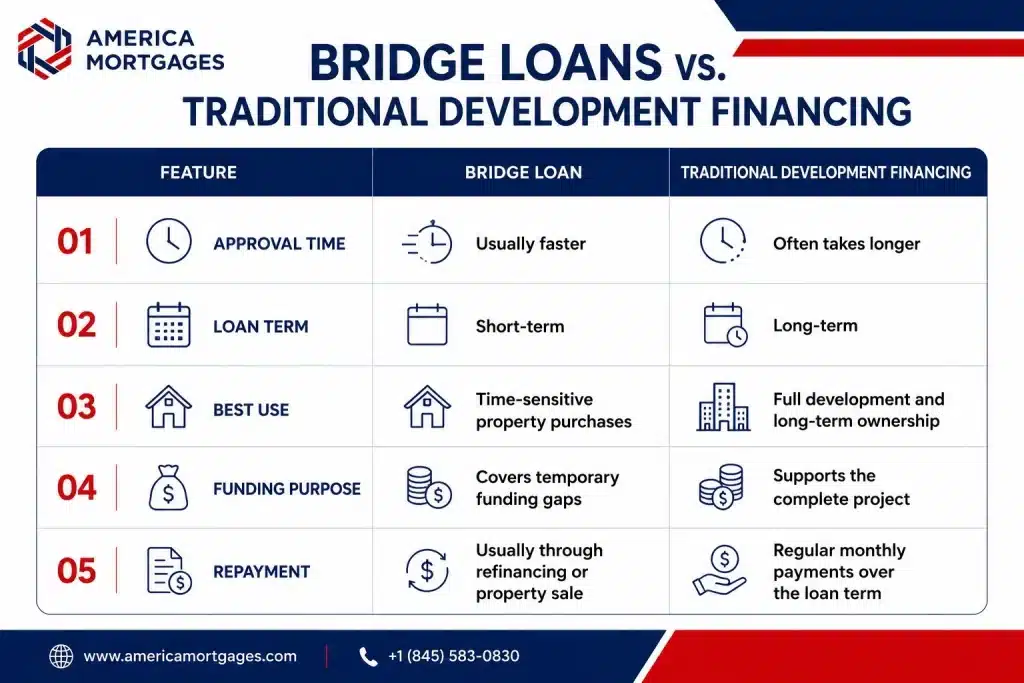
Comparison of bridge loans and traditional development financing, showing differences in approval time, loan term, funding purpose, repayment, and best use.

The right option depends on your investment goals and project timeline. If you need to secure a property quickly, short-term funding may be the better choice. If you still have questions about loan terms or eligibility, the bridge loan FAQ for HNW homeowners answers many common questions before you move forward.

Many developers use both options at different stages of the same project. They often secure the property with a bridge loan first. Later, they move to long-term financing once the project is ready. In many cases, a commercial bridging loan for property development provides the flexibility needed before permanent financing is in place.

What Risks Should Developers Consider Before Using Bridge Financing?

Bridge financing can help you move quickly, but it also comes with important risks. Before you apply, understand the loan terms, repayment plan, and project timeline. Careful planning helps reduce unexpected costs and keeps your development on track from start to finish.

Have a Clear Exit Strategy

Plan how you will repay the loan before signing the agreement. Many developers refinance into a long-term loan or sell the property after completion. A clear exit strategy helps reduce financial pressure and lowers the risk of repayment delays.

Prepare for Higher Borrowing Costs

Bridge financing often has higher interest rates and fees than long-term loans. Therefore, include these costs in your project budget. This helps you avoid cash flow problems and keeps your development financially stable.

Allow Time for Unexpected Delays

Construction delays, permit approvals, or market changes can affect your project schedule. As a result, your repayment plan may also change. Setting a realistic timeline gives you more flexibility if unexpected challenges arise.

Review Market Conditions

Property values and financing conditions can change during your project. Therefore, monitor the market regularly and adjust your plans when needed. This helps you make informed decisions and reduces the impact of unexpected market changes.

According to the Office of the Comptroller of the Currency (OCC), refinancing challenges, changing market conditions, and loan maturity are key risks in commercial real estate lending. Developers should review their repayment strategy and project timeline carefully before relying on short-term financing.

Move Your Development Forward with America Mortgages Bridge Loan Strategy

Delays in funding can slow your project, increase costs, and cause you to miss valuable investment opportunities. If you need quick access to capital for a housing development, the right lending partner can make all the difference.

America Mortgages helps foreign national investors secure financing for U.S. real estate with a simple and efficient process. Our experienced team understands the challenges international buyers face and works with you to find a solution that matches your project and timeline.

Whether you want to buy land, purchase a residential development, or move to long-term financing later, America Mortgages is here to help. Contact our team to discuss your project and funding needs. You can also email [email protected] or call +1 (845) 583-0830 to speak with an experienced lending specialist and explore the right solution for your investment.

FAQs

Q1: Can foreign national investors qualify without U.S. income?

Yes, many foreign national investors can qualify even without U.S. income. Instead, lenders often look at the property’s value, available assets, and your repayment plan. As a result, financing may still be available if you meet the program requirements.

Q2: Can this financing help me buy land for a future project?

Yes, this financing can help you purchase land before construction begins. It gives you quick access to funds while you finalize development plans or arrange long-term financing, helping you move forward without unnecessary delays.

Q3: How is it different from a regular business loan?

This financing is designed specifically for real estate projects, while a regular business loan supports general business needs. It also offers faster funding and focuses more on the property’s value than your business income or operating history.

Q4: Can I use it for renovations or property purchases?

Yes, you can use these funds to buy investment properties, renovate existing buildings, or complete a development before moving to a long-term mortgage. This gives you greater flexibility at different stages of your project.

Q5: How do most investors repay the loan?

Most investors repay the loan by refinancing into a long-term mortgage after the project is complete. Others repay it by selling the property or using rental income once the development begins generating steady returns.

Apartment development project under construction with developers reviewing building plans on site. Bridge Loans Explained

Building an apartment project starts with choosing the right financing. bridge loans can help you buy land, begin construction, or refinance an existing loan. Understanding your financing options before you apply can help you make better decisions and keep your project moving.

In addition, understanding how bridge financing works can help you make better decisions. You can learn more about the bridge loan process and explore different financing solutions before choosing the option that best fits your apartment development project.

Whether you are a U.S. developer or a foreign borrower / developer, America Mortgages is ready to support your next apartment or condo development project. Our team can guide you through the lending process and answer your questions at every stage from the initial bridge to the full capital stack. This way, you can move forward with greater confidence.

Apartment development project under construction with developers reviewing building plans on site.

What Are Bridge Loans and Why Do Condo Developers Use Them?

Bridge loans are short-term financing solutions designed to meet immediate funding needs during apartment development. They give developers quick access to capital when traditional financing is not yet available. As a result, developers can move forward with important project milestones and avoid costly delays.

Common UseHow Bridge Loans Help
Buy development landProvides quick funding before construction begins
Start constructionCovers early project costs
Refinance existing debtReplaces a maturing loan
Complete a projectHelps finish construction before long-term financing
Improve cash flowKeeps the project moving during funding gaps

Many developers choose bridging loans for property development because they provide fast access to funding. Therefore, they can secure a property or begin construction without waiting for a traditional commercial loan. This can save time and reduce project delays.

This financing can also reduce pressure during the development process. It gives borrowers more time to complete important project tasks and meet lender requirements. Therefore, they can focus on moving the project forward.

Can Foreign Borrowers Get a Bridging Loan for Property Development in the United States?

Yes, foreign borrowers can get financing for apartment, condominium, and commercial development projects in the United States. However, loan terms and lending requirements may vary. Therefore, it is important to choose a financing option that matches your project and business goals and a team that understands the needs of developers. 

Foreign borrowers usually need:

  • A valid passport or government-issued ID.
  • Information about the  development project.
  • Proof of available funds for their contribution.
  • A clear exit strategy, such as refinancing or selling the property.
  • Details about the property and development timeline.

In addition, many lenders review the strength of the project instead of focusing only on the borrower’s U.S. credit history. This can make financing more accessible for qualified international investors. You can also learn more about the bridge loan process before starting your application.

If you are planning a large apartment, condominium 94 commercial development, it is important to understand your financing options before you apply. You can explore different bridge loan solutions or learn about asset-based financing to find an option that matches your project’s needs.

How Does a Commercial Bridging Loan for Property Development Work on Apartment Projects?

A commercial bridging loan helps fund apartment development projects during different stages of construction. It provides short-term financing until another source of funding is available. Therefore, developers can keep the project moving without long funding gaps.

Commercial bridging loan process for apartment projects, including land purchase, construction, project completion, and loan repayment.

Before you apply, lenders usually review the project’s value, budget, and exit strategy. Therefore, keeping your financial information clear and complete can make the application process smoother. You should also review the loan term sheet to understand the repayment terms and other loan conditions before signing.

Meanwhile, many developers compare different financing options before making a final decision. For example, some investment projects may benefit from DSCR financing, while U.S. citizens living abroad may have financing options designed for overseas borrowers. As a result, comparing your choices can help you select the loan that best fits your project.

What Should Borrowers Consider Before Choosing Bridging Loans for Property Development?

Before choosing a loan, make sure it matches your project’s needs and timeline. You should also understand the loan terms, repayment plan, and total costs. Therefore, taking time to compare your options can help you make a better financial decision.

Review the Loan Terms

Read the loan agreement carefully before you sign. Check the interest rate, fees, repayment period, and other important conditions. This helps you understand your responsibilities from the start.

Plan Your Exit Strategy

Bridge loans are short-term financing. Therefore, you should decide how you will repay the loan before you borrow. Many developers refinance, secure long-term financing, or sell the completed property.

Compare Your Financing Options

Different lenders offer different loan terms and funding amounts. For example, one option may work better for your project than another. Comparing your choices can help you find financing that fits your budget and development goals.

Prepare the Required Documents

Having the right documents ready can make the application process faster. Keep your project details, financial records, and supporting documents organized before you apply.

The Office of the Comptroller of the Currency (OCC) notes that lenders carefully evaluate commercial real estate loans by reviewing factors such as the project’s feasibility, the borrower’s repayment ability, and overall credit risk. Therefore, understanding these factors before you apply can help you choose financing that better supports your project.

Secure the Right Bridge Loan for Your  Development with America Mortgages Powered by GMG

Choosing the right bridge loan is an important step for your apartment development project. Before you apply, review your funding needs, project timeline, and repayment plan. This helps you choose financing that supports your goals and keeps your project on track.

In addition, America Mortgages helps both U.S. developers and foreign borrowers finance development projects above $5 million. The team understands complex financing needs and works with trusted lending partners to find a solution that fits your project.

If you are ready to get started, America Mortgages is here to help. Contact our team to discuss your project and financing needs. You can also email [email protected] or call +1 (830) 217-6608 or +65 8430-1541 to speak with an experienced lending specialist.

FAQs

Q1: Is a Bridge Loan right for apartment construction?

Yes, a bridge loan is a good option if you need money quickly for apartment construction. It helps you continue your project while you arrange long-term financing. As a result, you can avoid delays and keep your project moving.

Q2: Can first-time apartment developers qualify for this financing?

Yes, first-time apartment developers may qualify for this financing if they have a strong project and a clear repayment plan. In addition, working with an experienced team and having enough equity can improve the chances of approval.

Q3: How long does the loan usually last?

Most loans last between 6 and 36 months. However, the exact loan term depends on your project, the lender, and your repayment plan. Once your project is complete or long-term financing is available, you can repay or refinance the loan.

Q4: What happens after construction is finished?

Once construction is finished, many developers refinance into a long-term commercial loan. Alternatively, others sell the completed property. They then use the sale proceeds to repay the loan. As a result, they can move on to their next project with confidence.

Q5: What documents do I need to apply for?

Most lenders ask for your project details, property information, and financial documents. In addition, you need a clear repayment plan. If you are a foreign borrower, you may also need to provide extra identification or business documents.

Bridge Loans Explained

What Are Asset Based Bridge Loans? (Quick Explanation for Investors)

Asset based bridge loans are short-term real estate loans where approval is primarily based on the value of the property rather than the borrower’s income, tax returns, or credit history.

These loans are designed for situations where speed and flexibility are critical. Instead of evaluating employment records, lenders focus on the real estate collateral, loan-to-value ratio, and the borrower’s exit strategy.

Asset based bridge loans are typically used for:

  • Time-sensitive property acquisitions
  • Distressed or off-market real estate deals
  • Development site purchases
  • Short-term refinancing or liquidity events
  • Distressed situations 
  • Releasing equity before a sale closes
  • Business related expenses 

Because underwriting focuses on the asset, these loans can often close in 10–14 business days (or less), compared with 45–60 days for many traditional lenders.

For investors who cannot wait for bank underwriting cycles, asset based bridge loans allow capital to move at the same pace as the real estate opportunity.

Why Do Investors Use Asset Based Bridge Loans Instead of Bank Financing?

Investors use asset based bridge loans when traditional bank financing is too slow or documentation requirements are too restrictive.

Banks typically require:

  • Multiple years of tax returns
  • Detailed income verification
  • Debt-to-income analysis
  • Extensive credit history review

Asset based bridge loans simplify the process by focusing on three core factors:

  1. Property value
  2. Loan-to-value ratio
  3. Exit strategy

For global investors, this approach is especially helpful because many foreign national borrowers do not have U.S. credit history or domestic tax returns.

The flexibility of asset based bridge loans allows investors to act quickly while arranging long-term financing later.

For example, many borrowers later refinance into long-term programs such as DSCR loans, which qualify based on property income rather than personal income.


Learn more about this type of financing in the America Mortgages guide to DSCR loans.

What Are the Best Uses for Asset Based Bridge Loans?

The best uses for asset based bridge loans involve situations where speed, flexibility, or unconventional borrower profiles make traditional loans difficult.

Below are the most common investor scenarios.

1. Acquiring Distressed or Time-Sensitive Real Estate

Asset based bridge loans allow investors to close quickly on properties that require fast transactions. Often viewed “same as cash”. 

In competitive markets, distressed sellers or off-market opportunities often require closing within two weeks.

Because asset based bridge loans evaluate the property rather than the borrower’s tax returns, they allow investors to compete with cash buyers.

This is particularly valuable in major markets such as Miami, Los Angeles, Austin, and New York where real estate opportunities can disappear quickly.

2. Financing Renovations and Value-Add Investments

Asset based bridge loans are frequently used to purchase and renovate properties before refinancing into long-term financing.

Investors may acquire properties that require:

  • Renovation
  • Tenant stabilization
  • Property repositioning

Once improvements are completed and rental income increases, investors often refinance into longer-term financing structures.

This strategy allows investors to capture value appreciation before locking into permanent loans.

3. Development Site Acquisition

Developers often use asset based bridge loans to secure land before construction financing becomes available.

Traditional construction lenders usually require:

  • Final architectural plans
  • Permits and entitlements
  • Pre-sales or lease commitments

Asset based bridge loans provide interim capital so developers can acquire land while preparing full construction financing packages.

4. Accessing Liquidity Without Selling Property

Asset based bridge loans allow investors to unlock equity from real estate without selling their assets.

Investors frequently hold significant capital in property portfolios but require liquidity for:

  • Releasing equity before the sale of a property 
  • Portfolio expansion
  • International ventures

Bridge loans allow them to access capital quickly while maintaining ownership of valuable real estate assets.

5. High Net Worth (HNW) Liquidity Solution

Asset based bridge loans allow HNW investors to unlock equity from real estate without selling their assets.

High-net-worth investors frequently hold significant capital in real estate but require liquidity for:

  • Business opportunity 
  • Expansion of their business
  • Business acquisition 

Why wait to monetize what you own? Bridge loans convert real estate equity into immediate ammunition — fast capital, full control, no dilution.

How Do Asset Based Bridge Loans Qualify Borrowers?

Asset based bridge loans qualify borrowers primarily using property value and exit strategy rather than personal income verification.

Instead of traditional underwriting, lenders evaluate the following components.

Property Value and Market Strength

The property is the most important element of underwriting.

Lenders analyze:

  • Market location
  • Comparable property sales
  • Liquidity in the local real estate market
  • Appraised value or broker valuation

This evaluation determines the maximum loan amount.

For reference, investors can review broader U.S. housing market trends through sources such as the National Association of Realtors, which publishes regular real estate market data.

Loan-to-Value Ratio

Most asset based bridge loans are structured at up to 75 percent loan-to-value (LTV).

For development or renovation projects, lenders may consider:

  • Current property value
  • After-repair value (ARV)
  • After-development value (ADV)

This helps determine the risk profile of the transaction.

Exit Strategy

Every asset based bridge loan must have a clear exit plan.

Typical exit strategies include:

  • Refinancing into permanent mortgage financing
  • Selling the property after stabilization
  • Transitioning into construction financing
  • Consolidating assets into portfolio loans

Without a credible exit strategy, most bridge lenders will not proceed with financing.

Real Investor Case Studies Using Asset Based Bridge Loans

Below are two examples illustrating how investors use asset based bridge loans to move quickly on U.S. real estate opportunities when traditional financing is too slow or restrictive.

Case Study 1: Off-Market Hotel Acquisition in Florida

A private investment group based in Toronto identified an off-market boutique hotel in Key West, Florida that the owner needed to sell quickly due to a partnership dispute. The seller required a closing within roughly two weeks, which immediately ruled out most traditional lenders because commercial underwriting often takes several weeks and requires extensive financial documentation.

The investors secured an asset based bridge loan covering approximately 70 percent of the property value, allowing them to close before competing buyers could arrange financing. After acquiring the property, the group upgraded several units and repositioned the hotel to target higher nightly rates. Within a year, the stabilized property qualified for long-term commercial financing, allowing the investors to refinance the bridge loan and retain a significantly more valuable hospitality asset.

Case Study 2: Portfolio Expansion Through Bridge Financing

An experienced investor based in Dubai owned several stabilized rental properties across Phoenix, Arizona and Dallas, Texas. When two multifamily opportunities became available at the same time, the investor needed a fast way to secure both properties without selling existing assets or waiting for traditional loan approvals.

The investor used asset based bridge loans by leveraging equity from properties already held in the portfolio. Because the loans were structured around real estate value rather than income documentation, the financing was approved quickly and both acquisitions closed within weeks. After the properties reached stabilized occupancy, the investor refinanced the bridge loans into long-term portfolio financing, expanding the rental portfolio while preserving ownership of the original assets.

Case Study 3: The London Takeover

A London-based UHNW entrepreneur faced a narrow window to buy out his business partner and claim full control of his company. Traditional lenders demanded months of cross-border verification. Liquidating assets meant catastrophic tax exposure.

His weapon? A Los Angeles property—underleveraged, overperforming, ignored.

America Mortgages moved in 14 days. 60% LTV. Asset-only valuation. No income scrutiny. No jurisdiction delays.

Partner out. Empire secured. California asset untouched.

Bridge financing doesn’t wait for permission—it weaponizes equity.

Who Typically Uses Asset Based Bridge Loans?

Searching for bridge loans USA, real estate bridge financing, or asset-based lending? You’re not alone, and you’re in the right place. America Mortgages specializes in fast bridge loans for real estate investors who refuse to let traditional banking slow them down.

Foreign National Investors Seeking U.S. Real Estate Loans

International buyers acquiring investment property in America face a wall: no U.S. credit history, no domestic tax documentation, endless rejection. Our foreign national mortgage loans and asset-based bridge financing eliminate these barriers. Qualify on property value and exit strategy only—buy U.S. real estate without SSN or ITIN.

U.S. Expats & Overseas Americans

Living abroad? Earning internationally? Traditional lenders can’t comprehend your profile. We specialize in expat mortgage financing and cross-border bridge loans—structuring international borrower loans that turn global complexity into closed deals.

Professional Real Estate Investors & Developers

Fix and flip loans. Rental property acquisition financing. Commercial real estate bridge loans. Speed wins. While banks crawl through income verification, our no-doc bridge loans and stated income real estate loans let you close in 10-14 days—securing off-market deals and distressed property acquisitions before competition mobilizes.

High-Net-Worth Individuals & UHNW Investors

Asset-rich, cash-flow complex? We deliver high-net-worth (HNW) mortgage solutions and liquidity without selling assets. Unlock equity from investment property through portfolio bridge loans—no capital gains tax triggers, no dilution, just immediate capital deployment.

The America Mortgages Difference: AI-Powered, Asset-Focused, Velocity-Driven

Whether you need short-term real estate financing, fast property loans, international investor mortgages, or bridge loans for rental properties—we eliminate friction. No income verification. No employment checks. No DTI restrictions.

Property value. Exit strategy. Execution.

How Asset Based Bridge Loans Fit Into a Long-Term Investment Strategy

Asset based bridge loans are rarely permanent financing. They are tactical tools used to capture opportunities quickly.

Most investors use bridge financing as the first step in a broader strategy that may include:

  • Refinancing into long-term mortgage loans
  • Selling the property after improvements
  • Transitioning into construction financing
  • Expanding into larger property portfolios

By bridging the gap between acquisition and permanent financing, asset based bridge loans allow investors to move quickly while still planning for long-term capital structures.

Why America Mortgages Is Positioned to Deliver Asset Based Bridge Loans at Scale

While competitors rely on single-source funding, America Mortgages unleashes unmatched global capital firepower through our parent company Global Mortgage Group, a Singapore based industry titan in worldwide asset-based lending.

This alliance transforms your financing advantage:

Global Liquidity, Local Execution

Access U.S. bridge loans PLUS international funding sources—a dual-channel capital engine no standalone lender can match. More liquidity means better rates, higher LTVs, and faster approvals.

Flexible Underwriting Powered by AI

Our asset-based lending algorithms bypass rigid DTI requirements and income verification. We underwrite the property and exit strategy—not your tax returns. Complex financial profile? Global income? No U.S. credit? Approved.

Velocity That Wins Deals

Traditional lenders: 45-60 days. Hard money: expensive. America Mortgages: 10-14 days—because our global funding network eliminates bottlenecks. Time-sensitive acquisition? Off-market opportunity? You close first.

Cheaper Capital, Bigger Margins

Global competition for your loan drives down pricing. Lower bridge loan rates. Reduced origination costs. Your real estate ROI improves immediately.

The Global Capital Edge: Scale, Speed, Certainty

Asset-based bridge loans demand speed, capital flexibility, and real estate underwriting expertise. Most traditional lenders depend on single credit lines or limited funding partners, crippling their ability to structure large or time-sensitive transactions.

As part of Global Mortgage Group, America Mortgages taps institutional capital across Asia, Europe, and the United States. These multi-continent capital relationships enable us to structure bridge loans rapidly and scale seamlessly from $1 million cashout refinance to transactions exceeding $100 million.

Because underwriting focuses exclusively on the real estate asset, financing is streamlined versus traditional bank lending. No personal tax returns. No employment verification. No U.S. credit history required.

America Mortgages Bridge Loan Terms

FeatureSpecification
Loan Size$1 million to $200 million+
Loan Terms6 to 36 months
Loan-to-ValueUp to ~75%
Interest StructureInterest-only or rolled-up payments
Closing Speed10–14 business days
RecourseNon-recourse available for qualified borrowers

These aggressive bridge loan terms empower investors, developers, and international buyers to strike immediately when time-sensitive U.S. real estate opportunities emerge.

The Bottom Line

Searching for best bridge loan lenders USA, fast asset-based financing, large commercial bridge loans, or international investor real estate loans? America Mortgages isn’t another lender, we’re a global capital ecosystem engineered for elite real estate operators who demand speed, scale, flexibility, and pricing power.

Frequently Asked Questions

Q1: What is an asset based bridge loan?

A: An asset based bridge loan is a short-term loan secured primarily by the value of a property rather than the borrower’s income. These loans are designed for investors who need fast financing for acquisitions, refinances, or development opportunities. The lender focuses on the property value and the borrower’s exit strategy.

Q2: How fast can asset based bridge loans close?

A: Most asset based bridge loans close within 10 to 14 business days, depending on the complexity of the transaction. Because underwriting focuses on the property rather than tax returns and employment documentation, the approval process is typically much faster than traditional bank financing.

Q3: What loan amounts are available for asset based bridge loans?

A: Asset based bridge loans typically start at $1 million and can scale well beyond $100 million, depending on the property value and transaction structure. Large transactions exceeding tens of millions of dollars are common in major real estate markets.

Q4: Do foreign nationals qualify for asset based bridge loans?

A: Yes. Many lenders offer asset based bridge loans to foreign nationals without requiring U.S. credit history. Instead, lenders review the property value, the borrower’s experience, and the planned exit strategy.

Q5: What interest rates apply to asset based bridge loans?

A: Interest rates for asset based bridge loans are typically higher than traditional mortgages because they are short-term and flexible. Rates depend on factors such as property type, loan-to-value ratio, and market conditions.

Q6: What is a typical loan-to-value ratio for asset based bridge loans?

A: Most asset based bridge loans are structured between 60 percent and 75 percent loan-to-value. Lower LTV ratios may qualify for more favorable terms depending on the borrower and property profile.

Q7: Can investors refinance asset based bridge loans?

A: Yes. Many investors refinance asset based bridge loans into long-term financing once the property is stabilized. This is common after renovations, tenant stabilization, or development progress.

Q8: Are asset based bridge loans available for development projects?

A: Yes. Asset based bridge loans are often used to acquire development sites before construction financing becomes available. Developers use bridge loans to secure land while preparing project plans and permits.

Q9: Are asset based bridge loans only for commercial real estate?

A: No. Asset based bridge loans can finance multiple property types including multifamily, commercial, development land, and high-value residential real estate. The key factor is the value and liquidity of the property used as collateral.

Mortgage Term
Mortgage Term

A mortgage term indicates the total duration of a mortgage. You will pay the lender monthly installments during this period and finally own the home after clearing off the last installment. The term of a mortgage starts from drawing the funds from the lender institution and ends on the expiry date when you need to repay the lender.

America Mortgages offer loan terms as long as 30 years (for fixed-rate mortgages) and as short as 5 years (for adjustable-rate mortgages). There are even shorter terms available, known as Bridge loans. These special loans can be as short as six months to up to one year and are excellent for procuring immediate cash-flow.

Most financial institutions offer these loans to commercial bodies like investors and constructors, but America Mortgages serves individual clients and the guarantee of some form of collateral.

If you can afford the higher monthly installments, a short-term mortgage saves plenty of money down the road. The explanation is quite simple: the longer the mortgage term, the more is the sum of the payable interest. As the interest rate is primarily front-loaded, the interest amount of a 30-year mortgage would be higher than that of a 10-year loan during the early years.

Similarly, ARM is more financially beneficial than fixed-rate loans if you can pay off the loan during the first interest cap. However, fixed-rate loans are better for people with a limited income. So, you should choose a mortgage term carefully, considering your future plans and current income sources.

How to Choose the Right Mortgage Term

Choosing the right repayment length comes down to your financial goals, income stability, and future plans. According to Consumer Financial Protection Bureau guidance, borrowers should weigh monthly affordability against total interest paid over the life of the loan before committing to a term length.

Frequently Asked Questions

What is a mortgage term?

It’s the total length of time you have to repay a home loan, starting when funds are drawn and ending when the loan is fully paid off.

What is the shortest mortgage term available?

Bridge loans offer some of the shortest options, ranging from six months to one year, ideal for short-term cash-flow needs.

Is a shorter or longer loan duration better?

A shorter one usually saves money on total interest if you can handle higher monthly payments; a longer one offers lower payments but more interest paid over time.

Do fixed-rate and adjustable-rate loans have different term lengths?

Yes. Fixed-rate loans commonly run up to 30 years, while adjustable-rate loans often have shorter terms, typically around 5 years before the rate adjusts.

Who typically qualifies for short-term bridge loans?

These are traditionally offered to commercial investors and construction companies, though America Mortgages also extends them to individual borrowers with sufficient collateral.