Mortgage advisor explaining the mortgage pre-approval process to a couple using a checklist during a mortgage consultation.

Mortgage pre-approval usually takes 1 to 10 business days. The exact timeline depends on your financial documents, credit review, and lender requirements. If you provide complete and accurate information, you may receive a decision much faster.

The process begins when you submit your application and supporting documents. Your lender reviews your income, assets, employment, and credit history. They may also request additional information if anything is missing. Responding quickly can help avoid unnecessary delays.

Getting preapproved before you start house hunting offers several advantages. It helps you understand your budget and strengthens your offer when you find the right property. Contact America Mortgages today for personalized guidance and take the first step toward buying your U.S. property with confidence.

What Is Mortgage Pre-approval, and Why Does It Matter?

Mortgage pre-approval is a lender’s review of your finances before you buy a home. It shows how much you may be able to borrow based on your income, assets, and credit history. As a result, mortgage preapproval helps you shop with confidence and makes your offer more appealing to sellers.

What Mortgage Preapproval IncludesWhy It Matters
Income and employment reviewConfirms your ability to repay the loan
Credit history checkHelps determine your loan eligibility
Asset and savings verificationShows you have funds for the purchase
Estimated loan amountHelps you set a realistic home-buying budget
Preapproval letterStrengthens your offer in a competitive market

Unlike mortgage prequalification, mortgage preapproval is based on verified financial information. Your lender reviews documents such as pay stubs, bank statements, and tax records. Therefore, the approval estimate is more reliable. It also gives you a clearer picture of your borrowing power before you start looking for a property.

A mortgage preapproval can also make the buying process faster and more organized. You know your budget from the beginning. As a result, you can focus on homes that match your financing limits. In addition, sellers often view preapproved buyers as more serious, which may improve your chances of having an offer accepted.

How Long Does Mortgage Pre Approval Take from Start to Finish?

Most buyers receive a mortgage pre approval within 1 to 10 business days. The exact timeframe depends on how quickly your lender can verify your financial information. Providing complete documents from the beginning can help move the process forward without unnecessary delays.

Complete Your Loan Application

Start by filling out the application with accurate details. Your lender will request documents such as proof of income, bank statements, tax returns, and identification. Missing information can slow the review.

Financial Verification

Next, the lender verifies your income, employment, assets, debts, and credit score. This review helps determine your borrowing capacity. It also confirms whether you meet the lender’s qualification requirements.

Receive Your Preapproval Letter

Once the review is complete, the lender issues your mortgage pre approval letter. This document shows your estimated loan amount. You can then confidently begin searching for a suitable property.

For foreign nationals and U.S. expats, lenders may request additional documents before issuing a mortgage pre approval. These often include a valid passport, proof of overseas income, recent bank statements, employment verification, and funds for the down payment and closing costs. Preparing these documents in advance can help speed up the process.

According to the Consumer Financial Protection Bureau (CFPB), lenders may require different levels of financial information before issuing a mortgage preapproval. Some lenders verify income, assets, debts, and credit in detail before providing a preapproval letter. Preparing all required documents in advance can reduce delays and help buyers move through the process more efficiently.

Does Mortgage Pre Approval Affect Your Credit Score?

Yes, mortgage pre approval may cause a small, temporary change to your credit score. Most lenders perform a hard credit inquiry when reviewing your application. Although your score may decrease by a few points, it often returns to normal with responsible financial habits.

Key points to know:

  • A hard credit inquiry may have a minor impact on your score.
  • The change is usually temporary.
  • Many credit scoring models treat multiple mortgage applications made within a short period as one inquiry.
  • Making on-time payments supports a strong credit profile.
  • Avoid new loans or large purchases before closing.

A brief change in your credit score is a normal part of the mortgage preapproval process. Many homebuyers compare loan offers before making a decision. Therefore, lenders and credit scoring systems expect this activity. It also helps you secure competitive interest rates and better financing terms.

Once you receive a mortgage preapproval, keep your financial situation consistent. Do not increase your debt or miss any payments. In addition, avoid changing jobs unless necessary. These simple steps can improve your chances of receiving final mortgage approval without unexpected delays.

How Long Is a Mortgage Pre Approval Good For?

A mortgage pre approval is usually valid for 60 to 90 days. However, the exact period depends on your lender. During this time, you can shop for a home with confidence. If your approval expires, you may need to update your financial documents before moving forward.

Mortgage preapproval validity and renewal guide showing how active approval, expiration, income changes, higher debt, and interest rate changes can affect your mortgage application and loan terms.

A valid mortgage pre approval gives you more time to find the right home. It also shows sellers that you are a serious buyer. Therefore, your offer may stand out in a competitive market. Unlike mortgage prequalification, a preapproval is based on verified financial information, which gives sellers greater confidence.

If your mortgage pre approval expires, you can usually renew it. Your lender may ask for updated income and asset documents. In addition, they may review your credit score again. Keeping your finances stable and avoiding new debt can make the renewal process easier and improve your chances of final mortgage approval.

Get Ready to Buy Your U.S. Property with America Mortgages

Getting mortgage preapproval early can make your home-buying journey much easier. It helps you understand your budget before you start searching. It also gives sellers more confidence in your offer. As a result, you can move forward with greater confidence.

Whether you are a U.S. expat, foreign national, or international investor, America Mortgages offers a wide range of financing solutions. These include conventional home loans, DSCR loans, and bridge loans. The team makes the mortgage process easier. They also help you achieve your U.S. property goals.

Ready to buy your U.S. property with confidence? Contact America Mortgages for personalized guidance. Our lending specialists can answer your questions and help you choose the financing solution that fits your goals. To get started, email [email protected] or call +1 (845) 583-0830. We are here to support you through every step of your mortgage preapproval journey.

FAQs

Q1: Can You Make an Offer Without Mortgage Pre-approval?

Yes, you can make an offer without mortgage preapproval. However, it is not always the best choice. Many sellers prefer preapproved buyers. A preapproval letter shows that you are ready to move forward with financing.

Q2: Can Mortgage Pre-approval Be Denied After Approval?

Yes, it can. Mortgage preapproval is not a final approval. Your lender will review your finances again before closing. New debt, lower income, or a drop in your credit score may lead to a loan denial.

Q3: What Documents Do You Need for Mortgage Pre-approval?

Most lenders ask for proof of income, bank statements, tax returns, identification, and employment details. They also review your credit history. Having these documents ready can help speed up the mortgage pre-approval process.

Q4: Can You Get Mortgage Preapproval with Self-Employment Income?

Yes, you can get mortgage pre-approval with self-employment income. However, you may need to provide more financial documents. Lenders usually review your tax returns, bank statements, and business income to confirm that your earnings are stable.

Q5: Is Mortgage Pre-approval Required for Investment Property Financing?

No, mortgage preapproval is not always required for investment property financing. However, it is highly recommended. It shows your budget clearly. It also helps you act quickly and make a stronger offer when the right property becomes available.


Mortgage pre-approval documents checklist with passport, financial paperwork, home model, calculator, laptop, and application forms on an office desk.

Mortgage pre-approval helps lenders review your financial information before you buy a property. You need documents that confirm your identity, income, assets, and financial history. Preparing them early can speed up the process, prevent delays, and improve your chances of getting approved.

The exact requirements depend on your financial profile and loan type. However, most applicants need to provide similar financial documents. If you are purchasing U.S. property from abroad, explore our financing solutions for foreign nationals living overseas.

If you are ready to apply for a mortgage preapproval, America Mortgages is here to help. Our lending specialists will review your financial profile. They will explain the required documents. They will also guide you through each step of the application process. In addition, they will help you choose a financing solution that matches your homeownership or investment goals.

Mortgage pre-approval documents checklist with passport, financial paperwork, home model, calculator, laptop, and application forms on an office desk.

Mortgage Prequalification vs Preapproval: Which Documents Matter Most?

Mortgage prequalification uses the financial details you provide. Mortgage preapproval requires lenders to verify your documents. As a result, mortgage preapproval gives a more accurate borrowing estimate. It also provides a stronger preapproval letter when you are ready to buy.

Mortgage PrequalificationMortgage Preapproval
Uses self-reported informationUses verified financial documents
Gives an estimated loan amountConfirms your borrowing capacity
Usually needs few documentsRequires complete supporting documents
Good for early planningBest before making an offer
Does not include a verified preapproval letterMay include a verified preapproval letter

Mortgage prequalification is a good starting point. It helps you estimate your budget. However, lenders do not verify your information. Therefore, the estimated loan amount may change later. Mortgage preapproval gives a more reliable result.

For mortgage preapproval, lenders review your income, bank statements, employment, and identification. They use these documents to verify your financial profile. As a result, your preapproval letter carries more weight. It can also make your offer more attractive to sellers.

According to the Consumer Financial Protection Bureau (CFPB), lenders may use the terms prequalification and preapproval in different ways. However, mortgage prequalification often relies on information provided by the borrower. In contrast, mortgage preapproval usually requires verified documents, including proof of income, assets, and credit. As a result, a preapproval letter gives sellers more confidence that you are ready to buy a home.

How Long Does Mortgage Pre-Approval Take After You Apply?

Mortgage preapproval usually takes one to ten business days after you apply. However, the timeline depends on your financial profile and document verification. Submitting complete paperwork can help speed up the process.

Complete Your Application

A complete application helps lenders begin the review without delays. Therefore, check that all required documents are accurate before you submit them. Missing information may extend the mortgage preapproval timeline.

Respond to Document Requests Quickly

Lenders may ask for additional documents during the review. Reply as soon as possible to keep your application moving. Quick responses often help speed up your loan pre-approval.

Wait for the Final Review

The lender verifies your income, assets, employment, and credit history. After the review, qualified borrowers receive a preapproval letter. This letter confirms your estimated borrowing amount. It helps you shop for a home with confidence.

The time needed for mortgage preapproval can vary between lenders. However, staying organized and submitting accurate documents can reduce delays. As a result, you can begin your home search sooner with greater confidence.

When Does a Mortgage Pre-Approval Expire?

A mortgage pre-approval usually stays valid for 60 to 90 days. However, the exact period depends on the lender. Once it expires, you may need to update your financial information before receiving a new pre-approval letter.

Keep these important points in mind before your approval expires:

  • Most approvals remain valid for 60–90 days.
  • Check the expiration date on your preapproval letter.
  • Keep your financial situation stable.
  • Update documents if the approval expires.
  • Renew before making an offer on a home.

Lenders set an expiration date because financial details can change over time. Therefore, avoid changing jobs or opening new credit accounts. Also, continue paying your bills on time. These steps help maintain your eligibility.

If your approval is no longer valid, the lender may request recent income records, bank statements, and employment details. They may also perform another credit review. Therefore, renewing your approval early can help you avoid delays and stay ready to buy a home.

Does Mortgage Pre-Approval Affect Your Credit Score and Borrowing Power?

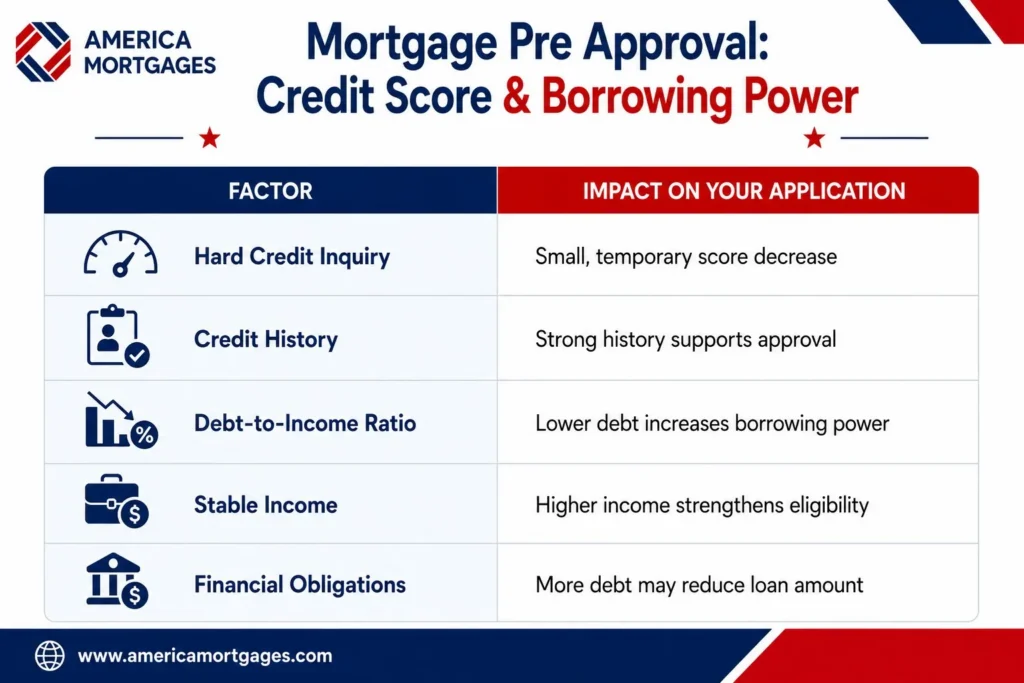
Yes, mortgage pre-approval can affect your credit score because many lenders perform a hard credit inquiry. However, the impact is usually small and often temporary. Your financial profile also plays an important role in determining your borrowing power.

Table showing how mortgage pre approval affects credit score and borrowing power through hard credit inquiry, credit history, debt-to-income ratio, stable income, and financial obligations.

A small change in your credit score should not cause concern. Credit scoring models usually treat multiple mortgage inquiries within a short period as a single shopping event. Therefore, you can compare lenders without significantly affecting your score. This makes it easier to find competitive loan terms.

Your borrowing power depends on more than your credit score. Lenders also review your income, savings, monthly expenses, and overall financial stability. Therefore, paying down debt and avoiding large purchases before home loan pre-approval can strengthen your application. These steps may also improve the loan amount you qualify for.

Get Your Mortgage Preapproval Started with America Mortgages Today

Getting ready before you apply can save both time and effort. First, gather your financial documents and check that all information is correct. This simple step helps prevent delays and keeps your application moving smoothly.

America Mortgages helps foreign nationals and U.S. expats finance U.S. real estate with confidence. Our lending specialists understand international borrowing requirements. As a result, you receive clear guidance and loan solutions that match your financial goals.

Ready to move forward? Contact America Mortgages for personalized guidance. Our lending specialists can answer your questions and help you choose the right financing solution for your needs. To get started, email [email protected] or call +1 (845) 583-0830. We are here to support you through every step of your mortgage pre-approval journey.

FAQs

Q1: Can I get a mortgage pre-approval before finding a house?

Yes, in fact, many buyers apply before they start house hunting. It helps you set a realistic budget. As a result, you can make a stronger offer when you find the right property.

Q2: What can cause a mortgage pre-approval to be denied?

Several factors can affect your application. For example, low income, high debt, poor credit, or missing documents may lead to a denial. Therefore, prepare your paperwork carefully before applying.

Q3: Can self-employed borrowers get mortgage pre-approval?

Yes, however, they usually require additional documents. These may include tax returns, business records, and bank statements. Clear financial records can improve the approval process.

Q4: Is mortgage pre-approval required to make an offer?

No, however, it is highly recommended. An approval letter shows sellers that you are a serious buyer. As a result, your offer may stand out in a competitive market.

Q5: Can foreign nationals get a U.S. mortgage pre-approval?

Yes, many foreign nationals can qualify through specialized lenders. They usually need proof of income, assets, and identity. Then, the lender reviews the documents to determine eligibility.

Foreign nationals meeting with a mortgage advisor for U.S. mortgage pre-approval, with a passport, house keys, loan documents, and an American home in the background.

A mortgage pre-approval shows how much you may be able to borrow. It helps foreign nationals and U.S. expats plan their U.S. home purchase. It also shows sellers you are a serious buyer. As a result, your offer may stand out.

Buying U.S. property from another country can feel challenging. However, good preparation makes the process easier. Lenders review your income, assets, credit history, and financial documents. Therefore, collecting these documents early can help prevent delays.

Next, choose a loan that fits your needs. Different mortgage options are available for international buyers. Each option has different requirements and benefits. Understanding these options helps you choose the right financing solution.

If you are ready to buy a U.S. property, America Mortgages is here to help. Our lending specialists will review your financial situation, guide you through the mortgage pre-approval process, and help you choose a financing solution that fits your goals.

Foreign nationals meeting with a mortgage advisor for U.S. mortgage pre-approval, with a passport, house keys, loan documents, and an American home in the background.

Who Needs Mortgage Pre-Approval Before Buying U.S. Property?

A mortgage pre-approval is helpful for most homebuyers. However, it is especially important for foreign nationals and U.S. expats buying property in the United States. It helps you understand your budget before you start looking for a home. As a result, you can shop with more confidence and make stronger offers.

Foreign Nationals Buying U.S. Property

If you live outside the United States, a mortgage pre-approval shows how much you may be able to borrow. It also helps you prepare the documents your lender may request.

U.S. Expats Living Abroad

U.S. citizens living overseas may face different lending requirements. A mortgage pre-approval helps you understand your loan options before returning or investing in U.S. property.

First-Time International Homebuyers

Buying a home in another country can feel confusing. A mortgage pre-approval gives you a clear budget and helps you avoid unexpected problems later.

Buyers in Competitive Housing Markets

Homes in popular areas often receive multiple offers. A mortgage pre-approval shows sellers that you are financially prepared. Therefore, your offer may receive more attention.

Buyers Who Want a Faster Closing Process

Getting pre-approved early can save time later. Many financial checks are completed before you make an offer. As a result, the loan process may move more smoothly.

Every buyer has different financial circumstances. Therefore, lenders may ask for different documents based on your income, assets, and residency status. Preparing these documents early can help reduce delays during the mortgage application process.

Mortgage Prequalification vs. Preapproval: Which One Is Right for You?

Mortgage prequalification and mortgage pre-approval both help you prepare for a home purchase. However, they serve different purposes. Mortgage prequalification gives a quick estimate of your budget. In contrast, mortgage pre-approval involves a detailed review by a lender and provides stronger buying confidence.

FeatureMortgage Prequalification
Financial ReviewBasic financial details
Credit CheckUsually limited or not required
Loan EstimateApproximate borrowing amount
Strength of OfferLimited support
Best Time to ApplyBefore starting your search

Your choice depends on your buying stage. If you are still exploring the market, mortgage prequalification can help you understand your budget. However, if you are ready to buy, mortgage pre-approval shows what you may qualify for.

According to the Consumer Financial Protection Bureau (CFPB), a mortgage pre-approval shows that a lender has reviewed your financial information and believes you are likely to qualify for a mortgage. This can strengthen your offer and give sellers greater confidence during the home-buying process.

How Do You Get a Home Loan Pre-Approval as a Foreign National or U.S. Expat?

A home loan pre-approval starts when you apply with a lender. You provide your financial information and supporting documents. The lender reviews your application and decides how much you may qualify to borrow.

Follow these simple steps to get started:

  • Choose a lender that works with foreign nationals and U.S. expats.
  • Complete the mortgage application with accurate information.
  • Submit your income, bank statements, identification, and other required documents.
  • Allow the lender to review and verify your financial details.
  • Receive your mortgage pre-approval letter if you meet the lender’s requirements.

Take time to compare different lenders before you apply. Review their loan options, interest rates, and eligibility requirements. Some lenders offer financing programs designed for foreign nationals and U.S. expats. Choosing the right lender can make the application process easier.

Stay in touch with your lender throughout the review process. Reply quickly if more information is requested. Prompt communication can help prevent unnecessary delays. As a result, you can receive your mortgage pre-approval sooner and move forward with confidence.

What Can Improve Your Chances of Mortgage Pre-Approval?

A strong financial profile can improve your chances of mortgage pre-approval. Lenders review several factors before making a decision. Preparing these areas in advance can help your application move forward with fewer issues.

Mortgage pre-approval factors table showing how good credit history, stable income, lower debt, a larger down payment, and accurate financial information can improve loan approval chances.

Every lender uses its own underwriting guidelines. Therefore, approval requirements may vary from one lender to another. Reviewing the lender’s criteria before you apply can help you understand what to expect and avoid surprises during the process.

It is also helpful to avoid major financial changes while your application is under review. For example, avoid opening new credit accounts or making large purchases. Keeping your finances stable can support a smoother review and increase your confidence throughout the home-buying journey.

Start Your U.S. Property Journey with America Mortgages 

Buying a home in the United States from abroad can feel confusing. However, the right guidance makes the process much easier. A mortgage pre-approval helps you understand your budget and shop with confidence.

Foreign nationals and U.S. expats often face different lending requirements. Therefore, working with a lender who understands international financing is important. Expert support can help you avoid delays and move forward with confidence.

America Mortgages helps foreign nationals and U.S. expats secure financing for U.S. property. Our team guides you through every step, from mortgage pre-approval to closing. Contact us today to discuss your financing needs. Explore our DSCR Loans page, email [email protected], or call +1 (845) 583-0830 to speak with an experienced lending specialist and find the right financing solution.

FAQs

Q1: Does mortgage pre-approval affect your credit score?

Yes, mortgage pre-approval usually requires a hard credit check. As a result, your score may drop by a few points for a short time. However, this is normal and often has only a small impact.

Q2: How long does a mortgage pre-approval last?

Most mortgage pre-approvals stay valid for 60 to 90 days. After that, your lender may ask for updated financial documents. This helps confirm that your information is still accurate.

Q3: What happens if my mortgage pre-approval expires?

If your pre-approval expires, you can usually apply again. Your lender may review your income, assets, and credit before issuing a new approval letter. Therefore, keep your documents up to date.

Q4: How long does mortgage pre-approval take?

The process often takes a few business days. However, the timeline depends on your documents and the lender’s review process. Complete paperwork can help speed things up.

Q5: How can I get approved for a higher mortgage loan?

Improve your credit score and reduce your existing debt. A larger down payment can also help. In addition, keep your income and financial records up to date. These steps can improve your chances of qualifying for a higher loan amount.

International Mortgage USA

SINGAPORE, October 27, 2022 /EINPresswire.com/ — America Mortgages, the world’s leading international mortgage brokerage, focusing on U.S. mortgage financing for non-resident investors, today announced the addition of a new Mortgage Loan Program that allows real estate investors to qualify using no ratio underwriting. This mortgage program for international investors features both fixed and adjustable rate mortgages (ARM), competitive rates, high LTV/LVR and loan amounts up to $5 million.

America Mortgages’ new No Ratio mortgage program can be used for investment properties in all 50 states. International borrowers can use credit from their home country to qualify.

Robert Chadwick, CEO of America Mortgages states “What makes this program very unique is that the borrower does not need to provide personal income documentation or rental income. Unlike underwriting requirements for conventional or standard non-QM mortgage loans that rely upon the information contained in tax returns, pay statements, rental income or various other ways to document income, America Mortgages’ no-ratio mortgages rely upon a borrower’s credit and overall financial profile. Self-employed borrowers find the relaxed documentation requirements of a no-ratio mortgage ideal, but it could also prove to be convenient for a salaried borrower with additional income that cannot be readily documented.” He goes on to state “This is a perfect loan program for all real estate investors when a conventional mortgage loan is not an option, and as there are no AUM requirements this is a perfect loan for our private banking clients.”

Although rental rates have increased at a much faster pace than mortgage interest rates, often borrowers have a difficult time qualifying using the standard DSCR formula where the loan qualifies on the projected rental income of the property. This is a perfect substitute for when DSCR or conventional income qualifying loans are not an option. America Mortgages’ No-Ratio loan allows a quick, viable and very aggressive loan option.

“We constantly strive to curate the best U.S. mortgage loan options for our global clients.” Stated Nick Worthing, VP of retail lending for America Mortgages. “As the market changes, we need to be fast, nimble and resilient. That is what keeps our company as the leader in U.S. mortgage financing for foreign national and U.S. expat investors”.

Some of the featured benefits of America Mortgages’ no-ratio mortgage include:

· Aggressive loan-to-value ratio (LTV) as high as 80% for both foreign nationals and U.S. Expats
· No tax returns or income verification
· No U.S. credit required
· Foreign passports allowed
· Investment property only
· Loans up to $5,000,000 or higher in some cases
· Loans available in all 50 states
· No restrictions on cash-out financing
· Interest-only terms available
· Approval within 72 hours

For more information on America Mortgages’ No-Ration U.S. Mortgage loan program, contact [email protected].

About America Mortgages and Global Mortgage Group

Founded in 2018, Global Mortgage Group PTE LTD [GMG], and headquartered in Singapore, is a full-service global mortgage financing firm offering mortgages for investment purposes in The United States, Australia, Canada, United Kingdom, Germany, France, Spain, Singapore, Hong Kong, Philippines, Thailand, Japan to name a few. For more information, visit www.gmg.asia or call +65 9773-0273.

Founded in 2019, America Mortgages, Inc. is a wholly-owned subsidiary of Global Mortgage Group PTE LTD [GMG]. America Mortgages headquartered in San Antonio, TX, with representation in 12 different countries, is dedicated to providing U.S. mortgage options for non-resident Foreign Nationals and U.S. Expats. 100% of America Mortgages [AM] clients are living and working outside of the U.S. Both GMG and AM focus on building quality, long-term relationships with its partners such as Private Banks, EAM, Family Offices, Realtors and other mortgage broker located around the world by offering a wide variety of mortgage loan programs focused on specific markets with an exceptional client experience.

For more information, visit www.americamortgages.com or call +1 830-217-6608.

Robert Chadwick
America Mortgages. Inc
+65 8430 1541
[email protected]
Visit us on social media:
Facebook
Twitter
LinkedIn
Other

mortgage specialists international

An adjustable-rate mortgage (ARM) refers to a mortgage with variable interest rates, which change regularly after an initial period. It fluctuates with the market interest rates, offering either a financial gain or loss to the borrowers. This is in direct contrast with the fixed-rate mortgage rules that impose a fixed interest rate for the entire repayment period.

Each ARM loan has an introductory period from 3 to 10 years where the interest rate stays lower than that of any fixed-rate mortgage. It’s possible to save a lump sum of money if you can settle the loan within that primary window.

After the initial fixed-rate period, an ARM’s interest rate will depend on the current market rates, meaning the rates can rise or fall over the mortgage’s remaining course. The lender will revise the rate at regular intervals, possibly once a year, and adjust it to the current market rate until the end of the term. To avoid paying extra money in rising interest, you can either sell the house or refinance the loan.

America Mortgages offers standard 5 and 7-year adjustable-rate mortgages (ARM) that you can qualify easily without going through much paperwork. You can also refinance if your home’s market price is at least $150,000 or pull out cash of the home equity.

An ARM might be the right choice if you can pay the loan off during the initial cap or don’t plan to live in the same house for your entire life. Ask the lender about the loan’s margin, the factors related to rate changes, and the intervals of rate changes to see if you can afford the calculated monthly installments.

Mortgage principal and interest breakdown illustration

Understanding the principal meaning in a mortgage is one of the first things every homebuyer should learn before signing a loan agreement. Principal refers to the initial mortgage amount taken against the property you mortgaged. When you obtain a mortgage, it comes in two parts — principal and interest. The principal is the amount that you borrow from the lender, and the interest is a percentage of that principal amount charged by the lender as the cost of borrowing that money. When repaying, you have to pay both the principal and the interest.

Whether you’re a first-time buyer or an experienced investor, knowing the definition of principal helps you understand exactly how your monthly payments are structured, and how much of your money is actually building equity versus covering the cost of borrowing.

What Is a Principal in a Mortgage?

Principal is the core loan amount you owe before interest is added. Every mortgage payment you make is split between reducing this principal balance and covering the interest charged by the lender. This applies whether you’re financing a primary residence in the U.S. or purchasing property as part of a cross-border investment strategy, a common scenario for foreign nationals investing in U.S. real estate and U.S. citizens living overseas.

For example: if you borrow $300,000 from a lender to buy a house, the principal loan amount is $300,000. At a 3% annual interest rate, it will add $750 of interest balance per month to the principal balance. If you repay $10,000 as a monthly installment, the lender will deduct $750 as interest, and the remaining $9,250 will pay off the principal balance. So, after one month, your loan principal will be $290,750. With each monthly installment, the principal balance will be reduced.

Principal Meaning: Principal and Interest Explained

The terms principal and interest (sometimes misspelled as “principle and interest“) together make up the two core components of every mortgage payment. While the principal is the amount borrowed, interest is the lender’s fee for providing that capital. Early in a loan term, a larger portion of your payment typically goes toward interest; as the principal balance shrinks over time, more of each payment goes toward paying down the principal itself.

If you find it difficult to calculate the principal balance, interest percentage, and other fees, check the loan’s monthly statement. Our lenders will provide you with a breakdown of all the numbers. It will show how much of the monthly installment goes toward paying off the principal balance and interest.

Other Words for Principal

Looking for other words for principal in a mortgage context? You may also see it referred to as the “loan amount,” “outstanding balance,” “unpaid balance,” or simply the “amount financed.” All of these terms describe the same core concept: the sum you originally borrowed (or currently owe) before interest is factored in.

What Is Principal on a Loan and How Can You Reduce It Faster?

A bigger loan comes with a bigger interest cost over the life of the mortgage. So what is principal on a loan doing to your long-term costs? The larger your outstanding principal balance, the more interest accrues over time. One way to avoid paying extra money is to pay off the loan faster by making additional payments with every monthly installment. Doing so in the case of adjustable-rate mortgages will save you plenty of money in interest over the loan term.

It’s also worth understanding how your principal balance relates to your property’s loan-to-value ratio, since a lower principal balance relative to your property’s value can open up better refinancing terms and equity release opportunities down the line.

How America Mortgages Can Help With Your Principal Loan

With America Mortgages, you can get anything between $150,000 and $5,000,000 and a choice from various pay-off options tailored to your financial goals, whether you’re looking to minimize monthly payments or pay down your principal balance faster. Contact our team or reach out directly at [email protected] to discuss which loan structure fits your situation best.

Frequently Asked Questions

Q1. What does principal mean in a mortgage?

Principal refers to the original loan amount you borrow from a lender to purchase a property, not including interest. It’s the base figure your monthly payments are calculated against.

Q2. What is the difference between principal and interest?

Principal is the amount you borrowed, while interest is the cost charged by the lender for borrowing that money. Every mortgage payment is split between reducing the principal balance and paying accrued interest.

Q3. How is my principal balance calculated each month?

Your lender applies part of your monthly payment to interest first, based on your current balance and interest rate, then applies the remainder to reduce your principal. Over time, as the principal shrinks, more of each payment goes toward the principal itself.

Q4. Can I pay off my principal balance faster?

Yes. Making additional payments toward your principal, beyond your required monthly installment, reduces the amount of interest that accrues over the life of the loan, especially useful for adjustable-rate mortgages.

Q5. What are other words for principal in a mortgage?

Principal is also referred to as the “loan amount,” “outstanding balance,” “unpaid balance,” or “amount financed.”

Q6. How much can I borrow as my mortgage principal with America Mortgages?

America Mortgages offers loan principals ranging from $150,000 to $5,000,000, with flexible pay-off options for foreign nationals and U.S. expats.