U.S. Residential Property Investment

Making a case for U.S. Residential Property Investment

“Let’s Look Under the Hood”

In the previous 2 weeks, we have discussed U.S. real estate investment’s relative affordability and income potential.

In this week’s Deep Dive, we will look at what the Key Drivers of Property Prices are and make an argument on which U.S. cities represent the best projects for future price appreciation.

The utility of owning a home is greater than any other possession – a roof over your head, it provides a sense of security for present and future generations, the sense of incredible accomplishment that “I have MADE IT in life,” and the list goes on.

However, as an investment, we need to think about its ability to produce income (dividends/rental income, etc.) and future price appreciation.

We start this discussion by digging into what factors drove property prices in the past, what ‘new’ factors exist today, and (drumroll….) we will try to take a stab at where they will be in the future.

We will also introduce a new proprietary index: AM Job Prospect Index

First, what drives property values up?

This is a vast topic that can get very granular – see below for a snapshot of a 2019 article written by the New York Fed about Forecasting Home Prices.

Forecasting Home Prices Example

But we will try to keep it simple.

Liquidity is plain and simple. The world has seen an unprecedented fiscal stimulus and monetary easing over the past 20 years.

A commonly accepted money base is M2 (Money in circulation, checking deposits, and savings deposits less than $100K).

Let’s look at M2 money supply over the past 10 years. You can see the amount the U.S. has grown its money base dwarfs any other country, and in fact, it is 4x the growth rate of the U.K. In absolute terms, the current M2 supply in the U.S. is almost twice that in Japan.
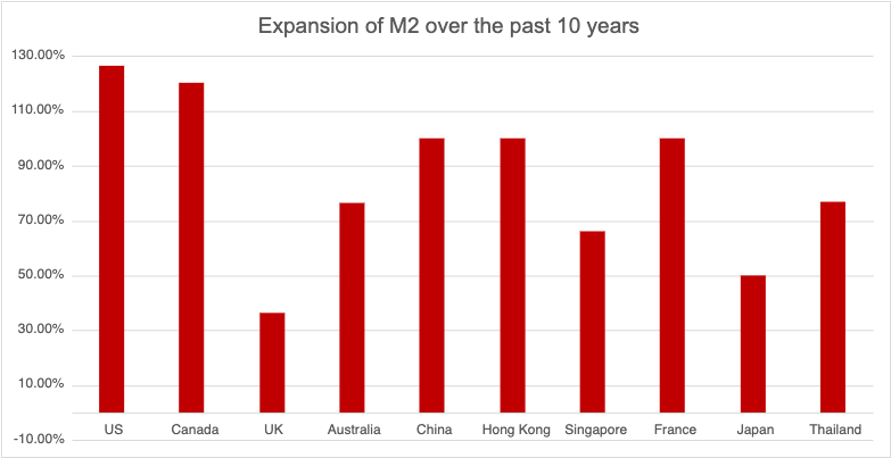
M2 Money Supply Over The Past 10 Years

Now that we have identified the global macro drivers, we can look into where the money is flowing into – specifically real estate and, more importantly, why.

It’s not surprising that the top 5 states in terms are GDP are:

CaliforniaTexasNew YorkFloridaIllinois

This is consistent with our most popular destinations for real estate investments (see below).

Within this context, we take another cut at the data and look at which cities in those states represent the highest contributors to the overall national economy:

Here are the cities with over 2% contribution to U.S. GDP:

New York City (8%!)MiamiFort LauderdaleFort WorthDallasHouston
SeattleChicagoLos AngelesSan FranciscoAtlanta

Now we look at cities with the highest GDP growth rates (over 1% y-o-y growth 2018-2019):

SeattleLos AngelesSan FranciscoSan Jose
AustinSan AntonioPortland

You can see that these cities naturally are attractive given the size of the economy; hence the probability of finding meaningful employment is higher. Now, the list likely looks much different 2020-2021, which I’m guessing will magnify the growth potential in the Texas cities even more!

Next, we will look at why these cities.

We have identified 3 main factors that raise the demand for properties in an area – 1) Economic prospects, 2) Gentrification 3) The China Effect

1) Economic prospects

AM Job Prospect Index

Our multifactor algorithm includes factors like the number of big companies moving to these cities, market capitalization of the new companies, new headquarter size, etc.

Using our “AM Job Prospect Index, in general, job prospects of U.S. cities appear to be better than other global cities. The average job prospect index for the U.S. is 70, but only 30 for other cities (the higher, the better). In the U.S., cities with the best job prospects are Austin, Dallas, Miami, Los Angeles. Austin, TX specifically, has the highest value as numerous big companies are setting up headquarters there– Tesla, Google, Amazon, SpaceX are just a few. Tesla’s new manufacturing plant in Austin alone will hire more than 10,000 through 2022. We can expect plenty of people to move to these cities, meaning increased demand and elevated home prices in these areas.
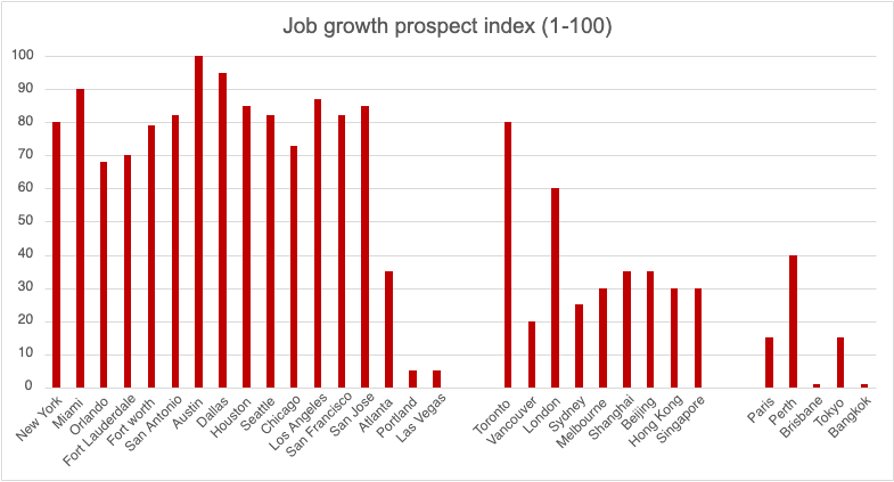
Job Growth Prospect Index

2) Gentrification

Gentrification is the process of changing the character of a neighbourhood through the influx of more affluent residents and businesses. When wealthier residents move into a neighbourhood, they often renovate homes, making them more aesthetically appealing and equipped with better facilities, which increases the value of the property. The addition of new and more “hip” businesses in the city also aids in job creation and can attract more people, increasing the demand and prices of homes.

According to the NCRC Research report, taking into account the number of neighborhoods gentrified and the intensity of gentrification, New York, Los Angeles, San Francisco, Houston, Austin, Miami are the most gentrified cities in the U.S. (arranged in order). Therefore, we can expect home prices to appreciate in these cities.

3) The China Effect

Instead of the usual demographic factors like immigration, we’ll look at the percentage of the population who are Chinese. Why do we do so? China has experienced rapid growth in recent years, and its people have gained a significant amount of wealth. It’s no surprise that according to the National Association of Realtors annual report of International Buyers of U.S. residential real estate, China was ranked #1 for the past 5 years.
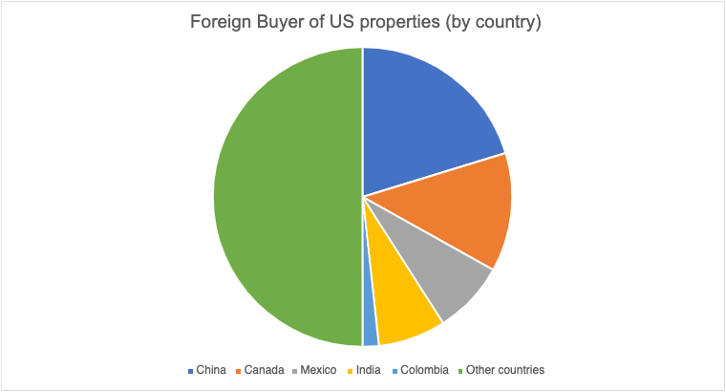
Foreign Buyer of U.S. Properties (By Country)

Excluding predominantly Chinese cities, we see that the average percentage of Chinese the U.S. cities (9.85%) is higher than those in other major cities (8.25%). Thus, we can expect Chinese investors to be more inclined towards U.S. cities, demanding more houses and driving up prices in U.S. cities more than other cities. They will typically choose areas with a significant Chinese population as it offers a sense of familiarity. U.S. cities with the highest percentage of Chinese population are Los Angeles, San Francisco, New York, Seattle.
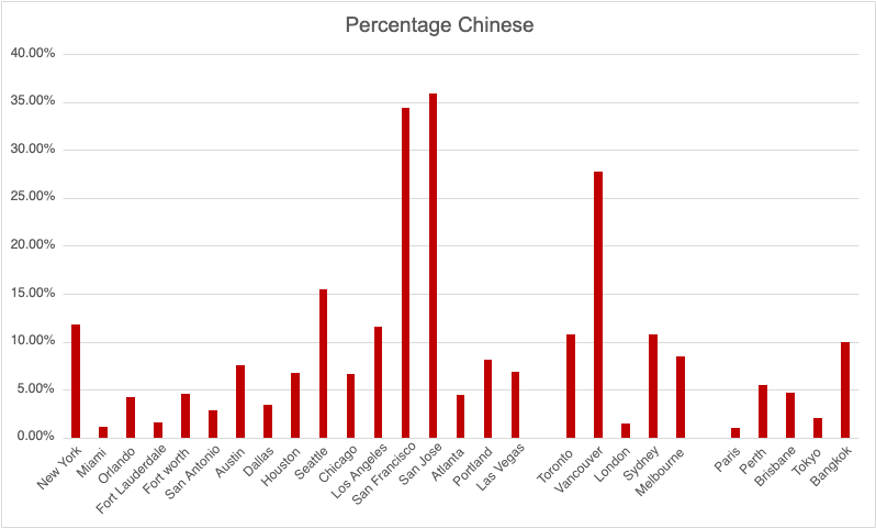
Percentage of Chinese

Based on the abovementioned factors and looking at the “top performers” in each category, prices will likely appreciate the most in Texas, Los Angeles, Miami. This is also in line with the price appreciation data provided by Case-Shiller Home Price Index and Zillow. Prices appreciated by 35.07% in Austin last year!
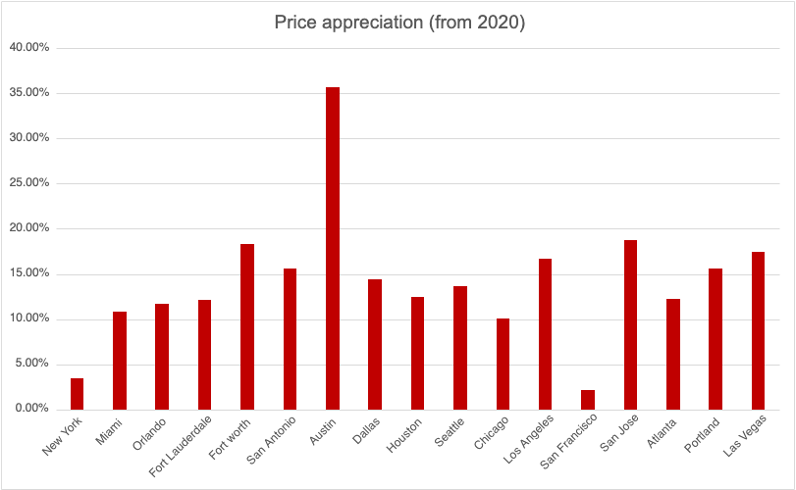
Prices Appreciated Graph

In summary, the conclusions in this report are consistent with our previous 2 reports. There is a tremendous amount of value in the Texas cities, with its abundant jobs, high wage growth, low taxes, easy of travel, strong ethnic mix, and the list goes on.

New York will always have a premium, and Los Angeles and San Francisco will always have specific attributes which make them unique.

HOWEVER, the high cost of living, home prices, and state taxes are quickly driving residents to other states. Almost every metric we see supports this argument. Gentrification in the U.S. is real and is happening much faster than we can imagine. Just look at new home sales from the largest home building company Lennar. They cannot sell enough homes, and it’s the Gentrification Effect we discuss above.

One area that the U.S. has lagged behind its low-cost international peers over the past 10 years is the vocational workforce – smartphone manufacturing, assembly, etc. This was a growth engine in the 80s before the Japanese began their auto manufacturing dominance. But slowly, the U.S. economy retooled and prospered again. Then in the early 2000s, the steel industry lost millions of jobs to low-cost manufacturers overseas, and those jobs have not returned.

The current trend of technology companies moving major offices inwards (See Texas) not only helps the local economies but it reflects a bigger theme – vocational employment. It may not be assembling smartphones, but it will be something else – smart cars, smart cities, smart grids, distribution centers, cloud kitchens, drone deliveries, and so on. Technology is clearly the growth driver going forward, and if you are thinking of real estate as an investment, you should look at states that offer this type of value. Right now, it is clearly Texas, and I suspect there is still more room to go here.

In next week’s Deep Dive, we will be bringing in a U.S. Tax Accountant who focuses specifically on U.S. Expats to explain how the tax regime on owning U.S. property is not as bad as you think and, in fact, could be the easiest and most flexible in the world!

Keep your eyes peeled and subscribe to our newsletter, so you don’t miss out! www.americamortgages.com

Residential Real Estate Investment US

Making a case for U.S. Residential Property Investment

“It’s not Apples to Apples”

As you may recall, last week, we looked at the affordability between popular U.S. investment destinations compared to major cities in the world. We argued that the U.S. offered the best “entry price” for real estate investments on absolute terms and when adjusted for affordability.

This week in Part 2 of our Deep Dive Series, we look at the Relative Income Potential of the popular U.S. investment destinations compared to major cities in the world.

Investing in residential properties or buying-to-let is a form of a business, and as a business owner, making a profit is of priority. A common metric that we use to measure the profitability of a real estate investment is rental yield. Net rental yield measures the profit you generate each year from your investment as a percentage of its value.

Same as what we did last week, we shall compare data sets from 2 sample groups:

1. Major global cities:

TorontoVancouverLondonSydneyMelbourne
ShanghaiBeijingHong KongSingapore

2. Top U.S. residential real estate investment destinations:

New York, NYMiami, FLOrlando, FLFt Lauderdale, FLFt Worth, TX
San Antonio, TXAustin, TXDallas, TXHouston, TXSeattle, WA
Chicago, ILLos Angeles, CASan Fran, CASan Jose, CAAtlanta, GA
Portland, ORLas Vegas, NV

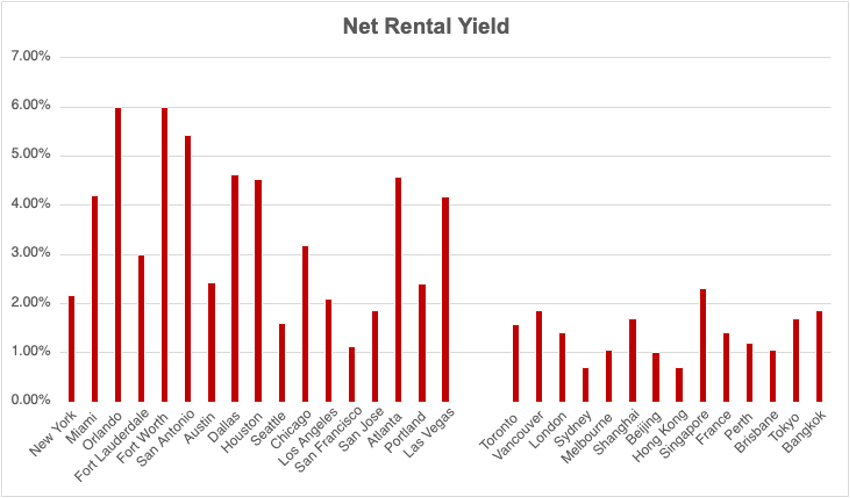
On average, the net rental yield of popular U.S. real estate investment destinations is 3.49%, much higher than that of other global cities – 1.39%. This means that on average, for a property that costs USD 500 000, you can earn approximately USD 17,450 if this property is in the U.S. and only USD 6,950 if this property is in other global cities. This is after accounting for property taxes. We see that investing in the U.S. can earn you 2.5 times the income you will earn in other cities!

In the following chart, you will see the disparity in the profit flow more clearly.

Net Rental Yield Chart

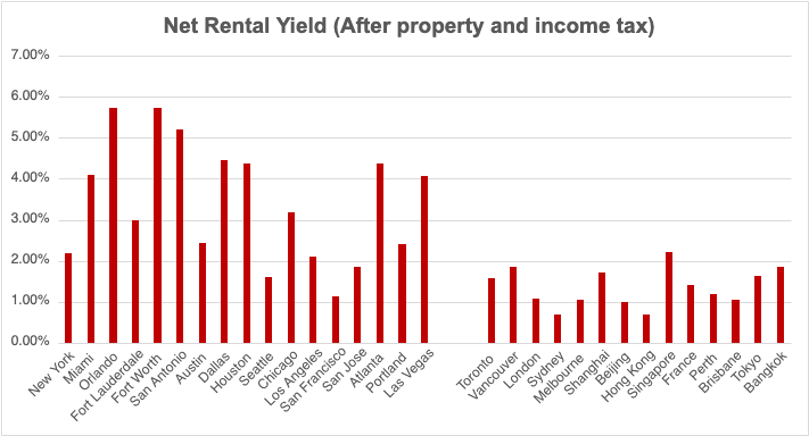
Now, if we look at the net rental yield that takes into account both local property and rental income tax as part of the costs, we can see that the results are similar. U.S. destinations, on average, have a much higher yield than other global cities (3.40% vs. 1.36%).

Note: Even after considering income tax, investing in the U.S. can still earn you 2.5 times the income you will earn in other cities.

Myth Buster – The common misconception that the U.S. tax regime makes investing difficult and not feasible is unfounded. Even adjusting for taxes, U.S. residential real estate is superior investment.

Net Rental Yield (After Property and Income Tax)

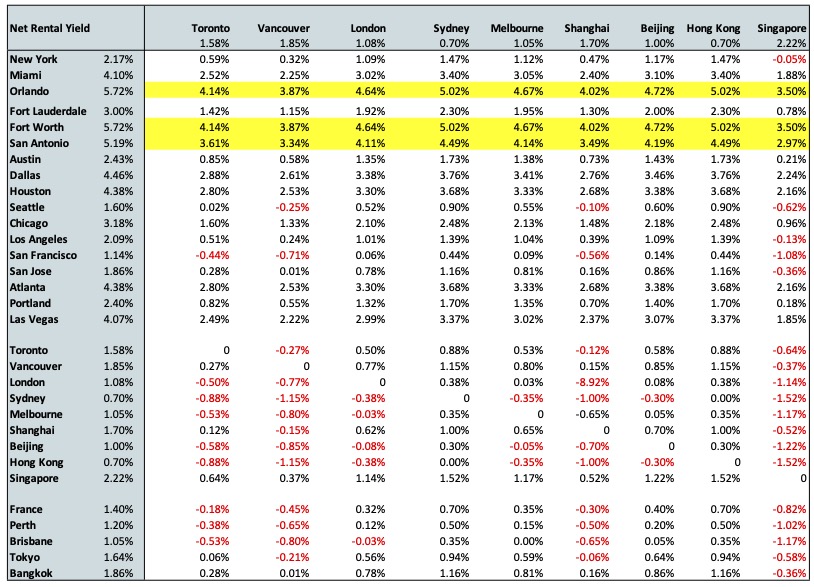
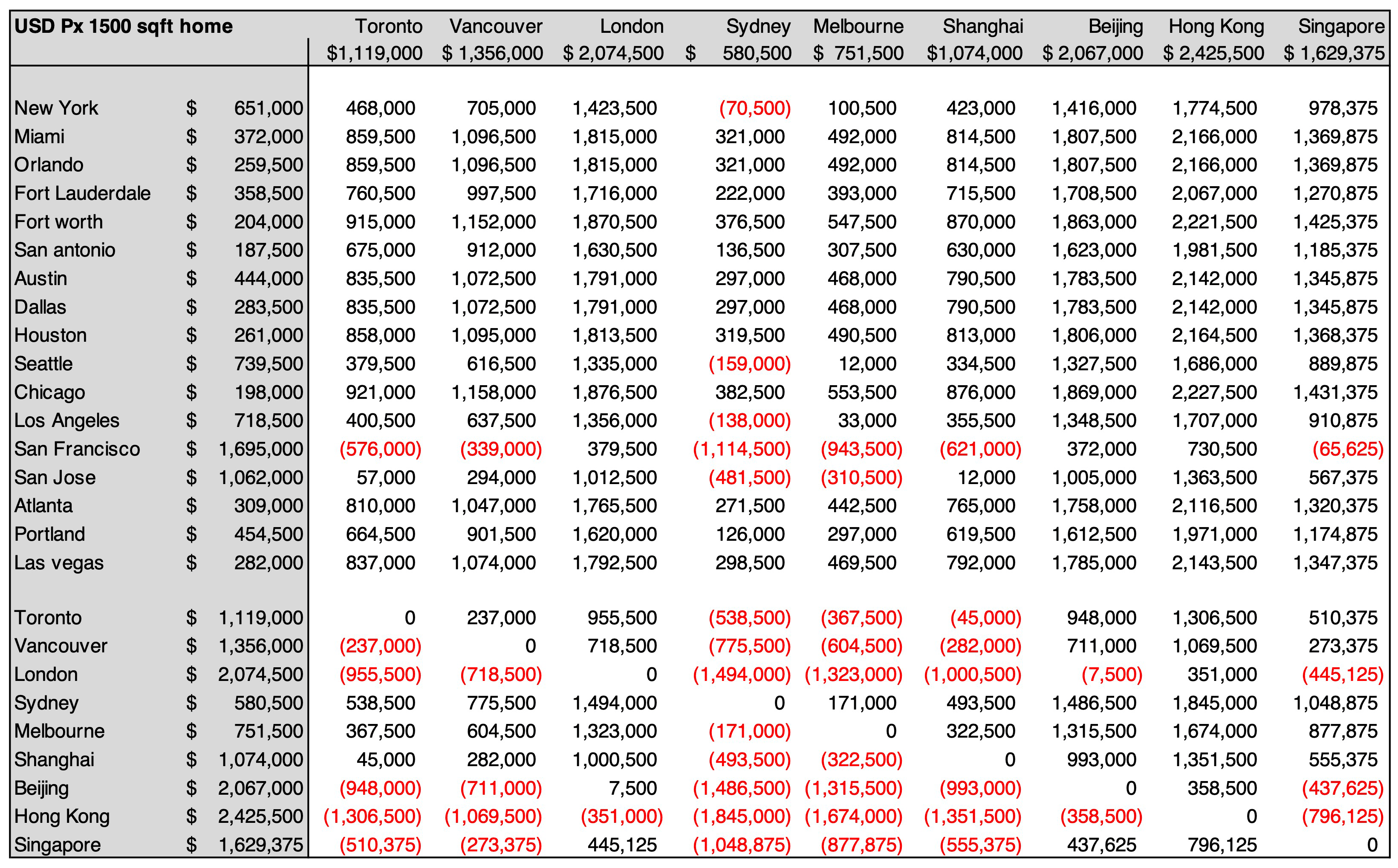
To further strengthen our point that the income potential of U.S. cities is much higher than other global cities, including your home cities, take a look at the table below. If you live in the cities stated in the row, you should definitely not buy-to-let in the cities highlighted in red as the income potential in those cities is worse than your home. Instead, it would be best to invest in the cities highlighted in yellow, where yield is much higher.

Net Rental Yield differences between Major Global Cities and U.S. Residential Real Estate Investment Destinations

Net Rental Yield Differences

Let someone else pay for your mortgage.

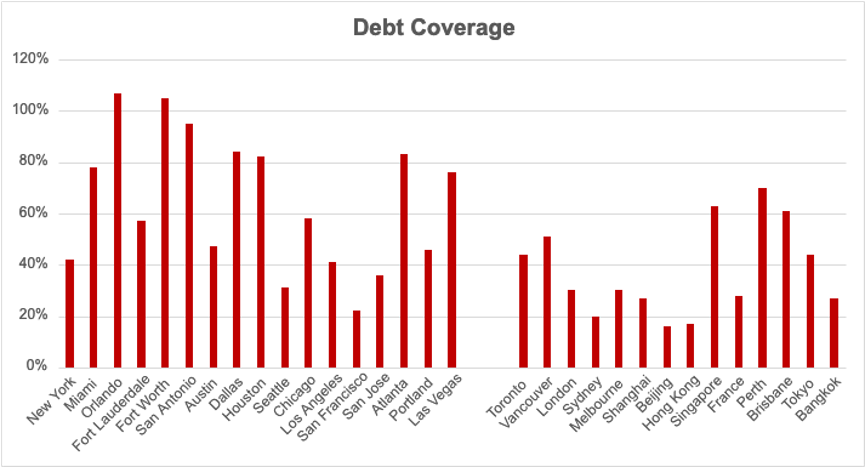
To make things better, in some U.S. cities, you can even pay off a sizeable portion of your mortgage loan with your post-tax rental income. Using the AM debt coverage ratio, we see that in cities such as Orlando and Fort Worth, without considering other maintenance costs of your home, your annual post-tax rental income can cover all of your annual mortgage payment (with some to spare). This is rare in other global cities. In Hong Kong, annual post-tax rental income can only cover 17% of the yearly mortgage payment.

The following diagram shows the debt coverage ratio comparison (the higher, the better).

Debt Coverage

Solely based on net rental yield, you should always consider Orlando, Fort Worth, San Antonio, and almost never San Francisco. It is interesting to see some overlap with last week’s affordability rankings, where Fort Worth and San Antonio were at the top and San Francisco at the bottom.

Just like affordability, rental yield is also just another aspect of property investment. It is important to consider other factors too – growth potential of the city, capital gains, and future price appreciations – which we will discuss in our next report.

To summarize, we see that U.S. real estate properties are outperforming other major global cities in terms of affordability and income potential.

Next week, we will get an even bigger picture by understanding the factors that drive property value growth and why these factors will affect U.S. real estate investments more than other major global cities. You won’t want to miss out!

Stay tuned for next week’s continuation of our Deep Dive series. Email Us

America Mortgages - U.S. Residential Property Investment

America Mortgages introduces….

In our never-ending crusade to acquaint and educate the world of the investment opportunities in U.S. residential real estate and the ease of securing financing, we launch “The Deep Dive Series.” We investigate major themes, dispel major misconceptions in the U.S. real estate market, and use data to confirm our thesis.

Over the next 5 weeks, we will publish a series of reports on the following theme:

Making a case for U.S. Residential Property Investment.

  • Week 1 – “Cheap as Chips”
  • We compare at the relative affordability of the major U.S. real estate investment cities vs. major global cities.
  • Week 2 – “It’s not Apples to Apples.
  • We look at the relative income potential of U.S. real estate investment cities vs. major global cities.
  • Week 3 – “Let’s Look Under the Hood
  • We investigate what drives property prices and why these factors are more constructive in the major U.S. real estate investment cities vs. major global cities.

“Cheap as Chips”

This week is Part 1 of our Deep Dive Series where we look at the Relative Affordability of the major U.S. investment destinations compared to major cities in the world.

When investors look at where they should buy real estate, most will typically choose where they live. This is rational because you know the market, the financing landscape and can physically see the property at any time.

However, if the assumption is to earn the highest risk-adjusted return for an investment property, then it would be irrational to not explore all real estate investment opportunities that could offer you the highest return.

Of course, as a primary home, there are other considerations to motivate a homeowner, such as not worrying about a “roof over your head.”

This is particularly true in Asia and ingrained in the culture, but in many countries like Germany and France, homeownership hovers around 50-60% vs. say Singapore, where homeownership is over 90% (admittedly the highest in the world).

When buying anything, you look at the absolute price of the asset and the associated costs (which include mortgage rates, stamp duties, taxes, etc.), what you can afford, adjusted for the risk (to include research time), its income potential and lastly what you think the asset will be priced in the future.

Let’s start with the price and cost of U.S. real estate vs. major global cities. 

We compare datasets from 2 sample groups.

1. Major global cities:

TorontoVancouverLondonSydneyMelbourne
ShanghaiBeijingHong KongSingapore

2. Top U.S. residential real estate investment destinations:

New York NYMiami FLOrlando FLFt Lauderdale FLFt Worth TX
San Antonio TXAustin TXDallas TXHouston TXSeattle WA
Chicago ILLos Angeles CASan Fran CASan Jose CAAtlanta GA
Portland ORLas Vegas NV

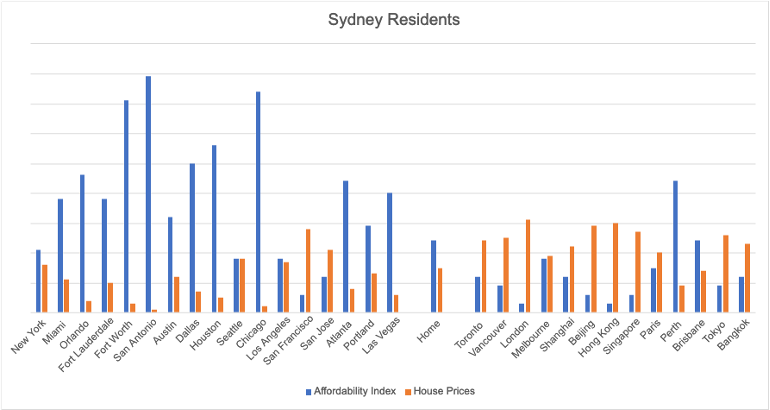
If we look at the major global cities where majority of our clients live, we will find that the affordability of a 1500 sq. ft house is really low.

AM Affordability Index*

*Our proprietary index includes factors such as, taxes, pension contributions, debt repayment, inflation, currency and others.

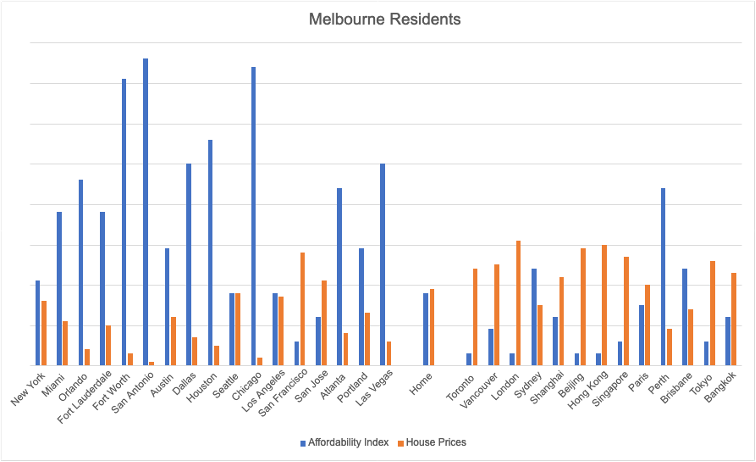
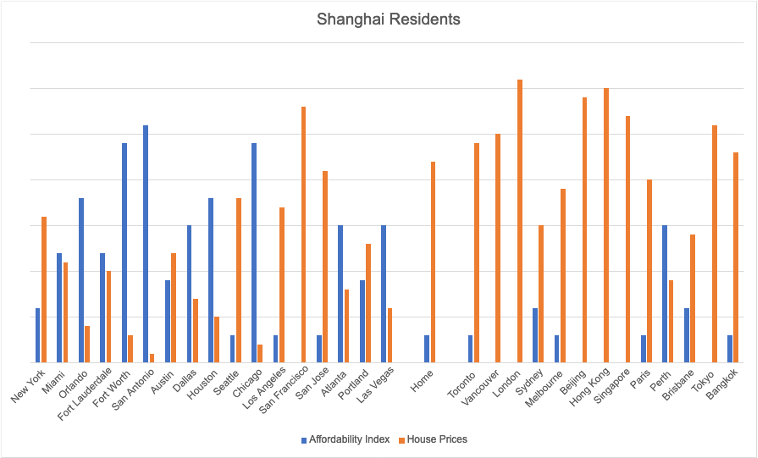
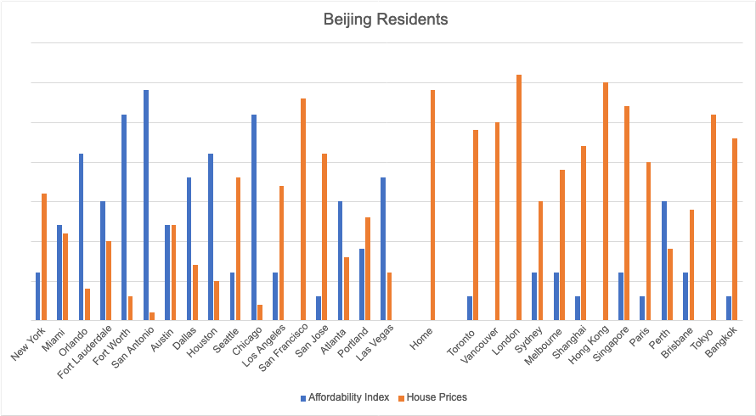
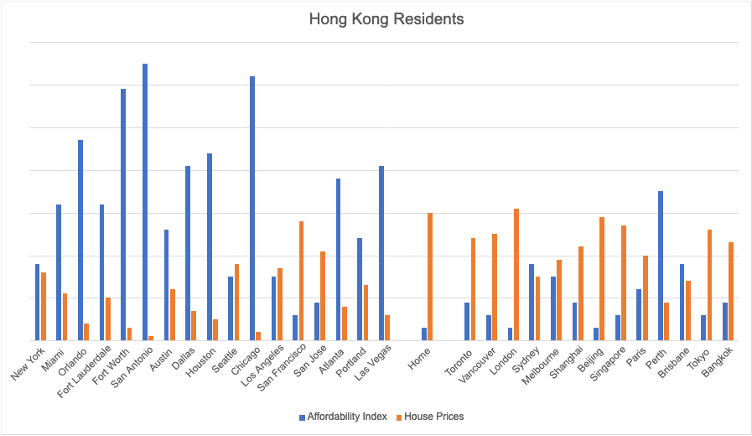
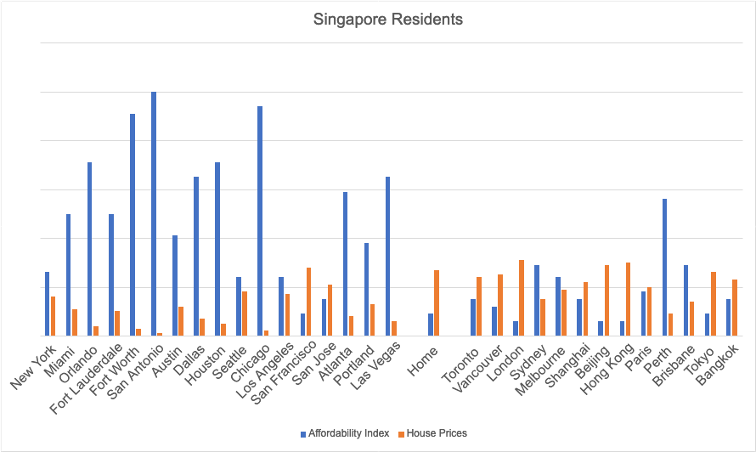
Using our proprietary AM Index, 0 represents a house that is very unaffordable and 100 represents a house that is very affordable.  Affordability only ranges from 0 – 24 in our client’s home cities.

Now, looking at the data for popular investment destinations in the U.S. for real estate investors. We see that the average affordability is drastically higher. This is particularly so for San Antonio, Chicago, and Fort Worth.

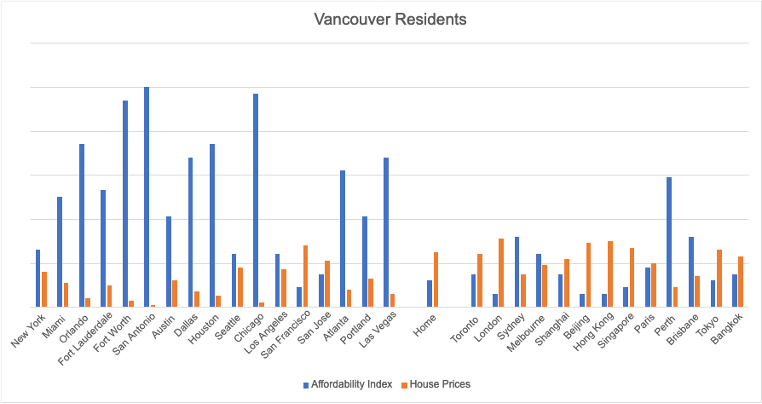
For example, if you live and work in Vancouver and earn the median income, the affordability index of 1500 sq. ft house in your city is at a meagre 12. However, the affordability index of a same-sized house in Fort Worth is at a whopping 94!

Read – if you live in Vancouver, buying a Fort Worth Texas investment property is 8x “more affordable” than back home!

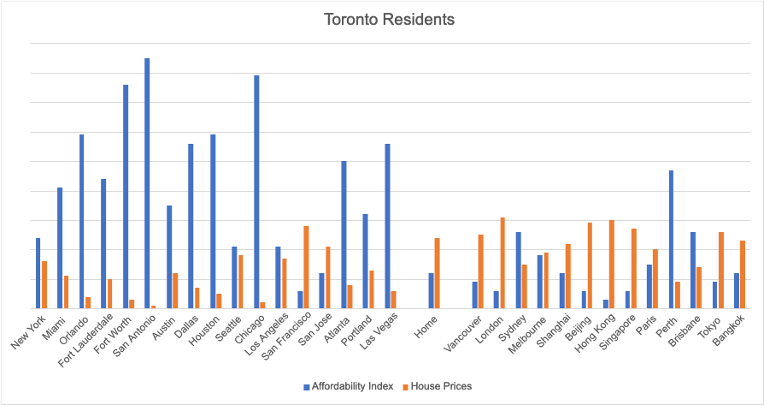
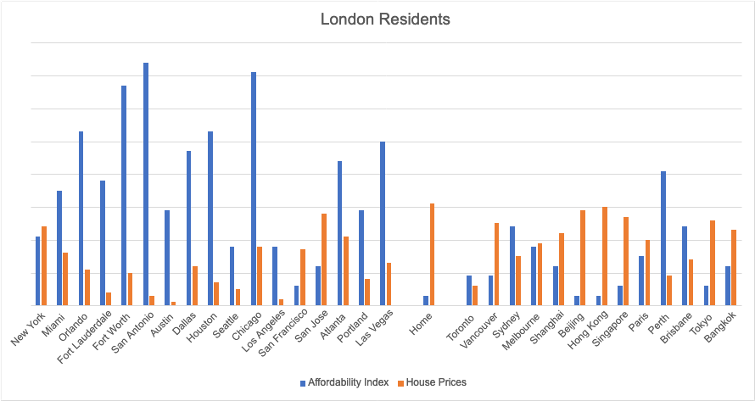
You will see this graphically in the following charts, and the results are very clear and obvious.

Solely based on affordability, when purchasing property for investment income, you should always consider Chicago, San Antonio, Fort Worth, and almost never San Francisco.

Now, we know there are many other considerations when buying property besides just being cheap and affordable – like historical price appreciation vs. future price expectations, net rental yield, ease of securing financing, friction costs of doing the research – all of which we will discuss in our upcoming reports.

In summary, when deciding where to invest next, it’s best to get out of your comfort zone and be open-minded to the opportunities.

There are other cities in the world that you can consider aside from your home country, but we argue the best cities for real estate investments are in the U.S.

Hopefully, Part 1 of our Deep Dive Series has showed you that U.S. properties are more affordable that you think. In fact, they could be up to twelve times more affordable than your own city, e.g. Hong Kong residents buying in Chicago!

Next week, we will illustrate the net income potential of U.S. real estate investment cities vs. major global cities, i.e. how much you can earn from renting after financing costs… the results will shock you!

Still not convinced?

Supporting Charts

Price Differences between Major Global Cites and U.S. Residential Real Estate Investment Destinations:

Supporting Charts - Price Differences between
Toronto Residents Chart
Vancouver Residents Chart
London Residents Chart
Sydney Residents Chart
Melbourne Residents Chart
Shanghai Residents Chart
Beijing Residents Chart
Hong Kong Residents Chart
Singapore Residents Chart

Stay tuned for next week!

www.americamortgages.com
Invest in U.S Property

How do I invest in U.S property without traveling there?

The house-buying experience is often synonymous with physically travelling to the location and exploring every aspect of the house in person. The very idea of investing in property that you’ve never seen physically is unusual – for some people. The “old” way of investing in Real Estate is becoming synonymous with the “old” way of buying socks in a store and not online. With the right partners in place – Mortgage Broker, Realtor, Property Manager, buying a property outside of the city, state, or country where you live is not only possible, it is almost as common as buying “socks” online these days.

Let’s first dispel the notion that the best property to invest in are those that are in the same country code as you. Location absolutely matters, but not in the traditional sense. Global real estate investors in the ‘know’ will tell you the most important factors are asset location and yield – their own proximity to their investment shouldn’t be a factor. Another thing they’ll probably tell you would be that the U.S is by far the best place to invest right now.

Why the U.S?

For one, it’s extremely easy – anyone can buy and own property in the U.S, regardless of citizenship. There are no restrictions (or stamp duties/extra costs) that prevent an individual of foreign citizenship from owning or buying a home in the U.S.

For another, the International Investor Survey done by AFIRE (Association of Foreign Investors in Real Estate) found that the U.S. continues to lead the world in terms of offering the best opportunity for capital appreciation. The same survey also found that 58% of respondents felt that the U.S is the most stable for real estate investment. Moreover, mortgage rates are expected to stay low for some time, resulting in the ability to secure cheap loans and fuelling demand for property within the U.S.

Can I do it?

The answer to this question would be quite different if it was 20 years ago when the ability to build a portfolio in markets beyond where you live was something you could do only if you were extremely wealthy. However, what seemed impossible is easily achieved these days, thanks to the Internet making the world a much, much smaller place. The key to success here is trust in the right partners.

It is essential that you find people you can trust throughout the process – look for licensed realtors and property managers with local expertise in the markets you find the most appealing. Whenever possible, ask associates for referrals, do website searches, find locals in real estate directories and check references. If you do decide to opt for financing, it’s all the more important you find experts who understand the situation and have experience with these transactions.

American Mortgages has proven results-driven solutions for U.S Expats and Foreign Nationals. We understand the requirements of our international borrowers and provide tailor-made mortgage solutions to purchase, refinance or release equity regardless if you have U.S. credit or prior investment experience. Speak to us today to understand how you can obtain a mortgage for U.S property without leaving the comfort of your home. Visit us at www.americamortgages.com to find out more.
Bridge Loan - America Mortgages

What is a Bridge Loan?

A bridge loan is a type of asset-based, short-term loan, typically taken out for a period of a few months to a couple of years pending the arrangement of longer-term financing or an exit such as the sale. It is usually called an asset-based bridge loan in the U.S, a bridging loan in the United Kingdom, or a “caveat loan,” or a swing loan.

What are the benefits of a bridge loan?

Let’s say you’re selling your house and need money to buy another house, but you’re short. In this case, a bridge loan can take care of the financing issue that emerges before your current home sells. Bridge loans fill the gap where traditional lenders cannot provide the speed of funding and flexibility of terms required by the borrower. It is used when financing is fundamental, and a favorable rate is not accessible – think of them as a form of secured debt upheld by collateral.

In addition, bridge loans fund faster than bank loans. Good opportunities don’t last long, which is why using a loan with fewer requirements that closes quickly is an excellent choice. It allows investors to grab a fleeting opportunity before someone else snatches it up.

How can you use a bridge loan?

1. Purchase transactions

In residential real estate, bridge loans are used to rapidly close on a deal before a long-term loan or mortgage with a lower financing cost is acquired. When a homebuyer wants to buy a new property before selling their previous home, a bridge loan can be used to pay off the old mortgage and purchase the new home.

2. Liquidity

Let’s imagine a scenario. Like many of our clients today, Covid has impacted your business and you need capital now. You’ve applied for a loan with your bank, but the lender tells you that it could be weeks before you get your funds or you may not qualify based on current cash flow. You don’t want to play the waiting game. Anything can happen in the time it takes for a “standard” mortgage to be approved and disbursed.

On the other hand, if you own real estate you could use a bridge loan and receive funding with a much shorter turnaround — even as quickly as a week depending on the complexity, location, LTV, and structure.

3. Flexibility

Bridge loans can give you the flexibility you need to buy your dream home in a competitive market. At America Mortgages, we provide U.S. short-term “bridging” loans for overseas borrowers and are certain to find you the right mortgage.

Often America Mortgages Bridge financing is a cheaper alternative to the standard hard money or private lending options, while just as flexible underwriting and fast with the turn around to fund.

America Mortgages provides bridge loan financing for companies, developers, and individuals on a global scale. These interim financing services have been designed to assist real estate investors with financial solutions that offer quick relief in challenging times when liquidity or cash flow is an issue. America Mortgages Bridge has normal terms of 12-36 months with interest-only payments.

4. Delayed purchase exit

Using a bridge for purchase is almost “same-as-cash” and could get your offer accepted when other offers may be tied to “traditional” financing. The big question, how do you exit out of a higher interest bridge loan? The answer is simple; Delayed Purchase.

In a delayed purchase transaction, you can take out a “traditional” mortgage on the property immediately. This allows you to have the advantage of being a “cash buyer” and gives sellers the chance to know the transaction will close while giving you the time and flexibility to obtain a long-term permanent mortgage. Depending on the loan program, this normally needs to be done within three months of closing.

Bridge loan Case Studies

Here are two case studies of America Mortgages Bridge financing solutions:

Canadian investment fund purchases hotel in Texas. Read More.

Chinese National closes US$5.6m purchase with GMG Bridge Loan. Read More.

Get in touch with us today to learn more about the structures and options of short-term bridge financing solutions www.americamortgages.com
Clients are from Canada

While America Mortgages has clients from most countries globally, Canada by far is where most of our clients come from.

This is consistent with public information released by the National Association of Realtors; in year-ended March 2020, Canadian’s purchased $9.5B of U.S. residential real estate!

If we assume an average home price of $500,000, that equates to a staggering 19,000 home purchases!

As the top U.S. mortgage specialist specifically focused only on Expats and Foreign Nationals living in Canada, the customer data we have would be considered as the best representation of “real” demand.

In this article, we wanted to dig a little deeper into where they are buying and why.

Here is our data over the past 12 months for Canadian buyers:

  • – Loans funded: 137
  • – Average loan amount: $460,000
  • – Client location: Ontario 52%, Vancouver 33%, Edmonton 5%, Montreal 3%, Others 7%
  • – Top 3 purchase locations: Orlando, FL; Atlanta, GA; Charlotte, NC

Orlando, Florida

Orlando is a natural fit for Canadians, especially those living in Ontario. They share the same time zone, and it’s only a 3-hour flight from Toronto to Orlando. It’s no secret that winters in Canada (and especially Toronto) can be long and harsh, which is why many choose to buy second homes in Florida to escape the cold. Of course, Orlando’s reputation for being an affordable location with social and economic benefits also helps with its popularity. The average home price in Orlando is $293,000 vs C$870,000 for an average home in Toronto. With tourism and job market growth in leisure and hospitality at their highs, it’s no wonder Forbes ranked Orlando as their #1 Best Place to Buy a House 3 years in a row.

Atlanta, Georgia

Atlanta ticks many boxes and is an underappreciated place for many but offers great value for those looking to take advantage of the recent demographic shift inwards for coastal cities. A little unknown fact is that the Atlanta International Airport is the busiest airport in the world, with over 110 million passengers a year! Beijing #2 at 100 million passengers (2019). Let that sink in a little. A city of 500,000 people has the world’s busiest airport. That is because geographically, it’s perfectly located as a travel hub and hence a growing trend for companies to expand their headquarters there – like Google and Blackrock. Meanwhile, the population growing by 12.18% in the last 8 years – 111% faster than the national average of 5.76%. That also means the area’s annual job growth has risen to the rate of 2.15%. Affordability is a key driver for many real estate investors looking for a strong rental yield. The median purchase price of a 3 bedroom single family home at only $190,000, 15% lower than the national average of $222,000.

Charlotte, North Carolina

Charlotte is not an obvious choice to own property in, but digging a little deeper, we found that it has been one of the best cities to own real estate over the past 10 years. The supply of homes is at a 17 year low, 8 years of home price increases with no signs of slowing down. Another fact that surprises many is that Charlotte has the second-most banking assets after New York City, with Bank of America and Wells Fargo having their regional headquarters there. Meanwhile, CNBC recognizes Charlotte as the third-best city in the country to start a business.

It was also surprising to find out from our clients in Canada that Toronto was only a 2-hour direct flight from Charlotte!

How America Mortgages can help…

Unlike a traditional bank, which can only show you their own bank programs, which are by definition rigid and hard to qualify for, we are a solutions provider. We understand your requirements and suggest several loan options that best suit your requirements; this could be from banks or wholesale lenders, which are unknown by many accounts for 70% of the mortgage lending market. For example, if you are an entrepreneur, you can almost assume you would not be able to qualify for a bank loan. The trouble is banks will drag this on for 3-4 months before rejecting your loan. Our Loan Officers are all experts working with Foreign National and Overseas Expat clients – that is all we do! When you tell us your requirements, we already know from our database of 150 U.S. lender programs that best suits your needs. (Also see Can a Canadian Buy a House in the USA?)

For more details, please visit us at www.americamortgages.com

Cash-Out Equity Release - America Mortgages

There’s something about having cash on hand that feels empowering. Being able to invest in projects, equities, crypto, or a business opens up endless possibilities. It could be to pay off high-interest debt or taking the family on a dream vacation before the children get too old. We hear this daily when speaking to clients that are considering cash-out refinancing.

What is a cash-out refinance?

A cash-out refinance is a mortgage refinancing option in which an old mortgage is replaced for a new one with a larger amount than owed on the previously existing loan, helping borrowers use their home mortgage to get some additional liquidity. You get the difference between the old mortgage and the new and the money can be used however you like. The amount received depends on the equity built up in your property.

How does it work?

Cash-out refinancing depends on several factors which include the value of the property, the amount owed, and how much you can qualify to borrow. Your America Mortgages loan officer can help you determine if this type of financing makes sense from a cost basis.

The potential benefits of a cash-out refinance

  • 1. A lower interest rate on your mortgage – Let’s say you bought your home when mortgage rates were much higher. Refinancing your home can improve your financial situation if you are able to obtain a lower rate.
  • 2. Debt consolidation – The money from a cash-out refinance can be used to pay off other high-interest debts, like credit cards and college loans. This could save you thousands in interest in the long run.
  • 3. Credit score improvement – Building on the previous point, paying your credit card debts off in full using a cash-out refinance can build your credit score by reducing your credit utilization ratio.
  • 4. Tax deductions – If you’re looking to improve your home using the cash from a cash-out refinance, you could potentially qualify for mortgage interest deduction.
  • 5. A cheaper way of paying for your kid’s education – It’s every parent’s dream to be able to put their kids through college, but high-interest student loans can be extremely stressful. Using a cash-out refinance can be a good alternative if the rates are lower.
  • 6. Inheritance – Although we advise you to speak with your attorney or tax advisor, it may be possible to reduce the amount of inheritance tax when estate planning with increased leverage.
  • 7. Take advantage of an opportunity – With the current situation with Covid, there are a lot of opportunities that may not be available once the world goes back to “normal”. Having access to liquidity and being able to act immediately can be potentially life-changing.

So, should you do it?

The truth is, cash-out refinancing can be a good way to improve your financial situation – we think of it as an affordable way to borrow money if you own substantial equity in your home. The money from a cash-out refinancing can even be used to rebuild equity that you’re taking out if you decide to use it on value-adding home renovations.

Interested in cash-out refinancing? America Mortgages has a 97% approval rate for both U.S. Citizens & Foreign Nationals. That is our sole focus and our expertise.

For more details please visit us at www.americamortgages.com

Vacation Homes Buoyant

Despite the slow reopening of workplaces nationwide, a new report by Redfin shows that demand for vacation homes– otherwise known as short-term rentals –is soaring at a record pace.

One reason for the rise in demand can be attributed to vacationers wanting to keep their distance from strangers in shared hotel spaces. Now, with the developing accessibility of the COVID-19 vaccines, more people are planning their future get-aways. A recent Vacasa review of U.S. vacationers revealed that 59% said they intend to vacation in spring 2021. Additionally, 52% said they would choose to stay in a vacation rental more regularly. A study by the National Association of Realtors also found a 16% increment in second-home purchases in 2020.

Rise in remote work

Another reason for the increased demand could also be due to more affluent families having more opportunities to do their jobs remotely for the foreseeable future. The increase in remote work for individuals in white-collar positions implies that families could leave urban cities and set up for business in more modest, remote towns.

Redfin chief economist Daryl Fairweather said, “The combination of the wealthy becoming wealthier, remote work turning into the new normal, and low mortgage rates is creating an ideal environment for affluent Americans to buy vacation homes,”

“As long as the economy continues to grow, I don’t foresee demand for second homes slowing down anytime soon,” she added.

Fortunes may have genuinely turned for the vacation home market since the start of the coronavirus crisis. But as a real estate investor, what does this mean for you?

From having a stable cash flow to obtaining tax benefits, investing in real estate can have several advantages. It’s also an excellent way to increase wealth over time. New investors can take advantage of this by getting in on this heightened interest for second homes being bought as vacation rentals.

America Mortgages has programs for both Foreign Nationals and U.S. Expats. Our U.S. Expats programs are exactly what you would find at your bank back home. We work with lenders in all 50 states, and we are sure to find the best loan option available for your needs. We also provide solutions for U.S. Citizens who have been “away from home” for an extended period and lack the depth of credit. No U.S. credit? No problem! America Mortgages has loan programs that accept your overseas credit and income. As Expats ourselves, we not only understand the challenges you face living abroad while trying to obtain U.S. mortgage financing, we live it.

Schedule a call with our U.S. mortgage specialist today at www.americamortgages.com

Sources: Redfin & Marketwatch

Home Sales Are Newly Built

New construction homes have steadily taken a larger share of the pie over the past decade, but during the coronavirus pandemic, there has been a remarkable acceleration. According to Redfin Lead Economist Taylor Marr, there are two main reasons for this: a rise in home construction and fewer Americans listing their houses for sale.

“Homebuilding has become more attractive and profitable during the pandemic because of record-low mortgage rates and strong demand for homes,” Marr claims. “At the same time, many homeowners have chosen to stay and refinance or remodel their existing homes rather than sell them, which has led to new construction taking a larger share of the market.”

In the US, new residential construction projects have increased by 20% each month since the pandemic and reached the highest level since 2006, in March this year. This goes to show that homebuilders are becoming more optimistic and hopeful about the current housing situation, notwithstanding the shortage in lumber and rising costs of construction.

According to Melanie Miller, a Redfin real estate agent in Houston, buyers choosing not to deal with bidding wars prefer new construction homes because builders rarely impose deadlines for offers. Furthermore, they can purchase a house at the asking price instead of bidding at a higher price.

With record-low mortgage rates and strong demand for homes, we think this is an excellent time to invest in real estate. With an investment mortgage, you will usually be able to tell whether you are approved relatively quickly. America Mortgages has pretty cut and dry standards when it comes to getting you approved for an investment mortgage. America Mortgages has loan programs for U.S. Expats with or without U.S. credit. We understand that living abroad often changes factors and your ability to borrow in the U.S. Our loan programs are tailored towards your exact situation.

What are you waiting for?

For more information on U.S. or mortgage loans in other countries, please enquire via email – [email protected].

Source: Redfin