House model on stacked coins representing DSCR Loan financing for real estate investors

A DSCR loan qualifies an investment property mainly through its rental cash flow instead of your traditional personal income. This approach can help real estate investors finance income-producing properties. However, other options use different qualification methods. Conventional, bank statement, hard money, HELOC, and personal loans each serve different financial needs and investment strategies.

House model on stacked coins representing DSCR Loan financing for real estate investors

Understanding these differences can help you choose financing that matches your goals and financial position. Some loans focus on your income and credit, while others consider bank deposits, property value, or existing home equity. Therefore, comparing a DSCR loan with other financing options gives you a clearer view of which structure may suit your investment plan.

How Does a DSCR Loan Compare With Other Mortgage and Financing Options?

A DSCR loan qualifies you mainly through a property’s rental income rather than personal employment records or tax returns. This can suit self-employed investors and buyers expanding rental portfolios. However, the right financing option depends on your property type, available income documentation, investment strategy, and repayment plans. Therefore, a careful DSCR loan comparison is essential.

Key factors to compare include qualification method, property type, income documentation, and repayment plans. Before applying, reviewing the DSCR loan required documents can help you prepare the information lenders typically request.

  • Qualification method: Property cash flow, personal income, bank deposits, credit, or home equity.
  • Property type: Primary residence, rental property, or short-term investment project.
  • Income documents: Tax returns, employment records, bank statements, or rental income records.
  • Investment strategy: Long-term rentals, portfolio growth, renovations, or fix-and-flip projects.
  • Upfront costs: Down payment requirements, closing costs, fees, and available cash reserves.
  • Repayment plans: Loan term, interest structure, monthly payments, and expected holding period.

The debt service coverage ratio shows whether a property’s income can cover its debt obligations. Meanwhile, other financing options may focus more on your personal income, credit, deposits, or equity. DSCR loans may require larger down payments and higher rates than traditional mortgages. Therefore, you should compare the total costs, qualification rules, and long-term goals.

DSCR loan compared with conventional, bank statement, hard money, HELOC, and personal loan qualification methods.

What Is the Difference Between a DSCR Loan vs Conventional Loan?

The main difference between a DSCR loan vs conventional loan is how lenders qualify you. A DSCR loan focuses mainly on the investment property’s rental income and cash flow. In contrast, conventional lenders review your personal income, tax returns, employment history, credit profile, and debt-to-income ratio before approving the loan.

When comparing a DSCR vs conventional loan, you should also consider property purpose, documentation, down payment, rates, and scalability. Conventional loans may offer lower rates but require stricter personal financial reviews. Meanwhile, DSCR loans can support rental portfolio growth without relying mainly on W-2 income. You can learn more in our DSCR loan guide.

How Does a Bank Statement Loan vs DSCR Loan Compare for Investors?

The main difference between a bank statement loan vs DSCR loan is the income source lenders review. Bank statement loans use deposits in your personal or business accounts to estimate income, making them suitable for self-employed borrowers, including some U.S. expats with non-traditional income records. In contrast, DSCR loans qualify borrowers primarily based on the rental income generated by the investment property, which can appeal to foreign nationals and U.S. expats investing in U.S. real estate.

A bank statement loan still relies on your personal or business income to support approval. Lenders typically review several months of bank deposits to assess your earning pattern. Meanwhile, a DSCR loan compares the property’s rental income with its debt obligations, allowing eligible investors to qualify without traditional income documents such as W-2 forms or tax returns.

Your choice depends on how you earn income and the type of property you want to finance. Bank statement loans may suit borrowers with strong cash flow but complex tax returns, while DSCR loans are often a better fit for investors focused on rental property income. Before comparing loan offers, it is also important to review each lender’s Loan Estimate, which outlines the interest rate, projected monthly payments, closing costs, and other key loan terms. The Consumer Financial Protection Bureau (CFPB) explains how borrowers can review and compare Loan Estimates to make informed mortgage decisions. You can also explore our mortgage options for foreign nationals when investing from overseas.

When Should You Choose a DSCR Loan vs Hard Money Loan, HELOC, or Personal Loan?

Choose a DSCR loan when you plan to buy or refinance a long-term rental property without using traditional personal income documents. However, other financing options suit different needs. A hard money loan can fund short property projects, while a HELOC uses existing home equity. Personal loans provide unsecured funds for smaller expenses.

The main differences include:

  • DSCR loan vs hard money loan: Choose DSCR financing for long-term rentals and hard money for short-term fix-and-flip projects.
  • DSCR loan vs HELOC: A DSCR loan uses rental cash flow, while a HELOC provides funds against existing home equity.
  • DSCR loan vs personal loan: DSCR financing supports rental property investment, while personal loans offer unsecured funds for smaller needs.

Your investment timeline, available equity, and property plans should guide your financing choice. DSCR loans often suit investors building rental portfolios for long-term income. In contrast, other options can provide faster or more flexible funding for specific needs. Before choosing financing, you can learn how to read a DSCR loan term sheet and compare important loan terms or compare the pros and cons of a DSCR loan to better understand your situation.

How Do Debt Yield, FCCR, Cash DSCR, and Interest Coverage Ratio Differ From DSCR?

DSCR measures a property’s cash flow against its required debt payments. The DSCR ratio calculation uses property income and debt obligations to determine repayment capacity. However, other financial metrics provide different views of risk and financial strength.

MetricWhat It MeasuresMain UseKey Difference From DSCR
DSCRCash flow compared with total debt paymentsLoan repayment analysisIncludes principal and interest payments
Debt YieldNet operating income compared with loan amountProperty lending riskDoes not depend on interest rate or loan term
FCCREarnings available for fixed financial obligationsWider financial analysisIncludes rent, leases, and other fixed charges
Cash DSCRAvailable cash compared with debt paymentsCash liquidity analysisFocuses more closely on actual available cash
Interest Coverage RatioEarnings compared with interest expenseInterest payment analysisMeasures interest coverage rather than total debt service

When comparing debt yield vs DSCR, FCCR vs DSCR, or DSCR vs interest coverage ratio, you should consider the purpose of each metric. The fixed charge coverage ratio vs DSCR comparison covers wider obligations. Similarly, cash DSCR vs DSCR focuses more closely on available cash. Together, these measures can support clearer lending and investment analysis.

Which DSCR Loan Option Is Right for Your U.S. Property Investment?

Financing a U.S. investment property from overseas can feel complicated. You may face challenges with income documents, residency requirements, rental income calculations, and unfamiliar loan terms. Moreover, the right option can vary by property type and investment strategy. Without clear guidance, you may struggle to compare loan structures and choose suitable financing.

At America Mortgages, we help foreign nationals and U.S. expats explore financing options for U.S. property investments. Our team considers your rental income, property type, investment plans, and borrower circumstances. You can speak with our mortgage team to discuss your options and find a financing approach that supports your investment goals.

FAQS

Q1: Can You Use a DSCR Loan for a Primary Residence?

No, a DSCR loan is generally designed for investment properties rather than primary residences. The lender evaluates the property’s expected rental income and debt payments. Therefore, you usually need another mortgage option for a home you plan to occupy. DSCR financing is better suited to eligible income-producing rental properties.

Q2: What DSCR Ratio Do Lenders Usually Require?

Many lenders look for a DSCR of around 1.0 or higher, although requirements vary between loan programs. A ratio above 1.0 means the property generates enough income to cover its debt payments. However, lenders may also review credit, reserves, property type, and other factors before making a lending decision.

Q3: Can Foreign Nationals Qualify for a DSCR Loan in the United States?

Yes, eligible foreign nationals can access DSCR loan programs for U.S. investment properties. Since qualification can focus on property cash flow, traditional U.S. income documents may not always be required. However, requirements vary by lender and borrower profile. Therefore, investors should review down payment, reserve, credit, and property requirements carefully.

Q4: Can You Use a DSCR Loan for a Short-Term Rental Property?

Yes, some DSCR loan programs allow eligible short-term rental properties. However, lenders may calculate qualifying rental income differently based on the property and program. They may review market rent, lease income, or other approved records. Therefore, you should confirm the income calculation method before relying on projected short-term rental earnings.

Q5: Can You Refinance an Existing Rental Property With a DSCR Loan?

Yes, you can use a DSCR loan to refinance an eligible rental property if you meet the lender’s requirements. Investors may refinance to change loan terms or access available property equity. However, qualification standards, equity limits, costs, and cash reserve requirements vary. Therefore, compare the new financing terms before refinancing.

Q6: Does a DSCR Loan Affect Your Personal Debt-to-Income Ratio?

A DSCR loan generally qualifies you through the investment property’s cash flow instead of a traditional personal debt-to-income calculation. This structure can support investors who want to expand their portfolios. However, lenders may still review credit and other borrower details. Therefore, qualification should not be confused with having no financial requirements.

Real estate investor calculating the DSCR ratio for a U.S. rental property using rental income and housing payment figures

Your DSCR ratio compares a rental property’s qualifying income with the housing payment used in the lender’s calculation. This figure helps investors understand whether the property’s income can support the proposed financing.

The calculation is especially relevant for foreign nationals and U.S. expats investing in U.S. rental properties. Their income, assets, employment, and tax records may be based outside the United States. Therefore, property-focused financing can offer a practical alternative to conventional income-based qualification.

However, calculating the ratio requires more than dividing expected rent by an estimated loan payment. You need accurate income and payment figures. You must also understand how the lender evaluates your specific property type.

Real estate investor calculating the DSCR ratio for a U.S. rental property using rental income and housing payment figures

What Is a DSCR Ratio and What Does It Measure?

A DSCR ratio measures how qualifying rental income compares with the property payment used for loan qualification. DSCR stands for debt service coverage ratio.

The result shows the relationship between two figures. A ratio above 1.0 means qualifying rent exceeds the calculated payment. A ratio of 1.0 means both figures are equal. Below 1.0, the qualifying rent falls short of that payment.

For example, a 1.25 ratio means qualifying rent equals 1.25 times the calculated payment. However, that figure does not represent a 25% investment return. DSCR measures income coverage rather than overall profitability.

Actual investment performance depends on additional factors. These may include maintenance, repairs, vacancies, management costs, and local market conditions. Therefore, investors should use DSCR as one part of their wider property analysis.

This property-focused approach can be useful for investors with financial records outside the United States. A foreign national may earn and bank abroad. Similarly, a U.S. expat may work for an overseas employer or own a foreign business.

Investors who need a broader overview can review the complete guide to DSCR loans for real estate investors.

What Is the DSCR Ratio Formula?

The DSCR ratio formula divides qualifying rental income by the applicable housing payment. Many residential DSCR programs calculate these figures monthly.

The basic calculation is:

DSCR Ratio = Qualifying Monthly Rental Income ÷ Applicable Monthly Housing Payment

The first figure is the rental income accepted for loan qualification. Depending on the property and program, lenders may review different sources to establish this amount. These can include existing lease information or an appraiser’s market-rent assessment.

The second figure is the housing payment used in the calculation. It commonly includes principal and interest payments, property taxes, insurance, and applicable association dues. These combined costs are often described as PITIA.

Consider this example:

Monthly FigureAmount
Qualifying rental income$2,800
Principal and interest$1,650
Property taxes$300
Insurance$150
HOA dues$100
Total housing payment$2,200
DSCR Ratio1.27

The DSCR ratio calculation is $2,800 divided by $2,200. Therefore, the result is 1.27.

In this example, qualifying rental income equals 1.27 times the calculated housing payment. This calculation gives the investor a clear view of the property’s income coverage.

DSCR is also a broader measure used in income-property lending to assess whether property income can cover debt obligations. The Office of the Comptroller of the Currency discusses debt service coverage as an important measure in income-property lending. However, the exact income and payment figures used in the calculation can differ by lending context and loan program.

Loan documents may also show annual debt service when presenting payment obligations over a yearly period. The meaning of total debt service can vary across lending contexts and programs. Therefore, investors should follow the definitions used in their specific loan documents.

Calculation methods can also vary between loan programs. For this reason, an investor’s initial calculation should use realistic figures and the correct program method.

How Do You Calculate the DSCR Ratio Correctly?

You calculate the DSCR ratio by confirming qualifying rent, determining the applicable payment, and dividing those figures. Following the correct order reduces errors and creates a more useful estimate.

Use these five steps:

  1. Identify the qualifying rental income.
    Start with the income that may qualify under the loan program. An existing lease can provide useful rental information. For vacant properties, an appraiser may estimate market rent using comparable local rentals.
  2. Calculate the applicable housing payment.
    Add the payment components required by the program. These may include principal, interest, property taxes, insurance, and applicable HOA dues.
  3. Apply the formula.
    Divide the qualifying monthly rent by the applicable monthly housing payment. For example, $3,000 divided by $2,400 produces a ratio of 1.25.
  4. Check the income method for your property type.
    Lenders may assess income differently across rental strategies. A leased property and a vacant property do not provide the same income evidence. Eligible short-term rentals may also require a program-specific income review.
  5. Compare the result with the program requirement.
    Check whether the calculated result meets the lender’s applicable Minimum DSCR. The required threshold depends on the lender and specific loan program.

Once you understand the calculation, review how it appears within the proposed financing terms. The interest rate, loan amount, and payment structure can affect the final figures. Learning how to read a DSCR loan term sheet can help you assess those details together.

What Is a Good DSCR Ratio for a Rental Property?

A good DSCR Ratio meets the chosen program’s requirement and supports the investor’s wider financing strategy. There is no single ratio that qualifies every property for every DSCR loan program. Lenders set their own program guidelines. Some programs require a ratio above 1.0. Others may consider different ratios under specific conditions. Therefore, investors should confirm the applicable threshold before relying on an early calculation.

The ratio also works within a wider loan structure. A lender may review available equity, cash reserves, credit profile, property type, and loan purpose. These factors can affect the financing options available for a particular transaction.For this reason, the lowest qualifying ratio should not become the only selection criterion. Investors should also review the interest rate, required equity, reserves, fees, and prepayment terms. Together, these details show how the financing may affect the investment.

International investors have additional practical considerations. Foreign nationals may need to document overseas assets or transfer funds across borders. U.S. expats may hold income, savings, or business interests in another country. The financing structure should fit those circumstances and the property itself. Foreign investors can explore financing options for foreign nationals based on their cross-border circumstances. U.S. citizens abroad can review mortgage options for U.S. citizens living overseas.

What Can Change Your DSCR Ratio Before Closing?

Your DSCR Ratio can change before closing when the lender updates qualifying income or housing payment figures. Several parts of the transaction may remain subject to review during appraisal and underwriting.

Key factors that increase or decrease your DSCR ratio before closing on a property.

For example, an investor may estimate rent using local listings before applying. Later, the appraisal process may support a different qualifying rental amount. That updated figure can change the income side of the calculation.

The payment side can also change during the loan process. A higher interest rate increases the principal and interest portion of the mortgage payment. Updated taxes, insurance premiums, or HOA dues can increase the total housing obligation.

Therefore, investors should update their calculation when important figures change. They should also ask which loan terms are final and which remain subject to review. This approach helps prevent surprises before closing. It also gives investors a clearer basis for reviewing the final financing structure.

How Can Investors Use DSCR When Comparing Rental Properties?

Investors can use DSCR ratio calculations to compare income coverage across potential rental properties. Applying a consistent method helps identify which properties provide more qualifying income relative to their calculated payments.

Consider three potential investments:

PropertyQualifying RentHousing PaymentDSCR Ratio
Property A$2,800$2,2001.27
Property B$3,100$2,5001.24
Property C$2,400$2,4500.98

Property A has the highest ratio in this comparison. Property B earns more monthly rent, but it also carries a larger housing payment. Property C has qualifying rent below its calculated payment.

This comparison shows why rent alone cannot measure financing strength. A higher-rent property can still have a lower ratio when its payment is also higher.

Investors can use this comparison during early property screening. However, they should also assess location, operating costs, rental strategy, and long-term ownership plans. Those factors address investment questions that the DSCR calculation does not measure.

For overseas investors, the comparison can support a more structured U.S. property search. It helps narrow potential investments before beginning a detailed financing review.

Understand Your DSCR Before Financing a U.S. Investment Property

Understanding your DSCR Ratio helps you review a rental property with greater financial clarity. Start with accurate rental income and housing payment figures. Then, consider how the financing fits your available capital and long-term investment plans. Foreign nationals and U.S. expats often manage assets, income, and banking relationships across different countries. As a result, their financing needs can require experience with cross-border borrower profiles and U.S. property investment.

America Mortgages works with international investors seeking financing for U.S. real estate. You can contact our mortgage team to discuss your property and available financing options. If you are considering a U.S. investment property, email [email protected] or call +1 (845) 583-0830. An experienced mortgage specialist can discuss your property and investment plans with you.

FAQs

Can I Improve My DSCR Ratio Before Applying for a Loan?

Yes. A higher qualifying rent or lower housing payment can improve the ratio. Depending on the transaction, investors may review pricing, loan amount, insurance costs, or other financing factors with their lender.

Does a High DSCR Ratio Mean a Rental Property Is Profitable?

No. DSCR measures whether qualifying rental income covers the payment used in the lender’s calculation. It does not fully account for maintenance, vacancies, repairs, management costs, income taxes, or investment returns.

Can Two Lenders Calculate Different DSCR Ratios for the Same Property?

Yes. Lenders may use different program rules for qualifying rent, short-term rental income, or payment components. Therefore, the same property can produce different results when approved calculation methods differ.

Should I Calculate DSCR Before Making an Offer on a Rental Property?

Yes. An early calculation can show whether projected rent supports the expected housing payment. However, use realistic figures because the final appraisal, interest rate, taxes, and insurance may change the result.

Can Currency Exchange Rates Affect a DSCR Loan Application for International Investors?

Exchange rates do not directly change a property’s U.S. rental-income DSCR calculation. However, currency movements may affect available funds, reserve documentation, and the cost of transferring money for closing.

DSCR Loans

If you are researching rental property financing, understanding how DSCR loans work is essential. Investors increasingly rely on DSCR loans to scale portfolios, refinance equity, and bypass traditional income documentation hurdles.

This guide explains how DSCR loans work, how qualification happens, how underwriting evaluates risk, and when these loans make strategic sense.

What You Will Learn

  • What DSCR loans are and how the Debt Service Coverage Ratio is calculated for residential investment properties
  • How DSCR loan qualification works for U.S. expats and Foreign Nationals
  • What lenders review during DSCR underwriting, including rent verification and PITIA analysis
  • The best uses of DSCR loans for scaling rental portfolios and cash-out refinancing
  • Real case study examples showing how DSCR loans are structured in practice
  • How America Mortgages structures flexible DSCR programs, including below 1:1 and no-ratio scenarios

What Are DSCR Loans and How Do They Work?

DSCR loans are investment property mortgages where approval is based primarily on whether the rental income covers the property’s debt obligations, rather than the borrower’s personal income.

DSCR stands for Debt Service Coverage Ratio. It measures a property’s ability to generate enough income to service its mortgage. For most residential 1–4 unit investment properties, lenders calculate DSCR using the property’s market rent divided by PITIA, which includes Principal, Interest, Taxes, Insurance, and HOA dues if applicable.

For residential DSCR loans:
DSCR = Market Rent ÷ PITIA

For example, if a property generates $4,800 per month in market rent and the total PITIA payment is $3,463, the DSCR equals 1.39. This means the property produces 39% more income than required to cover the mortgage payment, creating a lender cushion.

Most residential DSCR lenders require a minimum ratio between 1.1 and 1.25. A DSCR of 1.0 means the property breaks even. The higher the ratio, the stronger the perceived cash-flow stability and the better the potential loan terms.

What makes America Mortgages, a direct lender on DSCR loans unique is their flexibility in programs that other lenders will not consider including DSCR ratios below 1:1 and even NO RATIO. This means if you find the perfect property but it needs improvements to optimize the rental income, America Mortgages has you covered!

It’s important to note that in commercial and multifamily (5+ unit) lending, DSCR is typically calculated using Net Operating Income divided by total debt service, which accounts for operating expenses. Investopedia provides a broader explanation of this commercial DSCR framework for additional financial context.

Why Are DSCR Loans Popular With Real Estate Investors?

DSCR loans have grown in popularity because conventional loans restrict investors through personal income verification and debt-to-income ratios. Traditional mortgage programs require tax returns, W2s, and often limit borrowers to ten financed properties.

DSCR loans shift the focus entirely to property performance. It’s common sense underwriting. If the rental income supports the payment, approval is possible regardless of how personal income is structured. This makes DSCR loans especially attractive for portfolio investors, self-employed borrowers, and individuals who aggressively deduct expenses on tax filings.

Investors comparing funding structures often review rental property financing strategies to determine when DSCR loans outperform conventional options.

What Are the Best Uses of DSCR Loans?

One of the strongest uses of DSCR loans is scaling beyond conventional property limits. Because approval is not constrained by personal debt-to-income ratios, investors can continue acquiring rental assets as long as each property meets income thresholds.

DSCR loans are also widely used for cash-out refinancing. Investors refinance a performing rental, extract equity, and redeploy that capital into another acquisition. Since qualification depends on rent coverage rather than income growth, expansion becomes more systematic and predictable.

Self-employed borrowers benefit significantly from DSCR loans because approval does not depend on tax return income. Many entrepreneurs show lower taxable income due to deductions, which can create friction in traditional underwriting. DSCR loans remove that obstacle by evaluating asset performance instead.

Short-term rental investors also use DSCR loans, although underwriting can be more conservative. Appraisers may use market rent or historical income to determine qualification, and lenders often require stronger reserves or higher credit scores for seasonal properties.

How Do You Qualify for DSCR Loans?

Qualification for DSCR loans depends on both the property and the borrower.

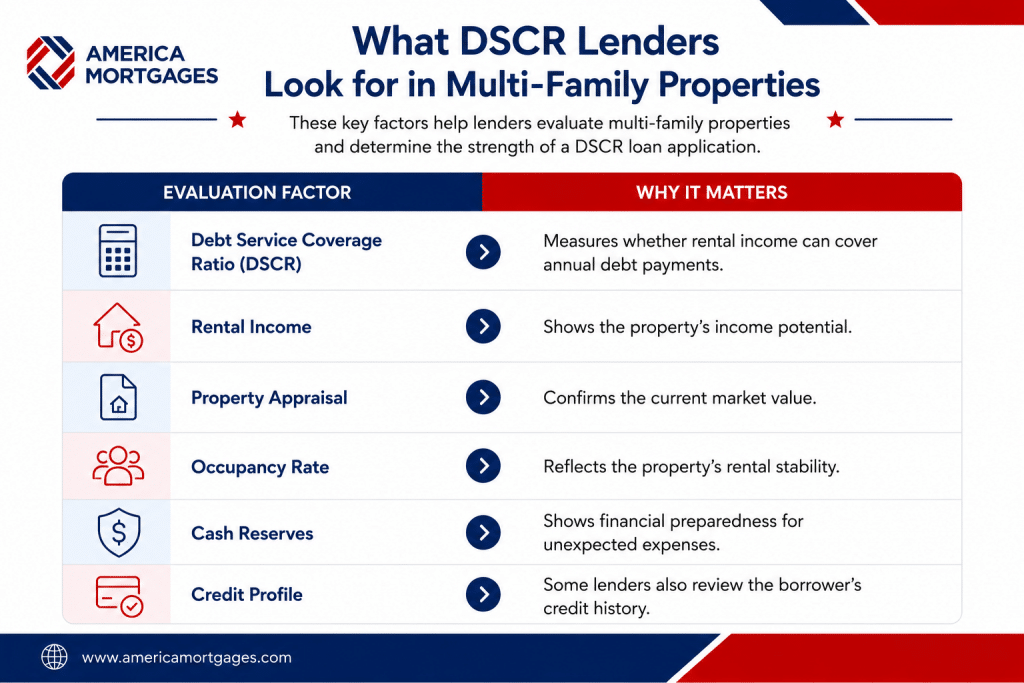
From a property standpoint, the rental income must meet the lender’s minimum DSCR requirement. The lender orders an appraisal to confirm market rent, property value, condition, flood zone, and deferred maintenance. The appraiser’s rent determination is used in the final DSCR calculation. If the ratio falls short, the lender may lower the loan amount or require a higher down payment.

From a borrower standpoint, although personal income is typically not verified, lenders still evaluate credit strength and liquidity. Most DSCR loans require a minimum credit score of 660, with stronger pricing available at 720 and above. Down payments usually range from 20 to 25 percent. Lenders commonly require six to twelve months of PITIA in reserves to ensure stability in case of vacancy or market shifts. BUT, as America Mortgages focuses on non resident mortgage lending for US expats and Foreign Nationals, our Foreign National loans do not require any U.S. credit. That’s correct – No US credit is required! 

Many DSCR loans, including those offered through America Mortgages allow borrowing through an LLC, which makes them attractive for investors using entity structures for liability management.

For broader consumer guidance on how mortgage underwriting works in general, the Consumer Financial Protection Bureau offers an overview of mortgage approval processes.

How Does Underwriting Evaluate DSCR Loans?

Underwriting for DSCR loans focuses on risk control and ratio verification. Underwriters independently confirm the DSCR calculation using the appraiser’s rent estimate and verified PITIA figures. Insurance quotes, tax assessments, and association dues are reviewed carefully to ensure the ratio is accurate.

If the DSCR is close to 1.0, lenders may adjust risk by lowering the maximum loan-to-value ratio or increasing pricing. Credit score also directly influences interest rates and leverage. For US citizens, higher  credit scores generally allow better terms within DSCR loan programs. For Foreign Nationals, no U.S. credit score (FICO) is required. 

For refinance transactions, underwriters may review lease agreements and rental history to confirm consistency. Stable income history strengthens approval and reduces perceived risk.

How DSCR Loans Work in Practice

A Chicago three-unit property purchased for $450,000 generated $4,800 in monthly rent. With a PITIA payment of $3,463, the DSCR calculated to 1.39. The strong cash-flow margin and 25 percent down payment made approval straightforward.

In another scenario, an investor refinanced a rental that appreciated significantly over four years. Increased rent improved the DSCR to 1.25, allowing a cash-out refinance that generated $120,000 in equity. That capital was used to acquire another property, illustrating how DSCR loans support portfolio expansion.

A third case involved a short-term rental with a DSCR of 1.05. Because the ratio was tight, approval required a higher down payment, a 720 credit score, and twelve months of reserves. The transaction was approved with compensating factors, demonstrating how structure can solve marginal ratios.

How Do DSCR Loans Compare to Conventional Loans?

DSCR loans differ from conventional mortgages primarily in how approval is determined. Conventional loans rely heavily on personal income documentation and debt-to-income ratios. DSCR loans focus instead on whether the property’s rental income covers the mortgage payment.

Conventional programs often limit the number of financed properties and require extensive documentation. DSCR loans provide more flexibility for scaling investors but may carry slightly higher interest rates because they rely on property performance rather than borrower income stability.

What Makes America Mortgages DSCR Different?

This is a game changer.

What truly sets America Mortgages apart as a direct DSCR lender is flexibility, the kind most lenders simply won’t offer. While others draw hard lines, America Mortgages looks at the bigger picture.

America Mortgages will consider DSCR ratios below 1:1 – and in some cases even NO RATIO at all.

What does that mean for you? Opportunity.

It means if you find the perfect property but the rental income isn’t optimized yet… if it needs light improvements, better management, or repositioning to unlock its full potential, you’re not out of luck.

America Mortgages understands real estate investors think ahead. They lend on vision, not just current numbers. So when the deal makes sense but the ratio doesn’t quite fit a box, you still have a path forward.

That’s the difference.

Speak with a specialist who understands investor strategy, repositioning potential, and real-world underwriting flexibility at [email protected] or call us directly at +1 (845) 583-0830.

Final Thoughts

DSCR loans are not designed for primary residence buyers. They are strategic tools for rental property investors who want scalable financing based on asset performance. When rental income is strong and underwriting is structured correctly, DSCR loans allow investors to expand portfolios without personal income bottlenecks.

Understanding how DSCR loans work is essential for any investor serious about long-term real estate growth.

Frequently Asked Questions

Q1. What is the minimum DSCR required for approval?

A: Most lenders require a DSCR between 1.1 and 1.25. Some may allow 1.0 with reserves, but higher ratios improve loan strength and pricing. America Mortgages offers below 1:1 including No Ratio DACR options. 

Q2. Do DSCR loans require tax returns?

A: No. Tax returns are not required because qualification is based on rental income rather than personal earnings.

Q3. Is U.S. credit required for DSCR loans?

A: No US credit is required for America Mortgages’ DSCR loans for Foreign Nationals. For U.S. Expats, a minimum score of 640 may be required. 

Q4. How much down payment is required?

A: Most DSCR loans require 20 to 25 percent down depending on your passport, and loan structure. Lower down payments may be possible with strong ratios and credit profiles.

Q5. Are DSCR loans suitable for short-term rentals?

A: They can be, but underwriting may be conservative. Lenders often require stronger reserves for properties with seasonal income.

Q6. Do DSCR loans include prepayment penalties?

A: It depends, many programs include a prepayment penalty, although structures can vary from zero to five years depending on the borrower’s requirements.

Q7. Can I borrow through an LLC?

A: Yes, DSCR loans allow entity or personal borrowing, which makes them attractive for investors managing liability and portfolio structure.

Q8. Are DSCR loans reported to personal credit bureaus?

A: Many are not reported to personal credit, which may help preserve personal debt-to-income ratios for future conventional borrowing.

Q9. Are DSCR loans more expensive than conventional loans?

A: Typically, rates are slightly higher due to the alternative underwriting model, but flexibility and scalability often justify the pricing difference for investors.