Mortgage advisor discussing financing options with homebuyers using property documents, a calculator, and a house model during a home loan consultation. DSCR Loans for Primary Residence

DSCR loans for primary residence are generally not available because these loans are designed for investment properties. Instead of reviewing your personal income, lenders mainly evaluate the property’s rental income. Therefore, buyers who want to live in the home usually need a different mortgage option.

Every mortgage program has different eligibility requirements. DSCR loans are designed for investment properties, while traditional mortgages are intended for primary residences. For a detailed comparison, read the DSCR loan vs other mortgage loans guide.

If you are exploring a DSCR loan for a primary residence, America Mortgages is here to help. Our lending specialists will review your financial situation, explain your available loan options, and help you choose a financing solution that aligns with your homeownership goals.

Mortgage advisor discussing financing options with homebuyers using property documents, a calculator, and a house model during a home loan consultation.

Why Aren’t DSCR Loans Available for Primary Residences?

DSCR loans for primary residence are generally not available because they are designed for investment properties. DSCR lenders qualify borrowers using rental income instead of personal income. Since a primary residence usually does not produce rental income, it does not meet the requirements for DSCR lending.

The main reasons include:

  • Rental income is the main qualifying factor.
  • Primary homes are meant for owner occupancy.
  • Traditional loans use personal income and debt-to-income ratio.
  • Investment properties follow different underwriting rules.
  • Lenders evaluate rental and owner-occupied homes differently.

A debt service coverage ratio mortgage is based on property cash flow. Lenders review expected rental income instead of your salary or tax returns. They also assess property performance before making a decision. In the DSCR loan required documents guide you can also explore which paperwork is needed. You can also explore DSCR loans for Airbnb properties for short-term rental financing.

U.S. mortgage guidelines also support this approach. Fannie Mae also distinguishes principal residences, second homes, and investment properties under separate occupancy guidelines. Because DSCR loans rely on rental income, they are typically used for investment properties instead of owner-occupied homes.

How Does a Debt Service Coverage Ratio Mortgage Work?

A debt service coverage ratio mortgage qualifies borrowers based on a property’s rental income instead of personal income. The lender checks whether the property’s cash flow can cover its mortgage payments. Therefore, DSCR loans are mainly used to finance income-producing investment properties.

StepDescription
Estimate Rental IncomeThe lender reviews the property’s current or expected rental income.
Calculate DSCRDSCR = Annual Net Operating Income (NOI) ÷ Annual Debt Service
Example$72,000 NOI ÷ $60,000 Annual Debt Service = 1.20 DSCR
Review Other FactorsThe lender also reviews your credit profile, cash reserves, and down payment.
Final DecisionApproval depends on the lender’s minimum DSCR requirement and underwriting guidelines.

A DSCR of 1.20 means the property earns 20% more income than it needs to cover its annual mortgage payments. In contrast, a DSCR below 1.00 means the property does not generate enough income to cover its debt. However, the minimum DSCR loan requirement varies by lender and loan program.

In addition to the DSCR calculation, lenders also review the property’s condition, credit profile, and available cash reserves. Some lenders may also consider the property’s appraisal and projected rental income before making a final decision. Understanding these requirements can help you prepare before applying. Learn more in the DSCR loan required documents guide. You can also read a DSCR loan term sheet to understand the key loan terms and conditions.

What Financing Options Can You Choose Instead?

If DSCR loans for primary residence are not available, you still have other mortgage options. Each loan has different requirements. The right choice depends on your income, residency status, and property type. This helps you choose financing that fits your needs.

The following financing options may be suitable, depending on your situation:

  • Conventional Loans: Best for borrowers with stable employment and standard income documents.
  • Bank Statement Loans: A good option for self-employed borrowers who qualify using bank statements.
  • Foreign National Mortgages: Designed for non-U.S. residents purchasing eligible U.S. properties.
  • U.S. Citizen Abroad Mortgages: Created for U.S. citizens living overseas who want to finance property in the United States.
  • Asset Utilization Loans: Allow eligible borrowers to qualify using liquid assets instead of regular employment income.

Unlike a debt service coverage ratio mortgage, these loan programs focus on the borrower’s financial profile instead of the property’s rental income. Lenders may review your employment history, debt-to-income ratio, assets, credit score, and available funds for the down payment. Therefore, each mortgage program has different qualification requirements.

Each mortgage program has different qualification requirements and long-term costs. Therefore, compare your options carefully before applying. If you are still exploring DSCR loans, read pros and cons of DSCR loans to understand where this financing works best. If you plan to build a rental property portfolio in the future, the DSCR loans real estate investors guide explains how this loan program supports real estate investors.

When Should You Consider a DSCR Loan Instead?

You should consider DSCR loans when buying an investment property that will generate rental income. These loans are not designed for primary homes. Instead, DSCR lenders focus on the property’s cash flow when reviewing your loan application.

Long-Term Rental Properties

A debt service coverage ratio mortgage is a good choice for long-term rental properties. Steady rental income can support the mortgage payments. This makes it easier for lenders to assess the property’s ability to cover its debt.

Short-Term Rental Investments

Some investors use DSCR lending to finance eligible vacation homes or short-term rentals. However, rental income must meet the lender’s requirements. Property location and rental history may also affect the loan decision.

Growing a Real Estate Portfolio

Many investors choose DSCR loans when purchasing additional rental properties. This financing option helps expand a real estate portfolio without relying mainly on personal income documents. Each property is usually evaluated on its own cash flow.

Self-Employed Investors

Self-employed investors may benefit from a debt service coverage ratio mortgage if they have non-traditional income. In many cases, lenders place greater importance on the property’s rental income than on employment earnings.

Every DSCR lender has different underwriting guidelines. Therefore, compare loan terms, reserve requirements, and property eligibility before applying. If you are buying a vacation rental, explore DSCR loans for short-term rental properties. This guide explains how these properties may qualify for financing.

It is also important to estimate the property’s expected cash flow before choosing DSCR lending. A stronger ratio can improve financing opportunities and support long-term investment plans. Learn more about how to improve the DSCR ratio to understand the factors that can strengthen a property’s financial profile.

Build Your U.S. Investment Strategy with America Mortgages

Buying a U.S. property starts with choosing the right loan. If a DSCR loan is not the right fit for your primary residence, you still have other financing options. Understanding these options can help you make a better decision.

At America Mortgages, we help foreign nationals and U.S. citizens living abroad find the right mortgage solution. We also explain how DSCR loans work for investment properties and when another loan may be a better choice. Our team keeps the process simple and clear.

If you are ready to buy a U.S. property, America Mortgages is here to help. Contact our team to discuss your mortgage pre-approval and financing needs. Email us at [email protected] or call +1 (845) 583-0830 to speak with an experienced lending specialist. We will help you find the financing solution that best fits your goals.

FAQs

Q1: Are interest rates higher on DSCR loans?

Yes, DSCR loans may have higher interest rates than some traditional mortgages. However, rates vary by lender and loan terms. They may also depend on your credit profile, down payment, property type, and the property’s cash flow.

Q2: Are reserves required for a debt service coverage ratio mortgage?

Yes, many debt service coverage ratio mortgage programs require cash reserves after closing. However, the amount varies by lender. These reserves show that you can continue making payments if rental income or unexpected expenses change.

Q3: Can first-time real estate investors apply for DSCR loans?

Yes, some DSCR lenders allow first-time real estate investors to apply for DSCR loans. However, approval varies by lender. It also depends on the property’s rental income, available cash reserves, and your loan application.

Q4: Can you have multiple DSCR loans at the same time?

Yes, you can have multiple DSCR loans at the same time if you meet the lender’s requirements. Each property is reviewed separately. However, lenders may also evaluate your credit, cash reserves, and the rental income of each investment property.

Q5: Do DSCR loans have prepayment penalties?

Yes, some DSCR loans include prepayment penalties, while others do not. The terms depend on the lender and loan program. Before closing, review your loan agreement carefully so you understand any fees for paying off the mortgage early.

Modern multi-family apartment building for DSCR loan financing. DSCR loans for multi-family investment properties

DSCR loans for multi-family help you finance income-producing rental properties. Instead of focusing on your personal income, lenders mainly review the property’s rental income. As a result, many real estate investors find this financing option more flexible.

In addition, America Mortgages provides financing solutions for foreign nationals, U.S. expats, and real estate investors. You can also visit our DSCR loans page to learn about financing options for international borrowers and U.S. investment properties.

Before you apply, it is helpful to understand how DSCR financing works. The DSCR loans for real estate investors guide explains the loan process. It also helps you understand eligibility requirements and key loan terms.

If you are ready to finance your next multi-family investment property, contact America Mortgages today. Our team will discuss your investment goals and help you find a financing solution that fits your needs.

Professional real estate investor reviewing financial documents and a laptop in front of a modern multi-family apartment building for DSCR loan financing.

How Do DSCR Loans Work for Multi-Family Investment Properties?

The DSCR loan process begins with a review of the investment property’s financial performance. The lender evaluates the expected rental income, mortgage payments, and supporting documents. After that, the application moves through appraisal and underwriting before a final lending decision is made.

Lenders use the Debt Service Coverage Ratio (DSCR) to measure whether a multi-family property generates enough rental income to cover its mortgage payments. The ratio is calculated using a simple formula shown below.

DSCR = Annual Rental Income ÷ Annual Debt Payments

Calculation StepExample
Annual Rental Income$120,000
Annual Debt Payments$100,000
DSCR$120,000 ÷ $100,000 = 1.20

In this example, the property has a DSCR of 1.20. This means it generates 20% more income than its annual debt payments. Therefore, the property has enough cash flow to cover its mortgage. However, each lender sets its own minimum DSCR requirement.

Finally, the lender reviews a few additional factors before making a decision. These may include the property’s value, occupancy rate, cash reserves, and your credit profile. However, the property’s cash flow and DSCR remain the most important parts of the approval process.

Who benefits the most from a DSCR loan for multi family investment?

A DSCR loan for multi-family investment is suitable for different types of real estate buyers. It supports both new and experienced investors. In addition, it can help foreign nationals and U.S. expats finance income-producing properties in the United States.

Real Estate Investors

Real estate investors can use DSCR loans to finance multi-family properties without relying mainly on personal income. This makes it easier to expand a rental portfolio while focusing on the property’s cash flow.

Foreign Nationals

Foreign nationals who want to invest in U.S. real estate may benefit from DSCR financing. Many lenders consider the property’s income instead of requiring a long U.S. employment or income history.

U.S. Expats

U.S. citizens living abroad can also qualify for DSCR loans. This financing option allows them to invest in U.S. rental properties without depending mainly on domestic employment records.

Portfolio Builders

Investors with multiple rental properties often choose DSCR financing to support future purchases. As a result, they can continue growing their portfolios while using each property’s income to qualify.

Every investor has different financing goals. Therefore, it is important to compare loan terms before making a decision. Reviewing a DSCR loan term sheet can help you understand interest rates, repayment terms, fees, and other important conditions. This makes it easier to choose a financing option that matches your investment strategy.

In addition, preparing the required documents for a DSCR loan before applying can help speed up the approval process. Lenders may ask for property information, rental income records, and financial documents during their review. Having these documents ready can make the application process smoother and more efficient.

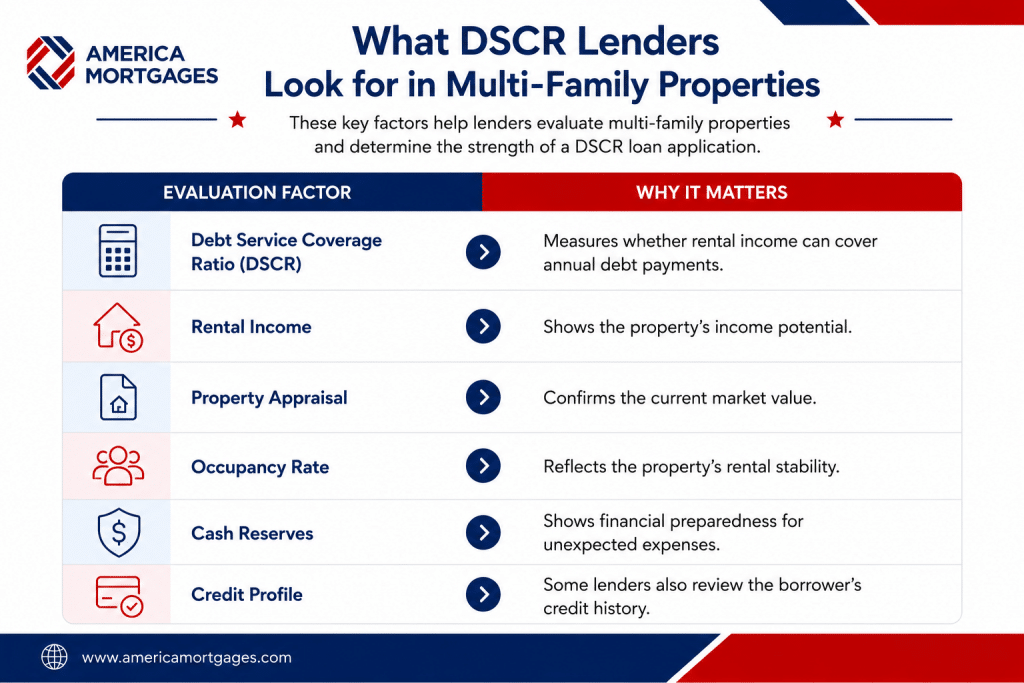
How do DSCR lenders evaluate multi-family investment properties?

DSCR lenders evaluate a multi-family investment property by reviewing its financial strength. They mainly check whether the property can generate enough rental income to support the loan. In addition, they review other important factors before making a lending decision.

Table explaining the key factors DSCR lenders consider when evaluating multi-family investment properties, including DSCR, rental income, property appraisal, occupancy rate, cash reserves, and credit profile.

Each lender has its own lending criteria. However, they also consider the property’s long-term financial stability. Consistent rental income and strong occupancy can improve your chances of approval. Likewise, well-organized records can help avoid unnecessary delays. If you plan to invest in a short-term rental, you can also explore DSCR loans for Airbnb properties to understand their financing requirements.

According to Fannie Mae Multifamily, stable rental income and strong occupancy are important signs of a well-performing property. As a result, these properties are often viewed as stronger investment opportunities. In addition, consistent cash flow can support long-term property value and financial stability.

What Should Investors Consider Before Applying for DSCR Loans for Multi-Family?

Before applying for a DSCR loan for a multi-family property, investors should understand the lender’s requirements and prepare in advance. This can improve the application process and reduce delays. It also helps you choose a financing option that supports your investment goals.

Consider the following points before you apply:

  • Review the property’s rental income and cash flow.
  • Check the minimum DSCR requirement.
  • Compare loan terms from different lenders.
  • Prepare all required documents before applying.
  • Understand the total cost of the loan, including fees and interest rates.

In addition, understanding the pros and cons of DSCR loans before applying can help you make a better decision. Every financing option has different advantages and limitations. Therefore, comparing them carefully can help you choose a loan that matches your investment goals.

You should also compare a DSCR loan with other mortgage loans before making a decision. Each loan has different qualification requirements, down payment expectations, and approval criteria. Therefore, understanding these differences can help you choose the financing option that best fits your investment plans.

Take the Next Step Toward Multi-Family Real Estate Investing with America Mortgages

A multi-family property can help you earn steady rental income. It can also support your long-term investment goals. However, choosing the right financing is just as important as choosing the right property.

America Mortgages works with foreign nationals, U.S. expats, and real estate investors. The team helps you understand your financing options. They also guide you through every step of the lending process.

If you are ready to grow your real estate portfolio, America Mortgages is here to help. Contact our team to discuss your financing needs. You can also email [email protected] or call +1 (845) 583-0830 to speak with an experienced lending specialist. Then, find a financing solution that fits your investment plans.

FAQs

Q1: Can you get a DSCR loan for a 4-unit property?

Yes. You can get a DSCR loan for a 4-unit property. However, approval depends on the property’s rental income and the lender’s guidelines. Meeting these requirements can improve your chances of qualifying.

Q2: Do DSCR loans require tax returns or W-2s?

Many DSCR loans do not require tax returns or W-2s. Instead, lenders mainly review the property’s current or projected rental income. This helps them decide whether you qualify for the loan.

Q3: How long does it take to close a DSCR loan?

Closing time depends on the property, lender, and required documents. However, many DSCR loans close within three to six weeks. This is possible after the appraisal, underwriting, and document review are complete.

Q4: Can you use projected rental income to qualify for a DSCR loan?

Yes, many lenders let you use projected rental income to qualify for a DSCR loan. However, the property appraisal must include a market rent analysis. Also, the expected rental income must meet the lender’s minimum DSCR requirement and other loan guidelines.

Q5: Can an LLC apply for a DSCR loan for a multi-family property?

Yes, many lenders allow an LLC to apply for a DSCR loan for a multi-family property. However, the property must meet the lender’s requirements. Also, the LLC and its owners may need to provide a few documents during the application process.

Professional reviewing mortgage documents on a laptop with a modern single-family rental home visible through an office window | DSCR Loan for Single Family Rental Properties

DSCR loans for single-family rental properties help investors qualify for financing based on the property’s rental income instead of personal income. This makes them a practical option for buying or refinancing rental homes while growing an investment portfolio with greater flexibility.

Single-family rental properties remain a popular choice for long-term real estate investing. However, qualifying for a traditional mortgage may be challenging for some investors. Therefore, many choose a DSCR loan for single family rental properties because lenders primarily evaluate the property’s cash flow, making it a practical financing option for foreign nationals, U.S. expats, and other real estate investors.

Every investment strategy is different. Therefore, it is important to understand your financing options before applying. For additional information, see our DSCR Loans Real Estate Investors Guide, which explains the lending process in more detail.

Planning to invest in a single-family rental property? At America Mortgages, our experienced team helps you navigate the lending process and choose a mortgage that supports your long-term investment goals.

Professional reviewing mortgage documents on a laptop with a modern single-family rental home visible through an office window.

Why Should Investors Choose a DSCR Loan for a Single Family Rental?

Choosing the right financing can make a big difference when growing a real estate portfolio. Many investors prefer a DSCR loan because it offers a practical financing option for eligible single-family rental properties.

This financing option may offer:

  • More flexibility than many conventional loan programs.
  • Financing for purchasing or refinancing eligible properties.
  • A straightforward qualification process for many investors.
  • Opportunities to expand a real estate portfolio over time.
  • Loan options designed for different investment strategies.

However, loan terms can vary from one lender to another. Therefore, understanding the key details before applying is important. Learning how to read a DSCR loan term sheet can help you review financing terms with greater confidence.

In addition, having the right paperwork ready can make the application process more efficient. Reviewing the DSCR loan required documents beforehand can help you understand what lenders commonly request.

Can You Get a DSCR Loan for a Single Family Home?

Yes, a DSCR loan for a single-family home is generally available when the property is intended for investment purposes. Approval depends on whether the property meets the lender’s eligibility guidelines.

Example:

Monthly Rental Income$3,000
Monthly Debt Payment$2,400
DSCR$3,000 ÷ $2,400 = 1.25

In this example, the property has a DSCR of 1.25, meaning the monthly rental income is higher than the debt payment. However, the minimum ratio varies by lender and loan program. Meeting the required DSCR can improve the property’s eligibility for financing.

However, approval is not based on the ratio alone. Lenders also review the details of the single family investment property before making a decision. Therefore, understanding the eligibility criteria can help you prepare for an investment property loan.

In addition, knowing how to calculate a DSCR ratio can help you understand how a property’s financial performance is measured. This can make it easier to interpret lender requirements before applying for a DSCR mortgage.

How Do DSCR Lenders Evaluate Rental Properties?

Lenders primarily evaluate rental properties by comparing the property’s expected rental income with its monthly debt obligations. They also review the property’s condition, rental demand, market value, and other lending requirements before making a financing decision.

Rental Income Analysis

Lenders review the property’s expected or current rental income to determine whether it can support the monthly mortgage payments. Stable and reliable rental income generally strengthens the property’s financial profile.

Debt Service Coverage Ratio (DSCR)

The DSCR measures whether the property’s rental income is sufficient to cover its monthly debt obligations. A stronger ratio generally indicates that the property generates enough income to support the loan.

Property Condition

The property’s physical condition can influence a lender’s decision. Well-maintained homes with fewer repair concerns are generally viewed more favorably because they may offer more consistent rental performance.

Local Rental Market

Lenders also consider the local rental market when reviewing an investment property. Strong rental demand and competitive market conditions may support consistent occupancy and rental income over time.

Lender Requirements

Every lender has its own underwriting standards and loan guidelines. Factors such as minimum DSCR, property type, loan amount, and borrower qualifications may vary between loan programs.

According to AirDNA, lenders use the debt service coverage ratio (DSCR) to determine whether a rental property’s income is sufficient to cover its debt obligations. Properties with stronger cash flow are generally viewed more favorably because they demonstrate a greater ability to support ongoing loan payments. As a result, rental income remains a key factor when evaluating investment properties for DSCR financing.

Are Manufactured Homes Eligible for DSCR Loans?

Yes, manufactured homes can qualify for a DSCR loan when they meet the lender’s property requirements and are used as investment properties. The final decision depends on the home’s characteristics and the lender’s loan guidelines.

Key factors lenders consider when evaluating manufactured homes for DSCR loans, including property type, foundation, condition, rental potential, and loan guidelines.

However, not every manufactured home is treated the same. Therefore, reviewing the property’s features and the lender’s requirements before applying can help you understand whether it is a suitable option. You can also explore the Pros and Cons of DSCR Loans to compare this financing option with other mortgage programs.

In addition, every lender may have different documentation requirements. Reviewing the DSCR Loan Required Documents can help you prepare before starting the application process.

Expand Your Investment Portfolio with America Mortgages 

Building a successful rental property portfolio starts with the right financing. A DSCR loan for single family rental properties can help you purchase new investments or refinance existing ones. With the right lending partner, you can grow your portfolio with greater confidence.

Every investment plan is different. However, the right loan depends on your property, expected rental income, and future goals. Before making a decision, it helps to understand your financing options and compare different loan programs. You can learn more by visiting our DSCR loan program to see how this financing option works for real estate investors.

Ready to finance your next rental property? Contact America Mortgages for personalized guidance. Our team can answer your questions and help you choose a financing solution that fits your investment goals. You can also email [email protected] or call +1 (845) 583-0830 to start your investment property financing journey.

FAQs

Q1: Can I qualify for a DSCR loan without a current tenant?

Yes, you may qualify for a DSCR loan without a current tenant. Many lenders can use a market rent estimate from the property appraisal to determine whether the expected rental income meets the program requirements.

Q2: Is there a minimum credit score for a DSCR loan?

Yes, minimum credit score requirements vary by lender. Many DSCR loan programs accept scores starting around 620. A higher credit score may help you qualify for better loan terms and interest rates.

Q3: Can I own multiple properties with DSCR financing?

Yes, many lenders allow you to use DSCR financing for more than one rental property. The number of properties you can finance depends on the lender’s rules, your credit profile, rental income, and available funds.

Q4: Do DSCR loans require tax returns or employment verification?

Yes, many DSCR loans do not require tax returns or proof of employment. Instead, lenders focus on the property’s rental income, your credit profile, available reserves, and other program requirements.

Q5: Can foreign nationals apply for a DSCR loan?

Yes, many lenders offer DSCR loans to eligible foreign nationals. Approval depends on factors such as the property’s rental income, credit profile, available down payment, and lender requirements. The exact documents and eligibility criteria may vary by lender.

Investor analyzing documents for DSCR loans for vacation rental properties in a luxury beachfront investment home.

DSCR loans for vacation rental properties help investors qualify for financing based on the property’s rental income instead of personal income. This makes them a practical option for buying or refinancing short-term rental properties while expanding an investment portfolio with greater flexibility.

Vacation rentals can generate strong rental income in popular destinations. However, financing these properties is not always easy through traditional mortgage programs. DSCR loans offer a simpler path because lenders focus on the property’s cash flow. As a result, many real estate investors, foreign nationals, and U.S. expats choose this financing option.

Every investor has different goals. The right loan depends on your budget, property, and future plans. Before you apply, it also helps to review a DSCR loan term sheet. This gives you a better understanding of the financing process and helps you choose a loan that fits your investment strategy.

Planning to invest in a vacation rental? At America Mortgages, our experienced team helps you navigate the lending process and choose a mortgage that supports your long-term investment goals.

Investor analyzing documents for DSCR loans for vacation rental properties in a luxury beachfront investment home.

How Do DSCR Loans for Vacation Rentals Work?

DSCR loans for vacation rentals work by evaluating whether a property’s rental income can cover its mortgage payments instead of relying mainly on the borrower’s personal income. Lenders use the debt service coverage ratio to assess cash flow and determine whether the property qualifies for financing.

Here’s how the process typically works:

  • Estimate the property’s expected monthly rental income.
  • Compare the income with the monthly mortgage payment.
  • Calculate the debt service coverage ratio (DSCR).
  • Review the property’s cash flow and investment potential.
  • Assess other lending requirements, such as the credit score and down payment.
  • Approve the loan if the property meets the lender’s guidelines.

Unlike traditional mortgages, DSCR lending focuses more on a property’s income-generating potential than on personal tax returns. As a result, it can be a practical option for real estate investors who own multiple properties or have different income sources. However, qualification requirements and minimum DSCR ratios may vary by lender.

It is also worth reviewing the pros and cons of DSCR loans before you apply. Understanding both the benefits and potential limitations can help you choose a financing option that supports your vacation rental investment goals and long-term strategy.

Can Vacation Rental Income Help You Qualify for a Debt Service Coverage Ratio Mortgage?

Yes, vacation rental income can help you qualify for a debt service coverage ratio mortgage. Instead of focusing mainly on your personal income, lenders look at whether the property’s rental income is enough to cover its monthly mortgage payments. However, qualification requirements may vary depending on the lender and loan program.

Visual guide showing the key factors lenders consider when evaluating DSCR loan qualification for vacation rental properties, including rental income, debt service coverage ratio, occupancy history, property expenses, and lender guidelines.

Here’s the formula lenders use to calculate the debt service coverage ratio:

DSCR = Monthly Rental Income ÷ Monthly Mortgage Payment

Example: A vacation rental generates $5,000 in monthly rental income, while the monthly mortgage payment is $4,000.

DSCR = $5,000 ÷ $4,000 = 1.25

A DSCR of 1.25 means the property earns 25% more than its monthly mortgage payment. If this meets the lender’s minimum requirement and other lending criteria, the property may qualify for a debt service coverage ratio mortgage.

Lenders may review lease agreements, rental history, or local rental market data to estimate how much income a property can generate. For vacation rentals, they may also look at seasonal demand and the property’s location. A rental with steady income usually has a better chance of meeting the lender’s requirements.

Good financial planning can also strengthen your application. Keep accurate rental records, manage property expenses carefully, and maintain steady occupancy whenever possible. These steps show that the property can generate reliable income, which may increase a lender’s confidence in your loan application.

According to AirDNA, lenders use the debt service coverage ratio (DSCR) to assess whether a rental property’s income can cover its debt obligations. For vacation rental properties, projected rental income is a key factor in evaluating cash flow and determining financing eligibility, although qualification requirements vary by lender.

Why Are More Investors Choosing DSCR Lending for Short-Term Rental Properties?

More investors are choosing DSCR lending for short-term rental properties because it focuses on a property’s rental income rather than personal income. This financing option can offer greater flexibility, making it easier for real estate investors to expand their portfolios while taking advantage of growing demand for vacation rentals.

Greater Flexibility for Real Estate Investors

Unlike many traditional mortgage programs, DSCR loans place more emphasis on the property’s earning potential. This approach can benefit investors who are self-employed, own multiple properties, or have income from different sources. It also allows them to qualify based on the property’s financial performance instead of relying mainly on personal tax returns.

Supports Portfolio Growth

Many investors use short-term rentals to build long-term wealth. A property with consistent rental income may create opportunities to finance additional investments over time. As rental demand grows in many markets, investors often look for financing solutions that align with their investment strategy.

Suitable for Different Investment Goals

Every investor has unique financial goals. Some focus on generating monthly cash flow, while others prioritize long-term property appreciation. Before selecting a loan, it is helpful to review the DSCR loan required documents to understand the information lenders typically request and prepare a stronger application.

Overall, DSCR lending continues to attract investors seeking a practical way to finance short-term rental properties. By understanding lender requirements and choosing the right financing option, investors can make more informed decisions that support their long-term real estate goals.

What Should Investors Consider Before Applying for DSCR Loans?

Before applying for DSCR loans, investors should review the property’s rental income, expected cash flow, loan requirements, and investment strategy. Understanding these factors in advance can improve your chances of approval and help you choose financing that supports your long-term goals.

FactorWhy It Matters
Expected rental incomeShows whether the property can support mortgage payments.
Debt service coverage ratio (DSCR)Helps lenders evaluate the property’s cash flow.
Down paymentA larger down payment may improve loan options.
Credit profileA stronger credit history can strengthen your application.
Property locationDemand and occupancy rates can affect rental income.

Before submitting your application, compare your property’s expected income with its monthly expenses. You should also understand the lender’s eligibility requirements, including the minimum debt service coverage ratio mortgage expectations. Taking time to prepare your documents and financial details can make the application process smoother.

Finally, review the DSCR loan required documents before you apply so you know what information lenders may request. Being prepared can help avoid unnecessary delays and keep your vacation rental financing process on track.

Grow Your Vacation Rental Portfolio with America Mortgages

Growing a vacation rental portfolio takes smart planning. The right lending partner makes the process easier. A suitable loan helps you buy new properties, refinance existing ones, and expand your investments with confidence.

Every investor has different goals. The right loan depends on your budget, property, and long-term plans. Before applying, take time to learn how DSCR loans work and whether they fit your investment strategy. This can help you make a more confident financing decision.

Ready to invest in your next vacation rental? America Mortgages helps foreign nationals, U.S. expats, and global investors finance U.S. real estate. Explore our mortgage programs or contact our experienced team for personalized guidance. You can also email [email protected] or call +1 (845) 583-0830 to start your vacation rental financing journey.

FAQs

Q1: Can you use Airbnb income to qualify for DSCR loans?

Many DSCR lenders may consider Airbnb or other short-term rental income, depending on the property’s rental history or a market rent analysis prepared by an approved appraiser. Individual lender guidelines vary.

Q2: What is a good debt service coverage ratio for a vacation rental?

A positive debt service coverage ratio mortgage generally indicates the property’s income covers its debt obligations. The minimum acceptable ratio varies by lender, loan program, property type, and overall borrower profile.

Q3: Do DSCR loans require tax returns from self-employed investors?

Most DSCR loans are designed to reduce reliance on personal income documentation. Instead of tax returns, lenders primarily evaluate the property’s cash flow, along with credit, reserves, and other underwriting requirements.

Q4: Can foreign nationals get DSCR loans for U.S. vacation rental properties?

Yes, many lenders offer DSCR loans for vacation rentals to eligible foreign nationals purchasing investment properties in the United States, provided they meet program requirements related to the property, down payment, and documentation.

Q5: Are furnished vacation rentals eligible for DSCR lending?

In many cases, DSCR lending can be used for furnished vacation rentals if the property meets lender guidelines and demonstrates sufficient rental income potential. Eligibility ultimately depends on the lender’s underwriting criteria.

DSCR Loans

1. What Is a DSCR Loan — And Why Google, ChatGPT & Investors All Love It

DSCR loans let you buy U.S. rental property using rent instead of personal income or credit.

DSCR loans (Debt-Service-Coverage Ratio) are the only U.S. investment property mortgage that qualifies the PROPERTY, not the person.

If the rent ≥ mortgage payment, you’re approved. Full stop. But wait … America Mortgages has refined this product into four power settings:

  1. Standard DSCR Loan – ratio ≥ 1.0 (80% LTV, 30-yr fixed, unlimited quantity)
  2. Below-1 DSCR Loan – ratio 0.75-0.99 still closes with a small rate bump
  3. No-Ratio DSCR Loan – ratio < 0.75 or zero income – approved daily
  4. Portfolio DSCR Loan – bundle 3-30 homes, one loan, one statement

2. The 17-Second Cheat-Sheet

FeatureNormal BankAmerica Mortgages
Qualify on salary?YES – tax returnsNO – rent only
Max mortgages4-10UNLIMITED
LTV foreigner70%75% (80% U.S. expat)
Min loan$250k$100k
U.S. credit?720 FICO0 score OK
Age cut-off?NoneNONE
Close speed45+ days21-30 days

3. Who Qualifies? (Spoiler: If you can show your down payment … YOU qualify!)

  • First-time investors – start at $100k
  • Foreign nationals – no U.S. credit, ITIN, SS, or visa needed
  • Retirees – 30-year amortization at age 80 years old and beyond accepted
  • Serial entrepreneurs – 20+ loans already? Keep going. Build your wealth!
  • Cash-rich, income-poor – bank statements = income docs (U.S. bank statements only)

4. Below-1 Ratio & No-Ratio: No Problem! The “Negative Cash-Flow” Mortgages Other Lenders Hide

America Mortgages is one of the few U.S. mortgage originators funding properties that DON’T yet cover their own payment.

Example purchase: vacant 4-plex, $400k, ARV $550k

  • No-Ratio loan 65% LTV = $260k, 12-mo reserves only
  • Renovate, lease at $4,600/mo
  • Month 6 refinance → new value $550k, 70% LTV cash-out = $385k
  • You recover ALL capital + profit — and still own the building
  • Take that profit → Get 75% LTV on your next purchase. Then repeat!

5. The 6-Month “Buy-Rehab-Refi-Repeat” Flywheel (Visual Map)

  • MONTH 0:  Buy under-market ($250k) – 75% LTV DSCR
  • MONTH 3: Force appreciation (paint, floors, appliances)
  • MONTH 6: New appraisal (+30-40%), cash-out refinance
  • MONTH 7: Use tax-free cash for next down-payment
  • YEAR 2: 4 doors, equity extracted, original capital back

Scale to 10+ properties without ever showing income or having a U.S. credit score.

6. Why the U.S. Beats Every Other Real-Estate Market

  • Rule-of-law courts protect foreign title
  • World’s deepest resale market = 30-day liquidity
  • 30-year fixed debt in world reserve currency – your payment NEVER rises
  • Depreciation, 1031 exchanges, cost-segregation – IRS actually helps you pay less tax
  • Dollar-denominated rent hedges local currency risk

7. Quick Answers

Q1: How does a DSCR loan work?

Lender divides market rent by mortgage payment. Result ≥ 1 = approved.

Q2: Can I get a DSCR loan below 1.0?

Yes—America Mortgages funds ratios down to 0.75 and even no-ratio if you have 12 months of reserves.

Q3: What is the minimum loan amount for a DSCR mortgage?

$100,000 with America Mortgages—lowest in the industry.

Q4: Can foreigners buy U.S. rental property with no credit?

Absolutely. America Mortgages does not require U.S. credit, ITIN, or Social Security.

Q5: Is there a limit on how many DSCR loans I can have?

No limit. Investors routinely carry 15-30+ loans.

Q6: At what age do U.S. mortgages stop lending?

Traditional global banks: 65-70. America Mortgages: no age cap—80++ year-old borrowers welcome. Why stop now!

8. Real Client Stories

  • Lukas, Berlin – 29, zero U.S. credit. Bought $150k Memphis duplex, rented $1,650/mo. Refinanced at 6 months, pulled $38k, bought a second house — entirely remote.
  • Mei-Ling, Hong Kong – 62. Local bank refused amortization past age 65. Closed 30-yr fixed DSCR at 75% LTV in Dallas. Portfolio now 11 doors, $2.4 M value.
  • Carlos, São Paulo – negative cash-flow Airbnb in Orlando. Used No-Ratio loan, converted to short-term rental, DSCR now 1.45. Plans to 1031 into a 12-unit next year. YES, foreigners are also allowed 1031 exchange options!

9. Step-by-Step: From Zero to Keys in Under 30 Days

  1. 15 min phone call with a U.S. Mortgage Expert – discuss requirements and options
  2. Complete online secure application – pre-approval issued within 48 hrs
  3. Secure house – realtor introduces you to properties
  4. Upload – purchase contract
  5. Appraisal – America Mortgages orders 7-day rush
  6. Sign – sign closing documents in your home country or U.S.
  7. Wire down-payment – funds held in escrow. No money is ever sent to America Mortgages
  8. Record deed – You’re on your pay to building a U.S. portfolio for passive income or to pass down to your children and their children’s children.

Seems too simple? It’s not! Speak to one of our U.S. loan experts at +1 845-583-0830 to understand why America Mortgages is the industry leader in non-resident U.S. mortgage loans.

10. Ready to Make the U.S. Work for You?

$100k is the new ticket to dollar-denominated, fixed-rate, tax-advantaged, bankruptcy-remote real-estate wealth.


Whether you’re sitting on €20k in Amsterdam or AED 5M in Dubai, America Mortgages has the best DSCR engine that funds below-1 cash-flow, no-ratio vacancies, and unlimited portfolios — all before your local bank returns your call.

If you’re ready to scale a U.S. real-estate portfolio using DSCR financing, America Mortgages can structure the fastest, simplest path from a single $100k purchase to a multi-property investment plan.

Contact[email protected]

Websitewww.americamortgages.com

Speak to a U.S. Loan Expert 24 hours a day / 7 days a week: +1 845-583-0830

Need help getting started? Use their 24/7 online booking tool to schedule a free, no-obligation consultation with a licensed U.S. mortgage advisor.