
Modern multi-family apartment building for DSCR loan financing. DSCR loans for multi-family investment properties

DSCR loans for multi-family help you finance income-producing rental properties. Instead of focusing on your personal income, lenders mainly review the property’s rental income. As a result, many real estate investors find this financing option more flexible.

In addition, America Mortgages provides financing solutions for foreign nationals, U.S. expats, and real estate investors. You can also visit our DSCR loans page to learn about financing options for international borrowers and U.S. investment properties.

Before you apply, it is helpful to understand how DSCR financing works. The DSCR loans for real estate investors guide explains the loan process. It also helps you understand eligibility requirements and key loan terms.

If you are ready to finance your next multi-family investment property, contact America Mortgages today. Our team will discuss your investment goals and help you find a financing solution that fits your needs.

Professional real estate investor reviewing financial documents and a laptop in front of a modern multi-family apartment building for DSCR loan financing.

How Do DSCR Loans Work for Multi-Family Investment Properties?

The DSCR loan process begins with a review of the investment property’s financial performance. The lender evaluates the expected rental income, mortgage payments, and supporting documents. After that, the application moves through appraisal and underwriting before a final lending decision is made.

Lenders use the Debt Service Coverage Ratio (DSCR) to measure whether a multi-family property generates enough rental income to cover its mortgage payments. The ratio is calculated using a simple formula shown below.

DSCR = Annual Rental Income ÷ Annual Debt Payments

Calculation StepExample
Annual Rental Income$120,000
Annual Debt Payments$100,000
DSCR$120,000 ÷ $100,000 = 1.20

In this example, the property has a DSCR of 1.20. This means it generates 20% more income than its annual debt payments. Therefore, the property has enough cash flow to cover its mortgage. However, each lender sets its own minimum DSCR requirement.

Finally, the lender reviews a few additional factors before making a decision. These may include the property’s value, occupancy rate, cash reserves, and your credit profile. However, the property’s cash flow and DSCR remain the most important parts of the approval process.

Who benefits the most from a DSCR loan for multi family investment?

A DSCR loan for multi-family investment is suitable for different types of real estate buyers. It supports both new and experienced investors. In addition, it can help foreign nationals and U.S. expats finance income-producing properties in the United States.

Real Estate Investors

Real estate investors can use DSCR loans to finance multi-family properties without relying mainly on personal income. This makes it easier to expand a rental portfolio while focusing on the property’s cash flow.

Foreign Nationals

Foreign nationals who want to invest in U.S. real estate may benefit from DSCR financing. Many lenders consider the property’s income instead of requiring a long U.S. employment or income history.

U.S. Expats

U.S. citizens living abroad can also qualify for DSCR loans. This financing option allows them to invest in U.S. rental properties without depending mainly on domestic employment records.

Portfolio Builders

Investors with multiple rental properties often choose DSCR financing to support future purchases. As a result, they can continue growing their portfolios while using each property’s income to qualify.

Every investor has different financing goals. Therefore, it is important to compare loan terms before making a decision. Reviewing a DSCR loan term sheet can help you understand interest rates, repayment terms, fees, and other important conditions. This makes it easier to choose a financing option that matches your investment strategy.

In addition, preparing the required documents for a DSCR loan before applying can help speed up the approval process. Lenders may ask for property information, rental income records, and financial documents during their review. Having these documents ready can make the application process smoother and more efficient.

How do DSCR lenders evaluate multi-family investment properties?

DSCR lenders evaluate a multi-family investment property by reviewing its financial strength. They mainly check whether the property can generate enough rental income to support the loan. In addition, they review other important factors before making a lending decision.
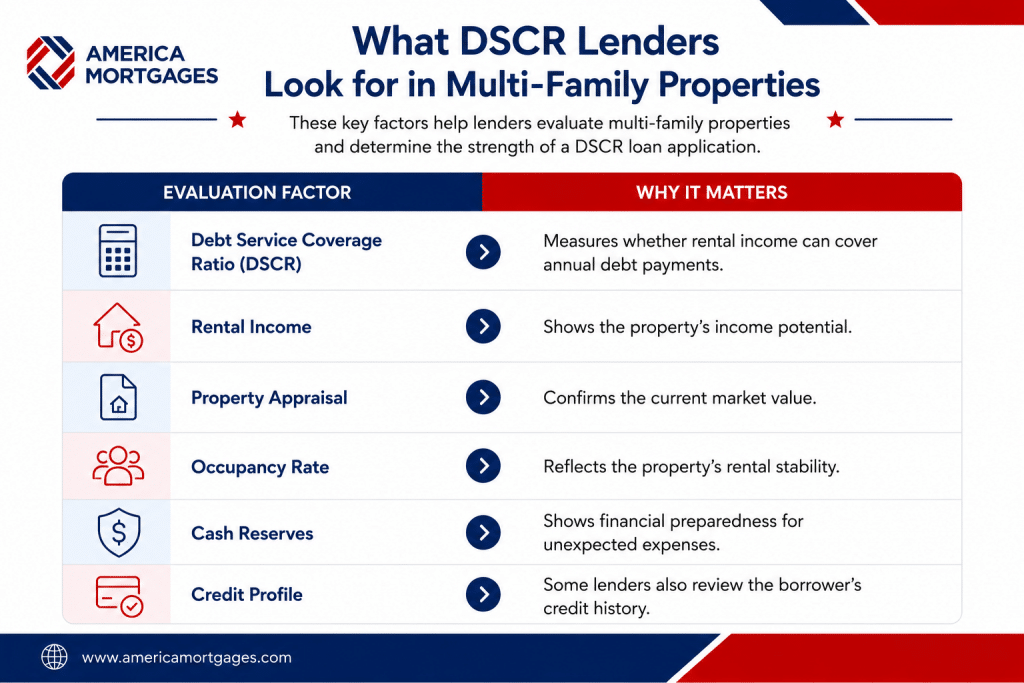
Table explaining the key factors DSCR lenders consider when evaluating multi-family investment properties, including DSCR, rental income, property appraisal, occupancy rate, cash reserves, and credit profile.

Each lender has its own lending criteria. However, they also consider the property’s long-term financial stability. Consistent rental income and strong occupancy can improve your chances of approval. Likewise, well-organized records can help avoid unnecessary delays. If you plan to invest in a short-term rental, you can also explore DSCR loans for Airbnb properties to understand their financing requirements.

According to Fannie Mae Multifamily, stable rental income and strong occupancy are important signs of a well-performing property. As a result, these properties are often viewed as stronger investment opportunities. In addition, consistent cash flow can support long-term property value and financial stability.

What Should Investors Consider Before Applying for DSCR Loans for Multi-Family?

Before applying for a DSCR loan for a multi-family property, investors should understand the lender’s requirements and prepare in advance. This can improve the application process and reduce delays. It also helps you choose a financing option that supports your investment goals.

Consider the following points before you apply:

  • Review the property’s rental income and cash flow.
  • Check the minimum DSCR requirement.
  • Compare loan terms from different lenders.
  • Prepare all required documents before applying.
  • Understand the total cost of the loan, including fees and interest rates.

In addition, understanding the pros and cons of DSCR loans before applying can help you make a better decision. Every financing option has different advantages and limitations. Therefore, comparing them carefully can help you choose a loan that matches your investment goals.

You should also compare a DSCR loan with other mortgage loans before making a decision. Each loan has different qualification requirements, down payment expectations, and approval criteria. Therefore, understanding these differences can help you choose the financing option that best fits your investment plans.

Take the Next Step Toward Multi-Family Real Estate Investing with America Mortgages

A multi-family property can help you earn steady rental income. It can also support your long-term investment goals. However, choosing the right financing is just as important as choosing the right property.

America Mortgages works with foreign nationals, U.S. expats, and real estate investors. The team helps you understand your financing options. They also guide you through every step of the lending process.

If you are ready to grow your real estate portfolio, America Mortgages is here to help. Contact our team to discuss your financing needs. You can also email [email protected] or call +1 (845) 583-0830 to speak with an experienced lending specialist. Then, find a financing solution that fits your investment plans.

FAQs

Q1: Can you get a DSCR loan for a 4-unit property?

Yes. You can get a DSCR loan for a 4-unit property. However, approval depends on the property’s rental income and the lender’s guidelines. Meeting these requirements can improve your chances of qualifying.

Q2: Do DSCR loans require tax returns or W-2s?

Many DSCR loans do not require tax returns or W-2s. Instead, lenders mainly review the property’s current or projected rental income. This helps them decide whether you qualify for the loan.

Q3: How long does it take to close a DSCR loan?

Closing time depends on the property, lender, and required documents. However, many DSCR loans close within three to six weeks. This is possible after the appraisal, underwriting, and document review are complete.

Q4: Can you use projected rental income to qualify for a DSCR loan?

Yes, many lenders let you use projected rental income to qualify for a DSCR loan. However, the property appraisal must include a market rent analysis. Also, the expected rental income must meet the lender’s minimum DSCR requirement and other loan guidelines.

Q5: Can an LLC apply for a DSCR loan for a multi-family property?

Yes, many lenders allow an LLC to apply for a DSCR loan for a multi-family property. However, the property must meet the lender’s requirements. Also, the LLC and its owners may need to provide a few documents during the application process.

AM Bridge Loans - Financing Solutions

In this edition of the Launchpad Series – we introduce the most widely-used tool for property investors at the moment, A Bridge Loan – often considered the “Swiss Army Knife” of financing solutions.

What are bridge loans?

A bridge loan is a type of asset-based, short-term loan, typically taken out for a few months to a couple of years pending the arrangement of longer-term financing or an exit, such as the sale. It is used to ‘bridge’ the gap during times when financing is critical but not readily available.

Bridge loans let homebuyers take out a mortgage against their current home to make the down payment on their new home. A bridge loan may also be a suitable choice for you if you want to purchase a new home before your current house has sold. This financing structure may also be beneficial to businesses that need to cover operating costs while waiting for long-term funding.

Introducing AM Bridge!

AM Bridge – A liquidity tool once reserved for the wealthy is now available for everyone!

Real Estate investors are often asset rich but cash poor. On paper, their net worth may be significant, but their wealth can be tied up in real estate or other businesses. Accessing such funds might mean sacrificing a stake in their business or surrendering some influence over its future – neither of which may be appealing.

It is not always the case that a real estate investor has a few hundred thousand dollars just sitting in the bank readily available to fund a property immediately. Even if they do, they may not wish to tie all their cash upon one property. In today’s market, the property that investors want could be in high demand and needs to be acted on quickly; these could be higher-yielding investments that need immediate funding. Having access to large sums of cash quickly and easily is what HNW investors have had at their disposal for decades. America Mortgages has now made this powerful liquidity tool available to everyone.

How is it used?

Here are some popular uses of “Bridging” Loans:

– Filling the contingency sale of an old property before you can purchase the new property. You can take a Bridge Loan and use your old house as collateral for the loan. The proceeds can then be used to pay a down payment for the new house and cover the costs of the loan. In most cases, the lender will offer a bridge loan worth approximately 80% of both houses’ combined value.

– To purchase based on the asset value of the new build so the borrower can meet the final payment before delivery.

– For the initial purchase until entitlement or for refinancing after a cash purchase until entitlement.

– To purchase greenfield land to begin commercial development. Once certain stages of development have been completed, it’s easier to obtain traditional bank financing.

– Cash-out Bridge Loan for short term personal or business use.

The Market

The pandemic has created a boom in the bridge loan market in several ways.

Firstly, it has created an economic environment filled with uncertainties, and as a result, more businesses need capital as soon as possible and can’t afford to wait for a traditional loan. They will thus turn to bridge loans.

Secondly, with the threat of the Delta variant and the increased number of companies delaying return-to-office plans, many are looking for new homes in more spacious areas. However, with how hot the property market is – data from Zillow show that houses are currently on the market for an average of 6 days only. Hence, it is critical for buyers to purchase their house as soon as possible to avoid disappointment. But, they may not have sold their old house yet and do not have enough money for this new house, which is why a bridge loan would be extra helpful.

Thirdly, there has been an accelerated trend of people migrating to Sunbelt cities due to greater job opportunities. This has driven up rents in these cities – the Phoenix area had the biggest rent increase in July, up 17% from a year ago. Due to the profitability of the rental trade, more developers and businesses are looking to acquire multifamily rental units. Short-term commercial bridge loans will provide them with the needed flexibility to take on such assets while they look for permanent financing options. This will help businesses get their assets to perform at maximum potential.

The Problem

When an American Mortgage bridge loan specialist gets a request for short term financing, they ask three things;

1. Where is the asset?

2. What is the value and the outstanding debt?

3. What situation are you trying to solve?

Number 3 is the most crucial and often the hardest to rationalize. Even the wealthiest people have used short-term bridge financing to access liquidity even when “conventional” options are still possible. This is mainly due to the time and effort required to obtain long-term financing. Cash-flow, credit issues, or asset use may prohibit a “conventional” bank loan. When time is a factor in a transaction, it is important to see the opportunity cost in not closing quickly or obtaining a simplified equity release.

Our Solution

Typically, the timeline for traditional bank loan processing from origination to closing is longer than most borrowers prefer for a time-sensitive funding solution or if the project lacks sufficient stable cash flow. The short-term nature of bridge loans generally allows alternative lenders to provide an approval decision and funding with greater speed than a more traditional lender. At America Mortgages, we’ve funded loans in as little as a couple of days since the initial contact.

To allow for such a speedy funding process, the sponsor’s expected property value and experience to execute the business plan are the determining factors in the decision-making process. For this reason, the loans are commonly non-recourse, which is another benefit to the borrower.

Bridge loans are often the preferred funding option for uses such as:

– Highly structured transactions

– Discounted note payoffs

– Lease-up stabilization

– Redevelopment of existing properties

– Repositioning of a tired or underperforming asset

– Property acquisitions with a short closing timeline (or challenges on the property or sponsor)

– Recapitalizations/Debt Restructuring or Partner Buyouts

– Other uses on a case-by-case basis depending on borrowers specific funding needs, where traditional funding sources like banks or insurance companies will have a hard time approving such loan requests.

– Lending to foreign nationals with a “same-as-cash” basis

Short-Term vs Long-Term

Unlike short-term financing, longer-term financing is susceptible to the regulatory hurdles associated with securing long-term fixed-rate mortgages. This is why bridge loans are often provided by unregulated lenders, family offices, or in some cases, HNW investors. In addition to the regulatory scrutiny, banks or insurance companies require, the sponsor’s credit history and financial strength also take a front seat in the credit decision for long-term loans. Keep in mind, America Mortgages will never work with “lend-to-own” investors and lenders. Our goal is to find you a solution that works with your situation with a long-term solution and exit from the bridge loan.

While bridge loans are the preferred option for many specific financing needs, several downsides come with short-term financing that is meant to fund projects. When assets need work, lenders will consider these higher risks and, therefore, charge higher interest rates.

Additionally, bridge lenders generally do not exceed 70%-85% of the property cost basis to limit their financial exposure. However, this leverage is higher than traditional lenders would advance for the same project. This is because bridge lenders rely on the sponsor to fix the issues, which made the property ineligible for long-term financing in the first place. This enables the asset to become stabilized and ready for exit through a sale or by refinancing the property through traditional channels.

There’s no denying a bridge loan can be convenient if you’re prepared for a change but don’t want to risk a contingent offer. A bridge loan can also be an excellent way to finance a new house if you need to relocate for a job. For more information on AM Bridge, please connect with us via email at [email protected]

www.americamortgages.com