
Professional reviewing mortgage documents on a laptop with a modern single-family rental home visible through an office window | DSCR Loan for Single Family Rental Properties

DSCR loans for single-family rental properties help investors qualify for financing based on the property’s rental income instead of personal income. This makes them a practical option for buying or refinancing rental homes while growing an investment portfolio with greater flexibility.

Single-family rental properties remain a popular choice for long-term real estate investing. However, qualifying for a traditional mortgage may be challenging for some investors. Therefore, many choose a DSCR loan for single family rental properties because lenders primarily evaluate the property’s cash flow, making it a practical financing option for foreign nationals, U.S. expats, and other real estate investors.

Every investment strategy is different. Therefore, it is important to understand your financing options before applying. For additional information, see our DSCR Loans Real Estate Investors Guide, which explains the lending process in more detail.

Planning to invest in a single-family rental property? At America Mortgages, our experienced team helps you navigate the lending process and choose a mortgage that supports your long-term investment goals.

Professional reviewing mortgage documents on a laptop with a modern single-family rental home visible through an office window.

Why Should Investors Choose a DSCR Loan for a Single Family Rental?

Choosing the right financing can make a big difference when growing a real estate portfolio. Many investors prefer a DSCR loan because it offers a practical financing option for eligible single-family rental properties.

This financing option may offer:

  • More flexibility than many conventional loan programs.
  • Financing for purchasing or refinancing eligible properties.
  • A straightforward qualification process for many investors.
  • Opportunities to expand a real estate portfolio over time.
  • Loan options designed for different investment strategies.

However, loan terms can vary from one lender to another. Therefore, understanding the key details before applying is important. Learning how to read a DSCR loan term sheet can help you review financing terms with greater confidence.

In addition, having the right paperwork ready can make the application process more efficient. Reviewing the DSCR loan required documents beforehand can help you understand what lenders commonly request.

Can You Get a DSCR Loan for a Single Family Home?

Yes, a DSCR loan for a single-family home is generally available when the property is intended for investment purposes. Approval depends on whether the property meets the lender’s eligibility guidelines.

Example:

Monthly Rental Income$3,000
Monthly Debt Payment$2,400
DSCR$3,000 ÷ $2,400 = 1.25

In this example, the property has a DSCR of 1.25, meaning the monthly rental income is higher than the debt payment. However, the minimum ratio varies by lender and loan program. Meeting the required DSCR can improve the property’s eligibility for financing.

However, approval is not based on the ratio alone. Lenders also review the details of the single family investment property before making a decision. Therefore, understanding the eligibility criteria can help you prepare for an investment property loan.

In addition, knowing how to calculate a DSCR ratio can help you understand how a property’s financial performance is measured. This can make it easier to interpret lender requirements before applying for a DSCR mortgage.

How Do DSCR Lenders Evaluate Rental Properties?

Lenders primarily evaluate rental properties by comparing the property’s expected rental income with its monthly debt obligations. They also review the property’s condition, rental demand, market value, and other lending requirements before making a financing decision.

Rental Income Analysis

Lenders review the property’s expected or current rental income to determine whether it can support the monthly mortgage payments. Stable and reliable rental income generally strengthens the property’s financial profile.

Debt Service Coverage Ratio (DSCR)

The DSCR measures whether the property’s rental income is sufficient to cover its monthly debt obligations. A stronger ratio generally indicates that the property generates enough income to support the loan.

Property Condition

The property’s physical condition can influence a lender’s decision. Well-maintained homes with fewer repair concerns are generally viewed more favorably because they may offer more consistent rental performance.

Local Rental Market

Lenders also consider the local rental market when reviewing an investment property. Strong rental demand and competitive market conditions may support consistent occupancy and rental income over time.

Lender Requirements

Every lender has its own underwriting standards and loan guidelines. Factors such as minimum DSCR, property type, loan amount, and borrower qualifications may vary between loan programs.

According to AirDNA, lenders use the debt service coverage ratio (DSCR) to determine whether a rental property’s income is sufficient to cover its debt obligations. Properties with stronger cash flow are generally viewed more favorably because they demonstrate a greater ability to support ongoing loan payments. As a result, rental income remains a key factor when evaluating investment properties for DSCR financing.

Are Manufactured Homes Eligible for DSCR Loans?

Yes, manufactured homes can qualify for a DSCR loan when they meet the lender’s property requirements and are used as investment properties. The final decision depends on the home’s characteristics and the lender’s loan guidelines.

Key factors lenders consider when evaluating manufactured homes for DSCR loans, including property type, foundation, condition, rental potential, and loan guidelines.

However, not every manufactured home is treated the same. Therefore, reviewing the property’s features and the lender’s requirements before applying can help you understand whether it is a suitable option. You can also explore the Pros and Cons of DSCR Loans to compare this financing option with other mortgage programs.

In addition, every lender may have different documentation requirements. Reviewing the DSCR Loan Required Documents can help you prepare before starting the application process.

Expand Your Investment Portfolio with America Mortgages 

Building a successful rental property portfolio starts with the right financing. A DSCR loan for single family rental properties can help you purchase new investments or refinance existing ones. With the right lending partner, you can grow your portfolio with greater confidence.

Every investment plan is different. However, the right loan depends on your property, expected rental income, and future goals. Before making a decision, it helps to understand your financing options and compare different loan programs. You can learn more by visiting our DSCR loan program to see how this financing option works for real estate investors.

Ready to finance your next rental property? Contact America Mortgages for personalized guidance. Our team can answer your questions and help you choose a financing solution that fits your investment goals. You can also email [email protected] or call +1 (845) 583-0830 to start your investment property financing journey.

FAQs

Q1: Can I qualify for a DSCR loan without a current tenant?

Yes, you may qualify for a DSCR loan without a current tenant. Many lenders can use a market rent estimate from the property appraisal to determine whether the expected rental income meets the program requirements.

Q2: Is there a minimum credit score for a DSCR loan?

Yes, minimum credit score requirements vary by lender. Many DSCR loan programs accept scores starting around 620. A higher credit score may help you qualify for better loan terms and interest rates.

Q3: Can I own multiple properties with DSCR financing?

Yes, many lenders allow you to use DSCR financing for more than one rental property. The number of properties you can finance depends on the lender’s rules, your credit profile, rental income, and available funds.

Q4: Do DSCR loans require tax returns or employment verification?

Yes, many DSCR loans do not require tax returns or proof of employment. Instead, lenders focus on the property’s rental income, your credit profile, available reserves, and other program requirements.

Q5: Can foreign nationals apply for a DSCR loan?

Yes, many lenders offer DSCR loans to eligible foreign nationals. Approval depends on factors such as the property’s rental income, credit profile, available down payment, and lender requirements. The exact documents and eligibility criteria may vary by lender.

Investor analyzing documents for DSCR loans for vacation rental properties in a luxury beachfront investment home.

DSCR loans for vacation rental properties help investors qualify for financing based on the property’s rental income instead of personal income. This makes them a practical option for buying or refinancing short-term rental properties while expanding an investment portfolio with greater flexibility.

Vacation rentals can generate strong rental income in popular destinations. However, financing these properties is not always easy through traditional mortgage programs. DSCR loans offer a simpler path because lenders focus on the property’s cash flow. As a result, many real estate investors, foreign nationals, and U.S. expats choose this financing option.

Every investor has different goals. The right loan depends on your budget, property, and future plans. Before you apply, it also helps to review a DSCR loan term sheet. This gives you a better understanding of the financing process and helps you choose a loan that fits your investment strategy.

Planning to invest in a vacation rental? At America Mortgages, our experienced team helps you navigate the lending process and choose a mortgage that supports your long-term investment goals.

Investor analyzing documents for DSCR loans for vacation rental properties in a luxury beachfront investment home.

How Do DSCR Loans for Vacation Rentals Work?

DSCR loans for vacation rentals work by evaluating whether a property’s rental income can cover its mortgage payments instead of relying mainly on the borrower’s personal income. Lenders use the debt service coverage ratio to assess cash flow and determine whether the property qualifies for financing.

Here’s how the process typically works:

  • Estimate the property’s expected monthly rental income.
  • Compare the income with the monthly mortgage payment.
  • Calculate the debt service coverage ratio (DSCR).
  • Review the property’s cash flow and investment potential.
  • Assess other lending requirements, such as the credit score and down payment.
  • Approve the loan if the property meets the lender’s guidelines.

Unlike traditional mortgages, DSCR lending focuses more on a property’s income-generating potential than on personal tax returns. As a result, it can be a practical option for real estate investors who own multiple properties or have different income sources. However, qualification requirements and minimum DSCR ratios may vary by lender.

It is also worth reviewing the pros and cons of DSCR loans before you apply. Understanding both the benefits and potential limitations can help you choose a financing option that supports your vacation rental investment goals and long-term strategy.

Can Vacation Rental Income Help You Qualify for a Debt Service Coverage Ratio Mortgage?

Yes, vacation rental income can help you qualify for a debt service coverage ratio mortgage. Instead of focusing mainly on your personal income, lenders look at whether the property’s rental income is enough to cover its monthly mortgage payments. However, qualification requirements may vary depending on the lender and loan program.

Visual guide showing the key factors lenders consider when evaluating DSCR loan qualification for vacation rental properties, including rental income, debt service coverage ratio, occupancy history, property expenses, and lender guidelines.

Here’s the formula lenders use to calculate the debt service coverage ratio:

DSCR = Monthly Rental Income ÷ Monthly Mortgage Payment

Example: A vacation rental generates $5,000 in monthly rental income, while the monthly mortgage payment is $4,000.

DSCR = $5,000 ÷ $4,000 = 1.25

A DSCR of 1.25 means the property earns 25% more than its monthly mortgage payment. If this meets the lender’s minimum requirement and other lending criteria, the property may qualify for a debt service coverage ratio mortgage.

Lenders may review lease agreements, rental history, or local rental market data to estimate how much income a property can generate. For vacation rentals, they may also look at seasonal demand and the property’s location. A rental with steady income usually has a better chance of meeting the lender’s requirements.

Good financial planning can also strengthen your application. Keep accurate rental records, manage property expenses carefully, and maintain steady occupancy whenever possible. These steps show that the property can generate reliable income, which may increase a lender’s confidence in your loan application.

According to AirDNA, lenders use the debt service coverage ratio (DSCR) to assess whether a rental property’s income can cover its debt obligations. For vacation rental properties, projected rental income is a key factor in evaluating cash flow and determining financing eligibility, although qualification requirements vary by lender.

Why Are More Investors Choosing DSCR Lending for Short-Term Rental Properties?

More investors are choosing DSCR lending for short-term rental properties because it focuses on a property’s rental income rather than personal income. This financing option can offer greater flexibility, making it easier for real estate investors to expand their portfolios while taking advantage of growing demand for vacation rentals.

Greater Flexibility for Real Estate Investors

Unlike many traditional mortgage programs, DSCR loans place more emphasis on the property’s earning potential. This approach can benefit investors who are self-employed, own multiple properties, or have income from different sources. It also allows them to qualify based on the property’s financial performance instead of relying mainly on personal tax returns.

Supports Portfolio Growth

Many investors use short-term rentals to build long-term wealth. A property with consistent rental income may create opportunities to finance additional investments over time. As rental demand grows in many markets, investors often look for financing solutions that align with their investment strategy.

Suitable for Different Investment Goals

Every investor has unique financial goals. Some focus on generating monthly cash flow, while others prioritize long-term property appreciation. Before selecting a loan, it is helpful to review the DSCR loan required documents to understand the information lenders typically request and prepare a stronger application.

Overall, DSCR lending continues to attract investors seeking a practical way to finance short-term rental properties. By understanding lender requirements and choosing the right financing option, investors can make more informed decisions that support their long-term real estate goals.

What Should Investors Consider Before Applying for DSCR Loans?

Before applying for DSCR loans, investors should review the property’s rental income, expected cash flow, loan requirements, and investment strategy. Understanding these factors in advance can improve your chances of approval and help you choose financing that supports your long-term goals.

FactorWhy It Matters
Expected rental incomeShows whether the property can support mortgage payments.
Debt service coverage ratio (DSCR)Helps lenders evaluate the property’s cash flow.
Down paymentA larger down payment may improve loan options.
Credit profileA stronger credit history can strengthen your application.
Property locationDemand and occupancy rates can affect rental income.

Before submitting your application, compare your property’s expected income with its monthly expenses. You should also understand the lender’s eligibility requirements, including the minimum debt service coverage ratio mortgage expectations. Taking time to prepare your documents and financial details can make the application process smoother.

Finally, review the DSCR loan required documents before you apply so you know what information lenders may request. Being prepared can help avoid unnecessary delays and keep your vacation rental financing process on track.

Grow Your Vacation Rental Portfolio with America Mortgages

Growing a vacation rental portfolio takes smart planning. The right lending partner makes the process easier. A suitable loan helps you buy new properties, refinance existing ones, and expand your investments with confidence.

Every investor has different goals. The right loan depends on your budget, property, and long-term plans. Before applying, take time to learn how DSCR loans work and whether they fit your investment strategy. This can help you make a more confident financing decision.

Ready to invest in your next vacation rental? America Mortgages helps foreign nationals, U.S. expats, and global investors finance U.S. real estate. Explore our mortgage programs or contact our experienced team for personalized guidance. You can also email [email protected] or call +1 (845) 583-0830 to start your vacation rental financing journey.

FAQs

Q1: Can you use Airbnb income to qualify for DSCR loans?

Many DSCR lenders may consider Airbnb or other short-term rental income, depending on the property’s rental history or a market rent analysis prepared by an approved appraiser. Individual lender guidelines vary.

Q2: What is a good debt service coverage ratio for a vacation rental?

A positive debt service coverage ratio mortgage generally indicates the property’s income covers its debt obligations. The minimum acceptable ratio varies by lender, loan program, property type, and overall borrower profile.

Q3: Do DSCR loans require tax returns from self-employed investors?

Most DSCR loans are designed to reduce reliance on personal income documentation. Instead of tax returns, lenders primarily evaluate the property’s cash flow, along with credit, reserves, and other underwriting requirements.

Q4: Can foreign nationals get DSCR loans for U.S. vacation rental properties?

Yes, many lenders offer DSCR loans for vacation rentals to eligible foreign nationals purchasing investment properties in the United States, provided they meet program requirements related to the property, down payment, and documentation.

Q5: Are furnished vacation rentals eligible for DSCR lending?

In many cases, DSCR lending can be used for furnished vacation rentals if the property meets lender guidelines and demonstrates sufficient rental income potential. Eligibility ultimately depends on the lender’s underwriting criteria.

Investor reviewing a DSCR loan term sheet to understand loan terms, DSCR calculations, and financing options for a U.S. rental property

A DSCR loan term sheet provides an early look at the financing terms offered for your U.S. rental property. It shows how much you can borrow, what the monthly loan payments may be, and whether the property’s rental income can support the proposed financing.

For foreign nationals, US expats, and domestic investors, reviewing the term sheet early can help prevent unexpected costs or loan conditions later in the process. The interest rate is important, but it is only one part of the loan. Your down payment, reserves, closing costs, prepayment terms, and property expenses also affect the overall deal.

Reviewing the full document gives you a clearer view of the financing. This guide explains the main parts of a DSCR term sheet. It also shows how to read the DSCR and which terms to check before accepting an offer. If you’re new to this financing option, first read our complete guide to DSCR loans before reviewing a lender’s term sheet. Understanding the pros and cons of DSCR loans before you request a term sheet also helps you know which trade-offs to expect once the offer is in front of you.

What Is a DSCR Loan Term Sheet and Why Does It Matter?

A DSCR loan term sheet is a summary of the proposed financing for an investment property. It lists the loan amount, interest rate, LTV, monthly payment, DSCR, fees, and reserve requirements. It may also include important conditions that apply to the offer.

The term sheet is not the final loan agreement, so you still have time to review the numbers and ask questions. At this stage, you can assess how much equity you need, estimate your monthly costs, and confirm that the proposed terms align with your earlier discussions with the lender.

It is very important to do this analysis when making comparisons between foreign national mortgage programs in US markets, as program requirements may vary depending on the borrower and the real estate itself.

What Should You Review in a DSCR Loan Term Sheet?

A DSCR loan term sheet should be reviewed section by section. Start with the borrower and property details. Then, move to the loan terms, payment information, fees, and reserve requirements. This approach makes the full financing structure easier to understand.

The main areas to review include:

  • Borrower and entity information: Check your name or LLC details, citizenship or residency status, and whether the loan is for a purchase or refinance.
  • Property details: Confirm the property address, type, purchase price, and appraised value.
  • Loan terms: Review the loan amount, interest rate, loan term, amortization period, rate lock, and LTV. These terms work together, so check how they affect both your upfront costs and monthly Mortgage Payment.
  • DSCR and payment details: Check the rental income used for qualification, as well as principal and interest payments, taxes, insurance, and HOA fees.
  • Closing costs and reserves: Review lender fees, appraisal costs, and the amount of cash reserves you need to keep available. If your funds are held overseas, confirm how the lender will document foreign accounts and transfer funds for closing.

Before your term sheet is issued, it’s worth confirming you already have everything the lender will ask for; our breakdown of required documents for a DSCR loan covers what to gather in advance.

Review these calculations together instead of concentrating on a single figure. An increased loan amount will likely result in a higher payment per month. The monthly cost of taxes, insurance, and HOA fees should also be considered.  Once these details are clear, you can review the DSCR calculation.

How Do You Calculate and Interpret the Debt Service Coverage Ratio?

The debt service coverage ratio shows whether a property’s qualifying rental income can cover the debt payment used in the lender’s calculation. For residential DSCR programs, lenders commonly compare qualifying rent with the applicable Mortgage Payment, which may include Principal and Interest Payments, property taxes, insurance, and HOA dues. If you want a full walkthrough of the formula and how lenders apply it, see our guide on how to calculate your DSCR ratio.

For example, if qualifying rent is $2,500 and the payment used in the calculation is $1,900, the DSCR is 1.31. This means the qualifying rent is higher than the payment.

Monthly Rental IncomeMonthly PaymentDSCRWhat It Means
$2,500$1,9001.31Rent is higher than the payment
$2,000$2,0001.00Rent and payment are equal
$1,800$2,0000.90Rent is lower than the payment

DSCR is a standard underwriting metric across commercial and investment lending, not something unique to one program; Freddie Mac’s multifamily glossary defines it the same way lenders apply it here, as the ratio of net operating income to debt obligations.

Your loan documents may also refer to Annual Debt Service, Total Debt Service, or a Minimum DSCR requirement. These terms can depend on the lender’s calculation method and loan program. Therefore, confirm which income and payment components the lender uses before comparing two offers.

Understand What Can Change Your DSCR

Your DSCR can change before closing. For example, the qualifying rent may change after the appraisal or rental income review. A higher interest rate can also increase your Mortgage Payment, while changes in property taxes, insurance costs, or HOA dues can affect the final ratio. Therefore, check which figures are final and which may still change before closing.

What Should You Check Before Accepting DSCR Loan Terms?

Before accepting DSCR loan terms, look beyond the interest rate. First, check the rate lock, LTV, and down payment. Next, review the prepayment terms and reserve requirements. Finally, confirm that the property is eligible for the loan program.

Before moving forward, review these key points:

  • Rate and lock period: Check whether the interest rate is locked and for how long.
  • LTV and down payment: Make sure the loan amount and required down payment match the terms you expected.
  • Amortization period: Check how long the lender uses to spread out the loan payments. A longer amortization period can reduce the monthly payment, but you should review it together with the loan term, interest rate, and total financing cost. 
  • Prepayment terms: Check whether a prepayment penalty applies and how long it remains in effect. This matters if you plan to sell or refinance the property before the penalty period ends. 
  • Reserve requirements: Confirm how much money you need to keep available after closing.
  • Property eligibility: Make sure the program accepts your property type, especially for condos, condotels, multi-unit properties, and short-term rentals.

If your file involves a foreign national borrower, entity ownership, or overseas income documentation, this additional documentation checklist for DSCR loans outlines what lenders typically request in those cases.

For investors managing U.S. property from abroad, the financing structure should align with both the property and the investor’s broader financial plans. This applies to foreign nationals as well as U.S. citizens investing while living overseas.

For example, an America Mortgages client living in Sydney used equity from an inherited San Diego rental property to support a business expansion in Australia. Her experience shows why the purpose and structure of financing matter. When reviewing a term sheet, investors should consider how the loan fits their wider financial plans rather than comparing interest rates alone.

What Should You Do If the Term Sheet Terms Change?

If the terms on your DSCR loan term sheet change, ask the lender for a clear explanation. Changes in the interest rate, loan amount, qualifying rent, or reserve requirements can affect the overall deal. Understanding the reason for each change can help you decide what to do next.

Then, compare the new terms with the original offer and your investment plan. Check whether the rental income still supports the new monthly payment. Also, make sure the updated down payment, reserves, and closing costs still fit your budget.

If the revised terms no longer fit your investment plan, ask whether another suitable loan program is available. Compare the updated rate, payment, cash requirement, reserves, and prepayment terms before deciding how to proceed.
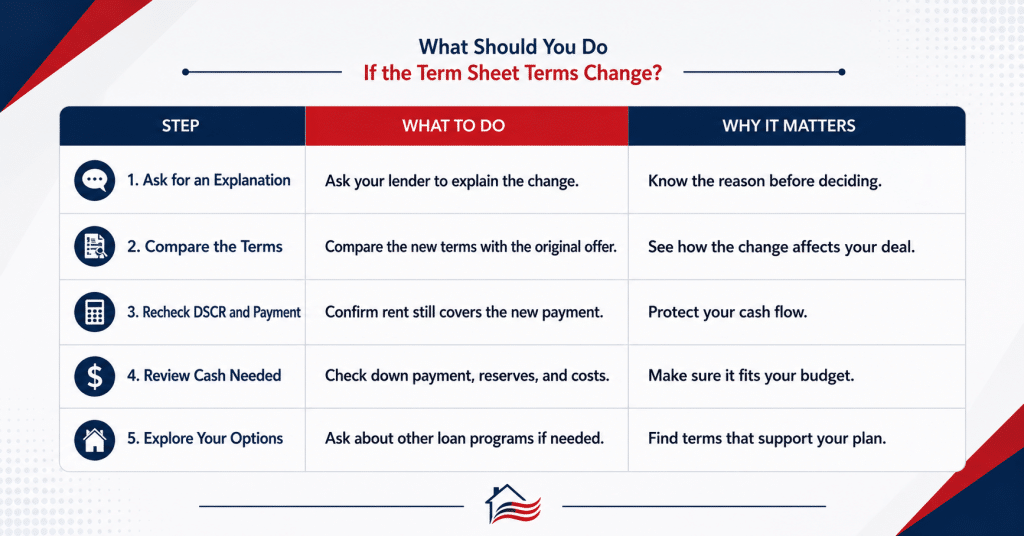
What to do if the DSCR loan term sheet changes?

Review Your DSCR Loan Term Sheet Before Moving Forward

A DSCR loan term sheet should help you decide whether the financing fits your rental property and investment plans. Before moving forward, consider the full loan structure and how it may affect your cash flow. Then, decide whether the financing supports your plans to hold, sell, or refinance the property.

Reviewing loan terms can be more difficult when buying U.S. real estate from another country. If you are a foreign national or U.S. expat, email us at [email protected] or call +1 (845) 583-0830. An experienced mortgage specialist can discuss your property and loan options with you.

FAQs

Q1: How Should Investors Compare the Best DSCR Lenders?

When comparing the best DSCR lenders, look beyond the interest rate. Review loan terms, property rules, required documents, reserves, closing costs, and prepayment terms. Then, consider whether the financing supports your long-term investment plan.

Q2: Can You Use a DSCR Loan in Florida for a Short-Term Rental?

A DSCR loan in Florida may finance an eligible short-term rental. However, lenders use different property and income rules. Therefore, confirm how the lender will calculate rental income before choosing a program.

Q3: Do DSCR Loan Lenders in the US Work With Foreign Nationals?

Yes. Some DSCR loan lenders in the US offer programs for eligible foreign nationals. However, requirements vary. Lenders may review property income, down payment, reserves, identification documents, and proof of funds.

Q4: What Should I Check When Comparing a DSCR Loan in Texas?

When comparing a DSCR loan in Texas, review the payment, property taxes, insurance costs, reserves, and prepayment terms. Together, these factors can affect both monthly cash flow and the overall financing strategy.

Q5: What Should I Compare When Reviewing a DSCR Loan in California?

When reviewing a DSCR loan in California, compare the interest rate, payment, LTV, fees, reserves, and prepayment terms. Then, consider whether the financing structure fits your plans for the property.