
The expat mortgage exchange rate influences the way lenders calculate your overseas earnings and borrowing capacity. In the process of applying for a US mortgage, your foreign earnings are converted to US dollars. Currency depreciation, however, can lower your income levels. Thus, your assessment and possible loan amount can vary.
Employment history, current debts, financial statements, and savings are also considered by lenders. Some lenders use currency adjustment in order to mitigate risks from the fluctuation of exchange rates. Hence, knowing how foreign income affects the process of US expat mortgage application can help you prepare more effectively. It will also provide information on the lender’s expectations before filing your application.
America Mortgages helps foreign applicants to find out which US mortgages they may be eligible for. The specialists at America Mortgages review your foreign income and other financial aspects. Reach America Mortgages now in order to find out what kind of expat mortgages you may qualify for.
How Does the Expat Mortgage Exchange Rate Influence Your Borrowing Capacity?
The exchange rate used in the expat mortgage has a direct impact on how much foreign earnings will be considered when calculating your eligibility for the loan. When the value of your currency drops against that of the US dollar, your earning will be less. Thus, you will end up qualifying for a smaller loan amount.
Consider an expat earning €8,000 per month. Different exchange rates can produce different dollar values.
| Exchange rate | Monthly income (USD) |
| €1 = $1.10 | $8,800 |
| €1 = $1.05 | $8,400 |
| €1 = $1.00 | $8,000 |
As such, the equivalent income in dollars drops due to the weakening of the euro. This will have an impact on your debt to income ratio, which may limit the amount you can borrow. In some cases, there may be the need to make currency conversions prior to the calculation of your qualifying income.
Currency fluctuations and available methods of funding must also be considered when creating your budget. For instance, learning about US mortgages for expats could assist in exploring funding arrangements and moving funds internationally. Comparison of lender requirements assists in identifying programs suitable for foreign earned income.
Can Currency Fluctuations Affect Your Expat Mortgage Application?
Yes, currency fluctuations can have an impact on your expat mortgage application in terms of the dollar value of your foreign income and savings. In case the value of your foreign currency weakens, then your income is going to be lower. This, in turn, will affect your ability to borrow money, the value of your deposits, and the affordability of mortgages.
Even if your salary stays the same, its value may vary. Some of the areas that will be affected include:
- Value of Foreign Income: When the value of your salary currency goes down relative to the dollar, the amount of your income becomes lower. This will make the lender see less income during the affordability assessment.
- Additional Down Payments: Depreciation of your currency may lead to a decrease in the dollar value of your foreign savings. Thus, you might need more money for the planned down payment.
- Debt to Income Ratio: Changes in exchange rates can influence your income recognition. Hence, any loans you have can take up a larger percentage of your recognized income.
- Monthly Mortgage Payments: If you are paid in a foreign currency, you will face increased costs for making mortgage payments in dollars due to exchange.
- Lender’s Risk Assessment: Changes in currency rates can make it difficult to estimate the value of overseas income. For that reason, some lenders use conservative currency conversions.
Recent Exchange Rate Statistics and Their Mortgage Impact
The figures presented by the Federal Reserve reveal the trends in the average exchange rate from euros to dollars from 2024 to 2025.
| Year | Average value of €1 in USD |
| 2024 | $1.0820 |
| 2025 | $1.1306 |
The value of the euro increased by about 4.5% relative to the US dollar according to these annual averages.
An expat earning 5,000 euros per month will earn different amounts in dollars during these years:
- 2024: Approximately $5,410.
- 2025: Approximately $5,653.
- Monthly difference: Approximately $243.
This is an example of how movement in currencies affects the dollar valuation of foreign earnings. However, average annual figures are not conversion rates for mortgages.
As such, it is advisable that expats consider various exchange rate possibilities before making decisions on how much they can afford for real estate purchases. Having extra savings is another way to have extra cash in case of unforeseen currency movements.
How Do Mortgage Lenders Assess Foreign Currency Income?
The lenders evaluate foreign currency earnings in terms of source, stability, documentation, and conversion to US dollars. Employment status and other financial obligations of the borrower are also analyzed to see whether they can afford timely mortgage repayments.
Key Factors Mortgage Lenders Evaluate:
Income Source and Employment Stability
The lenders check the employer’s name, position, and salary scheme. Lenders analyze employment history to prove consistent earnings. Consistent salary payments and stability in employment can help you in your application process. The lender will also consider the chances of having income in future.
Foreign Currency Conversion
The lenders convert your foreign income into US dollars to evaluate how much you earn and whether you can afford mortgages. The exchange rate plays an important role because your recognized monthly earnings may increase or decrease depending on currency movements. The lenders can also make adjustments with respect to currencies to protect themselves from financial risks.
Income Documentation and Tax Records
When applying for a mortgage loan, the lenders will need reliable documents for proof of earnings. This includes employment contract, recent pay slips, bank statements, and income tax returns. In some cases, you will need to provide a translated version of those documents.
Existing Loans and Financial Liabilities
Banks consider all existing loan accounts, credit cards, and monthly liabilities. These liabilities affect the debt-to-income ratio. Thus, clearing unnecessary liabilities prior to applying will positively impact your affordability situation and make you a better borrower financially.
Consistent Income and Future Earnings
Mortgage lenders consider the reliability and likelihood of your future foreign income. They consider the employment record, wage record, and proof of income. Reliable income is an important factor in handling your future mortgage payments consistently.
There are standards for evaluating income from employment for those receiving their income from foreign sources provided by Fannie Mae. Fannie Mae’s Standards for Employment Related Income describes the significance of proper income conversion and required financial documentation. This includes foreign language documents and required tax returns.
These standards guide lenders in the evaluation of foreign income during mortgage underwriting. However, the Fannie Mae guidelines are applicable only to eligible mortgage loans. Other lenders have their own policies regarding this issue.
How Can You Prepare for Exchange Rate Changes Before Applying?
Preparations for changes in exchange rates include the analysis of your overseas earnings, having enough financial reserves, and comparison of mortgages programs. First, calculate your income in USD. Then, see how changes in the exchange rate may affect your deposit and budget. Such preparations will help you to prevent unpleasant surprises.
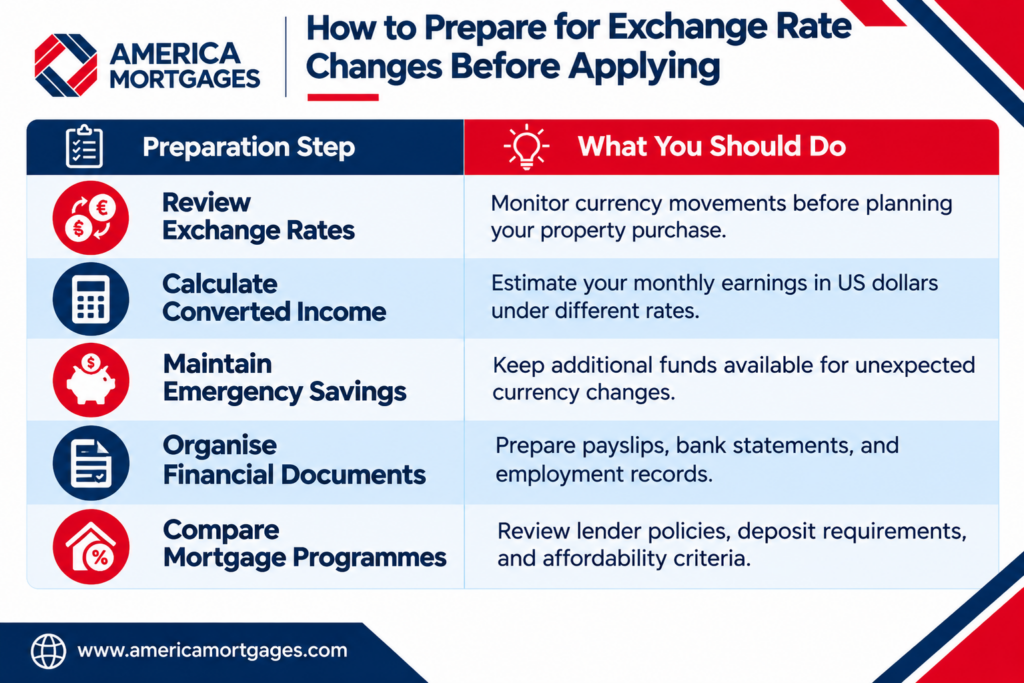
The currency of your income affects the amount that will be recognized when the underwriting is performed. Thus, it is better not to depend on one favorable exchange rate. Calculate your affordability in several scenarios. Additionally, have a record of your consistent income and source of your deposit. Knowing foreign income documentation requirements for US expats will help you to prepare the appropriate documents prior to application.
Finally, consider consulting with mortgage experts before the transfer of the funds abroad. They will provide you with information on foreign income requirements and possible financing options.
Case Study How America Mortgages Helped a US Expat Secure Financing While Living Overseas
An American citizen living abroad in Singapore had the requirement of buying a second property in the US. But because of the nature of his work abroad, it was difficult for him to provide proper documentation. He lacked a traditional W-2 statement from the US. However, he had a strong credit profile in America and an excellent financial portfolio.
America Mortgages evaluated his employment details, foreign income, and financial documents to determine a proper mortgage financing avenue for his unique situation.
This is one example of how specialized mortgage assistance can aid people abroad overcome the traditional issues faced in mortgage financing.
Explore Your Expat Mortgage Options With America Mortgages
Buying property in America despite being abroad may be a tough task. However, having the right mortgage partner can make this journey an easy one. Your foreign income, foreign currency, and place of work should not hinder you from seeking a suitable mortgage plan for yourself.
America Mortgages offers you access to over 150 mortgage programs in the US. The company’s experts will assist US expats and foreigners in exploring mortgage programs in all the 50 states. Whether you wish to acquire a holiday home, invest in property, or refinance, you can get assistance regarding your financial situation.
Are you ready for the next step? Contact America Mortgages now about your mortgage needs. Call us at +1 (845) 583-0830 or email us at [email protected] to talk to our US mortgage expert.
FAQs
Q1: What exchange rate do mortgage lenders use to convert foreign income?
The mortgage lenders usually use the standard exchange rate for converting foreign income into US dollars. However, the actual rate varies depending on the lender’s underwriting criteria. Certain lenders add more adjustment factors for the currency. Hence, it is important for the borrowers to ascertain the process beforehand.
Q2: How much income do I need to qualify for an expat mortgage in the USA?
There is no fixed income requirement for every US expat mortgage. Rather, the amount you earn, your liabilities, your credit record, and your assets are considered by the banks when making an evaluation. The deposit and mortgage program you have chosen affect your eligibility as well.
Q3: Can I get a US mortgage if I am paid in euros or pounds?
Yes, it is possible to buy a US mortgage with earnings in euros or pounds. It is necessary for the bank to validate your foreign employment and salary. They might convert your salary in dollars and make relevant calculations regarding the currency.
Q4: Do US mortgage lenders accept overseas bank statements and foreign payslips?
Yes, many specialty US mortgage lenders do accept bank statements and payslips from abroad. These are used to prove your income, employment status, and activity in financial dealings. Different institutions have different requirements, and some may require you to provide other documents.
Q5: Can I apply for a US mortgage without living or working in America?
Yes, you can get a US mortgage even if you are not a resident or worker in the U.S. There are several mortgage programs that are designed for foreign applicants buying homes in the US. But still, there will be certain factors that will affect your eligibility.
Share this article
Ready to get started?
Speak with our U.S. mortgage specialists today and discover your options.
Schedule a call