
Yes, a U.S. expat can get pre-approved for a mortgage while living and working overseas. There is no need to go back home to start an application process. Many mortgage providers accept remote applications with digital submission of required documents. However, getting pre-approved will depend on your income, credit history, assets, and liabilities.
A job abroad does not necessarily mean that you cannot qualify for U.S. mortgages. Lenders often accept salaries earned abroad, but only under certain conditions. That is why you should prepare all the necessary documents: your tax records, proof of employment, banking records, and personal identification. Getting acquainted with the influence of foreign income on a U.S. expat mortgage application could be useful as well.
America Mortgages assists U.S. expatriates to consider proper financing solutions in the USA. The experts of America Mortgages will be able to evaluate your financial situation and provide pre-approval remotely. Contact America Mortgages to learn about mortgage programs for you.
What Makes an Expat Eligible for Mortgage Pre-Approval While Living Abroad?
U.S. expats can obtain mortgage pre-qualification while residing abroad if they comply with the requirements of the lender. The lenders consider citizenship, financial stability, credit history, current debts, and available assets. Residing abroad does not necessarily mean that you will be disqualified. But one needs to show that he or she has the ability to handle monthly mortgage repayments.
| Eligibility Factor | What Lenders Generally Look For |
| U.S. Citizenship | Valid identification and confirmation of borrower eligibility. |
| Stable Employment | Consistent earnings and a reliable employment history. |
| Foreign Income | Verifiable overseas earnings with supporting tax records. |
| Credit History | A satisfactory U.S. credit profile and repayment record. |
| Debt-to-Income Ratio | Manageable monthly debts compared with qualifying income. |
| Financial Reserves | Sufficient savings for the down payment and closing costs. |
| Property Purpose | Details about primary residence, second home, or investment use. |
The Fannie Mae’s General Income Information sets standards regarding establishing that the income is stable, verifiable, and reasonably expected to continue. It describes how lenders analyze various types of income sources when underwriting mortgages. In addition, foreign employment income should be in compliance with the specific documentation requirements provided in Fannie Mae’s Standards for Employment-Related Income. This set of standards helps to identify if foreign income is sufficient to repay a mortgage.
The general financial situation is another important factor that affects the lending capacity. Current loans, credit card payments, and other liabilities determine the debt-to-income ratio. In addition, lenders take into account available savings to define if the borrower is able to pay his or her initial costs. That is why having well-organized finances and stable income may make the process easier. But the final eligibility will depend on the selected mortgage program.
What Documents Do You Need for an Expat Mortgage Pre-Approval?
Identification, income documentation, tax forms, bank statements, and employment verification are usually required by American expatriates for mortgage pre-approval. Lenders will use the aforementioned documents to ascertain your financial standing and ability to repay the loan. In some cases, extra documentation will be needed when your source of income is from abroad or you run a business in a foreign nation.
The list below indicates documentation that should be prepared prior to submission of the mortgage loan application to ease the verification process.
Required documentation checklist:
- U.S. Passport: Proves your identity and establishes your borrower eligibility.
- Latest Pay Slips: Demonstrates your current earnings and regular salary income.
- Employment Verification Letter: Establishes your current employment status, salary, and job title.
- Tax Returns for Past Two Years: Assists lenders in verifying your income.
- Foreign Bank Statements: Proves your savings and international financial dealings.
- U.S. Bank Statements: Indicates your domestic bank balance and available funds.
- Investment Statements: Proves your other financial assets and reserves.
- Existing Loan Statements: Details your existing loans and monthly repayments.
- Business Documentation: Income verification documents for self-employed applicants.
According to the CFPB, for applying to get a mortgage loan, you must have your latest paycheck stubs, last two year’s taxes and latest bank statements. These documents will help lenders to confirm your earnings, cash available and your other financial obligations. For self-employed individuals, it is necessary to have further documentation to prove that your earnings are consistent.
In the case of international applicants, the documentation process requires that you must check the currencies and translations if necessary. You must maintain the latest bank statements and also maintain proper records of all international transfers. It is important to note that your employment information must be in agreement with your application.
How Does the Mortgage Pre-Approval Process Work for US Expats Overseas?
U.S. expats are able to obtain mortgage pre-approval through online applications and submission of relevant documents. The lenders analyze financial documents, verify foreign income, and determine the borrowing capability. When the initial checks are made, qualified applicants are issued a pre-approval letter that is helpful in setting up realistic budgets for purchasing real estate properties.
Talk About Your Financial Circumstances
In this step, provide information about your occupation, living abroad, monthly salary and property needs. Also, state your current debts and available funds. This data will be useful for mortgage professionals in determining which programs are good for you.
Choose an Appropriate Mortgage Program
Make a comparison among the available mortgages with regard to your income, credit standing and use of the property. Some mortgage programs take into account income from foreign employment and others – rental income from the property. It will be beneficial for making a proper choice.
Provide Your Financial Documents
Submit your passport, tax return form, employment documentation, and bank statements for the last three months. If you are self-employed, submit documentation regarding your business and its profit and loss statements.
Complete the Lender’s Financial Assessment
The lender analyzes your qualifying income, credit record, existing debts, and assets. Also, he computes your debt-to-income ratio (DTI) to assess repayment capacity.
For instance, $2,000 per month in existing debt versus $8,000 qualifying income on a monthly basis generates a 25% DTI ratio.
Computation: ($2,000 ÷ $8,000) × 100 = 25%.
A low DTI is usually favorable and gives you more borrowing options although lender requirements vary individually.
Get Your Mortgage Pre-Approval Letter
Upon completion of your preliminary evaluation, your lender may give you a pre-approval letter which normally specifies your estimated borrowing capacity, proposed loan terms and any conditions remaining. This letter comes in handy whenever you negotiate offers with U.S. realtors.
Proceed to Select Your Properties
Now that you have been pre-approved, you can start looking for properties in line with your budget estimate. Analyze location, cost, and cost of owning the property in question. After making an offer, your lender will assess the property of choice and continue with underwriting process.
Note: Pre-approval is not a guarantee of final approval of mortgage. Your financial status should remain unchanged throughout the process. Furthermore, the lender may require an appraisal, updated statements, and further verification. Therefore, avoid taking new loans or making major financial changes before closing.
What Challenges Can Delay Mortgage Pre-Approval for Expats?
Foreign earnings documentation, minimal American credit history, and foreign bank transactions could result in pre-approval being delayed for non-citizens. It is possible that the lender will take extra time to review the financial documentation that is coming from abroad. Furthermore, there will be variations in regard to work history, taxation, and property needs.
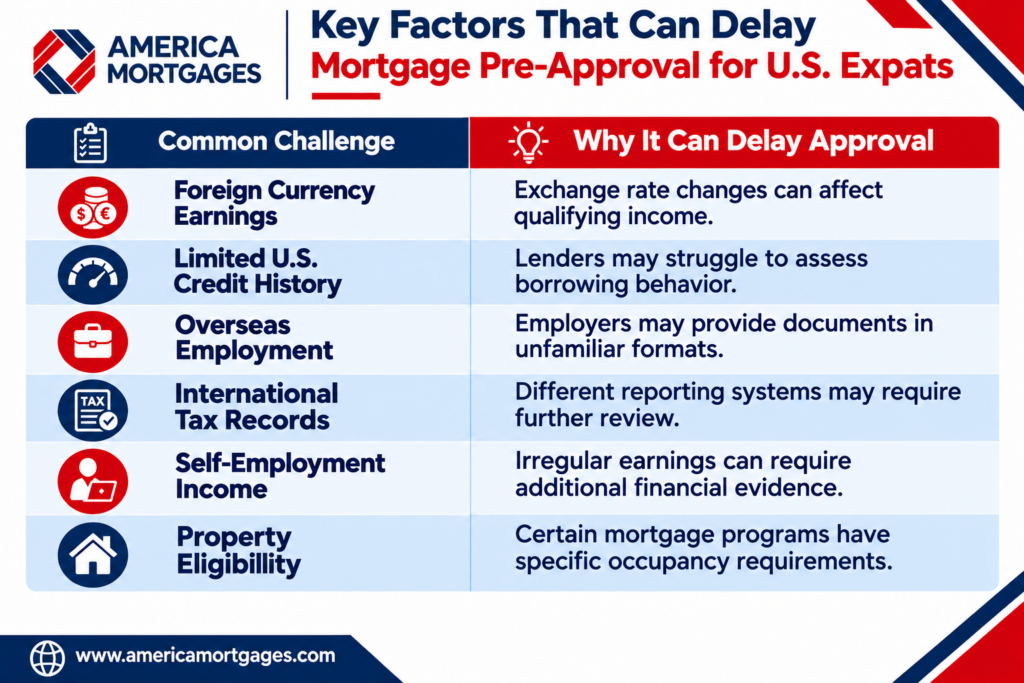
Another possible issue could be related to automatic underwriting. In some cases, manual review is needed in case financial information provided by applicants does not match certain verification criteria. Missing records, unclear information, and inconsistencies could lead to additional examination. Understanding why U.S. expat mortgages stall after automatic underwriting approval will help you be better prepared for such issues.
Selecting a qualified mortgage specialist who will notice all gaps in documentation before sending the application to the lender can help to simplify this process. In addition, try to keep your financial records organized and respond to lenders’ requests as soon as possible.
Case Study: U.S. Expat in Singapore Secures a Second Home Without a W-2
A recent America Mortgages case from January 2026 is one where there was an expatriate in America, residing in Singapore who wished to buy another property back home in America. Unfortunately, the expatriate did not have any U.S. W-2 form as he worked outside America.
America Mortgages reviewed the credit score of this U.S. citizen, the foreign income of the person, and his foreign financial portfolio as well. Possible lending solutions were sought out based on the financial situation abroad of this individual. Documentation for this case included foreign payslips, employment papers, and foreign bank statements.
This case illustrates that the absence of U.S. W-2 forms does not necessarily mean that an expatriate cannot seek mortgage financing solutions.
Get Your US Mortgage Pre-Approval Started With America Mortgages
Buying property in America while being an expat necessitates having the right financing partner. However, securing mortgage finance may not always be easy if your income comes from another country. A specialist will help you understand your eligibility, loan limits, and various loan programs before selecting a property.
America Mortgages provides financing services to U.S. expats and foreign nationals within all 50 states of America. With access to more than 150 mortgage programs, America Mortgages specialists evaluate overseas income, financial status, and individual needs. Also, one is able to fill out the initial form online and does not have to travel to America.
Interested in exploring financing options? Contact America Mortgages now and get your pre-approval process started. For inquiries, call us on +1 (845) 583-0830 or email us at [email protected]. Get in touch with America Mortgages to talk to a mortgage specialist today.
FAQs
Q1: Can I buy a house in the US while living and working abroad?
Yes, you can buy a property when living abroad as a citizen of the U.S. It is not necessary for you to go back home to begin the process of buying a property. However, the lender may ask for proof of income, credit score, and savings.
Q2: Do US expats pay higher mortgage interest rates than domestic borrowers?
Not always. There is a possibility that the U.S. expatriates could get interest rates like any domestic buyer. But the rate will depend on the credit scores, duration of the loan, down payment, and salary documentation. Some special mortgage schemes have higher interest rates due to increased risks.
Q3: Can I use foreign bank savings for a US home down payment?
Yes, foreign savings can finance your American real estate down payment in most cases. However, banks should be able to confirm that you are the owner of the savings accounts as well as prove the origin of the funds.
Q4: Can my spouse’s overseas income help me qualify for a US mortgage?
Yes, foreign income from your spouse can be beneficial for the mortgage application as a couple. However, lenders have to evaluate job security, qualifying income, and other financial obligations. Tax returns, pay stubs, and verification of employment are required from both parties, depending on the mortgage plan selected.
Q5: What happens to my US mortgage if I move to another country?
Your current mortgage loan from the U.S. will remain valid even when moving abroad. It is important that you make your payments in accordance with the agreed schedule. Moreover, it is important that you retain your ability to access your payment account and track your property expenses. If you rent out your property, you have to take into account certain limitations.
Share this article
Ready to get started?
Speak with our U.S. mortgage specialists today and discover your options.
Schedule a call