
US expats require a lender that is familiar with how to verify foreign income documentation since foreign income requires different ways of income verification. The experienced lenders are able to analyze international payslips, foreign tax documents, and bank statements in accordance with mortgage regulations.
Being abroad creates an additional problem in case an individual needs property financing in America. Such problems as currency conversion, unknown tax documents, and lack of US credit history might complicate underwriting process. Knowing what is required by the mortgage regulations in advance will help in preparing accurate paperwork and saving time on unnecessary procedures. Investors also have an opportunity to look for DSCR loans for real estate investors.
America Mortgages helps US expats to discover mortgage solutions appropriate for their income documentation and property plans. Contact America Mortgages in order to learn more about your possibilities of mortgage solutions.
What Makes Foreign Income Documentation Different From US Income Records?
Foreign income is documented differently from US income due to the fact that foreign employers, tax bureaus, and banks use different accounting systems. This may require further validation on the part of the lenders to understand how the income is earned and to ensure its authenticity.
There are a number of ways in which foreign income is different from domestic income, including:
- Conversion of Currency: The foreign salaries should be assessed in US dollars according to the procedures of the lending institution.
- Bank records: Foreign bank statements may demand further verification for proof of ownership and income deposit in the account.
- Language issues: Any documents in foreign languages may necessitate certified translations in English.
- Structure of Income: Overseas earnings may consist of bonus, commission, or allowance.
According to Fannie Mae’s Selling Guide, foreign income has to be converted to US dollars. The guidelines further state the requirements for tax returns and conversion of income from eligible conventional loans. Such criteria highlight the importance of additional preparation of overseas documents.
How Does a US Expat Mortgage Lender Evaluate Foreign Income?
The US expat mortgage lender evaluates foreign income through examining its source, stability, documentation, and sufficiency to support mortgage payments. This may involve looking at employment documents, foreign bank accounts, foreign tax statements, and currency exchange.
Foreign Income Documents Used in Assessment
| Document | What the lender evaluates |
| Foreign employment contract | Agreed salary, job status, and employment terms |
| Recent payslips | Regular earnings and payment frequency |
| Overseas bank statements | Salary deposits and available funds |
| Foreign tax returns | Reported earnings and relevant tax information |
| Employer verification letter | Current employment and compensation details |
| Business financial statements | Revenue and income evidence for self-employed applicants |
This will depend on the nature of the mortgage program and that of the borrower. There may be cases where certified translation of foreign documents is needed.
Example of Calculating Foreign Income
Take the case of an American expatriate who earns €8,000 each month in Germany. We shall use a rate of exchange of €1 = $1.10.
| Calculation | Amount |
| Monthly salary | €8,000 |
| Assumed exchange rate | $1.10 per euro |
| Converted monthly income | $8,800 |
| Converted annual income | $105,600 |
Calculation: €8,000 × $1.10 = $8,800 per month.
This is an illustration of the simple currency conversion, and not the actual qualifying income. The institution will use its own method of exchange rate conversion and its own underwriting criteria. Taxes, income stability, debt, and other financial commitments could also influence affordability.
The applicant must make sure that the employment details, bank deposits, and income declared are consistent. If there are inconsistencies, the underwriter must be provided with an explanation, accompanied by any necessary proof. Early preparation of the documents will help in making the review process easier for the underwriter.
Which Mortgage Options Can US Expats Consider When Earning Abroad?
For expats earning foreign currency, conventional mortgages, DSCR mortgages, bridge financing, and portfolio loans are among the loan programs available for buying property in the United States. Each will be the best for those who meet specific financial conditions.
Conventional Loans
The option may work for eligible expats who buy homes or refinance an existing home. Credit rating, ability to repay, assets, and income documentation are among the criteria that lenders will use in making such decisions. Conditions differ from one program to another, especially in the case where income is earned abroad.
Debt Service Coverage Ratio (DSCR) Loans
DSCR loans may work to allow expats to acquire rental properties. This will allow lenders to use rental income as a criterion for assessing the ability of borrowers to repay. However, other criteria like credit requirements, down payment, and financial reserves may play a role in the decision-making process.
Bridge Loans
Bridge loans provide short-term funding to borrowers who wish to buy property, renovate or make investments before selling the property or refinancing. However, such arrangements come at increased borrowing costs and time limits to repay.
Portfolio Loans
Portfolio loans could be a good option for borrowers who have financial backgrounds which do not match those set by traditional mortgages. In some cases, some lenders keep portfolio mortgages rather than sell them. As a result, the underwriting process could vary, including how foreign sources of income and assets are viewed.
Before you choose a mortgage, compare different factors like interest rates, costs, repayment periods, and required documentation. At the same time, check if the property usage corresponds to the selected mortgage program.
How Can the Right Lender Prevent Delays and Improve the Application?
The right mortgage lender can help avoid delays by detecting possible problems early on and helping the borrower navigate through all the steps in the process of application. The lender will help US expats get acquainted with the requirements, prepare correct records and avoid any delays during the mortgage underwriting process.
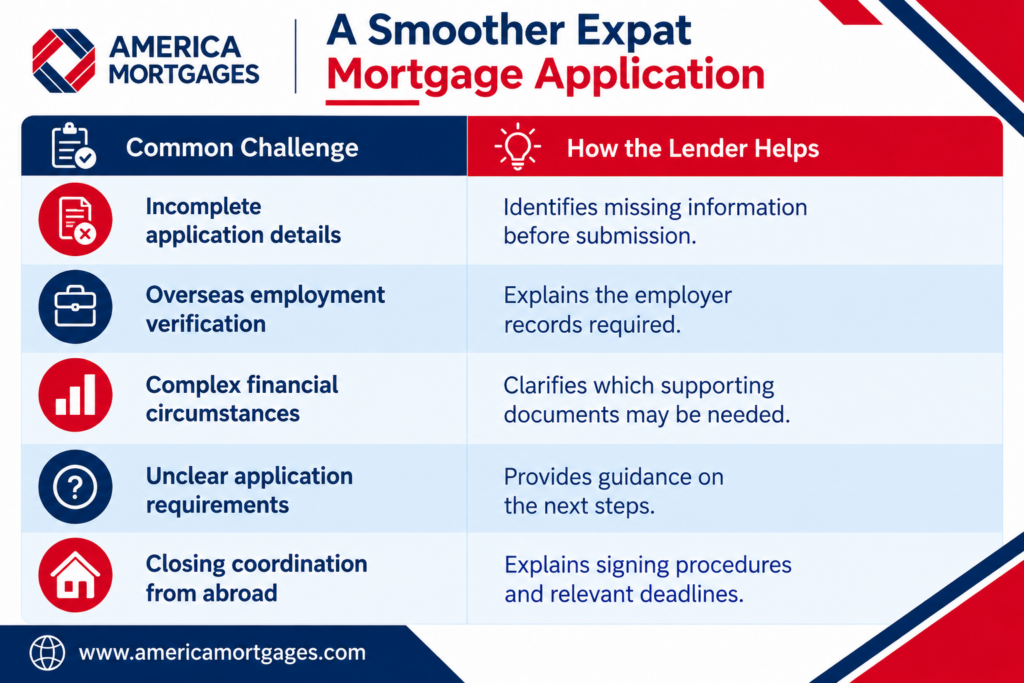
Organized document preparation will make the process easier for expats who have to apply from abroad. Keep all your financial documents well-organized and do not forget about the extra documentation that might be required. Besides, make sure you know all the necessary timespan to plan your property purchase better.
For further information, read guide to getting a US mortgage as an expat. It explains key considerations for Americans seeking property financing while living overseas. This resource provides useful context before beginning the application process.
Case Study: How America Mortgages Helped a US Expat Refinance From Hong Kong
An expat from the U.S, who was residing in Hong Kong, wanted to refinance his four-bedroom rental property located in Tempe, Arizona. However, he had no proof of income from the U.S, like a W-2 form, and also did not have any bank accounts from the US.
America Mortgages helped in arranging the financial documents along with the foreign income and Airbnb arrangements made by the client. America Mortgages arranged for a mortgage offer from the lenders in just ten working days. His refinancing was completed soon after that with 80% loan-to-value and 2.375% fixed interest rate.
Start Your US Property Financing Journey With America Mortgages
Buying property in the United States while working in another country is an elaborate process requiring proper financial planning. This is because your foreign employment, overseas accounts, and currency variations can make the mortgage process complicated. Hence, knowing the types of mortgage that best fit your finances will help you get the right documentation without any delay.
The ideal type of mortgage is determined by your salary level, credit profile, finances, and other factors depending on whether you are buying a family home or purchasing a rental property.
At America Mortgages, we assist US expatriates identify mortgages that suit their financial standing. Contact America Mortgages now at +1 (845) 583-0830 or [email protected] to know about your options for acquiring property. Visit America Mortgages for more details.
FAQs
Q1: Can I get a US mortgage while living and working abroad?
Yes, Americans abroad have the ability to be eligible for some types of American home loans. However, the availability of such a mortgage is contingent on one’s credit history, proof of income, available money, and other factors. Thus, it is important to choose an experienced lender.
Q2: Do US expats need a US credit score to buy property?
Not necessarily. There are some specialized mortgage schemes that take into consideration those who have little credit history in the USA. Still, the lender can analyze the credit report of the applicant from his home country.
Q3: Can I buy US investment property using foreign bank accounts?
Yes, some lenders accept foreign bank statements for the purpose of verifying the funds. But, in addition, borrowers will require extra documents that will prove ownership of the bank account, transaction history, and where the funds originated from. It all depends on the chosen mortgage plan.
Q4: Can US expats get a mortgage without filing US tax returns?
Yes, in some cases. There may be specific loan programs available which do not rely on the tax return process for underwriting purposes. However, it depends on the borrower’s situation, their tax obligations, and lender’s requirements.
Q5: How much deposit do US expats need to buy property in America?
Required deposits depend on various factors including the loan product, purpose of the property and the buyer themselves. Investment properties can have higher deposit amounts compared to the eligible home purchase options. Consequently, you must find out the minimum deposit requirement from your lender.
Share this article
Ready to get started?
Speak with our U.S. mortgage specialists today and discover your options.
Schedule a call