
Foreign income impacts a US expat mortgage application through income verification, exchange rates, and borrowing capabilities. Nonetheless, your foreign income will not necessarily preclude you from getting a US home loan.
The lender will check your employment history, tax history, bank statements, and other debts to ascertain whether you are eligible. In addition, changes in exchange rates could impact your eligibility income. When you want to buy a rental property, you can learn more about DSCR loans for real estate investors.
America Mortgages helps US expats to find mortgages while residing abroad. The company’s experts will look at your case and help you find appropriate financing methods. Visit America Mortgages to get more information about your foreign income.
How Do US Mortgage Lenders Evaluate Foreign Income?
US mortgage lenders determine the nature of foreign income by investigating its source, stability, documentation, and worth once converted to US dollars. They will also consider whether the income is reliable enough to be sustained and sufficient for mortgage repayments each month. However, the decision is dependent on the mortgage program used and the underwriting requirements of the lender.
In order to know if you qualify, mortgage lenders will usually check these things:
- Employment stability: Employment agreements, salaries, and employment history are checked to determine whether the income will be continued.
- Income verification: Payslips, tax filings, and bank statements help lenders verify the income.
- Currency conversion: Foreign incomes are converted to US dollars using the methods available to the lender. Exchange rate fluctuations may affect the amount of qualifying income.
- Consistency of income: Regular salaries are easier to verify than commission income, bonuses, or self-employment gains.
- Existing debt obligations: Current loans and regular debts help the lenders determine if the income qualifies you for an extra mortgage.
- Other financial documents: You may require additional documents to clarify your income, tax, or payment history.
The Selling Guide of Fannie Mae, dated March 4, 2026, B3-3.2-02 states how to evaluate foreign employment income in lenders’ work. In case of eligible conventional mortgages, the foreign employment income used by applicants should be documented by signed tax returns of the USA for the last two years. When necessary, foreign documents have to be translated into English, and foreign income should be translated into US currency.
This information shows that documentation is needed in order to receive a mortgage. However, different mortgage programs have different requirements.
What Documents Do You Need for a Foreign Income US Expat Mortgage?
Documents showing your income, employment, financial status, and ability to pay are some of the documents needed in your US expat mortgage application process. Lenders rely on these documents to establish the borrower’s eligibility and ability to repay.
| Required document | Purpose |
| Foreign employment contract | Confirms your job, salary, and employment terms |
| Recent payslips | Verifies regular earnings and payment history |
| Bank statements | Shows salary deposits, savings, and available funds |
| US federal tax returns | Supports income verification when required |
| Foreign tax records | Provides additional evidence of overseas earnings |
| Business financial statements | Helps verify profits for self-employed applicants |
| Passport and identification | Confirms identity and required personal details |
| Property and asset records | Supports purchase details and down payment verification |
Before filing an application, be sure to prepare your documentation. Make sure that the details provided on all documents are consistent; the names, dates, and income must be consistent. Where the documents are not in English language, provide translations where necessary. The lender might need additional documents in case you have income from bonuses, commissions, and businesses.
Also, the documents needed could depend on whether you are employed and the type of financing you would like to choose. Before applying, review US expat mortgage guide for information about financing options.
Can Foreign Income Reduce Your Mortgage Approval Amount?
Foreign income can lower the mortgage approval amount based on lenders adjusting foreign income, converting currencies, and disregarding the income which is not verifiable. The effect will be dependent on your income stability, debt liabilities, and mortgage programs.
Currency Conversion and Qualified Income
Lenders convert foreign income to US dollars prior to qualifying income calculation. Exchange rate fluctuations will lower the amount which can qualify as income underwriters. Thus, your income might not necessarily be the income figure during the mortgage qualification process.
Debt-To-Income Ratio and Borrowing Ability
Your debt-to-income ratio compares your debt payments with the qualifying gross income. The low qualifying income raises this ratio, and thus lowering the mortgage approval. In addition, current mortgages, vehicle loans, and credit cards will affect your ability to afford a mortgage.
Fluctuating Income and Income Verification
Bonnues, commission, and self-employed profits might be needed for additional proof before being accepted by the underwriters. Lenders will compute an average depending on history if your income fluctuates. Thus, the qualifying income might be lower than your current income.
Calculation of Mortgage Loan Approval
Let’s suppose that an expatriate makes €8,000 per month and take into consideration the example of the exchange rate of $1.10 for each euro. Let’s consider that the lender takes a 10% adjustment factor for currency risk.
| Calculation | Amount |
| Monthly foreign income | €8,000 |
| Converted US dollar income | $8,800 |
| Hypothetical 10% adjustment | −$880 |
| Adjusted qualifying income | $7,920 |
If debt payments are $2,400 per month, then the DTI ratio is 30.3% ($2,400 ÷ $7,920 x 100). This calculation is just for demonstration, not a lender requirement.
Keeping accurate records of income, minimizing debts, and comparing mortgage programs can make you more eligible. In addition, find out from your lender the process of currency conversion and variable incomes assessment.
How Can the Right Mortgage Lender Help You Qualify?
The right mortgage lender may enhance your likelihood of qualifying for loans by ensuring that your financial situation fits the right loan programs. Lenders who have experience know about international income conditions and assist you in preparing the needed documents.
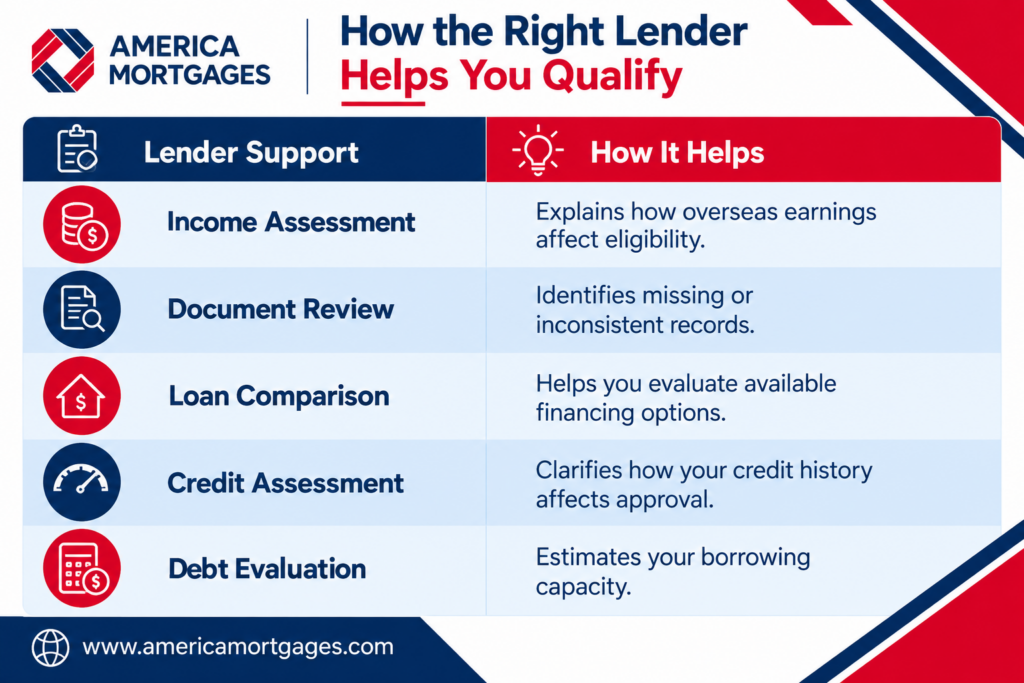
Each lender applies various underwriting policies. This means that comparing the different qualifications may aid in finding the right financing option. You may also check Fannie Mae’s mortgage qualification rules to learn how lenders determine income reliability and repayment capacity.
By choosing a lender with experience in dealing with foreign borrowers, you may get all possible information before filling the loan application form.
Case Study: How America Mortgages Helped a US Expat Navigate Foreign Income Requirements
A US expat living in Dubai wanted to purchase a rental property in Florida. However, his salary was paid in UAE dirhams, and he lacked recent US employment records. These circumstances made income verification and mortgage qualification more challenging.
America Mortgages reviewed his overseas employment documents, bank statements, and financial profile. Its team helped organize the required paperwork and explore suitable mortgage options. This approach helped address documentation gaps and identify a potential financing route based on his circumstances.
Start Your US Property Purchase With America Mortgages
Buying property in the USA from outside the country requires proper financial considerations as foreign salary, currency exchange rates, and banking from abroad may impact eligibility for a mortgage loan. Hence, getting familiar with the needs of lenders enables one to prepare a better application form.
America Mortgages helps U.S. expatriates in considering suitable financing opportunities for them based on their financial and other situations. No matter whether they earn money abroad or are looking to acquire property in the USA, America Mortgages can guide them regarding the various mortgage options available.
Start your US property purchase with America Mortgages. Contact us now in order to know about your requirements. Reach at +1 (845) 583-0830 or email [email protected].
FAQs
Q1: Can I get a US mortgage while living and working abroad?
Yes, you can obtain a US mortgage even when living abroad. However, the lender will consider your income, creditworthiness, job stability, and amount of funds. Being ready with all financial paperwork can help increase your chances of getting favorable financing.
Q2: How much deposit do US expats need to buy property in America?
Down payments for US expats can range from 10% to 25%, or even more. But it ultimately comes down to the specific lender, type of property, and other factors. So, it is always better to clarify the situation.
Q3: Do US expats pay higher mortgage interest rates than US residents?
Not always. The interest rate is determined by many factors including credit rating, loan tenure, down payment, and the terms of the lender. However, in some expat home loan schemes, you may be charged higher interest rates and fees.
Q4: Can foreign bank statements be used as proof of funds for a US mortgage?
Yes, lenders can accept foreign bank statements as proof of savings and availability of money. However, they will normally need transaction history, ownership of the account, and proof of where the money comes from. Translation might also be needed.
Q5: Can I use rental income from a US property to qualify for another mortgage?
Yes, qualifying rental income can help you obtain another mortgage. However, lenders will check your lease contract, rental history, property costs, and income computation methods. Requirements differ based on the loan program and individual properties.
Share this article
Ready to get started?
Speak with our U.S. mortgage specialists today and discover your options.
Schedule a call