
Buying property in California for rental income can be a good investment when buyers choose the right location and property. The state provides ample rental demand, well-established employment centers, and appreciation potential. However, the high prices of properties and ownership costs need proper planning for the transaction.
Buyers should assess the local market conditions, including rental rates, tax costs, insurance rates, and the demand for tenants. Such cities as Sacramento, Fresno, San Diego, and Los Angeles can provide different investment opportunities. At the same time, foreign buyers need to consider their eligibility for obtaining a mortgage and owning the property. Potential foreign buyers can also consider buying a property in California for non-residents guide.
In general, California rental property can help people create wealth provided that the numbers are favorable. It is critical to achieve positive cash flow, finance the property properly, and manage it correctly. Consequently, it is necessary to evaluate each of the available options carefully.
Want to learn more about financing California rental property? Feel free to contact America Mortgages to find out mortgage options and make an informed decision.
Why Should Investors Consider California for Rental Property?
Investors should consider California rental property because the state offers an established housing market, diverse employment opportunities, and multiple rental investment locations. Its vast population will ensure high demand for residential houses. Furthermore, there are various prices available on the market for investors to choose from. Nevertheless, it is important to pick the right location.
Here are the key reasons why California is a good place to buy property:
- Established rental market: There are 68,773 units of rental properties in California in October 2026. The state median monthly rent is $3,056.
- Various job opportunities: Technology, healthcare, education, entertainment, and manufacturing create job opportunities. These sectors help create a need for housing in metro regions.
- Different investment amounts: Sacramento recorded median list prices at $479,900 while San Francisco reported median list prices of $1,199,000.
- Future property value increase: Desired locations have the potential for future appreciation in value. Appreciation depends on the overall economy and housing stock.
- Multiple rental options: Investors have the choice of renting apartments, condominiums, single-family homes, and qualified furnished rental properties.
- Existing housing stock: California has 153,837 existing residential listings in October 2026. This allows buyers multiple property options.
According to Realtor.com, the median listing price of California stood at $725,000 in October 2026. The median price of sold property was $757,000. Properties took around 55 days to be sold. The median listing price fell by 3.14% year-over-year, while median sold price rose by 0.93%. However, monthly rental prices fell by 1.42% year-over-year.
On the other hand, there are some differences when considering city-level figures. In San Francisco, median monthly rental price is $5,145, whereas in San Diego it is $3,235. On the other hand, Sacramento’s median monthly rental price is $1,992, and Fresno’s is $1,697. Median listing prices are $1,199,000, $809,999, $479,900, and $429,950 for San Francisco, San Diego, Sacramento, and Fresno, respectively. Therefore, it is important to compare acquisition cost and rental income.
Which California Cities Offer the Best Rental Property Opportunities?
Sacramento, Fresno, San Diego, and Los Angeles provide unique options to the investor when considering rental properties. Every one of these cities has its own kind of tenants and property requirements. For this reason, the buyer needs to evaluate employment and demand for housing in each area.
| City | Rental Property Opportunities | Key Consideration |
| Sacramento | Single-family homes and apartments | Government and healthcare employment |
| Fresno | Family homes and residential rentals | Comparatively affordable property options |
| San Diego | Condos and long-term residential rentals | Military and healthcare presence |
| Los Angeles | Multifamily properties and apartments | Diverse employment and tenant markets |
Sacramento could be an ideal choice for those looking for more affordable options in terms of investments. Its work base comprises government, health care, and educational industries. On the other hand, San Diego is favored by tenants due to its military bases, educational institutions, and health care centers.
Fresno provides an opportunity that is worth exploring for investors looking to invest in residential rentals. From the Fresno County Housing Need Report by the California Housing Partnership, it is evident that there are huge gaps when it comes to affordable housing in the region. The rising costs associated with housing make it difficult for low-income earners. Thus, rental housing continues to be a vital component of the local housing market.
What Costs and Regulations Should Investors Evaluate Before Buying a California Rental Property?
Investors should analyze property taxes, insurance, maintenance costs, and landlord rules before buying rental property in California. This is because these aspects can have an impact on costs of ownership and profitability from rentals. In addition, awareness of the tenant protection laws will help avoid conflicts.
Property Taxes
California generally caps its base property tax rate at 1% of its assessed value according to Proposition 13. Nonetheless, there could be extra local taxes that could raise total taxes. Investors need to make a tax estimation based on the projected purchase price and not the assessment of the previous owner.
For international buyers, one needs to consider federal and state taxes. For more information, check our guide to U.S. real estate taxation and ownership for foreign investors, which includes rental income taxes, deductions, depreciation, and FIRPTA.
Landlord and Tenant Laws
There are unique regulations that govern rental agreements, the process of eviction, and protection for tenants in California. The Tenant Protection Act restricts some rent increases. However, there are exceptions for some eligible properties. Investors need to consider other housing laws at the city level.
Property Insurance
It covers property damage and liability for the owner of the property. However, premiums differ depending on location and conditions of the property. Investors need to get insurance quotes prior to closing, especially those buying in areas prone to wildfires.
Maintenance and Repairs
Properties need proper maintenance to be kept safe and attractive. It includes plumbing, electrical, roofing, and appliance repairs. Investors need to have a dedicated account for property repair costs.
Property Management Fees
Property management companies help in managing tenant relations, collecting rent, maintenance activities, and leases. Fees will depend on location and the agreement. Overseas investors may require property managers.
Vacancies and Tenant Screening
The lack of tenants leads to lower rental incomes. This is why investors need to consider vacancy costs before making any purchases. Tenant screening helps to avoid delays and property damage.
Security Deposit Requirements
For the state of California, security deposits are capped at one month’s worth of rent most of the time. However, some smaller-scale landlords may be eligible for a two-month provision. The property owner will have to comply with all relevant deposit regulations.
Understanding these expenses helps investors avoid unexpected financial pressure. When buying, determine the total cost of owning the property rather than solely considering the monthly mortgage payment.
How Can Investors Calculate Potential Rental Returns?
Investors can calculate their rental income through a comparison between their annual rental income and their purchase cost and expenses for maintenance of the house. This will help the investor know if they are earning a positive cash flow from their investment. Besides, analysis of the rental yield and expense of being an owner becomes more clear.
Before buying, the investor must think about these key figures:
- Gross Rental Yield: It is calculated by the formula of annual rental income divided by the price of purchase. If there is a $500,000 building that gives a monthly rental income of $2,800, the total rental income will be $33,600 per year, and the gross rental yield will be 6.72%.
Formula: (Annual Rental Income ÷ Purchase Price) × 100
- Net Operating Income (NOI): It is calculated using the formula of rental income minus operating expenses. Suppose there is an annual rental income of $33,600 along with an annual operating expense of $14,580; the NOI will be $19,020.
Formula: Annual Rental Income − Annual Operating Expenses
- Net Rental Yield: This takes into account returns less operating expenses. As shown in the above example, dividing $19,020 NOI by $500,000 gives us a net rental yield of 3.80%.
Formula: (Annual NOI ÷ Purchase Price) × 100
- Monthly Cash Flow: This calculates the amount of money left after accounting for all expenses and mortgage payments. Assuming rent income per month is $2,800, operating expenses total $1,215, and mortgage payments total $1,800, we can see that this property shows a loss of $215 per month.
Formula: Monthly Rent − Operating Expenses − Mortgage Payment
- Cash-on-Cash Return: This calculates the ratio between annual pre-tax cash flow and the amount of money invested in cash. In case the buyer invests $150,000 and is faced with a yearly loss of $2,580, the cash-on-cash return will be -1.72%.
Formula: Cash-on-Cash Return = (Annual Pre-Tax Cash Flow ÷ Total Cash Invested) × 100
These calculations are used by investors to compare different properties before making investments. The reality is that investment returns depend on financing, vacancies, taxes, and unforeseen expenses. Consequently, a potential buyer needs to base his or her calculations on realistic figures.
How Can Foreign Investors Finance a California Rental Property?
Foreign investors can finance an investment property in California using specialized mortgage programs specifically tailored for international clients. Such products include DSCR mortgages, foreign national mortgages, and asset-based financing. The difference between regular mortgages is that some don’t need U.S. credit history or proof of local income.
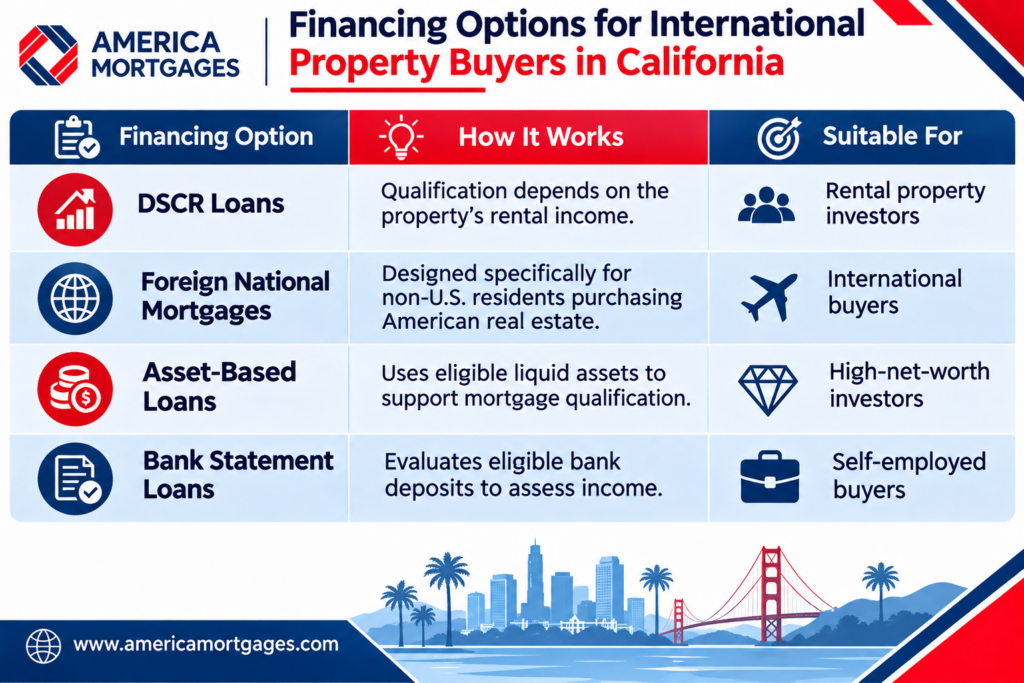
The DSCR loan type is especially important for the rental property investors. The lenders determine whether the future rentals will be able to pay off the mortgage payments, property taxes, insurance, and HOA, if any. There are options where the foreign nationals do not need any U.S. credit score, Social Security Number or tax return in order to qualify. Down payments might be different but there are also some foreign national programs that provide up to 75% of the financing of the property value. Investors may refer to the guide to DSCR loans for non-U.S. resident people.
In order to apply, it is necessary to have passports, bank statements, proof of funds availability, and details on the property itself. One must compare the interest rates, terms of the loan, closing costs and reserve requirements. Moreover, one might consider purchasing the property via LLC in certain eligible programs.
Case Study: How a Chinese Investor Secured $18 Million Financing for a Los Angeles Property in 2026
In March 2026, a Chinese technology entrepreneur intended to purchase a luxury property in Los Angeles. Nevertheless, there was still no money from the sale of his firm available. No traditional lender was able to provide the funding needed for this deal in the time frame required.
America Mortgages provided an $18 million bridge loan, based on the value of the asset at 70% loan-to-value. The deal was finalized in eight business days. The deal depended on the value of the asset and the sale of the firm as an exit strategy.
Explore California Rental Property Financing With America Mortgages
Buying a rental property in California demands appropriate financing and proper planning. International purchasers may find difficulties with credit history and income verification in the USA. Thus, selecting a professional mortgage broker will make the process easier. America Mortgages is a professional mortgage broker assisting foreign nationals and American expatriates in researching the available financing programs in all 50 states of America.
The mortgage broker has access to over 150 different financing programs from American lenders. These include the programs for foreign nationals, DSCR loans, and investment property financing. The specialists of the company analyze individual financial situation and suggest appropriate programs to clients. No US credit history or tax returns are required in most of the available programs.
Ready to get your California rental property financed? Then contact America Mortgages and let’s talk about your investment plans and mortgage options. You can reach our specialists by phone +1 (845) 583-0830 or via email [email protected].
FAQs
Q1: How much money do you need to buy a rental property in California?
Buying a rental house in California requires down payment, closing costs, and other cash reserves. This amount varies depending upon where the buyer wants to purchase the house, cost of the house, and financing method.
Q2: Is it better to buy a condo or a single-family home for rental income in California?
Both the choices have potential for earning rental income in California. The condos may cost less to maintain but involve HOA charges, while the single-family houses provide more privacy. Investors need to evaluate various factors before making a choice.
Q3: How do you find tenants for a California rental property?
You may find tenants through legitimate rent portals, licensed property managers, and local real estate brokers. Begin with competitive pricing and a compelling list. In addition, check on their earnings, rental record, and references.
Q4: Can non-residents collect rental income from California properties?
Yes, non-residents can lawfully earn rent from their properties in California. However, they must follow applicable landlord regulations and federal tax requirements. Proper documentation and professional tax guidance also help manage their financial responsibilities.
Q5: What taxes do non-residents pay on California rental income?
Non-U.S. citizens will be subject to U.S. federal and state of California income taxes for rental income. It is important to note that deductions may decrease taxable earnings. The non-U.S. taxpayer must be aware of any withholding provisions and filing requirements.
Share this article
Ready to get started?
Speak with our U.S. mortgage specialists today and discover your options.
Schedule a call