Yes, a U.S. expat can purchase a second house entirely in cash and apply for a mortgage loan after that. In this way, an American living abroad will be able to acquire real estate property irrespective of the loan approval process.
However, there are two possible ways to finance such purchases by means of deferred financing and cash-out refinance. Still, both of them have different periods of ownership, requirements for documentation and borrowing limits. The lender may consider a history of purchases, foreign income, property valuation, and assets. Information about second-home mortgage loans for US expats can also help to select an appropriate financing program.
America Mortgages can assist the overseas American in exploring second-home financing and refinance opportunities via special lending programs.
How Does Buying a Second Home With Cash and Refinancing Later Work?
Buying a second home using cash and refinancing it later entails buying a US real estate with cash prior to applying for the mortgage loan. Such a technique can help the US expatriates acquire properties within a short time frame. After that, they can look for ways to refinance the investment to recoup some of their initial money invested.
| Step | What Happens |
| Choose a property | Find a suitable US second home and agree on its purchase price. |
| Pay with cash | Complete the transaction using personal savings or other eligible funds. |
| Transfer ownership | Receive the property title and keep all closing documents. |
| Apply for financing | Contact a lender about delayed financing or cash-out refinancing. |
| Complete appraisal | Allow the lender to assess the property’s current market value. |
| Receive mortgage funds | Complete underwriting and closing to access approved funds. |
According to Fannie Mae’s Selling Guide, Chapter B2-1.3-03, there is a delayed financing exception for some eligible borrowers who have bought the property using cash. These borrowers will be eligible for a refinancing application within six months. However, they will have to meet certain requirements.
Choosing the Right Financing Route
Depending on when you bought the property, the amount of equity in the property, and your finances, one would be more appropriate than the other. Delayed Financing might be more appropriate for properties bought recently using cash, while Cash-Out Refinancing is ideal after fulfilling the ownership period requirement.
U.S. expats need to gather bank statements, purchase documentation, proof of income, and property information before applying for a refinancing mortgage loan.
What Mortgage Requirements Must US Expats Meet After a Cash Purchase?
US expats have to fulfill certain requirements by the lender before applying for a loan after buying their second house in cash. These requirements normally include income, credit rating, property value, ownership documents, and savings. However, these requirements depend on the chosen mortgage program and the lender.
The lender normally considers the following requirements before approving the application:
- Citizenship: The borrower may have to present a US passport or other acceptable form of ID.
- Income from Abroad: The lenders evaluate the foreign income including foreign business earnings. Knowledge on how foreign income affects expat US mortgage application process will enable applicants to gather appropriate financial documents.
- Credit History: Some mortgage programs necessitate the presence of credit history in the USA. Other programs accept the alternate form of credit documents.
- Property Appraisal: The value of the home is established through an independent appraisal.
- Loan-to-Value Ratio: For the purchase of one-unit second home, Fannie Mae allows up to 90% LTV. Cash out refinance has different loan to value ratio requirements.
- Financial Reserve: The applicant may be required to save additional money after the closing process.
- Documentation of Purchase: Disclosures during closing, bank statements, proof of funds are the supporting documents for cash transaction.
U.S. expats should also ensure that the property’s occupancy status is verified before application. The criteria for a second home must satisfy certain personal use requirements according to the traditional rules. In some cases, where the property is mainly rented out, an investment property loan might be more appropriate.
Which Refinancing Option Is Best After Paying Cash for a Second Home?
The best refinancing strategy will depend on the time that you bought the property, the value of the property, and your financial objectives. Americans living abroad have several choices available to them, including delayed financing or conventional cash out refinance.
Delayed Financing
The option of delayed financing is appropriate for buyers who have acquired a property using cash recently. The individuals eligible for such financing are those applying within six months according to the guidelines set by Fannie Mae. These individuals should provide documentation of the original cost of the purchase and financing sources.
Traditional Cash-Out Refinance
The cash-out refinance is ideal for borrowers that need access to the built-up equity in the home. The lender determines the appraised value of the home, the existing debts, and the permissible LTV ratio. The conventional policy requires that the borrower own the property for six months.
Non-QM Expat Mortgage Programs
Non-QM programs could work for expats who don’t meet the conventional criteria of financial documents. Some lenders recognize foreign income, foreign bank statements, and non-traditional credit histories. These programs might provide more leeway. Nevertheless, the interest rates and qualification criteria may differ from one lender to another.
Understanding Your Potential Cash-Out Amount
Consider a US expat buying a second home costing him $500,000 in cash. In six months’ time, the value of that property is appraised at $550,000.
Assume the lender allows a hypothetical 70% LTV:
- Property value: $550,000
- Eligible LTV: 70%
- Potential mortgage: $550,000 × 70% = $385,000
- Remaining property equity: $165,000
The maximum loan the individual could receive, ignoring expenses, is $385,000. The loan amount one could actually receive would vary depending on the lender’s rules and categorization of the property.
Selecting a proper option means knowing what it would cost to repay the loan, and whether the property qualifies for the loan. U.S. expats may consider the process of refinancing their homes while living abroad, including the available options and lending requirements.
What Risks Should US Expats Consider Before Buying a Second Home With Cash?
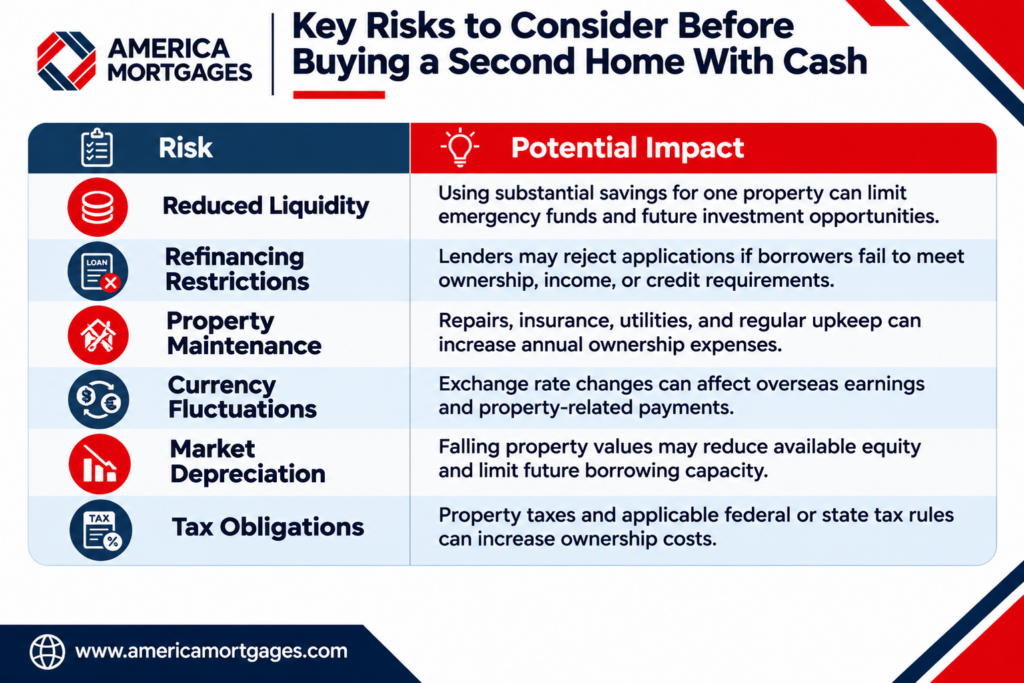
U.S. expats should assess the risks associated with their finances, laws, and properties when buying their second house in full cash. While such an action helps in avoiding immediate mortgage costs, it could lower the amount of money in savings.
Rising Homeownership Expenses
Research from the Federal Reserve Bank of Minneapolis shows the rising cost of owning residential property. Their findings show that the cost of homeowner expenses, which include property tax, insurance, and property maintenance, rose by 5.5% from 2021 to 2023. Rising costs may have an impact on those who own several properties.
It is important for US expats to have enough savings in case of any unexpected maintenance and expenses. Also, one cannot be sure of getting the loan refinancing approval after the cash purchase. This means that lenders may use other time frames, appraisals, and requirements when issuing loans.
Case Study: UK Expat Investor Secures $3.9 Million Miami Property Financing
An expat from the UK seeking to invest in real estate in the U.S. wished to buy a luxury condominium in Miami, Florida. However, the expatriate had no extensive credit record in the US and was faced with income coming from outside the US. Moreover, there was also a pressing time constraint for closing the deal.
With the help of America Mortgages, the expatriate obtained an asset-based loan without the need for US income or credit check. The story emphasizes the need for knowledge of refinancing terms and other future borrowing conditions.
Plan Your Second Home Purchase and Refinance With America Mortgages
Using cash for buying a second home will give you greater freedom in buying US property. But proper preparation before the process of refinancing gives you an opportunity to learn about borrowing limitations, ownership limitations, and possible costs. Preparation also helps you use your savings and benefit from your property’s equity more easily.
Before completing the deal, study the existing mortgage programs and the conditions for becoming eligible. Take into consideration your overseas earnings, the value of the property, your credit score, and your financial prospects in the future.
America Mortgages will help you in exploring your possibilities for buying second homes, delayed financing, and cash-out refinancing in 150+ U.S. mortgage loan programs. America Mortgages experts will help you if you are a borrower living abroad in all 50 U.S. states. Contact us now in order to discuss financing alternatives with us. Call +1 (845) 583-0830 or email hello@americamortgages.com.
FAQs
Q1: Can I get a mortgage on a second home if I live outside the US?
Yes, one can secure a US mortgage from abroad. Numerous lenders deal with citizens of the U.S. earning money abroad. These lenders may take into consideration payslips, tax statements, bank statements, and outstanding debts of applicants. Yet, the requirements vary depending on the loan type. A specialized lender will inform you about necessary documents.
Q2: Do US expats need a US credit score to qualify for a mortgage?
Not necessarily. Some banks may require a U.S. credit report, but some banks may need international credit reports. Their criteria will vary depending on their loan program and financial situation. Having a better U.S. credit report can make it easier to have options. Ask the bank what credit report is needed prior to applying.
Q3: Can I use foreign bank statements to qualify for a US mortgage?
Yes, some U.S. mortgage lenders allow foreign bank statements to be used as proof of the funds and financial stability of an applicant. One may require translations of the statements, the income statements, and the justification of large sums in one’s bank account.
Q4: Are mortgage interest rates higher for US expats buying property abroad?
Not always. The interest rates on mortgages vary according to the type of mortgage loan, how the property is going to be used, down payment made, borrower’s credit profile, and lender, among other factors. There are also non-qualified mortgages for expats that might have higher interest rates compared to regular conventional mortgages.
Q5: Can I rent out my US second home after getting a residential mortgage?
Possibly, although the terms of the mortgage should permit this purpose for the property. The loan for a second home is one that anticipates the personal use of the home during certain times of the year. A rental situation may necessitate financing for an investment property. Be sure to confirm occupancy policies before marketing the property.
Share this article
Ready to get started?
Speak with our U.S. mortgage specialists today and discover your options.
Schedule a call