
Yes, the US expatriate can refinance the US home while being out of the country according to his financial situation and lender’s criteria. Income from abroad, credit history, property value, occupancy and available equity may play a role in this matter. Overseas income may complicate the process of refinancing, as it may require extra documents.
It is possible to use refinancing to obtain a lower interest rate, alter loan terms, and utilize any existing equity. It is important to note that being an expat can complicate the process of proving income and organizing documents. If one plans to refinance abroad, gaining insight into U.S. mortgages for expats will be useful.
The decision to finance depends on your current mortgage, use of property, income and overall plans for the future. The analysis will give you an answer, whether it is worthwhile to refinance. America Mortgages can help you choose the appropriate mortgage option.
What Factors Affect Your Ability to Refinance From Overseas?
Various aspects such as your income, credit score, home equity, purpose of the home, citizenship status, debts, and finances might influence your ability to refinance from abroad. The lender will check on these things in order to determine your financial strength and whether the requested mortgage will meet the lender’s criteria.
| Factor | What Lenders May Consider |
| Citizenship | Whether you are a US citizen or qualify under another borrower category |
| Income | Source, stability, history, currency, and verification of earnings |
| Credit history | Credit score, payment history, and existing credit obligations |
| Home equity | Current property value compared with the requested loan amount |
| Property use | Whether the home is your residence, second home, or rental |
| Debt obligations | Existing monthly payments and overall financial commitments |
| Financial reserves | Available funds that can support the loan and closing |
| Property value | The home’s current market value and resulting loan-to-value ratio |
Having lived abroad, the process might be complicated as your financial statements are from different countries. For that reason, your lender will need some extra information from you regarding your employment, bank accounts, taxes, or even properties abroad.
The objective of your refinancing is yet another aspect that influences the options at hand. While some homeowners want to reduce their monthly payments, others have other intentions. In case you are earning abroad, then you can understand the mortgage criteria regarding foreign income.
Can You Refinance a US Home Using Foreign Income?
Yes, you can refinance a US property using foreign income if accepted by the bank and all the qualification criteria are met. Income should be consistent, verifiable, and well-documented. In addition, tax documentation, employment, currency, and overall financial standing will be analyzed by the lender.
Several factors can affect the consideration of foreign income for qualification purposes:
- Source of income: Foreign income generated by employment or any other occupation should be verifiable.
- Consistency of income: Past experience is useful in confirming qualification.
- Taxation documentation: Federal tax documents can prove the existence of foreign income.
- Conversion into US dollar: If needed, foreign income can be converted into US dollars.
- Documentation: Overseas documentation might be needed.
- Stability of income: Stability of the income will be considered by the lenders.
Freddie Mac guidelines indicate foreign employment income as one of the income sources that might require federal tax-return documentation for mortgage qualification purposes. Therefore, the importance of having full tax documentation becomes obvious.
Thus, the presence of foreign income does not rule out the possibility of refinancing your US home at all. You just need to ensure that the documentation proves the income.
What Does It Cost to Refinance a US Home From Abroad?
Refinancing a US home from another country may require fees from lenders, appraisal, title services, recording, and other closing expenses. Your total cost will depend on the loan amount, your property, your lender, your state, and the type of refinancing you are getting.
Lenders and Origination Fees
This fee covers the costs for processing your loan, underwriting your loan, and administrative fees. Some lenders may also offer pricing structures using discount points. You should consider the entire cost of your loan, and not just the interest rates alone.
Appraisal and Property Fees
Appraisal may be needed to establish the current market value of your property. The value derived may affect your loan-to-value ratio, equity, and refinancing terms.
Title and Closing Fees
The title search, title insurance, recording, and closing fees may all be among the closing costs that you need to pay. Different areas have different requirements; thus, you should factor in state-specific fees.
Prepaid or Escrow Costs
Prepaid interest, property tax, homeowners’ insurance, and escrow may be among the closing costs included in your closing statement. Note that these are not necessarily lender fees.
Possible Costs Involved with Currencies
If you earn from abroad, you may have to change currency to US dollars. Any fluctuations in exchange rates may impact the amount transferred for the closing costs. Your bank will also charge fees for international transactions.
Freddie Mac recommends comparing refinance costs with expected monthly savings to find the break-even point. For example, $8,000 ÷ $400 = 20 months. Thus, savings would recover the upfront cost after about 20 months, assuming payments remain consistent.
What Documents Do US Expats Need to Refinance Their US Home?
US expats may require documents like tax returns, income documentation, bank statements, identity, mortgage information, and property information to refinance their US home. The specific requirements will depend on the lender and the loan program. Additional documentation will be required from foreign borrowers to establish overseas income and asset sources.
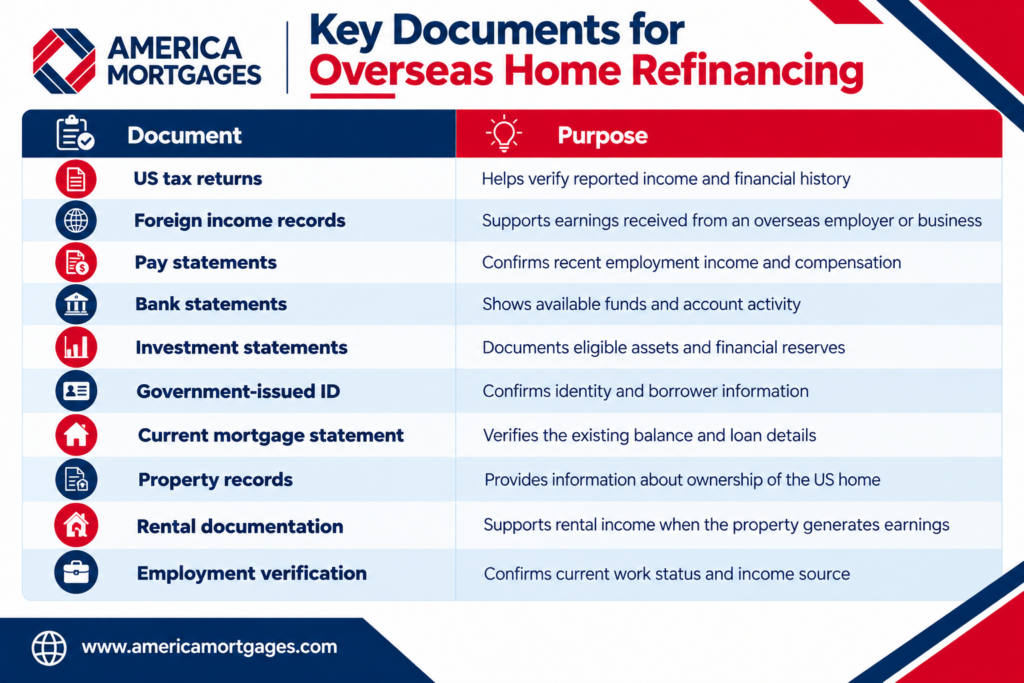
The foreign language documentation may require an appropriate English translation prior to completing the underwriting process. Currency conversion may also be involved if the income was earned abroad. Consistent documentation will ensure that verification is easier and prevents any unnecessary requests for documentation during the process.
Documents will also be required by self-employed individuals to demonstrate business stability and continued income. For further information on financing or refinancing of US residential property by overseas borrowers, please see US residential mortgage options for overseas borrowers.
Case Study: Expat Reduced Long-Term Financing Costs
An expat who lived in Hong Kong had a four-bedroom house in Tempe, Arizona, which was valued at $560,000 and mortgaged for 80% LTV with a loan of $448,000. He made income from abroad and used the property for short-term rentals.
The team at America Mortgages worked to help refinance the property based on his foreign conditions. The borrower did not have any payslip, W-2 form, or US bank account. His foreign income and the property information were well documented. A one percentage point reduction in interest rate was accomplished.
Start Your US Expat Refinance with America Mortgages
Refinancing from another country is challenging when all your income, bank account, and lifestyle are in another nation. Professional mortgage advice can be very helpful in understanding all the details involved. One will have a chance to assess his or her own property, existing mortgage, finance documents, and desired results.
America Mortgages has helped a lot of US expats with the search for financing options for their properties situated in the United States. They can help in assessing your finances, properties, documents and even available loan options in your case.
Do not hesitate to contact America Mortgages for more information on your US expat refinancing possibilities. Please contact us at any time and we will gladly assist you. Contact us at +1 (845) 583-0830 or [email protected].
FAQs
Q1: Can I refinance my US mortgage if I live in another country?
Yes, you can refinance a US mortgage even while being out of the country. The requirements set by the lender will determine your eligibility to refinance the mortgage and the type of loan that may be available to you.
Q2: Can I refinance my US home without a US bank account?
Yes, you can refinance a property in the USA without a USA bank account under certain lenders and loan programs. But you may have an alternative way to prove that your financial situation is solid.
Q3: Is refinancing a US home worth it if I live overseas?
A US home refinance while you live abroad is worth considering if it can help save money and improve your terms and goals. But make sure to consider the closing costs, savings per month, loan tenure, and breakeven period.
Q4: Can I refinance a US rental property while living abroad?
Yes, one can refinance a rental property in the US while abroad based on the lender and the kind of loan program being sought. This is dependent on the rental income, value of the property, equity, credit score, and foreign income.
Q5: Can I get a lower mortgage rate as a US expat?
Yes, a mortgage rate discount is possible for an expat in the USA, based on credit rating, salary, down payment amount, loan type, and market situation. Comparison of refinance options that you are qualified for may indicate a better deal.
Share this article
Ready to get started?
Speak with our U.S. mortgage specialists today and discover your options.
Schedule a call