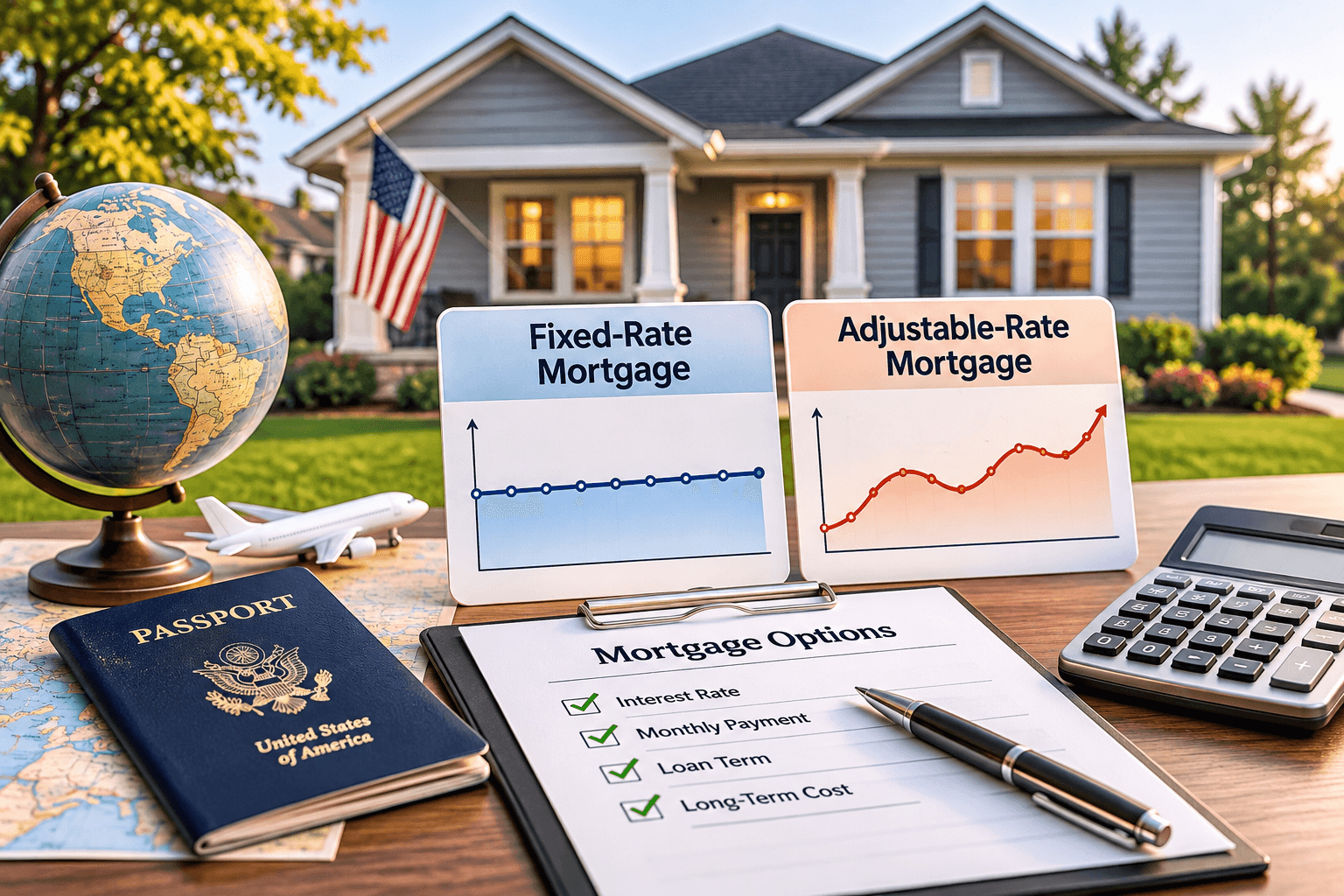
A fixed rate mortgage is typically preferred by expatriates for reliable monthly payments and financial security in the long term. Meanwhile, an adjustable rate mortgage may work for those who plan to keep their property ownership for a limited period of time. The type of mortgage to choose will depend on a variety of factors including your income, property objectives, financial flexibility, and willingness to accept future fluctuations in interest rates.
American expatriates also need to take into account currency volatility, lender restrictions, and mortgage refinancing. Earnings made outside the US may influence the ability to obtain and repay the mortgage. That is why it is important to know how different mortgage structures differ when you are considering home purchase. If you are looking for information on international property financing, guide on buying property in Washington from the UK may provide valuable information on owning a house overseas.
America Mortgages will assist expatriate Americans and foreign citizens in finding the most appropriate financing solutions using access to more than 150 lender programs in the USA.
How Does a Fixed-Rate Mortgage Work for US Expats?
A fixed rate mortgage means that you are able to take out a loan at an interest rate that will not change for the entire duration of your borrowing. You can be assured that the payment of your principal and interest will remain the same despite changes in the market rate.
Key Features of a Fixed-Rate Mortgage
| Feature | Explanation |
| Stable interest rate | The agreed rate remains unchanged throughout the loan term. |
| Predictable payments | Monthly principal and interest payments stay consistent. |
| Common loan terms | Borrowers can choose 15-year, 20-year, or 30-year options. |
| Interest protection | Market rate increases do not affect your agreed rate. |
| Loan amortization | Each payment gradually reduces the outstanding principal. |
| Refinancing option | You may refinance if better terms become available and you qualify. |
According to CFPB, fixed-rate mortgages have a constant interest rate during the life of the loan. These are different from adjustable mortgages as they give certainty on both principal and interest payments. This facilitates budgeting for a long time among those who seek financial stability.
In cases where the money earned is in other countries, such a mortgage can be ideal in simplifying the process of financial planning. This is because a borrower living in the USA, who earns money in Dirhams, can easily make repayments in USD. Nonetheless, exchange rates can complicate matters when it comes to mortgage repayment.
Fixed-rate mortgages are ideal for those borrowing to acquire retirement homes, vacation homes, or rental homes. When going for this type of mortgage, consider the terms of the loans, down payment needs, closing costs, and the eligibility of the lenders. Refinancing requires approval, which entails more costs.
Is an Adjustable-Rate Mortgage a Better Option for Americans Living Abroad?
Adjustable-rate mortgages (ARMs) are perfect for US expats who are considering selling or refinancing their home before the introductory period is over. ARM often comes with a lower interest rate compared to fixed mortgages. Future rate changes will affect your budget negatively since you’ll be facing an extra burden.
Consider some major factors about this option before making the final decision:
Key Features of an Adjustable-Rate Mortgage
- Lower initial interest rate: Some ARMs feature lower interest rates than fixed mortgages.
- Fixed interest rate during introductory period: Your interest rate will not change during the first period.
- Scheduled rate changes: Interest rate changes are made once the introductory period ends.
- Interest rate cap: These caps limit how much your interest rate can change.
- Interest rate calculation using index and margin: Lenders usually determine future rates based on the index and margin.
- Short-term flexibility: This option may work best for people who plan on selling or refinancing in the near future.
As per the ICE Mortgage Monitor of October 2026, adjustable-rate mortgages made up more than 11% of mortgage rate locks, which is their highest share in close to four years. But ARMs made up just 5.6% of active American mortgages. In addition, some ARM customers who will be resetting their loans in 2027 stand to experience a rise in the median monthly payments by about $1,066.
If you are a citizen of America residing outside of the country, an ARM will allow you to enjoy some money-saving benefits during the introductory period. It is advisable to plan ahead for future increases in payments. The exchange rates may influence those who earn foreign incomes. Hence, it would help to check the adjustment schedule and lifetime caps of the loan as well as the maximum amount that might have to be paid.
How Should US Expats Compare Fixed and Adjustable Mortgage Options?
US expats should compare interest rates, monthly payments, loan terms, and future financial risks before choosing a mortgage. With a fixed-rate mortgage, you have guaranteed repayments, while an adjustable mortgage allows you to reduce initial expenses. The period of ownership, foreign income, and financial flexibility should be considered.
Duration of Loan and Plans for Property Ownership
Think about how long you will own the house. Fixed mortgages fit well for a long time, but ARM suits better if you want to resell the property before the initial term comes to an end. Selling cost and future market situation should always be considered.
Interest Rate and Monthly Payments on the Beginning of the Loan
Make a comparison of initial rates that offer both types of mortgages. ARM provides a possibility to have lower initial monthly payments, but fixed mortgage ensures stable payment of the principal and interest amounts.
Future Paying Increases and Interest Caps
Take into account the initial, periodic, and lifetime interest caps. It helps you to define what changes may happen during the loan duration. Calculate your repayment of the mortgage at increased rates.
Currency Exchange and Foreign Earnings
Think about the currency in which you get paid. Your mortgage repayments will be made in US dollars. Thus, the movements in the exchange rate may influence your repayments. Save enough money to cater for currency movements and other unforeseen financial obligations.
Costs of Refinancing and Financial Flexibility
Ensure you have evaluated the possibility of refinancing before the end of your introductory rate. Look at the closing costs, credit requirements, and home appraisal. Do not take for granted that you will be approved. Rather, opt for financing that you can afford without counting on refinancing in the future.
Fixed vs Adjustable Mortgage: Monthly Payment Calculation
Suppose a US expatriate borrows $400,000 for 30 years using two different interest rates.
| Calculation details | Fixed mortgage | Adjustable mortgage |
| Loan amount | $400,000 | $400,000 |
| Initial interest rate | 6.50% | 5.75% |
| Loan term | 30 years | 30 years |
| Monthly principal and interest | $2,528 | $2,334 |
| Annual principal and interest | $30,336 | $28,008 |
The flexible mortgage initially saves about $194 per month or $2,328 per year. However, payments might rise once the promotional period expires. On the other hand, the fixed mortgage provides regular principal and interest repayments.
The above figures do not include any property tax, homeowner’s insurance, mortgage insurance, or other expenses. Payments vary from one lender and borrower qualification to another.
For additional guidance, explore guide on US mortgages for American expats. The guide offers insight into qualification with foreign income, mortgage options, and financing of Americans residing outside their country.
In conclusion, pick a mortgage plan that favors your financial goals. Make sure to consider the total cost of borrowing instead of considering the introductory payments alone. Additionally, ensure that you have enough money to cover any emergencies and fluctuation in currency.
What Mortgage Requirements Should US Expats Prepare Before Applying?
US expats should prepare documentation regarding identification, income, tax records, bank account statements, and credit history. The provided papers will help lenders assess the financial state and likelihood of repayment of the loan. Requirements will depend on mortgage programs, kind of employment, and the reason for property purchase.
The bank may ask the applicant who is self-employed for some additional documents. They may include business account statements, financial statements of profit and losses, and any other papers related to the business and its registration. Moreover, papers written in another language must be translated into English. Uniformity of all provided documentation will help to avoid additional complications.
Income sources and property use will determine the documentation that needs to be submitted with the application. For instance, buying an investment property is regulated by some other rules than getting a second home. Hence, it is better to study your options before filing an application. Study guide on foreign income requirements for US expat mortgages to learn more about income documentation and verification by banks.
Case Study: Swiss Investor Secures $3.75 Million Financing for US Property
A client from Switzerland wanted to fund an investment property in the U.S. However, he faced a problem in that his money was locked up in the European securities market, and it would take about 30 days for its liquidation.
In this situation, America Mortgages helped arrange a $3.75 million bridge loan with an asset-based underwriting approach. The funding was finalized in just 11 days without a US credit check or Swiss tax filing.
Speak With America Mortgages to Find the Right US Expat Mortgage
Selecting from the options of fixed rate mortgages or adjustable rate mortgages is something that needs to be done after proper considerations in accordance with your financial objectives. Your income from abroad, property expectations, and the ability to pay back in the future may affect your decision, so considering the various loan programs available is essential.
Dealing with a specialist in mortgages can facilitate your financial process significantly. America Mortgages has connections with over 150 loan programs in the U.S. for expats and foreigners living abroad. Their experts will guide you through all necessary requirements of lenders and help you find mortgage solutions.
You can contact America Mortgages now to have your financing questions answered. You may call +1 (845) 583-0830 or email hello@americamortgages.com. Go to America Mortgages to arrange an appointment.
FAQs
Q1: Can I get a US mortgage while living and working abroad?
Yes, US citizens residing outside the U.S. can be eligible for mortgages by using the right lenders. However, one must be approved according to their credit record, income, debt, and property. Mortgage companies specialize in handling foreign clients. Hence, they will be able to find financing schemes for individuals working abroad.
Q2: Do US mortgage lenders accept foreign income?
Yes, some US specialist lenders accept income earned from foreign countries. But you have to be able to prove that your income is authentic for them to grant you a loan. You might need to provide an employment contract, pay slips, bank statements, and tax returns.
Q3: Does living overseas affect my US mortgage interest rate?
Yes, living overseas may affect mortgage rates and choices for mortgages. However, how great of an effect it will have will depend on your personal financial situation and the selected lender. Other factors to consider include your credit score, the kind of property, the loan amount, and the down payment.
Q4: Can I buy a US investment property without living in America?
Yes, eligible foreign buyers can buy US real estate investments even if they are not living in that country. However, different lenders have their own set of requirements depending on their type of clients. They may need proof of income, identity, financial statements, as well as property information.
Q5: What credit score do I need for a US expat mortgage?
There is no universal minimum credit score for every US expat mortgage program. It depends on individual lenders and the way loans are structured. The better your credit score is, the more financing options you will have. Some special lenders take into account other financial proofs as well.
Share this article
Ready to get started?
Speak with our U.S. mortgage specialists today and discover your options.
Schedule a call