Equity Rich Homeowners
How Equity Rich Homeowners are Cashing In

U.S. homeowners have seen their equity increase by over 32.2% since the first quarter of 2021. That’s a year-over-year gain of over $3.8 trillion. This significant increase in home equity has provided many homeowners with the opportunities to cash in through home equity loans, cash-out refinancing, or home equity lines of credit (HELOC). 

What Does it Mean to be Equity Rich?

Equity is the market value of your home minus your mortgage balance. Homeowners are considered equity rich when they have a minimum of 50% equity in their homes. The number of equity-rich homeowners typically increases as property values soar because the market value of people’s homes is increasing while the amount they owe does not. 

Understanding the tremendous increase in property value across the United States over the past year, it’s only logical that there would be a steep increase in equity-rich homeowners. 

Why is Home Equity Important?

Home equity is an excellent long-term wealth-building strategy. To demonstrate just how true this is, let’s compare an auto loan to a mortgage. When you take out an auto loan, you are paying interest on an asset that depreciates in value as soon as you drive it off the lot. That means that when you’ve paid off the loan, the car will most likely be worth less than your purchase price and you will have paid interest. 

In contrast, mortgage payments reduce your debt while your home increases in value. Of course, property values could drop, but that is unlikely to happen over the long term. One very financially powerful aspect of this is that you don’t need to sell your home to profit from it. 

How to Access Home Equity

  1. Home Equity Loan — Think of this as taking out a second mortgage for a fixed rate that must be repaid within a set period. Home equity loans often have slightly higher interest rates than primary mortgages because if a home is foreclosed, the primary lender must be repaid first.
  2. HELOC — Like a home equity loan, a home equity line of credit (HELOC) acts like a second mortgage, but it provides more flexibility for the borrower. That’s because HELOCs have a revolving balance like a low-interest rate credit card—you can borrow what you need, repay it, and borrow again. There are usually no closing costs, and HELOCs typically have adjustable rates that vary with the prime rate.
  3. Cash-Out Refinance — This option leaves homeowners with less equityin their home because you are refinancing your home for a larger amount and taking the difference in cash. Banks typically see this as riskier, meaning that closing costs can be higher. 

The best for cashing in on your equity depends on your goals. For example, a home equity loan would be great for medical fees, educational expenses, and debt consolidation because you have immediate access to the money. 

In contrast, a homeowner who needs money periodically for home improvements or a business might opt for a HELOC, and a cash-out refinance is typically best for those who need cash immediately. 

Should Equity Rich Homeowners Buy or Sell?

Both buying, selling, and staying in a home with untapped equity could be beneficial. Homeowners who want to sell can purchase another property and use a HELOC to make renovations on their first home while they live in their second. They could also take an equity line of credit to make a downpayment on a new home. 

However, staying in an equity-rich home can also be a wise financial decision. You can still cash in on the equity and enjoy the increasing value of the home. Keep in mind that if you sell a home in an up market, you will have to buy a home in an up market. 

Interested in releasing equity? America Mortgages has a 97% approval rate for both U.S. Citizens & Foreign Nationals. As a company our only focus is providing market rate U.S. mortgage financing for foreign nationals and U.S. expats. No one does it better!

Schedule a call with us at [email protected] today! 

www.americamortgages.com

Postcard from Austin

If you have been following the news, it’s no surprise Austin, Texas is by far the most popular destination for US property investors. This was echoed in our Deep Dive report, where we use empirical data to support this conclusion and the drivers behind its strong price appreciation and high (very) high rental yield. 

I would like to introduce you to our Summer Associate, Joaquin Penelas, who is attending Boston College and hails from Austin and has shared his views of the city; insights not available from any newspaper. 

Did you know that there are different parts of Austin that Californians prefer to own that is different from where New Yorkers prefer?  

Joaquin discusses in his report and explains why! 

“I like it here in Austin. Anybody got a room?” – Keith Richards, Rolling Stones

In the last 10 years, deep in the heart of the Lone Star State has emerged a booming, trendy, quirky, and self-proclaimed weird city called Austin, Texas. You may have heard of the housing market. You may have heard of the job opportunities. You may have heard of the food, parks, music, nightlife, shopping, and all-around astonishingly friendly people found one of the most popular and sought-after cities to live in the United States. So, what makes Austin so desirable? 

As a proud Austinite for over 15-years, there is so much to it that is living up to the buzz and hype you hear from your friends and families who have recently moved from California, New York, and Massachusetts, the states where the most people are coming from. 

There are a couple of aspects of Austin that make it so desirable for professionals. To begin, many global companies are relocating or setting up huge branches. Austin is home to the Oracle headquarters, the new Tesla Gigafactory, VRBO, Cirrus Logic, Dell Technologies, a brand new $1 Billion Apple campus, Meta/Facebook offices, and SpaceX facilities. Amazon is adding thousands of jobs, and it is a great spot for computer manufacturing, tech, finance, and a hot spot for startups as Austin takes first place in cities to start a company in the United States. 

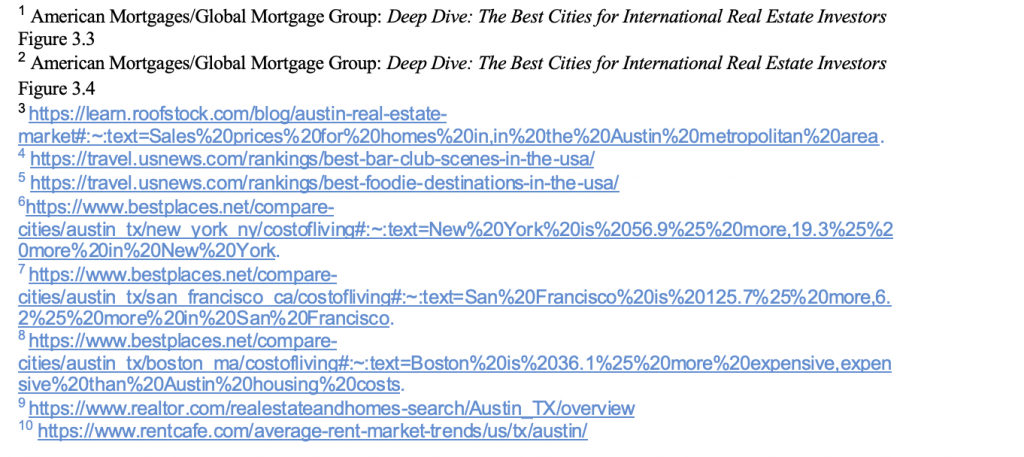
With overwhelming support for small businesses, a very educated workforce due to the high-profile companies located here, the University of Texas at Austin pumping out red-hot talent from the business, computer science, and engineering schools, and a record-setting 387 Venture Capital deals valued at $4.9 Billion in 2021, entrepreneurs from all across the United States are coming to Austin to change the world. If you take a look at our Deep Dive: The Best Cities for International Real Estate Investors[1], Austin is ranked as the top city in the United States and one of the best in the world for job prospects due to the high amount of companies moving there and building their roots there. 

Furthermore, the housing market has been incredibly kind to homeowners, with a 36% increase in home value since 2020[2]. Properties in Austin stay on average 22 days in the market, and with an average of 184 people moving there per day in the last decade alone, home demand has skyrocketed, making it a worthwhile investment if you’re looking to rent out a property or are looking for a property with high appreciation. 61% of homes in Austin are occupied by renters, and with rents for 3-bedroom places increasing by 27% over the last three years, it is hard to ignore the lucrative opportunities at stake[3].

Austin, Texas skyline from Zilker Park
Austin, Texas skyline from Zilker Park. Photo by Joaquin Penelas.

Neighborhoods like Tarrytown offer quick commutes to downtown in under 5 minutes with great food, shopping, and lake access- which is huge in the summer. We have seen people from denser cities move closer to the city, so from what I have seen and heard from others, if you are from New York City or other cosmopolitan areas, Tarrytown, just west of the central financial district of Austin, is the place to be for professionals with families. Located right by Austin High School and O’Henry Middle School, which are a part of the Austin Independent School District. Austin ISD is also home to the Liberal Arts and Science Academy (LASA), which claims the title of second-best public school in Texas and number 10 among magnet schools across the United States. Tarrytown is one of the best places to raise a family in Austin due to its proximity.

South Congress has also proved to have a great city-neighborhood feel to it, being right by the hottest food and shopping parts of Austin- also a quick 5-minute drive from central Austin and super friendly for young millennials moving out of big cities without families yet with top nightlife districts right up the street.

The Independent & Seaholm neighbourhood in Central Austin
Left: The Independent; Right: Seaholm neighbourhood in Central Austin. Photos by Joaquin Penelas.

West Austin, penetrating the foothills of the hill country, offers amazing Beverly-hill style hills, views, and luxury homes, along with the best public school district in Texas- Eanes Independent School District, with Westlake High School being the 4th best high school in Texas. With incredible teachers, facilities, and sports programs like the football team dominating the state with three consecutive championship titles since 2019, it is another great part of town to raise a family. Californians are escaping the high taxes and costs of living to move to West Austin due to its similarity to the Californian hills and neighbourhoods. West Austin is also home to Lake Austin, which is exactly what you need for all of your water-sports needs from wake surfing, waterboarding, tubing, jet skiing, kayaking, and so many more year-round activities- even in winter. Lake homes in West Austin have skyrocketed, making it hard to find anything too affordable for the average homeowner but offering incredible property options for the new executives and high-ups for the companies making Austin their home and headquarters. And with star-studded neighbors like Joe Rogan, Matthew McConaughey, billionaire video-game designer Richard Garriott, and a rumored lake estate owned by Elon Musk, they prove that it is hard to go wrong in West Austin. 

If the neighborhoods with characteristics for people from any part of the United States did not convince you, if the lucrative job opportunities did not convince you, if the phenomenal property appreciation did not convince you, then maybe the fact that Austin is ranked 8th in the States for nightlife will change your mind.[4] Or that Austin is ranked 13th in the nation for the best food will change your mind.[5] Or the fact that it is the live music capital of the world and you can see live shows almost every night and drink a local beer will change your mind. Or that Austin is surrounded by parks, greenbelts, lakes, and nature areas, so you can get your outdoor fix with your dogs at Zilker Park, take a boat out with your friends, go hiking on one of the 130 trails, or bridge jump into the year-round 68°F crystal clear Barton Springs water will change your mind. The Formula 1 Circuit of the Americas track is a 20-minute drive from downtown if you enjoy tracking your cars or watching motorsports. The Hill Country is littered with vineyards if you prefer to indulge in wine-tasting tours. All in all, Austin is a great place for your career, your property value, raising kids, or even discovering what it is like being young, independent, and single on Rainy Street or 6th street is like. There is something for everyone under the violet skies and the big and bright stars deep in the heart of Texas. 

Key Statistics: 

  • New York City is 56.9% more expensive than Austin. Housing is 84.4% more expensive than in Austin.[6]
  • San Francisco is 125.7% more expensive than Austin. Housing is 273.6% more expensive than in Austin.[7]
  • Boston is 36.1% more expensive than Austin. Housing is 63.3% more expensive than in Austin.[8]
  • Median home prices in Austin are $639.9K. The median price per square foot is $356.[9]
  • The mean rent in Austin is $1,735, with the mean apartment size being 862 sq. ft.[10]

Global mortgage group

Tax Strategies for U.S. Real Estate
There are many income tax issues that must be considered when a foreign national invests in U.S. real estate.  

There are many income tax issues that must be considered when a foreign national invests in U.S. real estate.  

The analysis begins with the foreign national’s tax status in the U.S. tax system:

1) Are they U.S. citizens (dual citizens)? 

2) If not, do they hold a “Green Card” that allows permanent U.S. residency status?  

3) If not, do they meet the “substantial presence” test?

4) If they do not satisfy these tests, they are treated as a U.S. non-resident. 

The following comments summarize some of the most important items to consider before investing in U.S. real estate, including:

  • U.S. citizens and U.S. residents – global taxation
  • U.S. non-residents and foreign entities – U.S. source income taxation
  • Foreign nationals – U.S. residents vs. U.S. non-residents 
  • Foreign Investors Real Property Tax Act (FIRPTA)
  • Rental income from U.S. sources received by U.S. non-residents and foreign entities  
  • Rental activity U.S. trade or business election
  • Personal use real estate
  • Holding title to U.S. real estate
  • International Income Tax Treaties
  • State income taxes

U.S. Non-residents and Foreign Entities – U.S. Source Income Taxation

Foreign nationals who are not U.S. citizens or U.S. residents are treated as U.S. non-residents. U.S. non-residents and foreign entities are subject to U.S. income tax only on their U.S. source income.  

“Fixed or Determinable Annual or Periodic Income” (FDAP) is income that is not effectively connected with a U.S. trade or business. FDAP includes income such as interest, dividends, rents, royalties, etc. FDAP is subject to U.S. income tax withholding at a 30% rate. FDAP income is taxed on a gross basis and is not reduced by any related expenses.  

U.S. source capital gain income earned by U.S. non-residents generally is not subject to U.S. income tax, but FIRPTA has a critical difference, as discussed below. 

Income earned by U.S. non-residents that are effectively connected with a U.S. trade or business is subject to the same tax rates imposed on U.S. citizens and U.S. residents. Effectively connected income is taxed on a net basis (gross income less allowable expenses).  

Foreign Nationals – U.S. Residents vs. U.S. Non-residents 

Foreign nationals who are not U.S. citizens can be taxed as U.S. residents on their worldwide income under two different tests. 

A foreign national that has a “Green Card” that allows permanent U.S. residency status is taxed as a U.S. resident.  

A foreign national is also taxed as a U.S. resident if they meet the “substantial presence” test. The substantial presence test is based on the number of days that the foreign person is present in the U.S. The substantial presence test is a formula that includes the sum of: 

1) 100% of days present in the U.S. in the current tax year, 

2) One-third of days present in the U.S. in the prior tax year, and

3) One-sixth of days present in the U.S. in the second preceding tax year.

If the sum is at least 183 days, then the foreign national is treated as a U.S. resident taxable on their worldwide income. 

A foreign national that is not a U.S. citizen or a U.S. resident is treated as a U.S. non-resident. 

It is important for U.S. non-residents to keep track of the number of days that they spend in the U.S. so that they do not inadvertently become a U.S. resident. 

Foreign Investors Real Property Tax Act (FIRPTA)

FIRPTA imposes special income tax rules for foreign parties that invest in U.S. real estate, and it was enacted over 40 years ago. 

As discussed above, U.S. source capital gain income earned by U.S. non-residents generally is not subject to U.S. income tax. 

However, FIRPTA has a significantly different rule. 

FIRPTA treats gains derived from the disposition of real property located in the U.S. as effectively connected trade or business income. This means that U.S. non-residents who recognize a gain on the sale of U.S. real property are treated as taxable U.S. source income.

Rental Income from U.S. Sources Received by U.S. Non-residents and Foreign Entities  

There is some uncertainty about whether real property rentals qualify as a U.S. trade or business or as an investment activity. 

The tax consequences of a U.S. trade or business compared to an investment activity are dramatically different, as illustrated in the example below.

Real property rentals may qualify as a U.S. trade or business based on the facts and circumstances, but only if there are substantial operating and management activities. A real property rental business is taxed on a net basis. Net taxable income is gross income less allocable operating expenses, including mortgage interest, property taxes, insurance, repairs, maintenance, etc.  

Ownership of one rental property will almost always be treated as an investment activity. Investment activity character usually will apply unless several properties are owned and actively managed by the U.S. non-resident. The gross income from a real estate rental investment activity is subject to 30% income tax withholding.  

For example, assume that a U.S. non-resident owns a U.S. rental property that has a rental income of $50,000, rental expenses of $50,000, and net taxable income is zero. A rental business would pay no income tax because it has zero net taxable income. A real estate rental investment activity would pay $15,000 U.S. income tax withholding on its $50,000 gross income (30% times $50,000 gross income).

Rental Activity U.S. Trade or Business Election

The U.S. non-resident owner can make an election to treat an investment rental activity as a U.S. trade or business (“net election”). The net election would mean that the investment rental activity would be taxed on a net basis as a U.S. trade or business. The result in the above example would be that the real estate rental investment activity would have no gross income tax withholding and zero net income tax.

Most U.S. non-residents that do not own multiple rental properties that have substantial management and operating activities make the net election in the year that they purchase the rental property.

Personal Use Real Estate

Personal use real estate owned by U.S. non-residents that do not produce rental income will not be subject to U.S. income tax. Likewise, the carrying costs will be personal, non-deductible expenses. This includes mortgage interest expenses, real estate taxes, insurance, repairs, etc.   

Holding Title to U.S. Real Estate

A foreign national can hold the ownership title of U.S. real estate in their individual name. 

Many owners choose to hold title to U.S. real estate through a legal entity, including U.S. citizens, U.S. residents, and U.S. non-residents. There can be several reasons to do so, including legal liability insulation and confidentiality. The most common structure is to form a limited liability company (LLC) and use the LLC to take title upon purchase.    

An LLC that has only one owner is treated as a disregarded entity (DRE) for U.S. income tax purposes. A DRE’s activities are deemed to be conducted by the sole owner for U.S. income tax purposes, and the DRE is not required to file U.S. income tax returns.  

Some states, such as California, require DRE LLCs to file simple information returns and impose a minimum tax and/or a gross receipts tax.

The sole owner can contribute U.S. real estate held in their individual name to a single-member LLC as a non-taxable transaction for U.S. income tax purposes.

International Income Tax Treaties

The U.S. has almost 70 Income Tax Treaties with foreign countries. Income Tax Treaties supersede the income tax rules of both countries. Each Treaty is separate and distinct, and the provisions and details in each Treaty may differ. Treaties can provide better tax results than the consequences under the host country’s income tax rules, and they rarely provide detrimental results.

A foreign national must be a citizen or resident of the Treaty partner country to claim the benefits of that Income Tax Treaty.

The 30% U.S. withholding FDAP tax rate is usually reduced or eliminated under most Treaties.

Most Treaties provide a “tie-breaker” rule when a foreign national is treated as a resident under the laws of both countries. 

The tie-breaker will determine which country will treat the foreign national as a resident.  

State Income Taxes

Most states have an income tax, which is separate from and in addition to U.S. income tax. Many states follow federal income tax rules and have stated differences, but some have their own system. States are not part of the U.S. government, so they are not subject to and do not follow U.S. international Income Tax Treaties.    

Rental income usually is taxable in the states that have an income tax. Most states do not have an FDAP system. The specific rules in the state that you plan to invest in must be considered.

Most states also have various non-income tax fees and filing requirements.

www.americamortgages.com

Housing Market in the U.S.
2022 has been a particularly hot year for the U.S. housing market overall, but in sunny Tampa, Florida, that market is scorching.

2022 has been a particularly hot year for the U.S. housing market overall, but in sunny Tampa, Florida, that market is scorching. The city was rated as the hottest market of 2022 by Zillow, outranking other hot markets like Austin, Texas, and Phoenix, Arizona.

Overseas buyers likely know Florida for its excellent weather and as a mecca for retirees, but this is not the primary impetus for its home value growth. Rather, the city is experiencing growth at the same time the average 30-year fixed U.S. mortgage rate has jumped above 5%. Furthermore, Fannie Mae has recently predicted that home prices will increase by 10.8% this year and another 3% in 2023.

In short, the city of the sun is experiencing a perfect storm for home prices to break even more records in 2022.

Price Growth

Throughout the fiscal year of 2021, home values experienced record-breaking growth across the United States. This was due, in part, to limited inventory. Additionally, many millennials began reaching prime home-buying age while boomers were downsizing for retirement. This demographic shuffle, exaggerated further by the pandemic, created the perfect environment for increased valuations.

This course is likely to continue into 2022 as the housing supply is still limited and prices are already high. Some markets are expected to slow as they reach a ceiling of valuation, however,

Tampa is a unique case, leaping from the fourth-fastest home value growth in 2021 to the fastest this year.

Supply and Demand

Anyone who has sat through an Econ 101 class could understand the variables fuelling the meteoric gains in value taking place in the Tampa housing market. They are:

● High demand

● Restricted supply

● Fewer willing sellers

● Fewer homes are being built.

The demand is not only due to people looking to buy a home right now, but because they have been looking for a new home since 2021. Many Americans found themselves touring home after home last year, only to find crowds of competitors putting in higher and higher offers to snatch up their dream home. This put the ball in the seller’s court, allowing them to set higher and higher prices.

In a state like Florida, where many boomers retire, and many millennials are moving for business opportunities, this phenomena has been even more pronounced.

Former Hot Spots Cooling Down

Formerly hot markets like New York, San Francisco, and Chicago are expected to be the coolest of 2022. These cities offer fewer jobs and unfavourable demographic trends compared to a market like Tampa.

Many individuals who lived in or would have moved to these megacities in the past have been untethered by remote work and want to take advantage of lower taxes, competitive business conditions, year-round sunshine, and miles of white-sand beaches.

Risks

No investment is without risk, and the Tampa housing market is no exception. Home loans will likely become more expensive as U.S. and Florida mortgage interest rates are expected to rise in 2022. The result would be restricted inventory access in expensive markets like Tampa and could increase competition for cheaper homes.

Sellers already invested in this market may benefit, but those looking to leap into this hot market would be wise to start looking sooner rather than later.

100% of our clients are living outside the U.S. Every loan program America Mortgages features are specific to these markets. We understand the landscape, the clients, and the process better than anyone else. 

Keen to know more? Arrange a no-obligation call with one of our loan specialists today. [email protected].

US Home Loan

Canada’s housing market is hot. Home prices have rocketed 30% since early 2020, and the Canadian Real Estate Association recently reported that the average price of a Canadian home was nine times the average household income. 

It wouldn’t be ridiculous to assume that things might be comparable just across the border to the south in the U.S. In fact, price increases in the U.S. have been only slightly lower, at 27%. Despite this, the standard home in Canada now costs twice as much in the U.S. There is clearly more to the story here.

Canadian Housing Market vs. The U.S. Housing Market

Just how much more expensive is the Canadian market compared to the U.S.? Here’s some perspective. Home prices in both countries have been rising since 2010; however, while disposable income in the U.S. has roughly matched its home prices, Canadian disposable income has become entirely uncoupled from them. 

Disposable income in the U.S. is only about 10% higher than its neighbour to the north, but Canadian home prices are about 75% higher than in the U.S. What this tells us is that despite a surge in the price of real estate in the U.S., it is likely not in a bubble. In contrast, Canadian prices are severed from fundamentals, which should unsettle any would-be investor. 

What if The U.S. Market Was as Hot as Canada’s?

To further put the dramatic difference in perspective, let’s imagine that the U.S. had a comparably hot market. The average median home price in the United States is roughly $375,000. If what’s happening in Canada happened in the U.S., the median home price would jump to around $656,000.

That’s just the median. Expensive coastal real estate markets likely wouldn’t see an increase of 75%, but it’s possible that they would jump by double-digit percentages. 

Most Affordable Countries in the World

The U.S. real estate isn’t just more affordable than Canada’s, it’s the second most affordable country in the world, according to data from Numbeo, Canada is the 17th. The report takes income, gross rental yield, price-to-rent, and international mortgage as a percentage of income into account when ranking each country. 

According to the data, the average Canadian spends a whopping 49.62% of their income on their mortgage. 

Investing in Real Estate in the U.S. 

Canadians are buying US real estate. In fact, Canadians bought more real estate in the United States from April 2020 to May 2021 than any other country in the world, spending about $4.2 billion dollars (foreign buyers from the U.K. only spent $2.3 billion).

Furthermore, in 2022, the Canadian government announced that it will ban overseas buyers from buying houses in Canada in hopes that it will help the housing market cool off. This will likely funnel more investment into U.S. real estate. 

Despite being a business-friendly economic powerhouse, with geographic diversity, excellent weather, and an abundance of land, real estate in the United States remains a bargain and one with great potential for returns. 

America Mortgages is the world’s leading U.S. mortgage specialist based overseas. We are expats ourselves so know exactly how to best serve you. Explore your possibilities when you speak to our U.S. mortgage specialists today!

Sounds enticing? Schedule a call with us to find out all about this and more! [email protected]

www.americamortgages.com

U.S. Expat Investor
Real Estate Can You Get for USD

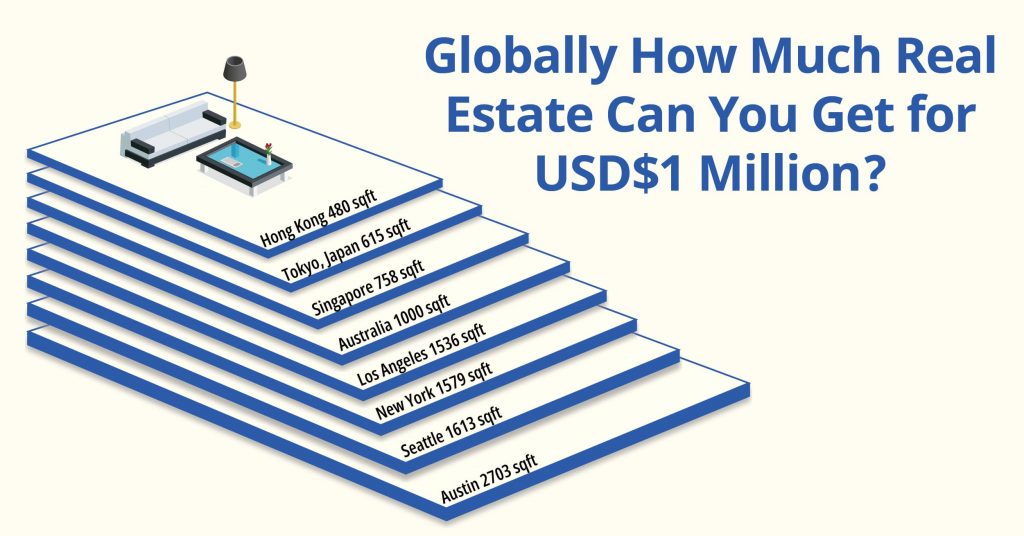
As a foreign national or U.S. expat investor, real estate remains one of the wisest and most lucrative investments one can make. With technology making the world smaller every day, there is no reason investors shouldn’t be searching out opportunities globally. However, when looking to invest in real estate, getting the best bang for your buck will help you get the most out of your investment when your property appreciates. Investing in global cities might not get you the profits you are looking for.

Below is a list of how many square feet of real estate you can buy for $1 million in 8 different cities around the world.

U.S. Average Price Per Square Foot
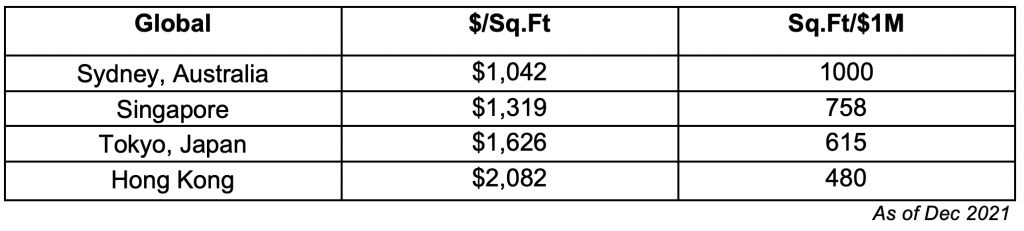
Global - Average Price Per Square Foot

Austin, Texas

Austin has become a hot spot for real estate investors because of its continued growth and high demand. The state reported a population of about 960,000 in 2020, a 21.7% increase over 10 years. It is one of the best-performing U.S. metro areas for business. While 2020 hit the economies of most U.S. cities hard, Austin added over 11,000 jobs. It’s home to advanced manufacturing, cleantech, digital tech, financial services, and space tech. If you are looking to buy property in the USA, Austin should be somewhere near the top of your list.

  • Average Price Per Square Foot — $370
  • Square Feet for $1 million — 2,702 

Seattle, Washington

A seaport city on America’s North-West Coast, Seattle is the largest city in Washington. Due to low mortgage rates, real estate sales in Seattle have remained robust in 2021 and 2022. A 2021 report from The Urban Land Institute (ULI) named Seattle as a boomtown, drawing in talented young workers. The local economy is expected to continue to grow, putting upward pressure on the price of real estate.

  • Average Price Per Square Foot — $620
  • Square Feet for $1 million — 1,613

New York, New York

New York is the most densely populated city in the United States, with almost 9 million people distributed over 300.46 square miles and over 20 million people in its metropolitan statistical area. Over the past decade, the city has continued to grow, gaining 629,000 residents between 2010 and 2020, more than any other city in the U.S. With its history as a port of entry for immigrants, New York is extremely diverse, and about 37% of its population is foreign born. In 2021, the city saw its highest sales volume since 1989 due to New York’s low mortgage rates, pandemic-related pent-up demand, and the reopening of the economy.

  • Average Price Per Square Foot — $633
  • Square Feet for $1 million — 1,579 

Los Angeles, California

Southern California is known for its year-round sunshine and overall excellent climate. Los Angeles is the second-largest country in the United States and boasts a stable job market, and is an excellent place for buying-to-let opportunities. It’s important to note that there are vast differences between neighbourhoods in L.A.; some are safe, expensive, and home to Hollywood elites, like Beverly Hills, while others have high crime and poverty rates.

  • Average Price Per Square Foot — $651 
  • Square Feet for $1 million — 1,536

Sydney, Australia

Sydney was the strongest performing Australian housing market in 2021, with property values increasing in nearly every area of Sydney. Some locations experienced as much as a 24% growth in housing prices. Among the global cities we compare, Sydney ranked 1st.

  • Average Price Per Square Foot — $1,042
  • Square Feet for $1 million — 1,000

Singapore

Singapore’s property market has a strong reputation as a solid investment sector. The island city-state boasts a highly developed market economy and is widely regarded as a free, innovative, and dynamic place to do business. Despite the pandemic, Singapore’s housing market has remained relatively healthy, with house prices rising by 2.16% year-over-year in 2020. This continued increase in housing prices signals strong demand.

  • Average Price Per Square Foot — $1,319
  • Square Feet for $1 million — 758

Tokyo, Japan

Japan remains the third-largest economy in the world, with many of its prefectures and regions having economies larger than even developed countries. Measured in terms of economic strength, Tokyo is the world’s largest city. It is home to a number of major corporations and attracts plenty of foreign businesses as a result of good working standards and a welcoming tax environment.

  • Average Price Per Square Foot — $1,626
  • Square Feet for $1 million — 615

Hong Kong

Hong Kong is the world’s most expensive city for real estate. However, the city is economically vibrant and relatively stable. Its low taxes, business-friendly policies, and excellent location have made it a favourite of investors around the world. Until 1997, Hong Kong was still a British Colony and has historically served as an important trade port, leading to its current prosperity.

  • Average Price Per Square Foot — $2,082
  • Square Feet for $1 million — 480

In comparison, the U.S. cities give you the best value for your money per sqft, and no global city seems to come close to it. Based on our list, if we compare the most affordable U.S. city – Austin, and the most affordable global city – Australia, the price per square foot in Sydney is 2.8x that of Austin’s! If this doesn’t convince you to set your sights on U.S. property, take a look at the rest of the cities:

Price comparison per Sqft:

Price comparison per Sqft

All of the global cities price per sqft are double if not triple that of U.S. cities. Investing in U.S. real estate might just help you get the best value for your money and prove itself to be a lucrative investment opportunity

At America Mortgages, our only focus is to provide mortgage financing solutions to foreign nationals and U.S. expat investors. This is all we do, and no one does it better.

Ready to start your journey? Arrange a no-obligation call with one of our loan specialists today. [email protected].

www.americamortgages.com 

Buying Property In The U.S.
Whether you're a foreign national or U.S. expat looking for an overseas investment property, buying real estate in the U.S. can be a wise and lucrative financial decision. However, in a country so vast, diverse, and spread out, choosing the best location can be a daunting task.

Whether you’re a foreign national or U.S. expat looking for an overseas investment property, buying real estate in the U.S. can be a wise and lucrative financial decision. However, in a country so vast, diverse, and spread out, choosing the best location can be a daunting task.

Luckily, a recent SmartAsset study examined home prices in over 400 U.S. metropolitan areas since 1997 and ranked them based on price stability and home value growth. The following are the top 10 best places to buy a house in the U.S. if you’re looking for the best return on your investment.  

1. Austin-Round Rock-Georgetown, Texas

The Austin-Round Rock-Georgetown Metropolitan area, also known as Greater Austin, is situated on the edge of the American South in Central Texas. The region is home to a number of major universities and boasts a diverse economy fuelled by software, semiconductors, education, and government services. 

  • Price Change — 368%
  • Population — 2,173,808
  • Median Age — 35
  • Median Household Income — $80,852
  • Median Value of Owner-Occupied Housing Units — $303,300

2. Boulder, Colorado

Boulder, Colorado, sits in the Boulder Valley, where the Great Plains and the Rocky Mountains meet. The city has a temperate climate, with most days of the year being sunny. Top employers include the University of Colorado at Boulder, IBM Corporation, Google, and Ball Corporation.

  • Price Change — 277%
  • Population — 108,777
  • Median Age — 28.8 
  • Median Household Income — $72,279
  • Median Value of Owner-Occupied Housing Units — $736,000

3. Midland, Texas

Midland, Texas, is a major producer of oil and natural gas and had the lowest unemployment rate in the United States, according to a 2014 report. The city is located in the plains of West Texas and has a semi-arid climate with cool to mild winters and hot summers.

  • Price Change — 266%
  • Population — 141,194
  • Median Age — 31.4
  • Median Household Income — $83,616
  • Median Value of Owner-Occupied Housing Units — $238,000

4. Odessa, Texas 

Odessa, Texas, ranked as the third-fastest-growing small city in the United States in a 2014 Forbes article. The city is the former home of the Bush family and is primarily fueled by the oil industry, with its economy rising and falling with the price of crude oil.

  • Price Change — 247%
  • Population — 122,630
  • Median Age — 30.4
  • Median Household Income — $63,829
  • Median Value of Owner-Occupied Housing Units — $159,700

5. Fort Collins, Colorado

Fort Collins, Colorado, is a mid-sized college town with an economy based on a mix of service-related business and manufacturing. High-tech companies like Hewlett Packard, Intel, and Microsoft all have offices in Fort Collins due to the resources of the Colorado State University research facilities.

  • Price Change — 242%
  • Population — 166,069
  • Median Age — 29.9
  • Median Household Income — $70,528
  • Median Value of Owner-Occupied Housing Units — $398,800

6. Rapid City, South Dakota

Rapid City, South Dakota, is home to many famous attractions, and Mount Rushmore is located in the nearby Black Hills. Rapid City’s largest sector is government services, with tourism and finance, and investment companies also making up a large part of the city’s economy.

  • Price Change — 231%
  • Population — 76,541
  • Median Age — 37.2
  • Median Household Income — $53,760
  • Median Value of Owner-Occupied Housing Units — $194,100

7. Dallas-Plano-Irving, Texas

Dallas-Plano-Irving, Texas, is one of North America’s largest business centers and is home to a diverse metropolitan economy. The region has an expanding light rail transit system that spans over 90 miles and 60 stations. 300 corporations, including 24 Fortune 500 companies, are headquartered here.

  • Price Change — 228%
  • Population — 4,997,015
  • Median Age — 34.9
  • Median Household Income — $74,251
  • Median Value of Owner-Occupied Housing Units — $254,300

8. Houston-The Woodlands-Sugar Land, Texas

Houston-The Woodlands-Sugar Land, Texas is also known as Greater Houston. It is the fifth-most populous metropolitan area in the United States and ranked first in employment growth in 2017. It has routinely been categorized as one of the top 10 best places to do business in the United States. 

  • Price Change — 221%
  • Population — 6,979,613
  • Median Age — 34.5
  • Median Household Income — $69,328
  • Median Value of Owner-Occupied Housing Units — $208,100

9. Kennewick-Richland, Washington

Kennewick-Richland, Washington’s economy is based on the Hanford Nuclear Reservation and agriculture. Three nearby rivers provide enough water for growing wheat, its most common product, and its semi-arid climate allows grapes to grow in its many wineries. 

  • Price Change — 217%
  • Population — 294,396
  • Median Age — 34.1
  • Median Household Income — $70,545
  • Median Value of Owner-Occupied Housing Units — $246,700

10. San Angelo, Texas 

San Angelo, Texas, has been routinely ranked as one of the best small cities for business and employment. For a city of its size, San Angelo has a diverse economy. Oil fields to the west employ many local residents, and the city boasts a strong agricultural industry.

  • Price Change — 214%
  • Population — 100,509
  • Median Age — 34
  • Median Household Income — $55,682
  • Median Value of Owner-Occupied Housing Units — $143,300

At America Mortgages, 100% of our clients are either Foreign Nationals or U.S. Expats. We understand the intricacies and complexities of this type of lending for our borrowers. It’s as simple as that. Providing competitive pricing with the assurance that your loan will close is our only focus, and no one does it better. Ready to begin your journey? Speak to us to find out more! [email protected]

www.americamortgages.com

U.S. Housing Boom

The pandemic and rising level of inflation have birthed a global housing boom. This spike prompted U.S. property investors to invest in a second home and building their real estate investment portfolios. Sophisticated U.S. real estate investors can foresee that rental prices will steadily increase along with rates. The question is; how exactly are they pulling this off? By releasing their equity for existing realestate! 

It’s safe to say that this trend began in last year’s second quarter. As per stats from Black Knight, Inc., that period saw the most significant quarterly volume in cash-out refinances in over a decade, with U.S. homeowners withdrawing $63 billion in equity from their homes. 

It’s tricky to identify the exact number of U.S. real estate owners cashing out from their current properties to purchase more. However, this pool has both experienced real estate tycoons and beginner investors hoping to become the next thriving generation of lessors. 

What Are The Chances Of Success? 

Of course, releasing equity to invest in a second home or investment may seem somewhat risky, especially for a first-timer, but this is not necessarily a doomed endeavour if you play your cards right. In fact, cash-out refinances have enabled countless non-resident and U.S. expat property investors to grow exponentially within a limited period. A majority of those who sunk that money into rentals now bring in thousands of dollars in rent. 

The thing is, interest rates have increased all across the nation. As a result, many first-time buyers cannot afford to purchase homes due to high mortgage rates, so they are forced to settle for rentals until the housing market becomes friendlier. With the soaring demand for these properties, landlords have no option but to push up rents. Therefore, you are likely to make huge profits from your rental property, which might even pave the way for you to purchase more. 

As you contemplate buying a second home or investment in the U.S. through releasing equity from your existing property, do your homework. Don’t make any purchase decision before you know exactly what you are getting yourself into by remortgaging. For example, what are the costs involved, and how do they measure against the potential proceeds from your new property or the expenses you will incur to take the best care of it? If these sound daunting, fret not, this is where America Mortgages comes in! Consult our team of expert mortgage advisors tohelp you judge if you are making the right choice. 100% of our clients are living abroad. As the global leader in this market, we know how to navigate through this process better than anyone. 

If becoming a U.S. real estate investor is on your bucket list this year and you own U.S. real estate, releasing your equity could be the fastest path to get you there. Yes, this could easily be a holiday home for you and your loved ones, or a buy-to-let and boost your monthly income. 

America Mortgages’ ONLY focus is to provide U.S. mortgage financing to foreign nationals and U.S. expats looking to buy, refinance or release equity for U.S. property. We offer the most comprehensive loan programs for international real estate investors. Ready to release equity to purchase your U.S. home?

Ready to release equity to purchase your second U.S. home? Speak to us today to find out more! [email protected]

Interest Rate Rise

Interest rates are going up – there is no doubt. However, depending on the property’s purchase price, a rise in rates amortized over a 30 year period may not be as bad as one may think. Interest rate increase converts the average home buyer into a renter. This creates a shortage of available rentals, which in return drives up rental rates. This could be the opportunity and time to increase your rental portfolio as a real estate investor. In fact, over the past couple of weeks, we’ve seen an increase in the number of applications received. Most of the applications are not first-time investors. These are seasoned and sophisticated investors that look at real estate investing not as a quick flip but as a long-term hold.

Nick Worthing, America Mortgages’ Head of Sales, states, “The amount of money real estate investors make from rent is more significant when interest rates are higher. When interest rates go up, it will be more expensive for people to borrow money, which means that they will be less likely to buy a house or apartment and rent instead. When rates go up, landlords see an increase in their rental income simply because people will be willing to pay higher rents for properties with higher yields”.

How are increased rates advantageous to real estate investors?

1. Rent is at an all-time high.

Low inventory and higher prices equate to more people being forced to rent. According to John Burns Real Estate Consulting, the overall number of renters has increased 29% since 2000. Vacancies for rental units are at a 25-year low. Interest rates are on the rise, forcing buyers out of the market. This is a perfect storm for real estate investors. Real estate investors can use leverage to increase their property portfolio, fix a specific monthly housing expense for 30 years, and see their yield increase with time.

2. Rent prices are increasing.

In December 2021, single-family rent growth tripled year-over-year in the U.S., as reported by CoreLogic’s Single-Family Rental Index. Real estate professionals and investors tapping into the rental market are capturing this added value and supplementing a sizeable income. Increasing rent prices can translate to increased monthly income for investors. For instance, New York City, where rent has increased over 60% since 2009, still has one of the highest demands for rental properties.

3. The rise of property technology has changed the rental sector.

​​There is a growing relationship between technology and real estate, commonly known in the industry as proptech (property technology). Integrating technology has exploded during the pandemic and has streamlined how real estate investors, property managers, and other professionals conduct their business. Real estate investors now have more tools at their fingertips to find properties for the right price with the highest-earning yields. As we have always stated at America Mortgages, it shouldn’t matter where the property and the property owner are located with the use of sophisticated technology and an efficient and trustworthy property management company. Real estate investors can use the same technology and software regardless if they are 10 miles away or 10,000 miles away.

What do these trends mean for investors?

The real estate industry is in an exciting place right now. It’s going through some historic moments with interest rates, low housing inventory, and a booming rental market. However, the demand for rentals is unquestionable at this point, so for U.S. Expats and Foreign National investors, we believe this is an excellent time to acquire properties. For those “still on the fence” or “just looking,” we think this is the perfect time to strike while the iron is hot.

At America Mortgages, our ONLY focus is providing U.S. mortgage financing for U.S. Expats and Foreign Nationals looking to invest in U.S. properties. America Mortgages approves 97% of the loans submitted. This is all we do, and no one does it better.

Speak to us today to find out more. [email protected]

www.americamortgages.com