
Mortgage pre-approval helps lenders review your financial information before you buy a property. You need documents that confirm your identity, income, assets, and financial history. Preparing them early can speed up the process, prevent delays, and improve your chances of getting approved.
The exact requirements depend on your financial profile and loan type. However, most applicants need to provide similar financial documents. If you are purchasing U.S. property from abroad, explore our financing solutions for foreign nationals living overseas.
If you are ready to apply for a mortgage preapproval, America Mortgages is here to help. Our lending specialists will review your financial profile. They will explain the required documents. They will also guide you through each step of the application process. In addition, they will help you choose a financing solution that matches your homeownership or investment goals.

Mortgage Prequalification vs Preapproval: Which Documents Matter Most?
Mortgage prequalification uses the financial details you provide. Mortgage preapproval requires lenders to verify your documents. As a result, mortgage preapproval gives a more accurate borrowing estimate. It also provides a stronger preapproval letter when you are ready to buy.
| Mortgage Prequalification | Mortgage Preapproval |
| Uses self-reported information | Uses verified financial documents |
| Gives an estimated loan amount | Confirms your borrowing capacity |
| Usually needs few documents | Requires complete supporting documents |
| Good for early planning | Best before making an offer |
| Does not include a verified preapproval letter | May include a verified preapproval letter |
Mortgage prequalification is a good starting point. It helps you estimate your budget. However, lenders do not verify your information. Therefore, the estimated loan amount may change later. Mortgage preapproval gives a more reliable result.
For mortgage preapproval, lenders review your income, bank statements, employment, and identification. They use these documents to verify your financial profile. As a result, your preapproval letter carries more weight. It can also make your offer more attractive to sellers.
According to the Consumer Financial Protection Bureau (CFPB), lenders may use the terms prequalification and preapproval in different ways. However, mortgage prequalification often relies on information provided by the borrower. In contrast, mortgage preapproval usually requires verified documents, including proof of income, assets, and credit. As a result, a preapproval letter gives sellers more confidence that you are ready to buy a home.
How Long Does Mortgage Pre-Approval Take After You Apply?
Mortgage preapproval usually takes one to ten business days after you apply. However, the timeline depends on your financial profile and document verification. Submitting complete paperwork can help speed up the process.
Complete Your Application
A complete application helps lenders begin the review without delays. Therefore, check that all required documents are accurate before you submit them. Missing information may extend the mortgage preapproval timeline.
Respond to Document Requests Quickly
Lenders may ask for additional documents during the review. Reply as soon as possible to keep your application moving. Quick responses often help speed up your loan pre-approval.
Wait for the Final Review
The lender verifies your income, assets, employment, and credit history. After the review, qualified borrowers receive a preapproval letter. This letter confirms your estimated borrowing amount. It helps you shop for a home with confidence.
The time needed for mortgage preapproval can vary between lenders. However, staying organized and submitting accurate documents can reduce delays. As a result, you can begin your home search sooner with greater confidence.
When Does a Mortgage Pre-Approval Expire?
A mortgage pre-approval usually stays valid for 60 to 90 days. However, the exact period depends on the lender. Once it expires, you may need to update your financial information before receiving a new pre-approval letter.
Keep these important points in mind before your approval expires:
- Most approvals remain valid for 60–90 days.
- Check the expiration date on your preapproval letter.
- Keep your financial situation stable.
- Update documents if the approval expires.
- Renew before making an offer on a home.
Lenders set an expiration date because financial details can change over time. Therefore, avoid changing jobs or opening new credit accounts. Also, continue paying your bills on time. These steps help maintain your eligibility.
If your approval is no longer valid, the lender may request recent income records, bank statements, and employment details. They may also perform another credit review. Therefore, renewing your approval early can help you avoid delays and stay ready to buy a home.
Does Mortgage Pre-Approval Affect Your Credit Score and Borrowing Power?
Yes, mortgage pre-approval can affect your credit score because many lenders perform a hard credit inquiry. However, the impact is usually small and often temporary. Your financial profile also plays an important role in determining your borrowing power.
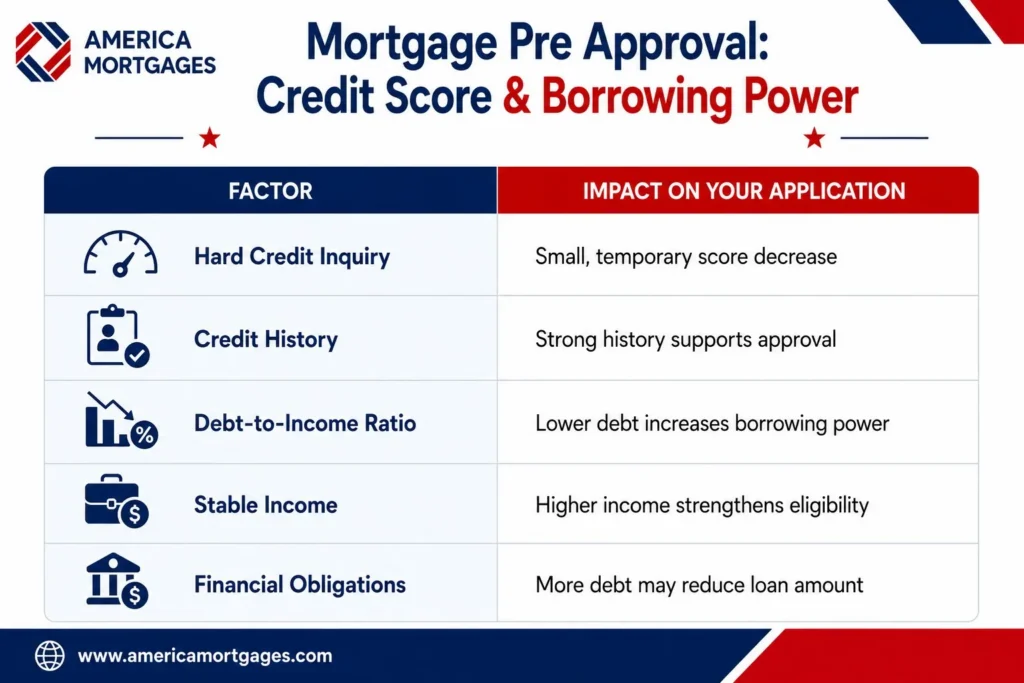
A small change in your credit score should not cause concern. Credit scoring models usually treat multiple mortgage inquiries within a short period as a single shopping event. Therefore, you can compare lenders without significantly affecting your score. This makes it easier to find competitive loan terms.
Your borrowing power depends on more than your credit score. Lenders also review your income, savings, monthly expenses, and overall financial stability. Therefore, paying down debt and avoiding large purchases before home loan pre-approval can strengthen your application. These steps may also improve the loan amount you qualify for.
Get Your Mortgage Preapproval Started with America Mortgages Today
Getting ready before you apply can save both time and effort. First, gather your financial documents and check that all information is correct. This simple step helps prevent delays and keeps your application moving smoothly.
America Mortgages helps foreign nationals and U.S. expats finance U.S. real estate with confidence. Our lending specialists understand international borrowing requirements. As a result, you receive clear guidance and loan solutions that match your financial goals.
Ready to move forward? Contact America Mortgages for personalized guidance. Our lending specialists can answer your questions and help you choose the right financing solution for your needs. To get started, email [email protected] or call +1 (845) 583-0830. We are here to support you through every step of your mortgage pre-approval journey.
FAQs
Q1: Can I get a mortgage pre-approval before finding a house?
Yes, in fact, many buyers apply before they start house hunting. It helps you set a realistic budget. As a result, you can make a stronger offer when you find the right property.
Q2: What can cause a mortgage pre-approval to be denied?
Several factors can affect your application. For example, low income, high debt, poor credit, or missing documents may lead to a denial. Therefore, prepare your paperwork carefully before applying.
Q3: Can self-employed borrowers get mortgage pre-approval?
Yes, however, they usually require additional documents. These may include tax returns, business records, and bank statements. Clear financial records can improve the approval process.
Q4: Is mortgage pre-approval required to make an offer?
No, however, it is highly recommended. An approval letter shows sellers that you are a serious buyer. As a result, your offer may stand out in a competitive market.
Q5: Can foreign nationals get a U.S. mortgage pre-approval?
Yes, many foreign nationals can qualify through specialized lenders. They usually need proof of income, assets, and identity. Then, the lender reviews the documents to determine eligibility.

