
Yes, Seattle can become a good city to invest in rental property due to its existing employment opportunities and the demand for housing. However, expensive property prices and operating costs require thorough financial planning.
The presence of technology, healthcare, and educational sectors in Seattle attracts many professionals and students looking for accommodation. Moreover, in different neighborhoods, one can find various types of real estate and tenant profiles. Investors can also look at how rental income qualifies for mortgages.
Successful real estate investment also requires adequate financing and reasonable return expectations. America Mortgages can assist investors in analyzing mortgage options.
What Makes Seattle Attractive for Rental Property Investors?
Seattle attracts rental property investors through its diverse economy, job centers, and high population growth. The presence of big corporations results in a need for individuals requiring accommodation on a permanent basis. Moreover, universities and hospitals add to the rental market.
| Investment factor | Why It Matters |
| Technology industry | Attracts skilled professionals seeking rental accommodation. |
| Healthcare sector | Supports housing demand from medical professionals. |
| Higher education | Creates rental opportunities among students and university employees. |
| Population growth | Expands the potential pool of residential tenants. |
| Regional employment | Supports demand from workers across multiple industries. |
Another factor that favors investing in this market is the population trend in Seattle. The population and demographic information provided by the City of Seattle shows that demographic trends offer a good explanation of the housing needs of this city. The distribution of populations, household profiles, and age groups will be useful for analyzing the profile of future renters.
Seattle also enjoys a robust economy that is characterized by several key industries including technology, health care, education, and professional services that attract employees with various housing needs. As such, investments in property that caters for students, young professionals, and families would be viable.
However, the growth in the population and employment in the area does not necessarily mean profitability through rentals. Costs related to acquisition, financing, property tax, and maintenance of the property will continue to affect profitability in the area.
How Is the Seattle Rental Market Performing in 2026?
Seattle’s rental market is showing signs of improvement in 2026, with falling apartment vacancy and rising rents. Nevertheless, rental performance depends on the property type and location. Investors are advised to look at market numbers currently available before making any investment decisions.
Current market numbers reveal some important developments:
- Apartment vacancy: The multifamily vacancy rate in Seattle rose to 6.6% in Q3 2026, compared to 7% a year ago.
- Average rent: The average monthly rent was $2,041, which showed an increase by 1.1% annually.
- Studios: The average monthly rent was $1,548.
- One-bedrooms: The average monthly rent was $1,906.
- Two-bedrooms: The average monthly rent was $2,270.
- Three-bedrooms: The average monthly rent was $2,613.
- Rental absorption: The rental absorption was 2,829 units in Q3 2026.
- New construction: The new construction of apartment buildings totaled 1,849 units.
As per the Q3 2026 Seattle Multifamily Market Report of Kidder Mathews, Seattle also had 19,059 apartment units under construction. This new supply can affect the prices in the future. Thus, the investors need to benchmark the existing properties against the new ones. The property location, status, and operating costs will finally decide the profitability of the property.
Which Seattle Neighborhoods Should You Consider for Rental Property?
Seattle’s Capitol Hill, Ballard, University District, and West Seattle are worth considering for rental property investment. Each area offers varied properties, rental requirements, and location advantages. Investors need to align their budgets with the demand for housing.
Capitol Hill
Capitol Hill attracts young professionals, students, and individuals looking for an active urban life. The presence of the restaurants, nightlife establishments, and public transportation make rentals in this area in demand. Studios and one-bedroom apartments might attract those who value convenience and accessibility.
Ballard
Ballard provides various rental options for professionals and families interested in well-established residential areas. Its restaurants, shops, and facilities attract different tenants. Investors can consider apartments, townhouses, and single family residences depending on their budgets.
University District
The University District offers its advantage because it is located near the University of Washington. It has unique housing demands among the students, researchers, and university employees. Properties providing shared living arrangements and access to campus may attract potential tenants throughout the year.
West Seattle
There is a lot of appeal in West Seattle for families looking for places to live in. This area features a number of houses, apartments, and other properties alongside its waterfront and businesses. It would be important to assess commuting possibilities and prices for investment purposes.
Such an extensive analysis of the neighborhoods will help the investor determine the cost of property, its rental opportunities, and benefits associated with the location. In addition, people who are interested in purchasing property in this area can use our article on how to buy real estate in Seattle as a non-U.S. citizen.
What Risks Should You Evaluate Before Buying Rental Property in Seattle?
Buying rental property in Seattle comes with associated financial, regulatory, and operational risks. Such factors include high purchase costs, maintenance costs, tenant rights laws, and competition from other rental properties. As such, the prospective investor should be aware of these risks.
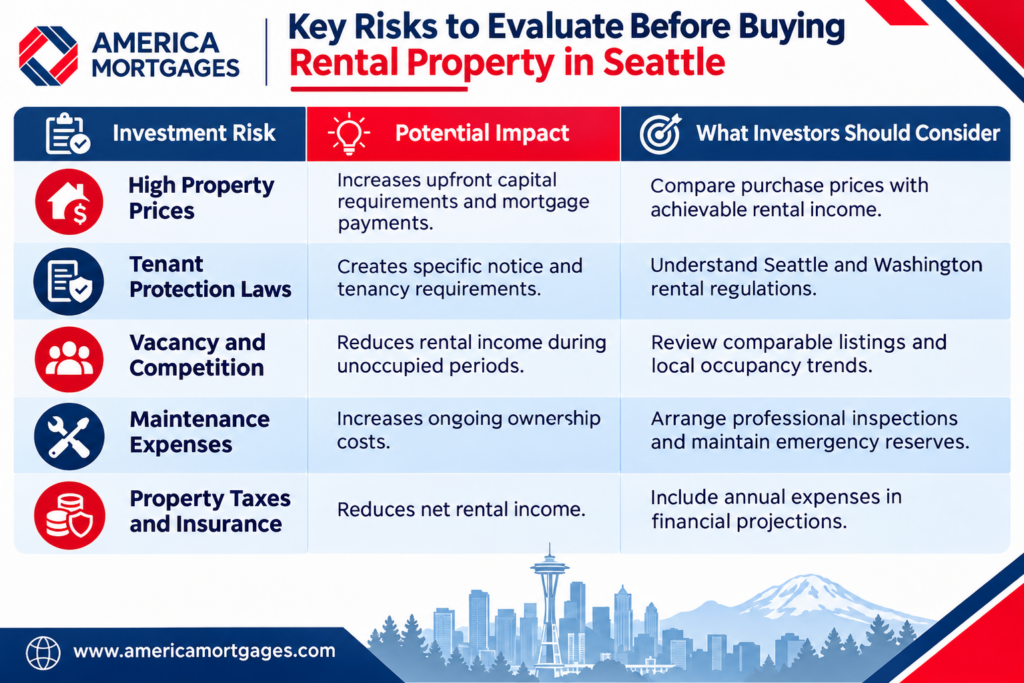
Seattle has some particular landlord obligations that must be considered. First, the city’s Rental Registration and Inspection Ordinance (RRIO) mandates certain rental properties covered by the law to meet particular standards of registration and inspections. Secondly, advance notice of 180 days is required for increasing housing cost in Seattle. Washington state has laws limiting rent increases for covered residential properties. Investors will need to consider the current state of affairs before setting rental prices or writing lease agreements.
The condition of the property needs to be considered carefully before making the purchase. Properties that are old may need plumbing work done, new roofing put in place, or electrical systems fixed. Besides, there could be unexpected maintenance costs. Investors will need to undertake proper inspections and calculate the expected costs of repairs before creating budgets.
How Can I Calculate Potential Returns on Seattle Rental Property?
You can calculate potential returns from investment in Seattle rentals by looking at the comparison of yearly rental income against the cost of purchasing and running the rental property. The following factors that an investor needs to consider include gross rental yield, NOI, capitalization rate, and cash-on-cash return.
These calculations are key to investment success:
- Gross Rental Yield: It represents the ratio between the annual rental income and the cost of purchasing the property.
Formula: (Annual Rental Income ÷ Purchase Price) × 100
- Net Operating Income (NOI): It represents the amount of income that is left after deducting the operating expenses from the annual rental income and is before mortgage and taxes.
Formula: Annual Rental Income − Operating Expenses
- Cap Rate: Capitalization Rate represents the ratio between the NOI of the annual income and the value of the property.
Formula: (Annual NOI ÷ Property Value) × 100
- Cash on Cash Return: It represents the ratio between the pre-tax cash flow and the total amount of cash invested in the property.
Formula: (Annual Pre-Tax Cash Flow ÷ Total Cash Invested) × 100
Let us say we are investing in Seattle and the cost of the property is $500,000. Assuming the annual rental income is $30,000, the Gross Rental Yield would be 6%. However, there will be various other costs involved to reduce your return.
Hence, an investor must keep realistic expectations for the rent and include all the costs in the estimation process.
Case Study: Financing a Seattle Rental Property With America Mortgages
The overseas buyer wishes to buy the Seattle property that he will be renting out but finds difficulty in arranging the funds necessary for such an investment. Traditional mortgage qualifications and few sources of finance pose problems for the investor in this regard. He consults America Mortgages for advice on property financing.
America Mortgages assists him in determining the cost of purchasing the property, expected income from rent, and the amount of finance required. Its mortgage professionals provide information regarding loan choices, documents to be furnished, and payment conditions. This helps him compare various options in order to make an informed decision regarding his investment.
Make Your Seattle Rental Property Investment Decision with America Mortgages
Rental property investment in Seattle requires strategic thinking, proper financial considerations, and smart property selection. Knowledge about local market conditions may help you recognize opportunities and mitigate any risks. Good research on your part will be useful for making proper investment decisions.
Before purchasing a property, you should consider financing possibilities, possible rental income, expenses related to property management, and the needs of the particular property. Comparing these criteria may help you choose a property that suits your finances.
America Mortgages will help you explore financing options for American real estate. We welcome your inquiries about your investment objectives and mortgage solutions. Contact us at +1 (845) 583-0830 or write an email to [email protected] for a consultation with a mortgage expert.
FAQs
Q1: How much money do you need to buy a rental property in Seattle?
Buying a Seattle rental property needs an initial payment and money for closing costs. In most cases, one would require quite a lot of money. But this amount varies according to the price of the property.
Q2: Is it better to buy a condo or a single-family rental in Seattle?
A condo may have lower maintenance costs compared to a single family home, but it will include HOA fees. Hence, one should consider the cost of ownership, renter’s demand, and profitability before making a decision.
Q3: Are short-term rentals profitable in Seattle?
Short-term rentals could make more money per night. But occupancy rates, cleaning expenses, and city regulations play an important part in profitability. Potential investors have to look at these aspects before they invest.
Q4: What taxes do Seattle rental property owners have to pay?
The Seattle rental property owners usually pay their property taxes and income taxes based on federal rules. There are certain tax laws that exist in Washington regarding rental activities. However, there may be some factors that will influence tax liability.
Q5: How do you find reliable tenants for a Seattle rental property?
Finding reliable tenants begins with standard screening practices. Check employment, background, reference, and credit records. Furthermore, adhere to fair housing policies and conduct all applicants through the same screening process.
Share this article
Ready to get started?
Speak with our U.S. mortgage specialists today and discover your options.
Schedule a call