
Yes, Georgia is a good place for buying rental property as it provides a variety of housing markets, employment centers, and the possibility of earning money for many years to come. But the profitability will depend on property values, rental demand, finance costs, and other factors. You need to consider specific properties before buying.
Different places in Georgia, such as Atlanta, Savannah, Augusta, and Columbus, provide different prospects for housing investors. Atlanta can attract tenants due to its diversified labor market, whereas Savannah can attract tenants due to the presence of shipping companies. You need to estimate the cost of rent, property taxes, insurance, and vacancies in your area.
America Mortgages can help you, as an overseas investor or U.S. expat, learn more about ways of financing your American investments. Find out more about DSCR loans for those who are thinking about renting investment properties. Contact America Mortgages today to learn more about your financing options.
Why Is Georgia for Rental Property Investment Worth Considering?
Georgia is worth considering for rental property investment due to the presence of various local economies, diverse housing markets, and various options within different price ranges. Investors may choose properties located near major places of work, colleges, and health care institutions. However, finding the best location and analyzing the demand for rentals are key factors that need to be considered while making investment decisions.
| Investment factor | Why it matters |
| Diverse industries | Healthcare, logistics, manufacturing, and technology create employment opportunities. |
| Multiple housing markets | Investors can compare properties across metropolitan areas and smaller cities. |
| Different property types | Single-family homes and multifamily properties offer different investment options. |
| Employment centers | Nearby workplaces may attract tenants seeking convenient housing. |
| Rental income potential | Local rent estimates help investors evaluate possible cash flow. |
The housing situation in Georgia is reflected in the housing statistics of the state. Based on the information provided by the Federal Reserve Bank of St. Louis’ FRED database, the rental vacancy rate annually in Georgia dropped from 8.3% in 2024 to 6.6% in 2025.
In addition to market conditions, it is advisable to examine the cost factors that will influence rental income. Factors such as property tax, insurance, maintenance costs, property management costs, and vacancy period can all lower the net income earned by the real estate investor.
Which Georgia Cities Offer Rental Property Opportunities?
Atlanta, Savannah, Augusta, Macon, and Columbus present varying opportunities for those who are interested in investing in Georgia rental properties. Different costs of purchase, tenant demands, and returns on investment exist for each city. Your decision will be based on your budget and investment objectives.
Here are five Georgia cities worth considering, each offering different property prices, rental demand, and investment opportunities:
- Atlanta: Features varied employment opportunities and large tenant base. Yet, higher property prices can mean bigger investments.
- Savannah: Has tourism, port activities, and logistics in its favor. Insurance rates and local rental policies should be considered by the investor too.
- Augusta: Can attract investors who prefer cheaper property prices. Employment in health care, education, and military can contribute to rental demand.
- Macon: Provides investors with a more affordable entry point. Property condition, demand in the neighborhood, and rent prices should be estimated prior to the purchase.
- Columbus: Can fit buyers who prefer affordable property. Local employment, rental demand, and costs of operation should be taken into account when considering a potential property.
According to the Georgia REALTORS® 2025 Annual Report, median home prices varied significantly across these cities.
| Georgia city | 2025 median home price | Annual price change |
| Atlanta | $405,000 | 0% |
| Savannah | $369,990 | +1.9% |
| Columbus | $215,000 | +10.3% |
| Macon | $205,995 | +5.6% |
| Augusta | $197,000 | +3.1% |
From these statistics, it is clear that property values differ greatly from city to city in Georgia. The fastest growth in property values on an annual basis was witnessed in Columbus, while the lowest median home value was found in Augusta. It is also important to remember that low property values do not necessarily result in good rental returns.
It is important for you to assess the rental income against the cost of taxes, insurance, repairs, management charges, and vacancy period before investing in any city.
How Can You Calculate Rental Property Returns in Georgia?
The returns from rental property investment in Georgia can be calculated using the rent vs. purchase cost, operating expense, and financing cost approach. Start with an estimate of what the market rents are in the area. Then use the following steps to determine the gross rental yield, net operating income, and monthly cash flow.
Calculating Gross Rental Yield
The gross rental yield represents the annual amount of rental that a property earns compared with its cost. This ratio is useful when deciding whether one should invest in a property based on its yield.
Formula:
Gross Rental Yield = (Rental Income Annually ÷ Price Paid for the Property) × 100
Example: In Georgia, a rental property is bought at the price of $250,000 and generates an income of $2,000 per month.
Rental income annually: $2,000 x 12 = $24,000
Gross rental yield: ($24,000 ÷ $250,000) × 100 = 9.6%
Calculate Net Operating Income (NOI)
Net operating income is a measure of rental income after deduction of expenses related to the operation of the property. Expenses like mortgage payments and income tax should not be considered.
Formula:
NOI = Annual Rental Income – Annual Operating Expenses
Example:
Annual rental income: $24,000
Operating expenses: $8,400
Annual NOI: $24,000 – $8,400 = $15,600
Monthly Cash Flow Calculation
Monthly cash flow indicates the amount left after operating expenses and mortgage payments. It is calculated to see if the rental income covers regular expenses and still leaves something extra.
Formula:
Monthly Cash Flow = Monthly Rental Income – Monthly Operating Expenses – Monthly Mortgage Payment
| Item | Monthly amount |
| Rental income | $2,000 |
| Operating expenses | −$700 |
| Mortgage payment | −$1,000 |
| Estimated cash flow | $300 |
The property yields $300 per month or $3,600 per year, excluding other unmentioned expenses and income tax.
Calculate Cash on Cash Return
The cash on cash return ratio divides the annual pre-tax cash flow by the total amount of cash invested. Down payment, closing costs, and renovation costs should be taken into consideration here. This ratio proves to be especially useful in cases where properties were bought with various types of financing.
Formula:
Cash on Cash Return = (Annual Pre-Tax Cash Flow ÷ Total Cash Invested) × 100
For example,
Cash flow: $3,600
Cash investment: $75,000
Cash-on-cash return: ($3,600 ÷ $75,000) × 100 = 4.8%
Analysis Before Purchase
The above analyses help to determine how well a property is performing financially. The gross yield will indicate the relationship between rent and the buying price, while the NOI will indicate the operating performance of the property.
Before buying, ensure that you compare comparable rents and calculate the cost of insurance, taxes, maintenance, and financing. For more help, research on the process of buying and financing real estate in Georgia.
What Risks Should You Evaluate Before Buying in Georgia?
Prior to purchasing a rental property in Georgia, one should consider issues like vacancy rates, property tax, insurance, maintenance, and rental laws. It is important to consider these because, despite appealing rental rates, they may lead to losses. Conducting thorough research will enable investors to determine potential problems.
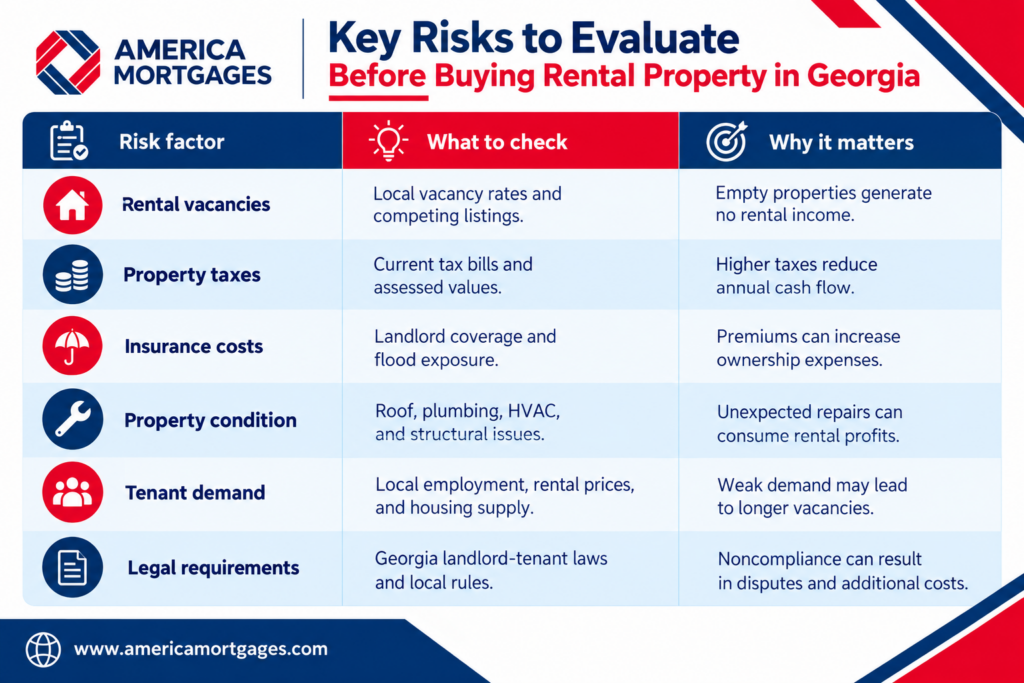
It is important to focus on rental vacancies since they have an impact on income. From the Georgia Rental Vacancy Rate data by the Federal Reserve Bank of St. Louis, one can check the history of rental vacancy in the state before making a decision about the purchase. This will not be sufficient though as it will not show the situation in all neighborhoods. Check local listings and see how fast your rental may become occupied.
The condition of the property as well as the conditions of weathering of the building need to be checked as well. Make sure to conduct an expert inspection of the property and get quotations for insurance before making a decision. It is also necessary to review the landlord-tenant requirements in Georgia.
Case Study: How America Mortgages Helped an Investor Manage 400+ Georgia Properties
An investor from Hong Kong had over 400 residential properties in Georgia, but there was difficulty in managing the mortgages, insurance and property tax payment. America Mortgages offered a solution in the form of portfolio loans to simplify the financing for the investor.
As per the case study on America Mortgages, it has been seen that this approach decreased administrative cost by 50% and streamlined more than 400 payments into four. This is an example that shows that right type of financing can simplify the management of the portfolio of properties in Georgia.
Evaluate a Georgia Rental Property with America Mortgages
Before buying an investment property in Georgia, examine its projected income, cost of acquisition, and associated expenses. Take into account local rental prices in order to come up with an estimate of your projected cash flow. It is also necessary to take into account other factors such as taxes, insurance, repairs and even the period when the property might be vacant.
Investment finance is another major component of your investment plan. Compare all the mortgage possibilities available, including down payments, interest rates, and payment plans. Foreign nationals and international investors should also take note of their qualifications and required documentation.
Ready to finance your Georgia rental property? America Mortgages provides assistance to foreign individuals, expatriates living in the USA, and international investors in finding the best financial solutions for investment properties in the US. Contact us today by calling +1 (845) 583-0830 or emailing [email protected].
FAQs
Q1: How much rental income can you make from a house in Georgia?
A Georgia rental house can produce hundreds or even thousands of dollars per month. This would greatly depend upon the location and size of the rental house. The rent price charged for houses in Atlanta would be different from those located in smaller cities.
Q2: Is it better to buy a rental property in Atlanta or Savannah?
Atlanta can be ideal for investments due to its diversity in tenant requirements due to employment, while Savannah provides chances tied with port activities and tourism. However, none of these markets promises good profits. Make comparisons based on the cost of buying a building, attainable rents, insurance costs, property taxes, and vacancy levels.
Q3: What is the 1% rule in rental property investing?
The 1% rule suggests monthly rent should equal at least 1% of a property’s purchase price. Thus, a $200,000 house would have a minimum monthly rent of $2,000. However, this rule does not take into account the costs of financing, taxes, insurance, maintenance, and vacancy.
Q4: Do non-US residents need a US credit score to buy rental property in Georgia?
Non-US citizens do not necessarily require a credit score from the U.S. for buying rental properties in Georgia. There is variation in the financing of purchases across different lending programs. There are lenders who check credit history from abroad and also verify income levels and down payment ability.
Q5: What taxes do rental property owners pay in Georgia?
Property taxes are normally paid by rental property owners in Georgia, while federal and state income taxes may also apply if there is profit from renting. The applicable tax rate will vary depending on the value of the property assessment, income, and other factors. Tax deductions can be made for some expenses, such as interest on a mortgage.
Share this article
Ready to get started?
Speak with our U.S. mortgage specialists today and discover your options.
Schedule a call