
Yes, a U.S. expat can buy a house in U.S. for their child who will be studying in that country. Being abroad will not stop them from owning property. Mortgage approval is based on salary, credit, assets, documentation, and lender criteria.
In many cases, buying will mean that the family will have a stable place to live during university studies. In addition, the property can be an asset after the completion of those studies. Families should take into account several issues when making such a decision, including the campus where the student will be studying, transportation, property taxes, insurance, maintenance, and intentions regarding the future.
It is important that the financing method used corresponds to the property purpose. Some documents about the foreign work experience and available assets might be needed from the parent, among other things. Knowledge of these documents and conditions will ease the process. Additional information about U.S. expat mortgage options can be found in our guide.
If you are considering a U.S. home for a child studying there, America Mortgages can help you understand the financing path and requirements for your situation.
Can a US Expat Buy a Home in the U.S. for a Child Studying There?
Yes, a U.S. expat could buy a house in U.S. for their offspring studying in the country. Residence abroad does not restrict property possession. However, mortgage approval is dependent on income, assets, credit score, documentation, and property use.
| Factor | What to Consider | Why It Matters |
| Income | Overseas salary or business earnings | Supports mortgage qualification |
| Credit | U.S. credit history and existing debts | Helps determine borrowing capacity |
| Assets | Savings and international bank accounts | Shows available funds and reserves |
| Property use | Student residence or future rental | Can affect loan eligibility |
| Location | Campus access and local housing demand | Supports practical and long-term value |
An expat may utilize certain income from abroad during mortgage application for some mortgage programs in U.S. Income, banking history, tax papers, and other financial documentation may be requested by lenders. Use of the property should also be clearly stated before applying for mortgage financing.
The purpose of buying the house could differ depending on the postgraduate activities of the owner. This is because the family may retain the property, rent it out, or sell it in future. Consequently, consideration of the property’s location and cost is important.
What Mortgage Options Are Available for a U.S. Expat Buying a Student Home?
U.S. expats could potentially be eligible for several types of mortgages if they are buying a home to house a student. The decision on which one is best will depend on factors like income, creditworthiness, assets, occupancy, and if the home will produce rental income.
Some options might include:
- Traditional mortgages: If the borrower qualifies on normal income and credit terms.
- Foreign income mortgages: These could possibly take into account foreign earnings from employment or business.
- DSCR loans: May be a good fit for investment homes based on rental income.
- Asset-based mortgages: Could be considered by individuals with assets but low income.
- Portfolio loans: Offer alternative financing if borrower does not qualify on normal terms.
It is also clear from research-based mortgage guidelines that foreign earnings are taken into consideration provided that certain documentation conditions are met. Fannie Mae demands that lenders document the foreign income and provide the required documentation. The foreign documentation may be translated and currency converted.
When dealing with a student home, it is also important to note the intended occupancy. A property that will be occupied by the child has a difference compared to the one acquired for rental income purposes.
How Should Ownership and Taxes Be Handled for a Student’s Home?
Ownership and taxation must take into account who the property buyer is, how the property is to be utilized, and what will occur after graduation. Expat parents need to look at their ownership obligations, rental income, property expenses, and possible taxes before making a purchase.
Choose the Right Ownership Arrangement
The buyer needs to decide on ownership before closing. This decision will have an effect on control of the property, financial obligation of the owners, future inheritance plans, and possible transfer of the property in the future.
Separate Personal from Rental Use
When the student lives in the property, personal use will become relevant for taxation purposes. Room rental will change the tax status. One should maintain proper records of all rental income and expenses during the period of ownership.
Maintain Proper Records for Property Expenses
Property taxes, property insurance, property repairs, property mortgage interest, and improvements need to be recorded. These expenses may have relevance for deductions or the calculation of basis for the property.
Future of the Property after Graduation
The property can be rented out, used as a family residence, or sold at a later date. These will give rise to various tax implications. It is important to take into account the likely holding period to determine what would be the best way forward.
Be Aware of Possible Tax Upon Sale
Upon the sale of the property, there may be a taxable gain. According to the IRS, the tax outcome will depend on the amount realized and the adjusted basis of the property. There are some special home-sale exclusions that come with certain requirements.
According to the IRS, rental properties have their own rules regarding tax reporting. Rental income needs to be reported, and some expenses are allowable deductions. In addition, depreciation is a consideration.
It may be wise for an expatriate to seek professional tax advice due to special cross-border tax issues.
What Should an Expat Do Before Buying a Home for a Student?
An expat needs to evaluate finances, verify income sources, make a realistic budget, research the area, and determine future plans for the property. Preparation will ensure there is enough time and no unexpected delays or expenses. Moreover, the families will have an insight into the cost before making any commitment.
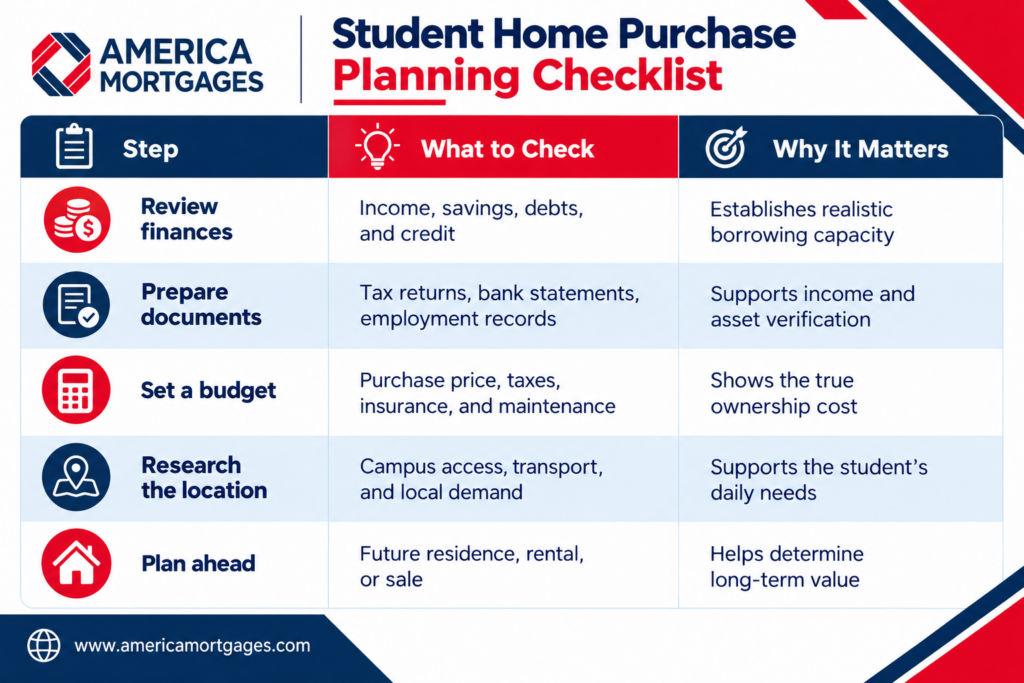
Prior to visiting properties, get a good understanding of your borrowing ability. Income from abroad will need additional documentation during the underwriting process. So, collect your employment papers, foreign tax papers, bank statements, and proof of funding beforehand. In addition, you will need to determine what the property will be used for.
The location also needs consideration. Properties close to the campus can cut down on commuting and costs incurred. But this factor should not supersede the condition of the property, its desirability, and the associated costs. Buyers can also learn more about buying real estate in Colorado as a foreign buyer.
How Can America Mortgages Help an Expat Buy a Student Home
In case a U.S. expat is planning to make a home purchase for their child who studies in the U.S, it can become a complicated task in terms of income and financing. Foreign income may need more documentation and approval by the lender.
America Mortgages will be able to assess the financial situation of the borrower and find out which type of financing is the most suitable one. America Mortgages will be able to look into foreign income, available assets, the credit history of the borrower, and the intended purpose of the property purchase. It will also be possible to find out whether student occupancy or renting of the property will play a role in financing.
With proper preparation, the borrower will be able to figure out which loan options will be available when he makes an offer.
Start Planning Your U.S. Student Home Purchase With America Mortgages
A home planning project while the child is undergoing studies in the USA will offer more stability while in college. Begin by analyzing your budget, the location, period, and intentions for the property.
Afterward, analyze the financing alternatives and obtain necessary financial documents. Include factors like taxes, insurance, maintenance costs, and closing costs besides monthly payments. This will also be useful in making informed decisions upon locating the property.
America Mortgages assists foreign nationals based in the USA in analyzing various options for financing their home purchase. This can assist in acquiring necessary knowledge about the loans and other financing procedures involved.
Contact us on +1 (845) 583-0830 or via e-mail on [email protected] to discuss your U.S. home financing options..
FAQs
Can an expat refinance a U.S. property after moving overseas?
Yes, an expat can seek to refinance their U.S. property even if they have relocated abroad. Yet, the approval will depend on the bank and several other factors like income, credit rating, value of the property, and so on.
Can I buy a house in the U.S. while living overseas?
Yes, you can buy a house in the USA while being based abroad. It all depends on your income level, credit history, assets, and conditions set by the lender. Besides, you can buy the house either for yourself or for investment purposes.
How much down payment does an expat need to buy a house in the U.S.?
The required down payment differs by the type of mortgage program, type of property being purchased, and profile of the borrower. Some expatriates would qualify for a reduced down payment amount, whereas others would require higher down payment amounts.
What documents do expats need when applying for a U.S. home loan?
The expats might be required to provide evidence of their earnings, employment history, bank statements, tax papers, personal identification, and credit reports. There could be requirements for foreign income papers, currency information, and asset papers as well.
What happens to a U.S. mortgage if I live abroad?
A U.S. mortgage will usually stay active even if you live outside the country. You still need to keep up with the mortgage payments. It is possible that the fact that you live elsewhere will influence your ability to refinance, declare taxes, insure or borrow money in the future.
Share this article
Ready to get started?
Speak with our U.S. mortgage specialists today and discover your options.
Schedule a call