
Yes, U.S. expats can use foreign earnings to qualify for a second home loan. A lender may take into consideration salary, assets, credit, and bank account from abroad while making his decision regarding your qualification.
All you need to do is provide evidence of stable income and enough payment capacity. Your lender may ask for employment confirmation, payslips, tax returns, and bank statements from abroad. Foreign currency conversion will also play its role. Hence, having all the required documents will ensure easier qualification.
The other thing to take into consideration is usage of the property. The right second home needs to satisfy certain occupancy requirements. In case you are researching more about the whole process, you should check out the U.S. Expat’s Complete Guide to Buying a Second Home.
Do you want to find out more about possible financing options? You can contact America Mortgages to discuss your options.
Can Foreign Income Be Used for a U.S. Second Home Mortgage?
Yes, foreign income could be utilized as part of a U.S. mortgage loan for a second home. It will all depend on whether it is steady, verified, and appropriately documented by you.
| Foreign Income Source | Documents Lenders May Review |
| Overseas salary | Pay slips and employment letter |
| Self-employment income | Business records and tax returns |
| Bonuses or commissions | Earnings history and employer records |
| Investment income | Account statements and income records |
| Foreign savings | Bank statements and proof of funds |
The lender may check your income consistency and ability to pay back the mortgage. In addition, the currency exchange rate may play a role in the qualifications. This is why recent documents will help in painting the overall financial picture. Moreover, you can know about using foreign income in U.S. mortgage qualification while preparing your application.
Your foreign banking records might assist in showing that you have consistent income. Again, the mortgage programs vary in terms of qualifications. In addition, some lenders may require additional documentation to be translated.
What Do Lenders Look for When Financing an Expat?
The lender normally evaluates the borrower’s income level, creditworthiness, asset base, debt obligations, and property before making any financing decisions. Well-structured finances and documentation improve the chances of approval.
Various issues can determine whether the lender will make financing available to you:
- Stable Income: Earnings from consistent employment are evaluated.
- Credit Rating: Your credit standing in the US will determine your eligibility.
- Debt Obligation: Monthly payments are calculated together with the new mortgage amount.
- Financial Asset: Investments and savings prove your strong financial status.
- Down Payment: Funds should satisfy the requirements for the selected program.
- Property Information: These include location, value, occupancy, and usage.
- Documentation: Documentation of income and assets is important.
For example, let us say that the qualifying monthly income for you is $10,000. The debt obligations you have now add up to $1,500. The new mortgage is $2,500. The total obligation is thus $4,000. This gives a ratio of 4,000 ÷ 10,000 × 100 = 40% Debt to Income Ratio.
It is through this calculation that lenders compare monthly obligations to the qualifying income. Actual values differ from one loan program to another. It means that your financial picture matters much more than one aspect.
When Does a Property Qualify as a Second Home?
Second homes usually are those properties where you stay at least for part of the year. There are several rules which need to be fulfilled by these types of properties.
Personal Use
You are supposed to use this property personally during part of the year. You are not supposed to use this property to earn additional income.
Year Round Habitable
It needs to be inhabitable throughout the year. This means that this type of the property should have all the characteristics of a residential house.
One Unit Property
According to the general guidelines, the second home should be a one unit property. Types of eligible properties include qualified houses, condominiums and planned unit developments.
Controlled by Borrower
You should be able to control this property during the period of your visits. Arrangements such as timeshares might not fulfill the requirements of a second home.
Separate from Principal Residence
A second home is supposed to be separate from your principal residence. Your lender will examine its location and its usage during underwriting.
According to Fannie Mae, a secondary home should have been occupied by the borrower for some part of the year. Moreover, it should be a single-unit structure capable of being lived in throughout the year.
As an instance, when there is an eligible property worth $500,000 and the borrower has made a down payment of 20%, the initial equity will be $100,000 and the outstanding mortgage will amount to $400,000.
How Much Do Expats Need for a Second Home Purchase?
There will be the need for financing for the down payment, closing costs, reserves, and additional expenses associated with purchasing the property. The amount required varies based on the loan program, property price, and the financial situation of the applicant.
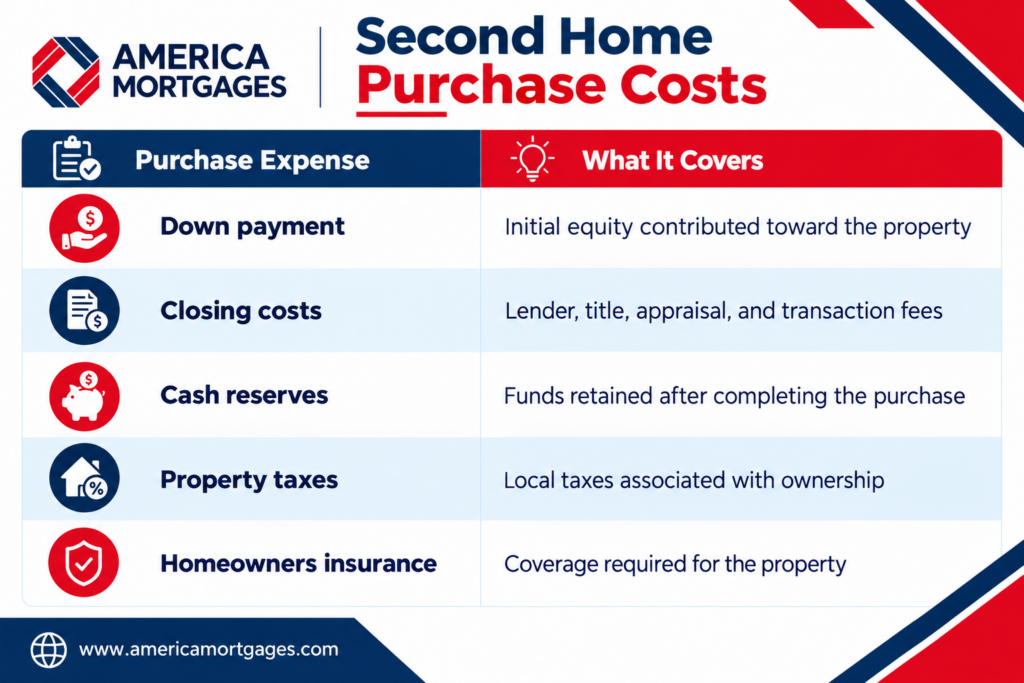
For instance, let us consider a second home costing $500,000 with a 20% down payment. The first equity will then be $100,000. The closing cost will amount to 2%-5% or approximately $10,000-$25,000, bringing the total up front to be $110,000 – $125,000. There are also the reserves and additional expenses.
Apart from the purchase price, it is essential to have sufficient liquidity to manage any surprises that come your way regarding the house. According to the CFPB, there should be closing costs and other expenses considered when calculating the amount of home that can be afforded.
Case Study: U.S. Expat in Tokyo Secures Hawaii Home Financing
A U.S. expat that had resided in Tokyo for over two decades desired to buy a property in Hawaii before retiring. He had no active U.S. credit profile, which made securing funding from a conventional lender difficult. America Mortgages arranged the loan on the basis of his existing credit profile in Japan.
The loan amount involved buying a Hawaii property worth $1.6 million with $1.12 million loan amounting to a 70% LTV loan. The loan arrangement was for a fixed interest rate over 30 years with an option to refinance into an expat mortgage in the future.
Start Your U.S. Second Home Purchase With America Mortgages
Buying a second home abroad may seem complicated. But with the right lender, you will be able to make it much easier. Depending on the financing program you choose, foreign earnings and assets may be taken into account. Documentation can also play its part in making the application process easy.
To ensure that you are ready to make an offer, you should know your financing choices as well as the documents needed for this process. Pre-approval is the way to get more confident about your budgeting and home-hunting process.
Want to start exploring your financing options? Contact us today at +1 (845) 583-0830 or [email protected] to discuss your second-home financing needs with America Mortgages.
FAQs
Q1: Can a U.S. citizen living abroad buy a house in the United States?
Yes, a U.S. citizen living outside the country is still capable of purchasing a home in the U.S. Being an expatriate will not affect his ability to purchase properties. However, he must first secure funds based on his income, credit, and other financial qualifications.
Q2: Can I get a U.S. mortgage if I live and work overseas?
Yes, you can qualify for a mortgage in the U.S. even if you reside and work abroad. This is because lenders can recognize foreign sources of income as long as proper documentation is available. Of course, the decision on whether or not to approve depends on various factors.
Q3: Can foreign bank accounts be used for a U.S. mortgage?
Yes, foreign bank accounts can help in the process of applying for a mortgage in the U.S. The lending institution may consider the foreign statements to confirm the amount saved. However, the requirements may differ depending on the lender. As such, it is important to present clear statements of ownership, balance, and transactions.
Q4: Does living abroad affect my U.S. credit score when applying for a mortgage?
Yes, living abroad will affect your U.S. credit scoring, although this does not mean that it will have negative effects on your score. If you retain U.S. credit cards, payment history remains important, although with little activity, there is less credit data. Hence, other documents will be reviewed during mortgage processing.
Q5: Can I buy a U.S. vacation home while living in another country?
Yes, you can buy a vacation home in the U.S. despite being an international resident. Citizenship in the United States can facilitate this transaction, even from an international locale. However, a mortgage will be issued based on your finances, your credit score, assets, and the intended use of the house.
Share this article
Ready to get started?
Speak with our U.S. mortgage specialists today and discover your options.
Schedule a call