
Who This Guide Is For
This guide addresses issues facing non-resident investors interested in buying properties in the U.S. Non-resident investors are both individuals who live abroad and those who live outside the U.S. but who have American citizenship. The manual is intended to address issues facing investors in relation to real estate investing as an investment strategy. These include issues of market selection and property management from abroad.
The financing aspects have been discussed in the accompanying Foreign National Mortgage Guide and DSCR Investor Guide, which encompasses foreign national mortgages, DSCR, and LTV. The current guide is all about the strategy behind the investment and its selection of markets. This is the guide discussing the strategic level above the financing one. All the case studies presented here are hypothetical and composite.
Contents
- Why Non-Residents Invest in U.S. Real Estate
- Investment Strategies: An Overview
- How to Choose a Market From Abroad
- Property Management From Abroad
- Financing: A Quick Overview
- Building a Portfolio Remotely
- Currency and Repatriating Profits
- Insurance, Landlord-Tenant Law, and Risk Management
- Common Mistakes Non-Resident Investors Make
- Frequently Asked Questions
- About This Guide
1. Why Non-Residents Invest in U.S. Real Estate
The United States is still a desirable real estate market for foreign investments. There are some other reasons behind the appeal of the U.S. real estate market besides city or property. Firstly, it is a dollar-based investment opportunity. Secondly, it has secure property rights. Thirdly, there is an ample mortgage and title market in the US. Finally, there is legal predictability in the U.S. market as well.
Foreign purchasers invested $45.3 billion on existing U.S. housing from April 2025 to March 2026. This is according to figures from the National Association of REALTORS®. This consisted of single-family rentals and luxury condominiums. The purchases were largely in certain states.

2. Investment Strategies: An Overview
| Strategy | What It Involves |
| Buy-and-hold rental | Purchase a property, rent it long-term, hold for cash flow and appreciation — the most common non-resident strategy. |
| Short-term / vacation rental | Higher potential income, more active management, and market-specific regulatory considerations (some cities restrict short-term rentals). |
| Buy-refinance-repeat (equity recycling) | Season and refinance a property to release equity, funding the next acquisition — covered in the DSCR Investor Guide. |
| Fix-and-hold / value-add | Purchase below-market, renovate, then rent or refinance at the improved value — often financed initially with a bridge loan. |
| New construction / pre-construction | Purchase during development, typically requiring different financing timing and larger deposits than a completed property. |
3. How to Choose a Market From Abroad
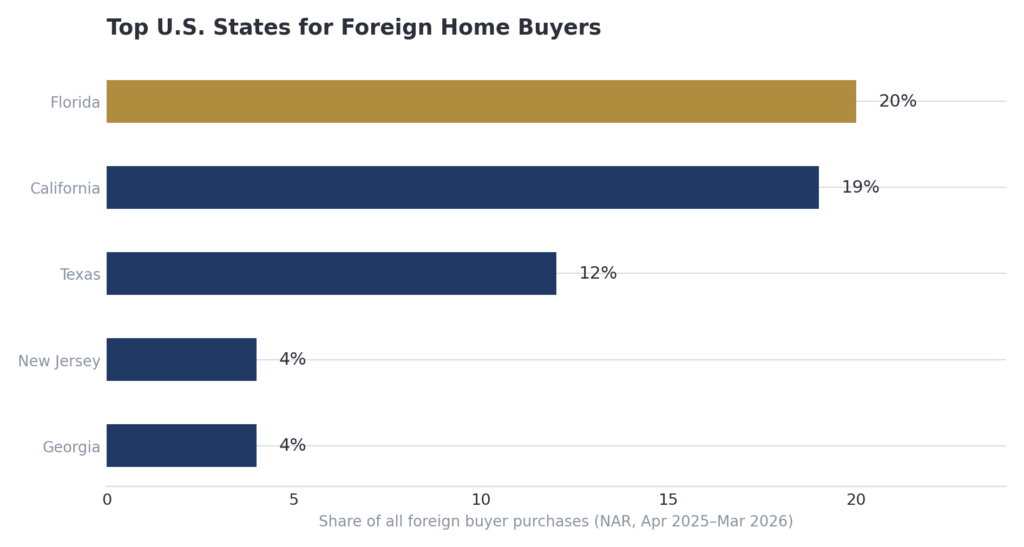
Top U.S. states for foreign buyer purchases, National Association of REALTORS®, April 2025–March 2026.
Florida, California, and Texas comprise over half of the purchases made by foreign buyers. This concentration is by no means random. The markets have favorable climates, cultures, and expat communities. In addition, they have structural characteristics that favor distant investors.
- No state income tax in Florida and Texas, which simplifies the tax picture on rental income.
- Landlord-friendly legal frameworks, with relatively efficient eviction processes compared to some other states.
- Deep pools of property managers, agents, and title companies experienced specifically with international and remote owners.
- Strong, diversified rental demand — not dependent on a single employer or industry.
Not all investors are automatically attracted to these types of markets. Yet, they boast a very well-developed ownership infrastructure that is located far away. This becomes significant if one does not have an opportunity to come and see the property personally.
4. Property Management From Abroad
To have a rental property in which you do not often visit is common for foreign investors. The key to success is having the right team in place prior to closing.
- The locally licensed property manager would be able to take care of the tenants, repairs, and collecting rent.
- The property manager usually takes 8-12% of the monthly rental fees.
- The local attorney or CPA should be aware of non-resident ownership and taxes.
- Remote banks make rent collection and payment of expenses possible without coming to the U.S.
- Walk-through videos and virtual property inspection will help track the buying, remodeling, and state of the property.
ILLUSTRATIVE EXAMPLE
Henrik Larsen — Copenhagen, Denmark
Henrik purchased a Tampa duplex without ever visiting in person, relying entirely on his agent’s video walkthroughs and a local property manager for tenant placement. Rent is deposited into a U.S. account he manages remotely, with the property manager handling every day-to-day issue.Three years in, Henrik has never needed to travel to the U.S. to manage the property — the team he assembled before closing has handled everything.
5. Financing: A Quick Overview
The choice of financing for non-residents falls into one of two categories. One is a foreign national mortgage program, which employs alternative documentation for qualification of the borrower. The other one is a DSCR loan, which qualifies the property based on its income from rental payments. The information on both options is provided in companion guides, which include detailed information on down payments and documentation.
6. Building a Portfolio Remotely
Non-residents will be able to use the same strategy of buying-refinancing-repeating as their local counterparts do. It is also effective when using DSCR lending. The DSCR loan may not need proof of personal income every time a purchase is made. Just hold on to the property and let it season. Allow the property to appreciate and gain some equity. Later, you can refinance to get some equity out.
ILLUSTRATIVE EXAMPLE
The Nakamura Family — Osaka, Japan
Starting with a single Phoenix rental, the Nakamuras used two refinances over six years to fund the down payments on two additional properties, growing from one property to three without injecting significant new capital from Japan after the initial purchase.
7. Currency and Repatriating Profits
There are two important considerations relating to the currency of the investments by non-residents. One is the exchange rate risk associated with purchase and closing of the transaction. The second consideration is the conversion of the rental payments in your own currency.
For larger transactions, professional FX planning is worth treating as part of the investment strategy, not an afterthought.
A rate move of even a few percent between agreeing a price and wiring funds at closing can meaningfully change your effective purchase price or net proceeds on a sale. Many investors also simply choose to keep rental income and proceeds in U.S. dollars, reinvesting in additional U.S. property rather than repatriating — a strategic choice worth making deliberately rather than by default.
8. Insurance, Landlord-Tenant Law, and Risk Management
There is a wide variation of landlord-tenant laws across states and cities. The process of eviction itself may also differ across markets. In some markets, there might be longer eviction timeframes. There could also be variations in tenant rights. Be aware of the laws in your target market before you buy.
- Landlord insurance is critical for the protection of your investment property.
- Flood insurance could be needed in flood zones.
- Most mortgage lenders require proper insurance coverage before closing.
- The umbrella liability coverage will help cover you together with LLC.
- A local property manager will assist in the tenant screening and eviction process.
- It is hard to find a replacement for local knowledge when investing remotely.
9. Common Mistakes Non-Resident Investors Make
- Selecting a market according to travel preference rather than rental characteristics and remote ownership setup.
- Underestimating costs, such as taxes, insurance, HOA fees, and management expenses.
- Failing to create a local team prior to closing, and reacting when issues occur.
- Neglecting U.S. and Estate Tax implications. Read the companion Tax and Ownership Guide.
- Not utilizing the right type of ownership for you. Read the companion LLC Guide.
10. Frequently Asked Questions
Q1: Can a non-resident invest in U.S. real estate?
Yes, there are no restrictions based on citizenship or residence for buying property in the U.S. Loans may be arranged via foreign nationals and DSCR schemes.
Q2: Which U.S. states are most popular with foreign real estate investors?
Florida, California, and Texas continue to make it into the top three most sought-after states by foreign homebuyers. Combined, they make up over 50% of the purchases made by foreign buyers.
Q3: How do I manage a U.S. rental property from another country?
Non-resident investors mostly employ a property manager who is licensed in the area. These managers will assist in finding tenants for you, maintaining the property, and collecting rent. The banking system can be made convenient remotely. Video tours help with periodic property checks.
Q5: Do I need to visit the U.S. to buy a property?
Not really. It is possible to close many transactions through Power of Attorney or Remote Online Notarization. Requirements from state and title companies apply.
Q6: What’s the best strategy for a first-time non-resident investor?
The most basic form of rental property would be the easy buy-and-hold rental. Find a landlord-friendly area with good history. More complicated investment techniques are value-add properties and vacation rentals. Such investments are ideal for investors with good local connections.
Q7: How do I bring rental income or sale proceeds back to my home country?
It will depend on your currency and tax situation. Some investors routinely bring their income back home. Some use their income to buy more American real estate. Seek professional advice on FX and taxes before you begin.
11. About This Guide
This guide was created as an independent educational tool for non-resident investors in real estate. It is based on the underwriting and market expertise of America Mortgages. America Mortgages is the American subsidiary of the Global Mortgage Group. They provide financing to foreign nationals and U.S. citizens outside of the country in over 50 countries.
All statistics represent general industry information that is accurate as of the time of publication. The statistics are presented for educational purposes only. They do not constitute legal, tax, financial, or investment advice. The real estate market and demand for rentals differ by location. Laws are subject to change. Please consult qualified professionals in your area prior to investing.

