
U.S. expat mortgages often stall after automated underwriting approval because lenders must verify financial records, resolve outstanding conditions, and confirm property eligibility before closing. A favorable automated recommendation does not guarantee final approval. Consequently, missing documents, foreign income checks, or credit discrepancies can delay the process.
In case of U.S. expats living abroad, this may entail some extra procedures. This is due to the fact that the bank statements, foreign currency income, and international credit reports might need to be verified. In addition, the property appraisal, insurance, and title verification can cause other delays. Proper preparation of the documents will facilitate this process easily.
Understanding U.S. expat mortgage options will be helpful in getting the financing options while living abroad. Contact America Mortgages for your U.S. property financing today.
What Prevents Final Mortgage Approval After Automated Underwriting?
The final mortgage approval process may get stalled if there are missing documents, unverifiable income, credit issues, or property issues detected during the automatic underwriting process. While the automatic underwriting process might give a positive recommendation for mortgage lending, the lenders have to verify the mortgage application information. Therefore, there will be some additional conditions that the borrower will have to meet.
| Issue | Why It Matters | What Lenders May Require |
| Unverified income | Reported earnings may not match supporting records. | Payslips, tax returns, or employer confirmation |
| Credit discrepancies | Credit reports may contain errors or undisclosed debts. | Updated credit information or written explanations |
| Insufficient asset evidence | Available funds may lack a clear source. | Bank statements and deposit records |
| Property valuation | The appraisal may affect collateral eligibility. | An acceptable appraisal or further review |
| Outstanding conditions | Missing documents can prevent final clearance. | Updated paperwork and completed verification |
| Financial changes | New debts or reduced income may affect eligibility. | Revised financial details and reassessment |
The guidelines provided by Fannie Mae on the use of the Desktop Underwriter describe how the automatic underwriting process is used by lenders to analyze mortgage loan applications. Nevertheless, a positive recommendation does not mean that the mortgage loan application will be approved. There will be further verification of the income, assets, credit information, and other factors.
One of the ways that borrowers can save themselves from avoidable delays in mortgage loan processing is keeping their records complete and organized. You should keep all of your employment information, bank statements, and tax records in order. In addition, you should request a list of outstanding conditions from your loan officer.
How Can Foreign Income Delay an Expat Mortgage After Approval?
International earnings may cause delays in obtaining expat mortgages after approval when lenders are unable to confirm their consistency, origin, and qualifying income. Oversee income, fluctuating currencies, and uncertain earnings might necessitate further examination. Therefore, underwriters might ask for further documentation prior to granting approval.
In order to minimize delays in getting expat mortgages, you should prepare the following information in advance:
- Employment Verification: An employment contract, recent payslips, and employer’s letter. This will allow the lenders to determine your salary and job stability.
- Conversion of Foreign Currency: Lenders may convert foreign earnings into US dollars before computing the qualifying income. Thus, for instance, if you earn €7,000 per month in foreign currency at a hypothetical exchange rate of $1.10 per euro, you have an income of $7,700 monthly, or $92,400 yearly.
- Variable Income: Bonuses, commissions, and overtime might be excluded from qualifying income. Lenders might examine your historical earnings to determine whether the payments are stable.
- Foreign Tax Documents: The foreign and U.S. tax documents are useful in verifying the income reported. Discrepancies that exist between gross income, taxable income, and cash deposit could be necessary to clarify.
- Self-Employed Income: It could be necessary for business owners to provide financial statements, tax documents, and proof of ownership. Lenders will have to make sure that income is reliable enough.
- Income Reliability: The fact that you changed your employment, that the contract expired, or you are planning to move could also be an important factor for lenders. Inform your lender of any change before completing the loan process.
Foreign income requirements differ from one lender and mortgage program to another. Organize all necessary documents and prepare explanations for any peculiarities before submitting your application. Knowledge about U.S. expats mortgage programs could also be helpful.
How Can Credit History and Overseas Assets Complicate Approval?
Foreign credit history and assets can be challenging factors during the mortgage process when verification of records is difficult or when creditworthiness is hard to establish. For U.S. citizens who have been living abroad, domestic credit activities can be minimal.
U.S. Credit History Is Limited
Citizens who have been living abroad for many years can lack domestic credit accounts. Even though foreign credit histories can prove responsible borrowing, acceptance depends on individual lenders. Certain programs can require other types of credit or financial information.
Overseas Banking and Asset Verification
Verification of accounts and their balance, as well as the origin of money, is always required by lenders. Since foreign bank statements may need translations or clarifications, you should provide all relevant information about savings accounts and transfers.
Large Amounts of Money and International Transfers
In case there are large amounts of money, additional checks may be done when lenders cannot determine where those deposits came from. Save documents from both accounts that prove transfers. For instance, a $50,000 transfer should be proven by documents, which prove that it had been received and sent.
Foreign Credit Reports and Other Proof of Credit
Certain conventional mortgage programs accept foreign credit reports or proof of credit depending on certain conditions. Fannie Mae requires that foreign credit reports be provided either in English or with translation. However, this will depend on the underwriting method and its requirements.
Down Payment and Loan-To-Value Ratio
The amount of your available finances will affect the amount that you will have to borrow. For instance, a house costing $600,000, with $120,000 down payment will give an LTV ratio of 80%. The rest of the money ($480,000) is the loan amount proposed to you.
So, prepare foreign assets documentation, clarify large deposits, and provide proof of credit before applying. The foreign asset requirements of Fannie Mae explain all the required documents about overseas finances.
What Other Issues Can Delay Closing After an Expat Mortgage Approval?
There are certain aspects that may cause delays during the process of completing the closing process, even though the financial status of the borrower is in accordance with the demands of the lender. These include issues related to property valuation, title, insurance, and other documentation problems.
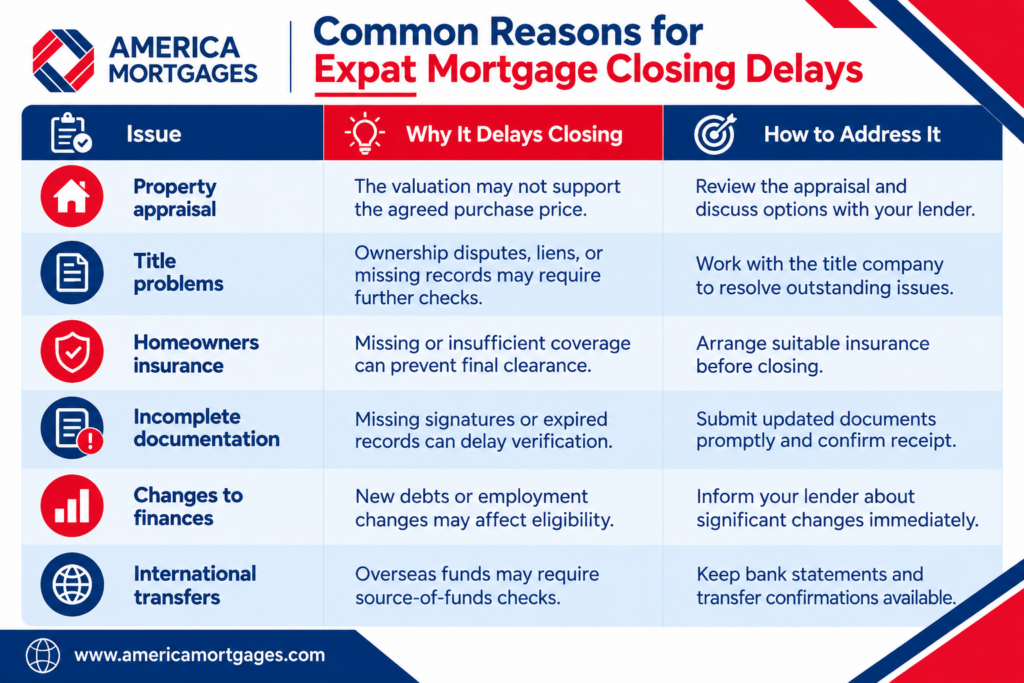
International documentation for American expatriates may lead to additional coordination difficulties due to time differences, foreign banking practices, and paperwork certification. Be sure to keep your lender in the loop and request a list of unresolved issues in writing. It will be easy to recognize the task at hand and determine priorities.
The second major step is to find a type of loan that works for you. In case you consider any other types of loans, review DSCR loans for Americans investing in U.S. property. They will help you to qualify for a loan if you have rental income, but their requirements are slightly different.
Case Study: How a U.S. Expat Refinanced a Florida Rental Property While Living in Singapore
A U.S. expat who resides in Singapore wished to refinance a rental property located in Tampa, Florida. The expat’s status along with income sources from abroad would call for a lender experienced in working with foreign customers. Conventional documentation demands may complicate such requests, despite the borrower’s ability to qualify financially.
This loan is among the expatriate refinances given on America Mortgages website in connection with the rental income financing program, which doesn’t require U.S. tax records from expats. This situation illustrates how an unconventional underwriting process may assist in overcoming the documentation problem. However, it is not evidence of obtaining automated underwriting clearance by the borrower.
Move Your U.S. Expat Mortgage Closer to Closing With America Mortgages
Automatic underwriting approval is significant but does not guarantee mortgage approval. The U.S. expatriate is likely to have problems with their foreign income, credit history, foreign bank statements, and foreign property requirements. Resolving those problems in advance will help you avoid unnecessary complications.
Maintaining proper financial documentation will simplify the verification process. Make sure you keep relevant paperwork on hand, such as employment forms, tax documentation, bank statements, and any other transfer documentation. Also, make sure that you clear out any conditions with your mortgage company regarding what is left before closing.
Contact America Mortgages now to consider appropriate financing options for the purchase of your U.S. property. We can provide you with advice on expat mortgage requirements and difficulties connected with foreign income and credit history. Call us at +1 (845) 583-0830 or email [email protected] or visit America Mortgages to discuss your situation.
FAQs
Q1: Can I get a U.S. mortgage while living and working abroad?
Yes, U.S. citizens residing outside the country may be eligible for mortgages for U.S. properties. However, banks consider your income, your credit history, any debts you have, and your savings. There are also mortgage programs that recognize your income even if it comes from another country.
Q2: What documents do U.S. expats need to apply for a mortgage?
U.S. expats usually require identification, documents for income, bank statements, credit history, and tax returns. But the requirements vary from one lender or loan program to another. Overseas workers can present employment contract documents. For self-employed individuals, documents related to their business finances will also be required.
Q3: Can I use foreign bank accounts for a U.S. mortgage down payment?
Yes, there are mortgage providers in the USA who will accept funds from accounts maintained at foreign banks. But, they need to be able to prove ownership of the account, balance of the account, and the source of the funds. So, please make the necessary documentation available.
Q4: Do U.S. expats need to file U.S. tax returns to qualify for a mortgage?
Not every mortgage application follows the same tax documentation guidelines. However, it is common for the bank to require U.S. tax statements where applicable to prove income qualifications. Foreign tax documents could be of assistance as well. Talk to your bank about documents that could be accepted.
Q5: Can a U.S. expat refinance a property while living overseas?
Yes, there are lenders who do provide refinancing opportunities for qualified U.S. expats residing outside of the country. But, the qualifications include creditworthiness, income proof, equity in the property, and other loan requirements. Compare different programs and see which one will work best for you.
Share this article
Ready to get started?
Speak with our U.S. mortgage specialists today and discover your options.
Schedule a call