Yes, buying property in Hawaii can be a smart investment for those who are looking for rental property that appreciates in value over time. On the other hand, high purchase price, high insurance and maintenance costs may influence profitability. As a result, it is vital to plan your finances well before making a purchase decision.
Hawaii provides various investment options depending on the islands, starting from residential rental to vacation rental property. However, different regulations for rentals and seasonal demand influence ownership and related expenses in Hawaii. It is necessary to compare expected earnings and expenses in order to decide what property to choose. Moreover, it may be helpful to know how rental income influences mortgage eligibility, especially in case of DSCR loans.
America Mortgages assists real estate investors in investigating mortgage options for investment properties in Hawaii. To find out more information about your mortgage options in Hawaii, contact America Mortgages.
What Makes Property in Hawaii Attractive to Real Estate Investors?
Properties in Hawaii become appealing to real estate investors due to the limited availability of land, rental demand, and the possibility of future appreciation. However, expensive purchases and associated costs must be taken into account. Before buying a property, an investor needs to determine the current state of local housing.
| Investment factor | Why it matters |
| Limited housing supply | Development constraints can restrict the availability of homes in desirable areas. |
| Rental opportunities | Eligible residential properties may generate recurring income from tenants. |
| Market demand | Desirable locations can attract buyers and renters, depending on affordability and local conditions. |
| Property variety | Investors can consider condominiums, single-family homes, and other eligible residential properties. |
| Long-term potential | Future returns depend on purchase price, expenses, and changing market conditions. |
According to the Hawaii Housing Factbook 2026 from the University of Hawaii Economic Research Organization, the impact of a limited number of homes and increased demand on the price level of properties is evident. Thus, the report states that the median price of a single-family home in Hawaii was $950,000 in 2025.
Moreover, renting possibilities differ in terms of islands. There were approximately 34,500 rental properties in Hawaii in 2025. The investor should take into account the legality of their using as short-term rentals since there might be local restrictions on it.
What Risks Should You Evaluate Before Buying Property in Hawaii?
The purchase of real estate in Hawaii can be associated with several risks like expensive insurance, high maintenance costs, natural risks, and restrictions on rentals. Thus, one must examine the property carefully to avoid unnecessary financial burden and losses.
There are several risks that require your attention before the purchase:
- Insurance: It is possible that you will not find enough or affordable insurance coverage for the property.
- Natural disasters: The coastal location of the property, floods, hurricanes, and volcanos can be risks for the owner.
- Maintenance: Humidity, salt air, and tropical climate can damage the property faster.
- Restrictions: Zoning, permit, or association restrictions can prevent you from renting the property.
- Assessments: You can be asked to pay additional money for building renovations.
- Re-sale: You may have trouble selling the property later because of the high cost of owning it.
This is particularly true for those living in high-risk zones in Hawaii. This is stated in the Insurance Commissioner of Hawaii’s 2025 Annual Report, which mentions difficulties in insurance availability in Lava Zones 1 and 2 and aged condos with serious maintenance issues. The report further states that some insurance companies have become stricter about underwriting in certain zones.
How Can Investors Finance a Property in Hawaii?
The investor may use conventional mortgages, DSCR loans, portfolio loans, or bridge loans to finance his/her property in Hawaii. All these options depend on the purchase price, available funds, rental income, and qualification of the borrower. Hence, the loan terms comparison may help investors select proper financing.
Conventional Loans
Conventional mortgages are appropriate for eligible buyers who satisfy income, credit, and down payment requirements set by the lenders. The investors need to make a comparison of interest rate, repayment term, and closing costs. Besides that, lenders analyze existing debt and eligibility of the property.
DSCR Loans
DSCR loans evaluate the ability of the property’s qualifying rental income to pay off the property’s debt obligations. Such loans may be appropriate for investors who have enough rental income generated by their property. Yet, minimum coverage ratio, down payments, and property restrictions depend on the lender.
Calculation example: If the qualifying rental income is $6,000 per month and the qualifying debt obligation is $5,000 per month, the DSCR is equal to 1.20 or $6,000 divided by $5,000.
Portfolio Loans
Through portfolio loans, lenders are able to keep their eligible mortgages within their respective investment portfolios. This may be flexible in cases where investors have complex finances or have more than one property. However, interest rates, fees, and requirements will vary according to lenders and loans.
Bridge Loans
Through bridge loans, investors get short-term loans to fund their eligible purchase where the permanent financing is unavailable. Bridge loans can assist an investor in moving fast or in taking care of other property transactions. However, higher borrowing costs and shorter repayment periods mean that an investor must have an exit plan.
It is necessary for the investor to determine how much money is available as down payment, closing costs, monthly cash flow, and others before deciding on a loan. Insurance premiums, property tax costs, property maintenance costs, and vacancy costs need to be considered to check the affordability of the property.
How Can You Determine Whether Buying Property in Hawaii Is Worth It?
Investing in real estate in Hawaii is a good idea when the benefits outweigh the cost of buying the property, the cost of financing, and additional operating costs. The investor needs to calculate how realistic rental income will be compared to owning the property.
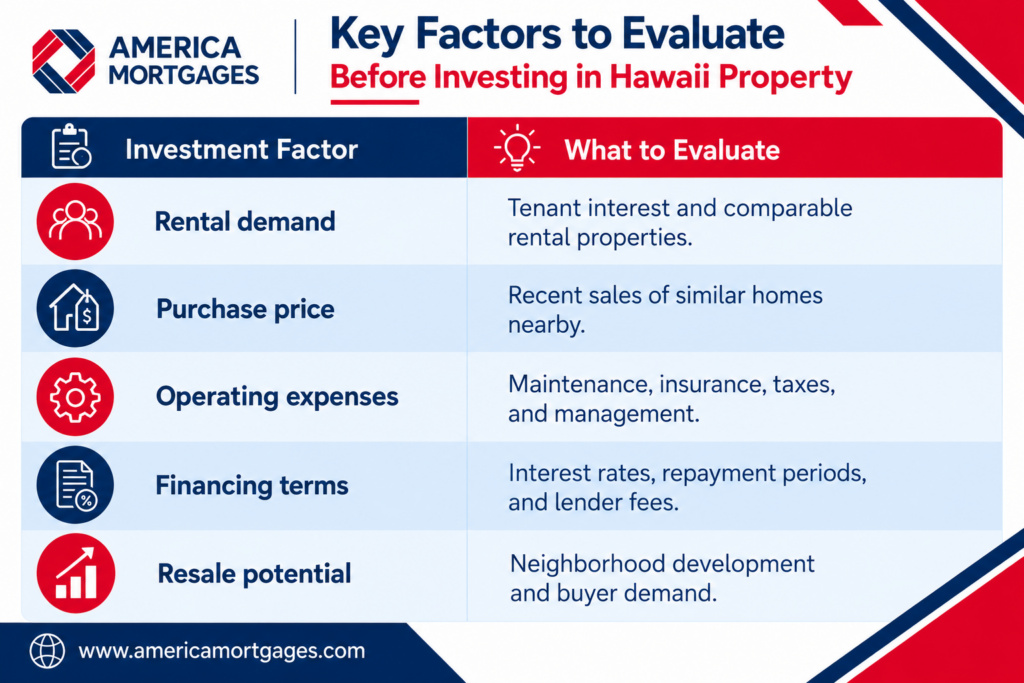
The analysis of all financial aspects of a deal can show if the property is right for you. It is important to calculate potential cash flow at different occupancy and different rental rates. In addition, one needs to make allowance for possible repair work and vacancy.
Also, the financing method affects the total return from the investment. The investors need to compare mortgage options and requirements for qualification. Rental income will influence the eligibility for a mortgage loan according to the lender’s requirements. It is discussed in the guide to qualification for the real estate investments in the USA based on rental income. It is necessary to select the right property that fits into your budget.
Case Study: Financing a Luxury Property Purchase in Maui
A family who had to relocate from California wanted to buy a $9.5 million beach-front property in Wailea, Maui. The sources of income for the family consisted of retirement income, rental income, and variable board payments. Such a complicated financial situation prevented obtaining conventional mortgage funding.
America Mortgages provided a bridge loan of $6 million at 63% LTV. The transaction was completed in 18 business days during which time the family sold their California property. Once the sale took place, the bridge loan was paid off and permanent DSCR financing was arranged on rental income from their portfolio.
Start Your Hawaii Property Investment With America Mortgages
Buying property in Hawaii requires careful planning and suitable financing. It is necessary to analyze the cost of the properties, the rental capabilities, ownership expenses, and the laws in force. An appropriate mortgage will enable the acquisition of a property that matches your financial objective.
America Mortgages provides real estate investors the opportunity to evaluate the financing options available for the investment properties. Whether it is rental property or a luxury property that you want to purchase, knowing the financing options will make it easier for you.
Thinking of investing in Hawaii real estate? Please contact America Mortgages today at +1 (845) 583-0830 or via email at [email protected].
FAQs
Q1: How Much Money Do I Need to Buy Property in Hawaii?
A large down payment may be needed to buy property in Hawaii. The exact amount will vary according to the price of acquisition and the loan required. It is also important to consider closing fees, insurance, taxes, and repair costs.
Q2: What Is the Average Rental Yield in Hawaii?
Rental yield in Hawaii depends on the island, property type, and location. Divide annual rental income by the cost of purchase to find the gross yield. But don’t forget to subtract operating expenses for a true understanding of the return.
Q3: Can I Buy Property in Hawaii Without Living There?
Yes, you may usually purchase a property in Hawaii even if you are not a resident there. But the means of finance will depend on the type of residency, proof of income, and usage of the property.
Q4: Which Hawaiian Island Is Best for Real Estate Investment?
These include Oahu, Maui, Kauai, and Big Island, which have distinct investment opportunities. Your preferred destination will depend on your budget, rental approach, and projected income. It is necessary to consider property costs, demand, cost, and applicable rental laws.
Q5: How Much Are Closing Costs When Buying Property in Hawaii?
Closing costs in Hawaii depend on the purchase price, the terms of the financing, and other aspects of the deal. Home buyers should budget for lender fees, title costs, escrow costs, and prepaids. Get a detailed estimate prior to closing.
Share this article
Ready to get started?
Speak with our U.S. mortgage specialists today and discover your options.
Schedule a call