Property in Arizona - Mortgage for Indian Buyers

What You Will Learn

  • Why Arizona has become a leading U.S. real estate market for Indian investors exploring property in Arizona.
  • The property types and locations across the state where property in Arizona offers strong rental and long-term appreciation potential.
  • How Indian buyers can qualify for an Arizona mortgage when purchasing property in Arizona, even without U.S. credit or U.S. income.
  • The loan programs available for second homes and investment properties.
  • Key tax considerations and ongoing ownership costs when holding real estate in Arizona.

Introduction

Indian investors represent one of the fastest-growing groups entering the U.S. real estate market, and Arizona has quickly become a preferred state for both lifestyle and investment purposes. While Indian buyers have historically favored California, New Jersey, and Texas, Arizona’s affordability, rental strength, and economic growth have made it an increasingly strategic choice. Whether buying for long-term appreciation, student housing, retirement planning, or rental returns, Indian investors see Arizona as a high-potential state with lower entry costs and strong upside.

The U.S. Real Estate Market Outlook 2026 highlights Arizona as one of the most resilient and migration-driven markets in America. With major companies relocating to Phoenix, Tempe, and Mesa, the demand for housing continues to rise. For Indian buyers accustomed to competitive urban markets like Mumbai, Bengaluru, and Delhi, Arizona offers accessibility and long-term value that is difficult to match.

Why Arizona Appeals to Indian Investors Using an Arizona Mortgage

Many Indian buyers are drawn to Arizona because it offers strong rental yields and long-term appreciation without the high price barrier seen in coastal U.S. states. Phoenix and its surrounding areas continue to attract tech workers, engineers, healthcare professionals, and university students, creating steady rental demand. This aligns closely with Indian investors’ preference for stable, income-producing assets.

Another major advantage is affordability. Compared to markets like San Francisco or Toronto, Arizona offers significantly lower purchase prices for both single-family homes and condos. Insights from Why Investing in U.S. Real Estate Is the Smartest Choice reinforce why Indian investors view U.S. real estate as a long-term wealth strategy, especially in markets positioned for growth.

Property Types Indian Buyers Prefer in Arizona

Indian investors typically focus on properties that offer predictable rental occupancy, lower maintenance, and long-term appreciation prospects. Arizona’s housing stock suits these preferences well, with modern communities, well-planned neighborhoods, and a strong supply of new developments.

Preferred Property Types Among Indian Buyers:

  • Single-family homes in Phoenix, Chandler, and Gilbert
  • Condos near Arizona State University for student housing
  • New-build properties in fast-growing suburbs
  • Scenic vacation homes in property for sale in Northern Arizona and property for sale in Williams, Arizona

Indian investors also explore luxury properties, supported by demand patterns outlined in U.S. Luxury Property Investments.

How Indian Investors Use Arizona Real Estate

Indian buyers often purchase Arizona homes for multi-generational benefit, combining investment goals with family needs. Many plan to use the property during U.S. visits, while others purchase for children studying in America. Long-term rental strategies are also common due to strong tenant demand.

Common Uses for Indian-Owned Arizona Properties:

  • Long-term rental investments
  • Second homes for family visits
  • Student housing for children attending U.S. universities
  • Vacation homes in scenic mountain or desert areas

For those exploring U.S. holiday-home options, Vacation Home Mortgages provides helpful guidance.

How Indian Buyers Finance Arizona Property With an Arizona Mortgage

Financing is often the biggest challenge for Indian investors, as most U.S. banks require U.S. income, U.S. credit history, and domestic tax filings. America Mortgages solves this by offering financing options tailored specifically to non-U.S. residents.

✔ Second-home financing

Indian buyers qualify using global income, supported by Indian salary slips, tax documents, and asset statements.

✔ Investment property financing

Approval is based on property rental income (DSCR), not Indian or U.S. income, allowing investors to scale quickly.

Tools such as the Arizona mortgage calculator or the mortgage calculator Arizona help Indian buyers estimate affordability, forecast rental yield, and plan long-term cost structures. With rising demand and discussions around long-term financing outlined in The 50-Year Mortgage and Trump’s 50-Year Mortgage Proposal, investors are increasingly locking in competitive U.S. financing earlier.

Loan Types Available to Indian Investors

America Mortgages provides flexible mortgage programs specifically structured for Indian buyers entering the U.S. market. These programs allow for competitive long-term financing without U.S. credit or residency.

Popular Loan Types Include:

  • DSCR loans for investment properties
  • Second-home loans using Indian income documentation
  • Fixed-rate Arizona home mortgage loan programs
  • Cash-out refinancing for portfolio expansion

Investors comparing market risk across states reference insights such as Red vs Blue State Property Markets.

Understanding Arizona Taxes for Indian Investors

One major advantage for Indian investors is Arizona’s low property tax structure. The effective arizona real estate tax rate averages about 0.56 percent, making it more affordable than many U.S. states. Low annual taxes improve rental returns and support stronger long-term yields.

Indian buyers researching how much is property tax in Arizona, what are property taxes in Arizona or average property tax in Arizona often use SmartAsset for state comparisons or the Arizona Department of Revenue for county-level details. Understanding property taxes early helps investors plan long-term cash flow more accurately.

Working With Local Professionals in Arizona

Indian buyers benefit from working directly with a knowledgeable real estate agent in Arizona who understands rental markets, desirable school districts, and fast-growing neighborhoods. Agents can also coordinate virtual tours and remote transactions for overseas buyers.

An Arizona real estate attorney can assist with contract review, title clearance, and entity structuring, especially for those purchasing multiple properties or entering commercial real estate for sale in Arizona. Some investors also explore broad U.S. city comparisons using Best U.S. Cities for Foreign Mortgage Borrowers.

Conclusion

Arizona offers Indian investors a compelling combination of affordability, rental strength, and long-term appreciation. With financing options such as the Arizona Mortgage, Indian buyers can purchase Arizona real estate confidently without U.S. credit or U.S. income. Whether acquiring investment properties, second homes, or future retirement residences, Arizona stands out as one of the most promising U.S. markets for Indian investors entering the American real-estate landscape.

To explore your financing options, contact our team or email us directly at [email protected].

Frequently Asked Questions

Q1. Can Indian residents qualify for an Arizona mortgage without U.S. income?

A: Yes. America Mortgage allows Indian buyers to qualify without U.S. income or U.S. credit history.

Q2. How can Indian buyers estimate monthly mortgage payments?

A: Using the Arizona mortgage calculator or the mortgage calculator Arizona helps estimate payments and affordability.

Q3. Are Arizona property taxes low compared to other states?

A: Yes. Arizona’s average property tax rate of roughly 0.56 percent is well below national averages.

Q4. Can Indian investors buy commercial real estate in Arizona?

A: Yes. Many Indian investors purchase commercial property for sale in Arizona to diversify income streams.

Q5. Can Indian investors buy property in Arizona without visiting the U.S.?

A: Yes. Indian investors can purchase property in Arizona entirely from overseas using remote processes. Most steps, including mortgage approval and closing, can be completed digitally, making it possible to acquire property in Arizona without traveling to the U.S.

Q6. Is property in Arizona suitable for long-term rental income?

A: Property in Arizona is widely considered suitable for long-term rental strategies due to population growth and steady tenant demand. Many investors choose property in Arizona for its balance of rental yields, affordability, and long-term appreciation potential.

Q7. Are there financing options available specifically for property in Arizona?

A: Yes. Specialized lenders offer mortgage programs designed for foreign buyers investing in property in Arizona. These programs allow international investors to finance property in Arizona without relying on U.S. income or U.S. credit history.

Right Time to Refinance for Real Estate Investors

Everyone wants to time the market perfectly: the lowest rate, the highest valuation, the ideal moment to act. But in real estate, waiting for the mythical “perfect” time often means missing the profitable time.

So when is the right time to refinance?

Historically, it is the moment interest rates begin drifting downward, but before the market realizes it. And, according to recent Finimize data, that shift is already underway. Equity release refinancing applications in the U.S. have jumped significantly, even as purchase demand slips. That is the earliest sign of a rate cycle turning.

Why refinancing early matters more than refinancing perfectly

Investors who wait for the bottom rarely capture it.

By the time rates hit a headline-grabbing low:

• Buyers flood back into the market

• Bidding wars return

• Inventory tightens

• Prices accelerate

A $300,000 property can quickly become a $380,000 property. This completely erases any additional savings you hoped to achieve by waiting another 0.25% in rate movement.

Refinancing when rates start falling, not when they bottom out, is what gives sophisticated investors the advantage.

Refinancing now allows you to release equity while prices are still relatively low

In many U.S. markets, prices have softened or stabilized, creating a rare moment where:

• Rates are easing

• Values are not yet inflated

• Competition is still quiet

This combination does not last long.

Refinancing now lets investors potentially pull out six figures of equity before the market turns and values rise again. That liquidity becomes your competitive weapon. Your tool or secret weapon for building a U.S. real estate portfolio.

Use the cash to buy additional investment property before the next wave of price increases

Smart investors do not refinance only to lower their payment. They refinance to multiply their portfolio.

With equity released today, you can:

• Acquire a second (or third) U.S. investment property with no LTV limitations or restrictions

• Move quickly on distressed or off-market listings

• Enter fast-growing markets before values rebound, gaining instant equity once rates are slashed and prices move

• Leverage current prices rather than future, higher ones

This is how global investors scale: refinancing one asset to buy two, three or more.

Why foreign nationals and U.S. expats are acting now

Traditional lenders still require U.S. tax returns, W-2 income, and U.S. credit history. Most global investors do not meet those requirements, which is why refinancing used to feel impossible. Until now…

America Mortgages changed the game for foreign investors and U.S. expats.

AM Cash-Out Refinance Loan Program: Built for Investors Who Want to Reinvest Quickly

Key Loan Highlights

• No Personal Income Required

Perfect for foreign nationals and U.S. expats with global income and cash-flowing properties.

• No U.S. Credit History Needed

We underwrite using common-sense underwriting principles based on the property, and not the borrower’s passport.

• Loan Amounts Starting from US$100,000

Ideal for pulling liquidity without selling the property or using funds to purchase multiple properties without limitations of LTV, allowing our clients to build U.S. portfolios.

• Loan-to-Value (LTV)

Up to 80% for U.S. citizens

Up to 75% for foreign nationals

• Closing Time: 30 to 45 Days

Fast enough to capture emerging opportunities.

• Amortizing or Interest-Only Options

Choose the structure that maximizes cash flow.

Fixed-rate loan programs are available regardless of the borrower’s age.

Regardless of whether you’re 19 or 99, take advantage of the longest amortization period available.

These programs give America Mortgages’ investors the freedom to refinance and reinvest strategically at the exact moment the market favours action.

The right time to refinance is when rates start falling, not when the headlines arrive.

There is no doubt, we are in that window now.

Rates are easing, prices are still attractive, and competition has not returned in force.

Refinancing today gives you:

• A lower rate heading into the next cycle

• Cash-out equity to expand your portfolio

• The ability to secure undervalued properties while they still exist

Waiting does not reduce risk. It reduces opportunity.

Refinance now. Buy more while prices are still low. Position yourself ahead of the next appreciation wave, not behind it.

Ready to refinance, pull equity, and scale your U.S. property portfolio?

America Mortgages can structure the fastest, simplest path from a single investment property to a multi-property strategy with our Cash-Out Refinance solutions.

If you’re ready to scale a U.S. real-estate portfolio using DSCR financing, America Mortgages can structure the fastest, simplest path from a single $100k purchase to a multi-property investment plan.

Contact: [email protected]

Website: www.americamortgages.com

Speak to a U.S. Loan Expert 24 hours a day / 7 days a week: +1 845-583-0830

Need help getting started? Use our 24/7 online booking tool to schedule a free, no-obligation consultation with a licensed U.S. mortgage advisor.

Mortgage for Second Home

Why U.S. Expats Are Buying Second Homes in the U.S. Again

For many U.S. Expats, owning a second home in the U.S. is more than a lifestyle decision; it’s a long-term financial anchor for future relocation, family visits, or extended stays. The good news is that qualifying for a second home mortgage does not require U.S. income, U.S. credit, or a domestic employer. Expat-specific mortgage programs allow foreign income, global assets, and alternative credit documentation to be used for qualification. For a broader overview, see How to Buy a Second Home in the U.S. as a Foreign National.

Many expats purchase in states where lifestyle meets long-term investment potential, as seen in this real expat case study: U.S. Expat Private Banker in Hong Kong Buys a Second Home in South Carolina. This highlights how second home mortgage programs allow expats to qualify quickly using foreign compensation packages and international banking history.

How Foreign Income Is Used to Qualify for a Second Home Mortgage

Second-home underwriting evaluates your foreign income, employment stability, and global banking profile, not U.S. documents. Borrowers provide international salary slips, employer letters, and two months of bank statements, which is significantly easier than traditional domestic underwriting. Many America Mortgages programs do not require a U.S. credit score or even a home-country credit file, accepting banking references instead.

Foreign income must support repayment for a second home mortgage, and the property must be for personal use, not rented out full-time. Investment property underwriting is different and does not use foreign income, as seen in this example of a Singapore-based expat purchasing an investment unit through a separate loan structure: U.S. Expat Living in Singapore Buys Investment Home in San Diego. Understanding this difference ensures compliance with lender rules and sets clear expectations.

The Second Home Mortgage Requirements U.S. Expats Should Know

The qualification process for a second home mortgage focuses on verifying stable income and strong global liquidity. U.S. Expats typically need:

  • Two months of bank statements
  • Foreign income proof (salary slips or employer letter)
  • Savings or assets for the required down payment

For expats buying their first property back in the U.S., down payment support options are available and outlined here: Down Payment Help for First-Time Expats. Borrowers purchasing vacation homes can refer to the step-by-step guidance in Vacation Home Mortgages for additional clarity on seasonal-use properties.

Market timing also plays a role when planning a second home. Current forecasts, such as Why 2026 Could Be a Breakout Year for U.S. Real Estate Investors, highlight opportunities where expats may benefit from stabilized pricing and potential rate improvements.

Why a Second Home Mortgage Is Easier Than Many U.S. Expats Expect

The majority of U.S. Expats qualify more easily than they assume. International employment is accepted, and tax reporting requirements differ from domestic borrowers. With second-home underwriting, the focus is on repayment capacity, global liquidity, and long-term stability rather than U.S. tax filings or domestic credit. This approach makes a second home mortgage not only achievable but streamlined for expats in Asia, Europe, the Middle East, and beyond.

Many expats explore luxury or coastal locations based on long-term value and lifestyle preferences. High-net-worth U.S. Expats often evaluate these markets using insights like those in U.S. Luxury Property Investments, which outline demand trends and supply constraints contributing to appreciation potential. Understanding these dynamics ensures that a second home mortgage serves both personal and financial objectives.

How a Second Home Mortgage Fits Into U.S. Expats’ Long-Term Plans

A second home mortgage provides U.S. Expats with the flexibility to maintain roots in the U.S. while living abroad. Whether for family visits, relocation planning, or retirement, a second home offers stable access and long-term security. For some expats, a vacation property evolves into a retirement home; for others, it becomes a place for extended stays during work rotations or children’s schooling. Market insights from our main site, America Mortgages, help borrowers understand how second homes fit into broader financial strategies.

Those purchasing holiday homes can further explore financial considerations in Is a Vacation Home a Good Investment?. While second homes are not underwritten as investment properties, many later transition to part-time rentals depending on local regulations and lender guidelines.

Conclusion: A Second Home Mortgage Gives U.S. Expats a Clear Path Back to U.S. Ownership

For U.S. Expats, qualifying for a second home mortgage is straightforward when using foreign income, international assets, and flexible credit alternatives. America Mortgages provides second-home financing tailored specifically for expats, ensuring the entire process,  from prequalification to closing, can be completed from overseas. With expert guidance, strong market timing, and expat-focused underwriting, buying a second home in the U.S. becomes achievable, strategic, and significantly easier than most expect.

To speak with an expat mortgage specialist or begin your application, contact us at America Mortgages or email [email protected]. To learn more about who we are, visit About America Mortgages.

Frequently Asked Questions

Q1. Can foreign income be used to qualify for a second home mortgage?

A: Yes. Foreign income is accepted for second homes and personal-use properties. It cannot be used for investment properties.

Q2. How many months of bank statements do U.S. Expats need?

A: Most second home mortgage programs require only two months of bank statements, not lengthy financial histories.

Q3. Do U.S. Expats need U.S. credit to buy a second home?

A: No. Many programs do not require a U.S. credit score or a home-country credit file. Banking references and international credit alternatives may be accepted.

U.S. Expats investing - DSCR and Asset Based Loans Explained
Group of tourists searching place on the map while sitting with takeaway coffee in front of skyscrapers in Moscow city.

Why U.S. Expats Are Using DSCR & Asset-Based Loans to Invest Back Home

U.S. Expats are increasingly turning to U.S. real estate as a long-term wealth strategy, even while earning income abroad. Because investment properties do not use foreign income for qualification, DSCR (Debt Service Coverage Ratio) and asset-based loans have become the most reliable financing options for expat investors. These programs eliminate the need for U.S. tax returns, domestic credit history, or local employment, allowing U.S. Expats to build property portfolios remotely.

This approach is ideal for investors who depend on rental income performance or global liquidity rather than salary verification. DSCR loans qualify based on projected rental income, while asset-based mortgages focus on cash reserves and portfolio strength. These expat-focused structures open the door for passive income, long-term appreciation, and even commercial acquisitions, which can be explored further through our U.S. commercial property financing overview.

How DSCR Loans Work for U.S. Expats Investing in Rental Properties

A DSCR mortgage evaluates whether the rental income from a property can cover the mortgage payment. Because U.S. Expats often have global income sources or irregular earning patterns, this underwriting model avoids traditional income documentation entirely. Instead of W-2s or U.S. pay slips, lenders rely on fair-market rent estimates and cash flow projections. For a deeper breakdown of DSCR benefits, see Top Benefits of DSCR Loans for Rental Yield Properties.

This model allows U.S. Expats to buy in cities with strong rental yields, rising rental demand, and stable occupancy. Many of these trends are highlighted in the U.S. Real Estate Market Outlook 2026. DSCR loans are also appealing in evolving rate environments, with macro-policy shifts summarized in Trump vs The Fed offering insight into how timing affects investor returns.

When Asset-Based Lending Helps U.S. Expats Qualify More Easily

Asset-based financing is the preferred choice for U.S. Expats who hold significant savings, investments, or company reserves. Instead of assessing monthly income, lenders underwrite based on available liquid assets, allowing investors to qualify using their global financial position alone. This structure suits entrepreneurs, consultants, business owners, and high-net-worth expats whose income may not be easily documented or taxed within the U.S.

This pathway also supports investing before a property is rented, giving U.S. Expats flexibility to buy into emerging markets or pursue luxury units with long-term appreciation. Market behavior in this category can be explored in U.S. Luxury Property Investments. Asset-based loans also allow expats to secure homes more quickly, without waiting for rental projections or tenant placement.

Why DSCR & Asset-Based Loans Are Surging Among U.S. Expats

U.S. Expats are seizing a unique moment in the real estate cycle. Stabilizing price growth, improving inventory, and the potential introduction of the 50-year mortgage model make early investment attractive. Since DSCR and asset-based underwriting are unaffected by foreign income rules, U.S. Expats can move quickly before domestic demand and affordability shift.

Research from CNBC and Forbes Real Estate reinforces the trend: rental housing remains one of the strongest global investment classes, even through rate and demand cycles. Combined with America Mortgages’ U.S. Expat Investor Toolbox, expats can access tools, calculators, and loan structures specifically created for investors living abroad.

How U.S. Expats Build Scalable Rental Portfolios From Overseas

U.S. Expats can build growing rental portfolios by using DSCR for cash-flow assets and asset-based loans for high-equity acquisitions. This balance creates diversification across markets, allowing expats to hold both long-term rentals and emerging short-term rental opportunities. Because neither approach requires U.S. employer income nor domestic credit history, investors can scale across multiple states seamlessly.

The remote process is streamlined for U.S. Expats:

  • DSCR or asset-based prequalification
  • Remote document submission
  • Closing via e-sign or local notary
    Support teams and loan specialists are accessible through our Contact page or directly at [email protected].

For career opportunities or partnership pathways assisting expat investors, explore America Mortgages Careers.

Why U.S. Expats Benefit From Timing, Currency Trends, and Portfolio Flexibility

U.S. Expats often benefit from foreign exchange windows, where a stronger local currency can reduce the effective cost of down payments and long-term mortgage expenses. Combining FX strategy with DSCR or asset-based financing allows expats to secure U.S. assets during favorable cycles, often before domestic demand rebounds.

As highlighted in the 2026 Market Outlook, investors abroad are actively entering the market ahead of expected price adjustments. Strategically leveraging these tools helps U.S. Expats build multi-property portfolios that remain resilient through shifts in inflation, rates, and market competition.

The Advantage U.S. Expats Have Over Domestic Investors

U.S. Expats often maintain global income, liquidity, and currency advantages that domestic investors do not. Because DSCR and asset-based mortgages evaluate either rental income or asset strength, not employment, U.S. Expats can invest confidently without meeting the criteria that U.S.-based borrowers face. This gives U.S. Expats a unique position to capture rental yield and long-term appreciation across high-demand regions.

Conclusion: DSCR & Asset-Based Loans Make Investing Accessible for U.S. Expats Worldwide

U.S. Expats have more investment pathways than ever. DSCR loans qualify based on rental performance, while asset-based lending uses liquidity rather than income. Together, these tools allow U.S. Expats to invest in U.S. real estate without U.S. credit, domestic earnings, or traditional documentation. With fully remote processes and expat-specific lending programs, America Mortgages makes it possible for U.S. Expats to build multi-market property portfolios from anywhere in the world.

To explore investment options or speak with a specialist, visit the Contact page or email [email protected].

Frequently Asked Questions

Q1. Do U.S. Expats need U.S. income to qualify for investment property loans?

A: No. Investment loans for U.S. Expats use DSCR or asset-based underwriting, not foreign or U.S. income.

Q2. Is U.S. credit required for DSCR loans?

A: No. Many DSCR programs do not require U.S. credit or tax returns. Approval depends on projected rental income.

Q3. What documentation is required for asset-based lending?

A: Asset summaries, investment portfolio records, or two months of bank statements demonstrating liquidity.

home mortgage rates arizona
village in Aragon. Frias de Albarracin, Teruel

Arizona has rapidly become one of the most desirable real estate markets for international investors seeking value, stability, and long-term growth. Its combination of economic expansion, population inflows, and diversified property options has attracted non-resident buyers from Canada, Singapore, the United Kingdom, China, India and beyond. Many investors begin their search exploring cheap property for sale in Arizona or property for sale in Northern Arizona, while others focus on larger metro hubs like Phoenix and Scottsdale, where rental demand continues to rise.

International buyers increasingly evaluate the market through an investment-first lens. Reports such as the U.S. Real Estate Market Outlook 2026 from America Mortgages highlight Arizona as a state with sustained rental performance and strong appreciation potential. Combined with the availability of an Arizona mortgage designed specifically for non-U.S. residents, Arizona presents a unique opportunity for global investors seeking both affordability and long-term security.

Arizona’s Growth Story and the Rising Demand for an Arizona Mortgage

Arizona’s growth is driven by a combination of business expansion, tech development, and strong employment fundamentals. Major employers in semiconductor manufacturing, advanced materials, aerospace, healthcare, and logistics continue to draw high-income professionals into the state. As these industries expand, long-term rental demand increases, supporting steady appreciation and high occupancy across multiple cities. Investigating opportunities through insights such as Why Global Investors Are Buying U.S. Luxury Property helps many foreign buyers better understand why demand continues to rise.

Affordability is another key factor. Compared to California or Washington, Arizona offers lower acquisition costs, competitive home mortgage rates Arizona buyers can access and generally more favorable tax requirements. Many non-residents conduct early research using how much is property tax in Arizona, what are property taxes in Arizona, and average property tax in Arizona, noting that the statewide effective tax rate averages about 0.56 percent. This makes Arizona one of the more tax-efficient markets for rental investments in the United States.

Why International Investors Prefer Arizona’s Real Estate Market With an Arizona Mortgage

International investors are drawn to Arizona because of its resilient appreciation patterns and balanced supply-demand environment. Phoenix, for example, remains one of the fastest-growing metro areas in the United States, while Scottsdale maintains strong luxury demand. Northern markets such as Flagstaff and Sedona continue to grow due to tourism, second-home purchasing, and short-term rental interest. This variety attracts both long-term investors and lifestyle-driven buyers. Articles such as Copy the Best Real Estate Investor in the World highlight the value of investing early in high-growth markets like Arizona.

Commercial opportunities also continue to expand, evidenced by rising global interest in commercial real estate for sale in Arizona and commercial property for sale in Arizona. These segments attract foreign nationals looking for stable, income-producing assets. Many buyers use an Arizona mortgage calculator to run returns, debt-service coverage, and long-term revenue projections before making offers.

How Investors Secure an Arizona Mortgage as a Non-U.S. Resident

Financing is a key component of entering the Arizona market, and non-U.S. residents rely on America Mortgages to access financing without traditional U.S. requirements. Domestic lenders typically require U.S. credit, U.S. tax returns, or Social Security numbers, but America Mortgages structures loans based on global income, international credit, or asset documentation. This allows international buyers to secure an Arizona home mortgage loan even if they have never lived in the United States.

Pre-approval is the most effective way for non-residents to compete with local buyers and make strong offers. It involves reviewing financial documentation, verifying international income or assets, and analyzing the desired property type. For buyers exploring second-home opportunities, our guide Vacation Home Mortgages for International Buyers provides a clear breakdown of how financing works for holiday or part-time residences. With fixed-rate terms up to 30 years, non-residents can secure predictable monthly payments even during fluctuating market conditions.

Evaluating Tax Advantages With an Arizona Mortgage

Tax efficiency is a major advantage for Arizona investors. The state maintains some of the lowest property taxes in the country, with the effective rate averaging around 0.56 percent according to SmartAsset. This is significantly below the national average, reducing long-term holding costs for foreign landlords and improving cash-flow projections. Many international buyers actively search for Arizona real estate tax rate insights or explore what are property taxes in Arizona to calculate their overall expenses.

County governments publish updated tax data through the Arizona Department of Revenue, allowing investors to evaluate specific rates based on location. This information is important when evaluating submarkets such as property for sale in Northern Arizona or property for sale in Williams Arizona, where values and tax obligations differ. Additionally, insights from Best U.S. Cities for Foreign Mortgage Borrowers can help non-residents understand which U.S. regions offer the strongest combined tax and financing advantages.

Working With Local Advisors to Strengthen an Arizona Mortgage Application

Working with a knowledgeable real estate agent in Arizona is essential for any non-resident entering the market. Local agents provide accurate market comparables, guide buyers through competitive bidding environments, and help identify properties with strong rental potential. They also ensure that buyers understand local rental rules, zoning, and permitted use categories that vary across metro regions.

Some foreign buyers also choose to work with an Arizona real estate attorney for added legal protection. Attorneys assist with reviewing purchase contracts, advising on title considerations, and supporting entity structuring if the buyer plans to hold multiple properties. This guidance can be particularly valuable for buyers entering the commercial sector or for those building a long-term U.S. investment portfolio. For deeper insights on investor behavior, explore Why Investing in U.S. Real Estate Is the Smartest Choice for Non-Residents.

Conclusion

Arizona’s strong economic fundamentals, attractive pricing, low taxes, and growing population make it one of the most compelling real estate markets for global investors. With financing options such as the Arizona mortgage tailored for non-U.S. residents, international buyers can enter the market with confidence. By combining competitive lending programs with strategic guidance, America Mortgages helps investors build long-term U.S. property portfolios in fast-growing markets like Arizona.

To explore your financing options, contact us here or email our team directly at [email protected].

Frequently Asked Questions

Q1. Why are international investors choosing Arizona over other U.S. states?

A: Arizona offers stronger affordability, lower taxes, and better rental yields compared to coastal markets. These factors support stable long-term investment performance.

Q2. Can non-U.S. residents qualify for an Arizona mortgage?

A: Yes. America Mortgages offers financing specifically for foreign nationals, without requiring U.S. credit, U.S. income or a Social Security number.

Q3. How do I estimate Arizona mortgage payments?

A: Investors can use Arizona mortgage calculator or the mortgage calculator Arizona tools to estimate payments, interest, and return projections.

Q4. Are property taxes lower in Arizona?

A: Yes. Arizona’s effective property tax rate of about 0.56 percent is below the national average, supporting stronger rental returns for global investors.

Property in Arizona
Las Vegas panorama at sunset with mountain, highway, street and luxury hotels.

Arizona has become one of the most attractive real estate markets for international investors due to strong population growth, increasing rental demand, and more accessible pricing compared to major coastal states. Many overseas buyers search for cheap property for sale in Arizona, property for sale in Northern Arizona, or even property for sale in Williams Arizona, as these markets offer a combination of value and long-term appreciation potential. Larger metros such as Phoenix, Scottsdale, and Tucson offer strong tenant pools and continued economic expansion.

Despite the opportunity, financing remains the primary obstacle for many foreign buyers because traditional banks require U.S. credit, U.S. income, or tax returns. America Mortgages solves this problem with specialized Arizona mortgage programs designed for non-U.S. residents. Our financing solutions allow foreign nationals to qualify without U.S. credit or income, making the purchase process smooth and predictable.

Why Arizona Is a Strong Market for Non-Residents

Arizona appeals to non-resident investors because of its affordability, predictable appreciation, and consistent rental market performance. Compared to states like California, New York, or Washington, Arizona offers stronger cash-flow potential and a lower cost of entry. Search interest for commercial property for sale in Arizona and commercial real estate for sale Arizona shows that investors across the world are entering both the residential and commercial sectors.

Northern regions also attract demand due to their scenic landscapes and short-term rental potential. As buyers evaluate long-term opportunities, many also compare tax advantages using searches such as how much is property tax in Arizona, what are property taxes in Arizona and average property tax in Arizona. With an average effective tax rate near 0.56 percent, Arizona remains one of the more tax-efficient states for global investors.


To understand why non-residents continue to invest in the U.S. overall, read Why Investing in U.S. Real Estate as a Non-U.S. Resident Is the Smartest Choice.

How Non-Residents Can Buy a Property in Arizona

The first step for foreign buyers is determining affordability and evaluating mortgage payments. Using tools such as Arizona mortgage calculator helps investors estimate payments, interest, and long-term costs. These tools provide realistic frameworks for buyers planning to hold rental properties, second homes, or future relocation homes.

Next, non-U.S. residents should obtain pre-approval from America Mortgages. Our Arizona home mortgage loan programs offer up to 75 to 80 percent LTV, fixed-rate terms up to 30 years, and underwriting that accommodates foreign income. Pre-approval shows sellers you are a ready buyer, especially important in competitive areas such as Scottsdale, Phoenix, and segments of Northern Arizona. For buyers considering a second home, our guide on Vacation Home Mortgages for Non-Residents is helpful.

How Non-Residents Can Finance a Property in Arizona

Financing a property in Arizona as a non-U.S. resident is more accessible than most investors expect. Traditional banks typically require U.S. credit, U.S. income, Social Security numbers, or tax returns, which excludes many foreign nationals. America Mortgages solves this challenge by offering Arizona mortgage programs designed exclusively for overseas buyers, allowing you to qualify using global income, foreign credit history, or liquid assets.

Underwriting for non-resident loans focuses on financial stability, global income strength, and proof of funds instead of U.S. financial data. Most clients supply only a passport, two months of bank statements, and asset documentation. For second homes, global income can be used to qualify, while investment property loans often rely on property cash flow. Fixed-rate terms up to 30 years ensure predictable payments, regardless of market fluctuations.

Key benefits of financing with America Mortgages

  • Up to 75 to 80 percent LTV for non-residents
  • No U.S. credit score required
  • No U.S. income required for investment properties
  • Global income accepted for second homes
  • Remote underwriting and global borrower support

This structure allows non-residents to compete confidently in Arizona’s market and secure property even without prior U.S. financial history.

Working With a Real Estate Agent in Arizona

Working with a knowledgeable real estate agent in Arizona is essential for non-resident buyers. Agents familiar with international transactions can guide you through local regulations, remote showing processes, escrow timelines, and FIRPTA considerations. Their expertise helps identify desirable neighborhoods and evaluate rental potential in Phoenix, Mesa, Tucson, and vacation markets.

Many foreign nationals also choose to work with an Arizona real estate attorney. While not required by state law for residential closings, attorneys can provide contract review, entity structuring, and clarity on legal protections. This is particularly valuable for commercial buyers entering the commercial real estate for sale Arizona market or those planning long-term U.S. retirement strategies. To learn more about long-term planning, explore Mortgage Options for Foreign Nationals Retiring in the U.S.

Understanding Property Taxes Before Getting an Arizona Mortgage

Understanding Arizona taxes is critical for calculating ROI. According to SmartAsset, the average effective property tax rate is roughly 0.56 percent, placing Arizona well below the national average. This supports stronger rental yields and long-term affordability for non-resident buyers. For those researching statements such as how much is property tax in Arizona or what are property taxes in Arizona, the Arizona Department of Revenue provides county-level details.


For broader U.S. market insights, explore the U.S. Real Estate Market Outlook 2026 or U.S. Luxury Property Investments.

Final Steps and Closing for a Non-Resident Arizona Mortgage

Once your offer is accepted, the final phases include inspection, appraisal, and underwriting. Non-residents typically complete their closings remotely using secure electronic signing methods and title services. Most transactions finalize in thirty to forty days when pre-approval is completed early.

America Mortgages remains involved through every stage of the process, helping clients evaluate financial documentation, prepare for underwriting, and complete the closing process efficiently. For further data on what drives U.S. market movement, review our U.S. Flash Market Update or explore Best U.S. Cities for Foreign Mortgage Borrowers.

Conclusion

With competitive pricing, strong rental demand, and accessible financing, Arizona remains one of the best U.S. real-estate markets for non-resident investors. America Mortgages provides Arizona mortgage solutions specifically designed for global buyers, allowing you to finance U.S. property without U.S. credit or income. With the right guidance and structure, non-residents can invest confidently and successfully in Arizona real estate.

To explore your financing options, contact us here or email our team directly at [email protected].

Frequently Asked Questions

Q1. What documents do non-residents need for an Arizona mortgage?

A: Non-residents typically need a passport, two months of bank statements and proof of down payment funds. America Mortgages does not require U.S. credit or U.S. income for investment properties.

Q2. Are property taxes higher for foreign buyers?

A: No. Arizona property taxes are the same for residents and non-residents. The arizona real estate tax rate averages around 0.56 percent.

Q3. Can foreign buyers purchase commercial property in Arizona?

A: Yes. Non-U.S. residents actively invest in commercial property for sale in Arizona and commercial real estate for sale Arizona using specialized financing options.

Q4. How can I estimate my monthly mortgage payment?

A: You can use an arizona mortgage calculator or mortgage calculator Arizona to estimate monthly payments, interest, and affordability before making an offer.

U.S. Mortgage for Green Card Holders

What You Will Learn

  • How U.S. green card holders living abroad qualify for a U.S. mortgage using foreign income.
  • The documentation, credit requirements, and income verification lenders expect from overseas applicants.
  • Which loan types permanent residents abroad can access, including second-home and investment property options.
  • Practical considerations when applying from overseas, including timelines, remote closing, and global lender support.
  • Key market insights to help green card holders decide when and where to buy in the U.S.

Understanding Your Eligibility as a U.S. Green Card Holder Abroad

Green card holders living abroad often assume that qualifying for a U.S. mortgage is difficult. In reality, permanent residents are treated much like U.S. citizens when applying for a mortgage loan, even when their income is earned outside the United States. As long as documentation is clear and income is stable, qualifying “like a local” is both realistic and accessible.

Understanding your rights and the process is essential. Many Americans overseas face similar challenges, and this guide is designed to simplify your path. For a broader overview, you may also explore our insights on U.S. citizens living abroad.

How Lenders View Green Card Holders Overseas

Lenders classify green card holders as U.S. permanent residents, not as foreign nationals. This means you generally have access to the same mortgage products as citizens, including conventional loans, second-home financing, and investment property options. Living abroad does not reduce eligibility; lenders simply require clear documentation to verify status, income, and credit.

For age and qualification concerns, this resource provides additional context: Is there an age limit for getting a U.S. mortgage?

Using Foreign Income to Qualify

Foreign income is acceptable to specialized lenders that understand foreign-earned income as long as it demonstrates stability and continuity. Lenders typically review employment history, conversion to USD, and the likelihood that income will continue. These standards align closely with guidelines from the Consumer Financial Protection Bureau (CFPB).

Income is evaluated based on your overseas employment contract, the consistency of past earnings, and bank statements showing deposits. This allows permanent residents abroad to qualify for second-home mortgages or investment property loans using foreign income.

Documentation Needed

Prepare the following before applying from abroad:

  • Valid green card
  • Two years of U.S. tax returns
  • Recent foreign payslips and bank statements

For verification of status, the U.S. Citizenship and Immigration Services (USCIS) provides official guidance:

Credit Requirements for Permanent Residents Abroad

Most lenders prefer a minimum FICO score of 640 for competitive pricing. A U.S. credit report is required, even if your history is limited. Lenders typically focus on recent repayment behaviour, active accounts, and the absence of recent delinquencies. If your U.S. credit file is thin, lenders may use alternative credit references or international credit data to support the application.

Income Requirements

When evaluating foreign income, lenders typically look for:

  • At least two years of stable employment
  • Proof of ongoing income in your current role
  • Clear, verifiable salary deposits
  • A transfer letter, if you are being relocated to the U.S., confirming your new position and the income you will earn

These factors help determine affordability for a mortgage loan on a second home or investment property.

Loan Types Available to Green Card Holders Abroad

Green card holders can access the same major U.S. mortgage products available to citizens, giving them flexibility whether they plan to live in the property or purchase it as an investment. Specialized lenders offer conventional mortgages for standard home purchases, along with jumbo loans for higher-value properties that exceed conforming limits. If the property will be used occasionally during visits to the U.S., second-home financing is available with competitive terms. For those building a portfolio, investment property loans allow permanent residents abroad to qualify based on credit, income, or, in some cases, the rental potential of the property.

If you are exploring investment opportunities, our articles on market trends offer deeper insights, such as why foreign investors are pouring into U.S. real estate and why luxury U.S. property continues to attract global buyers.

You may also find it helpful to review timing-based insights, including why many buyers are considering a purchase before the end of 2025 and projections on a potential breakout year in 2026.

Practical Considerations

When applying from abroad, plan for:

  • Currency transfers for your down payment
  • Coordination across time zones during underwriting, which can be simplified by working with globally based lenders such as America Mortgages (AM), which specialise in expat financing
  • Remote signing or consulate-based notarization

These considerations do not impact eligibility but may affect timelines.

Your U.S. Financing Path Forward

Now that you understand how green card holders can qualify for a U.S. mortgage using foreign income, this may also be the right time to explore financing options for a second home or investment property. America Mortgages specialises in supporting U.S. permanent residents living abroad.

You can reach us at [email protected] or through our contact page.
Visit our main site at America Mortgages to learn more.

Frequently Asked Questions

Q1: Can green card holders living overseas qualify using foreign income?

A: Yes. Foreign income is acceptable as long as it is stable and well-documented. Lenders typically verify the employer, review recent payslips, and convert earnings into USD for qualification. As long as the income is consistent and expected to continue, it can be used for both second-home and investment property financing.

Q2: Do green card holders get the same mortgage terms as U.S. citizens?

A: Generally yes. Permanent residents typically access the same mortgage loan programs and pricing. This includes conventional and jumbo loans without the premium pricing or restrictions often applied to non-resident foreign nationals. Your rate and terms are primarily based on credit, income strength, and property type, not your location abroad.

Q3: Do I need to travel to the U.S. to close the mortgage loan?

A: Not usually. Many lenders offer remote closing options, including embassy-based notarization. Most of the application, underwriting, and documentation steps can be completed digitally, allowing green card holders abroad to finalise the mortgage without making a physical trip. Remote closings have become standard for expat borrowers.

U.S. Expats Buying Property Home
View in Chicago with morning light, USA.

Why U.S. Expats and Green Card Holders Can Still Buy Property Without U.S. Income or Credit

Many U.S. Expats and Green Card holders assume they cannot buy real estate in the U.S. because they no longer earn American income or maintain a domestic credit score. In reality, both groups often qualify through programs designed specifically for Americans living overseas. These programs evaluate foreign income, international assets, and global banking history, allowing borrowers to finance a second home or prepare for future relocation. For a complete breakdown of expat documentation and eligibility, see the Guide to U.S. mortgages for U.S. Expats.

Traditional banks rarely accommodate overseas borrowers because they cannot interpret foreign financial documents. America Mortgages solves this by underwriting using international verification systems and expat-specific criteria. Many programs for U.S. Expats and Green Card holders do not require a U.S. credit score or even a credit score from your home country. Instead, alternatives such as banking references or strong asset history are accepted. For a clear comparison of how Americans overseas qualify differently, see How expats easily secure a U.S. mortgage.

How Americans Overseas Qualify Using Foreign Income and 2-Month Bank Statements

Foreign income can be used to qualify for second homes, holiday homes, and personal-use properties for both U.S. Expats and Green Card holders. These loans rely on salary slips, employer letters, and two months of bank statements, not six months or year-long histories. This structure allows U.S. Expats and Green Card holders to purchase a home for personal use or long-term relocation without needing U.S. tax returns or domestic deposits.

For investment properties, the rules differ. Investment loans do not use foreign income. Instead, they rely on DSCR (Debt Service Coverage Ratio), asset-based underwriting, or rental-cash-flow evaluation. This allows U.S. Expats to purchase investment units without proving employment income at all. For expats buying their first U.S. property, support options are outlined here: Down payment help for first-time expat buyers.

Why 2025–2026 Is an Ideal Window for U.S Expats and Green Card Holders Re-Entering the Market

Market data shows stabilizing prices across multiple U.S. metros, creating a strategic moment for U.S. Expats and Green Card holders to re-enter the market. The U.S. Real Estate Market Outlook 2026 highlights moderating price pressure, improved supply, and buyer activity shifting after years of volatility. These trends make it easier for expats to secure property while competition is still manageable.

In addition, expats are monitoring potential policy shifts, including the proposed 50-year mortgage model, which could reduce payment burdens for long-term buyers. Interest rate momentum explained in Trump vs The Fed may also create a short opportunity where rates steady before new demand returns. External sources such as CNBC and Forbes Real Estate confirm rising interest from overseas buyers when rates stabilize.

Where U.S. Expats and Green Card Holders Are Buying and Why High-Demand Markets Still Perform

U.S. Expats and Green Card holders often purchase homes for future relocation, lifestyle planning, or for family members studying in the U.S. Popular second-home markets include suburban metros with strong schools, warm-weather destinations, and stable, mid-tier cities that offer long-term appreciation. For investment-minded expats, financing depends on DSCR or asset-based lending rather than income, making it accessible even for entrepreneurs or consultants abroad.

Luxury real estate remains a significant driver of expat demand due to resilient pricing, limited supply, and favorable currency moments. A stronger foreign currency versus the U.S. dollar can reduce effective purchase costs, improving long-term returns. For market behavior across luxury segments, review U.S. Luxury Property Investments.

How Americans Overseas Can Time Their Purchase Using Currency and Market Cycles

One strategic advantage U.S. Expats often overlook is currency timing. When the U.S. dollar weakens relative to your local currency, your down payment and long-term mortgage cost can effectively decrease. Some borrowers transfer funds in stages, while others align their purchase timeline with favorable exchange cycles to maximize value.

These currency movements pair closely with broader U.S. market shifts. Trends outlined in the 2026 market outlook suggest that stabilization may give expats a window to secure property before larger pools of buyers re-enter the market. This makes timing both a financial and strategic opportunity.

Second Home or Investment? Choosing the Right Mortgage Path as U.S. Expats and Green Card Holders

Choosing the right structure depends on your purpose. Second homes allow U.S. Expats and Green Card holders to qualify with foreign income, making them ideal for future relocation or family use. These properties can later become rentals, offering flexibility over time. Investment properties, by contrast, are underwritten using DSCR or asset-based formulas, making them independent of employment income.

Expats and Green Card holders planning for long-term residence may benefit from fixed-rate structures, while investors may focus on cash-flow potential and market demand. Future affordability tools, such as the proposed 50-year mortgage program, explained here: Why smart buyers are locking in early may further help expats choose options aligned with long-term goals.

Conclusion: Buying U.S. Real Estate From Overseas Is More Achievable Than Most Expect

U.S. Expats can buy second homes or investment properties without U.S. income, domestic credit, or local tax returns when using expat-focused mortgage programs. America Mortgages evaluates foreign income for second homes and uses DSCR or asset-based underwriting for investments, allowing borrowers to qualify from almost any country. With remote processing, flexible documentation, and expat-tailored mortgage solutions, financing a home in the U.S. is simpler than expected.

If you’re ready to explore options, America Mortgages can prequalify you from anywhere in the world.

Frequently Asked Questions

Q1. Can U.S. Expats qualify for a U.S. mortgage using only foreign income?

A: Yes, but only for second homes or personal-use properties. Investment properties use DSCR or asset-based qualification instead.

Q2. Do I need a U.S. credit score or home-country credit report?

A: No. Many America Mortgages programs do not require credit from the U.S. or your home country. Banking references or asset history are often accepted.

Q3. How many months of bank statements are required?

A: America Mortgages typically requires two months of bank statements for qualifying U.S. Expats, not six months.

December Housing Trends

December is usually a quiet month in U.S. real estate, but the December 2026 data shows a market that is behaving very differently. HousingWire and Altos Research reveal that December has effectively become an early preview of the coming year. 

For foreign nationals and U.S. expats looking to invest, these six charts highlight a market that is stabilising, rebalancing and offering conditions far more favourable than what we saw during the volatility of the last several years.

Here’s what the December housing trends actually reveal — and why they matter for America Mortgages clients.

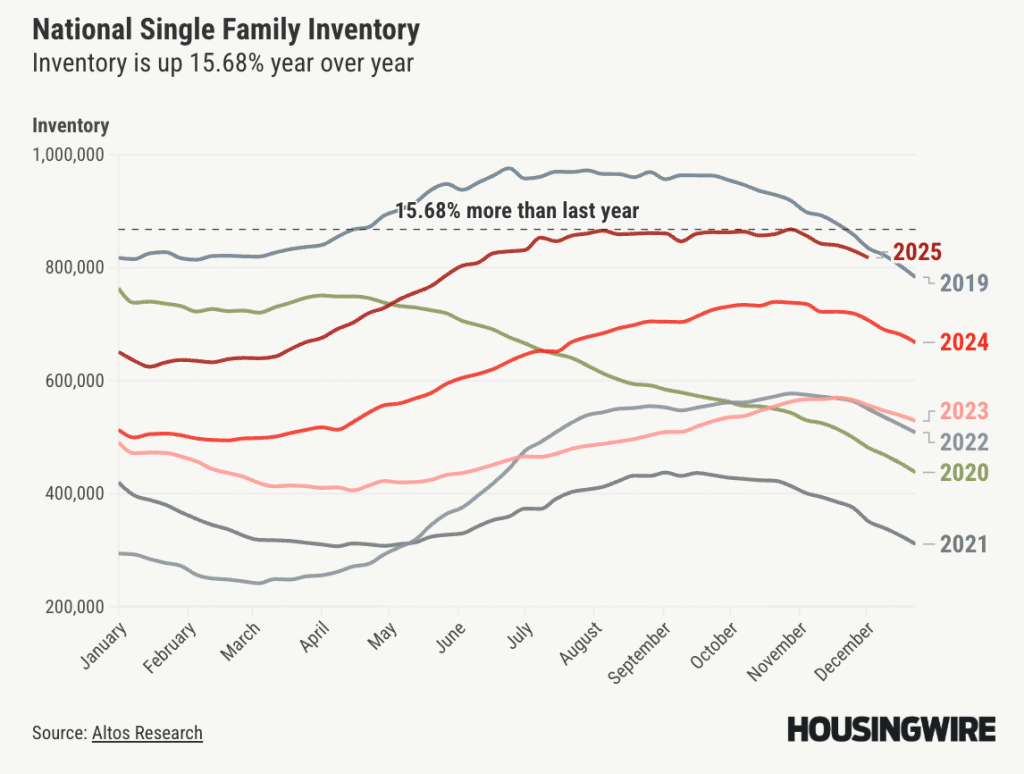
1. National Single-Family Inventory Is Recovering

National Single-Family Inventory

This shows one of the most important improvements in today’s housing environment: inventory is up 15.68% year over year. After years of ultra-tight supply, the market is finally loosening. Higher inventory levels give international buyers considerably more choice, stronger negotiating leverage and the ability to make decisions without the pressure of immediate competition. For those purchasing from abroad, where due diligence often takes more time, this renewed breathing room is particularly valuable.

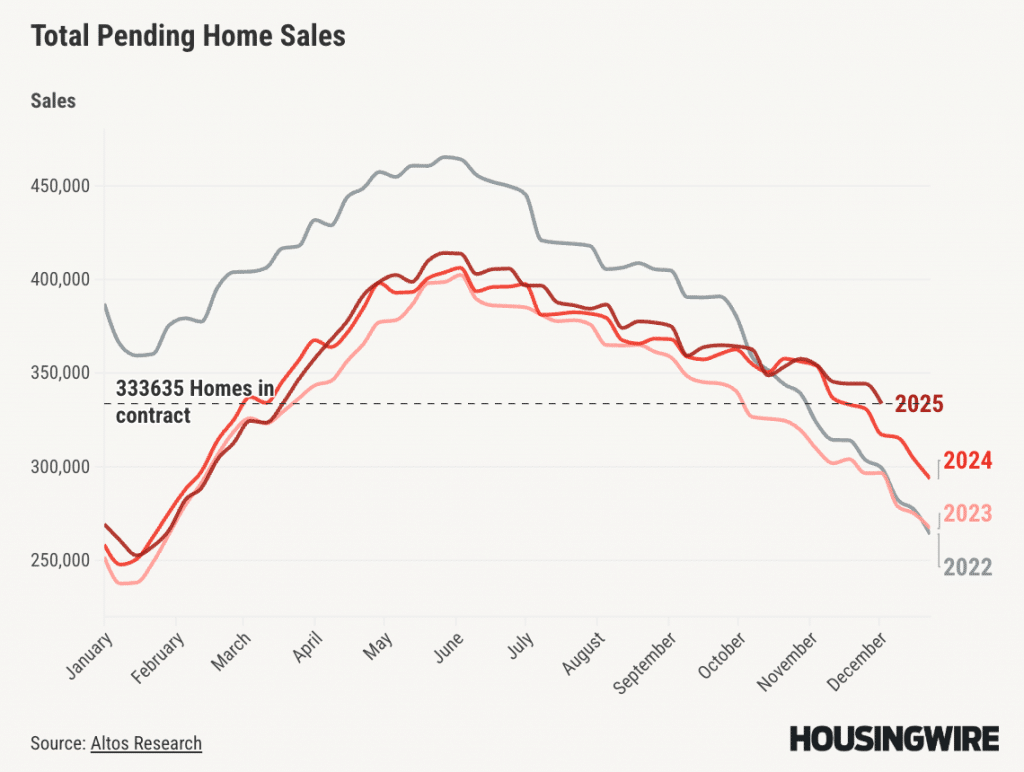
2. Pending Home Sales Show Buyers Are Returning

Total Pending Home Sales

Pending sales reached 333,635 homes in contract, a number that exceeds activity seen in 2023 and 2022. Even with higher interest rates, buyers are stepping back into the market earlier and with more confidence. This signals that demand is building beneath the surface and is likely to accelerate as affordability improves. For real estate investors, this trend suggests that early 2026 may be the calm before a much more competitive spring.

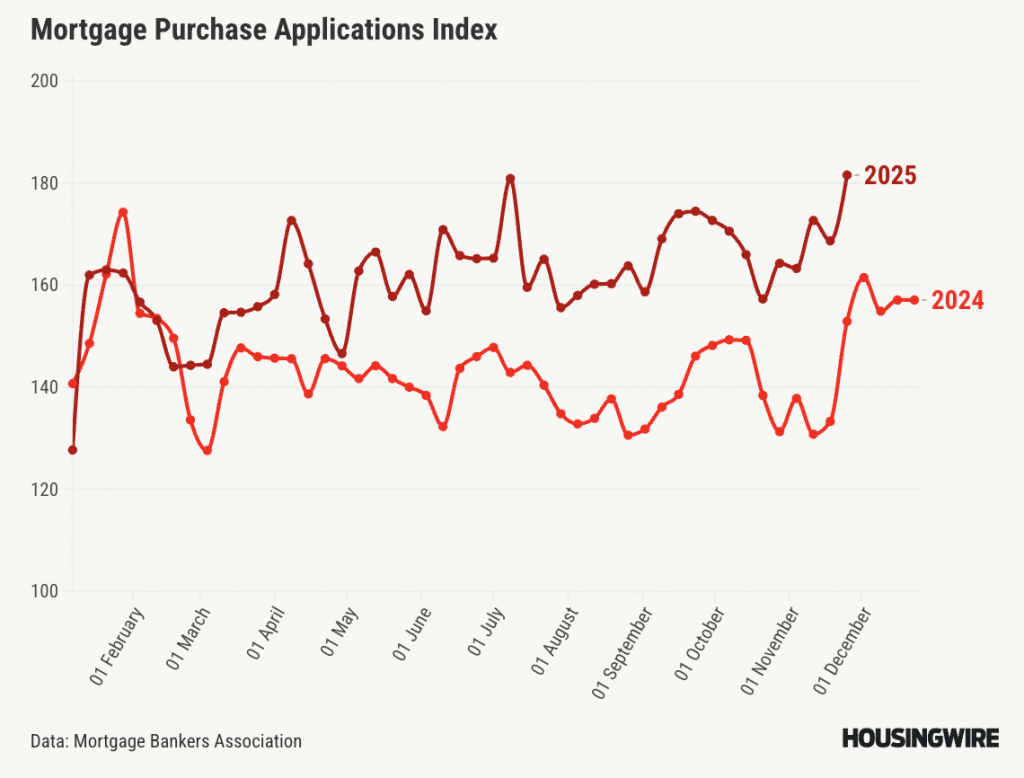
3. Purchase Applications Are Climbing Ahead of Peak Season

Mortgage Purchase Applications Index

Mortgage Bankers Association data shows a consistent increase in purchase applications throughout 2025 compared to 2024. Applications are one of the earliest indicators of forward demand, and this rise suggests that buyers are preparing for purchases sooner than expected. For buyers, this early upswing highlights the advantage of being proactive. With America Mortgages’ expat and foreign-national loan programs — which do not require U.S. credit, W-2 income, or domestic tax returns — overseas borrowers can move just as quickly as local buyers and position themselves ahead of the competition before activity intensifies.

4. Mortgage Rates Have Finally Stabilised

One of the most encouraging shifts is in rate stability. After several years of unpredictable spikes, mortgage rates in 2024 and 2025 have moved into a stable, flatter range. This allows buyers to plan long-term financing with much greater confidence. For investors who often rely on fixed-rate products to lock in predictable monthly payments, this environment reduces uncertainty and encourages decisive action.

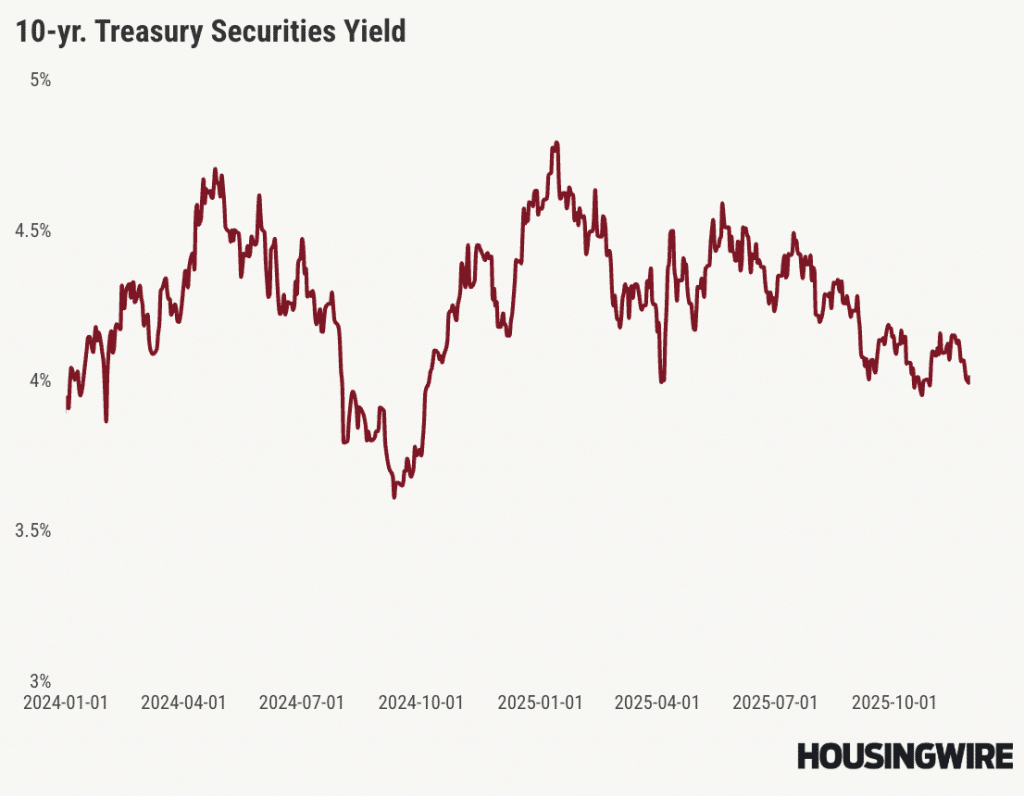
5. Treasury Yields Suggest Further Rate Relief May Be Ahead

10 yr Treasury Securities Yields

Because mortgage rates are heavily influenced by the 10-year Treasury yield, this chart provides an important signal. The yield saw periods of volatility in early 2024 but began cooling and drifting downward in late 2025. If this pattern continues, borrowing costs may ease further in 2026. For international buyers, entering the market before any major increase in competition — and potentially refinancing later if rates drop — can be a highly favourable strategy.

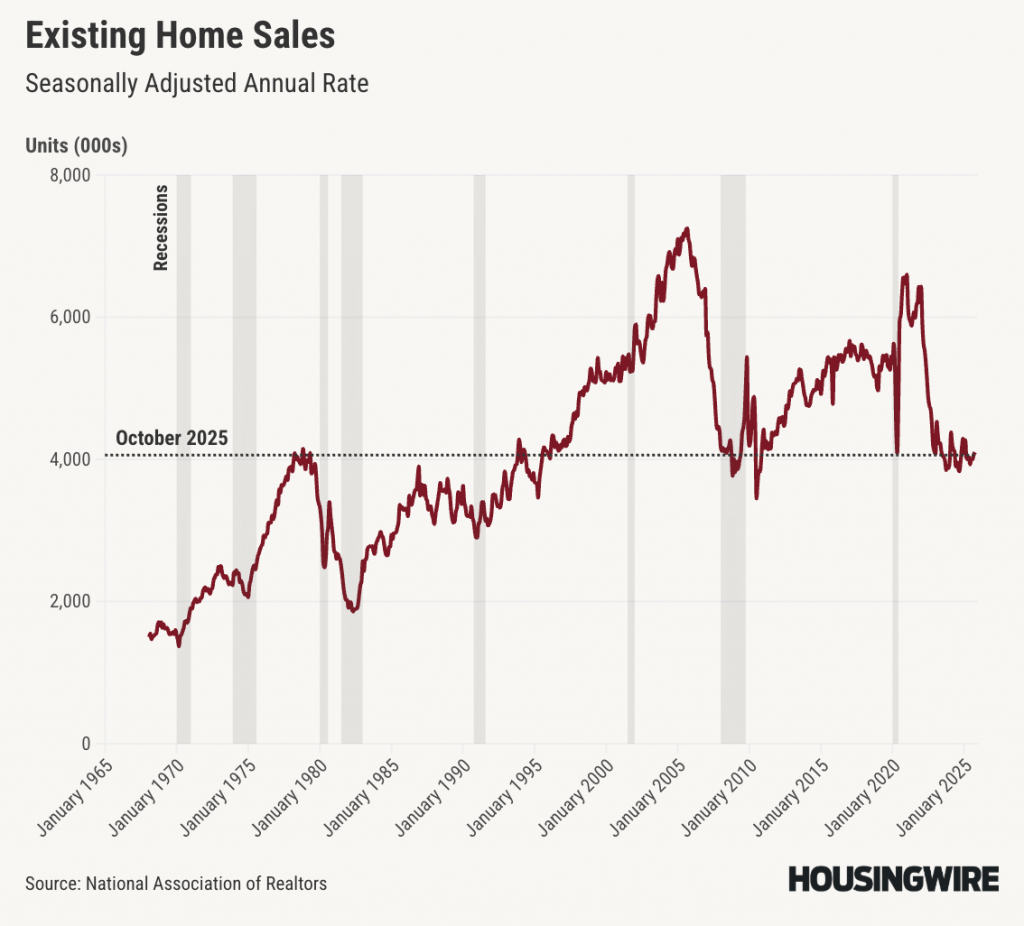
6. Long-Term Existing Home Sales Show Pent-Up Demand

Long-Term Existing Home Sales

The final chart offers valuable historical context. Existing home sales sit near multi-decade lows, a level typically associated with recessionary periods or moments of major affordability strain. Historically, such lows are followed by significant rebounds once conditions improve. This suggests that the market is not weak — it is paused. When affordability and supply continue improving, demand is likely to return quickly and forcefully.

What This Means for America Mortgages Clients

Taken together, these trends show a U.S. housing market in transition. Inventory is improving, demand is reawakening and rates are settling into a predictable range. For foreign nationals and U.S. expats clients of America Mortgages, this creates a rare early-cycle opportunity to buy before the spring market intensifies. Buyers who move now can secure better pricing, better positioning and better financing terms before competition builds.

How America Mortgages Helps You Act Before the Window Closes

If you’re living outside the U.S. but waiting for the right moment to buy property, the market signals suggest that time may be now. This is one of the rare times when the charts line up signaling the time to strike. 

At America Mortgages, we specialise in helping foreign nationals and U.S. expats secure full-term U.S. mortgage financing without the barriers of traditional banks.

You don’t need a U.S. credit score, U.S. residency, or American tax returns.

Our underwriting is designed around your international financial profile, making U.S. homeownership accessible no matter where you live or earn.

Key Highlights

  • No U.S. credit score required
  • Foreign income, assets, and international documentation accepted
  • Up to 80% loan-to-value depending on country and borrower profile
  • Access to 150+ loan programs designed for non-U.S.-resident borrowers
  • 30-year fixed rates, regardless of borrower age
  • Minimum loan amounts starting from US$150,000
  • DSCR investment property loans requiring no personal income to qualify
  • 10-year fixed interest-only loan options for investors
  • No W-2s or U.S. tax returns required for U.S. expats
  • Mortgages available in all 50 U.S. states
  • Remote closings supported worldwide
  • Loan officers working in 12 different countries in your time zone and speaking your language 
  • Residential, commercial, asset backed bridge loans – all available 

Whether you’re purchasing an investment property, refinancing an existing loan, or unlocking equity from your U.S. home, our global lending team ensures a fast, seamless experience built around the unique needs of international borrowers.

This is how America Mortgages empowers buyers abroad to move quickly — before competition rises and the window of opportunity narrows.

Bottom Line

The December data offers a clear signal: the U.S. housing market is stabilising, strengthening and preparing for a potential resurgence. Buyers who act early, before the first wave of spring competition, will be best positioned to take advantage of this rare opportunity of timing.

Ready to explore your options? Our team of America Mortgages specialists is here to guide you, no matter where in the world you’re based.

If a U.S. purchase is on your horizon, this is the ideal moment to start planning. We work with you from the mortgage, to the property, to the tax planning to the holding structure … all under one roof. 

We’ll help you build a clear financing strategy so you’re prepared before market conditions shift.

Speak with a U.S. mortgage expert anytime, 24 hours a day, 7 days a week: +1 845-583-0830

Prefer to book online? Use our 24/7 scheduling tool to arrange a free, no-obligation consultation with a U.S. mortgage advisor at your convenience.