
Yes, U.S. expats may obtain second-home financing without providing a regular W-2 statement. Special mortgage financing considers earnings in a foreign country and money in foreign banks. It is necessary to evaluate the borrower’s earnings, credit score, liabilities, and available cash reserves. Hence, life abroad does not mean that you cannot buy property in the U.S.
However, it is crucial to select the right loan program. A borrower can apply for both regular and special loans according to his financial situation. Work contracts, foreign payslips, and foreign bank statements will prove the ability to repay the loan. For further information, check out complete guide to U.S. mortgages for American expats.
Looking for appropriate financing? America Mortgages is here to assist overseas Americans with second-home mortgages. Contact our specialist now and get your property in the USA!
Why Can U.S. Expats Qualify for a Second Home Without a W-2?
U.S. expats have the chance to apply for a second home loan without the W-2 form via other methods of income verification. For instance, the lenders may consider foreign payroll statements, tax filings, and employment contracts. Such sources of information prove that you have steady incomes and can pay off the loan. In other words, working overseas does not necessarily mean that you cannot get a mortgage loan.
| Qualification factor | What lenders evaluate |
| Foreign employment | Job stability and employment duration |
| Monthly income | Regular salary and payment consistency |
| Credit history | U.S. credit score and repayment record |
| Existing debts | Monthly financial obligations |
| Available assets | Savings, investments, and cash reserves |
| Property eligibility | Intended use and second-home requirements |
Regular American employees have W-2 forms issued by their employer. But American citizens working overseas may have different payroll procedures. That is why the lenders analyze your finances differently. Some traditional mortgage programs take into account foreign income if the borrower satisfies all necessary conditions.
Additionally, the picture of your finances plays a role in this process. A consistent income, well-controlled liabilities, and enough resources make you a better applicant. Furthermore, having a solid credit history within the U.S. helps in this process as well. For additional guidance, explore U.S. expat mortgage loans for Americans living abroad. This can help you understand available financing options before applying.
What Income Documents Do Lenders Accept for Second-Home Financing for US Expats?
Several financial documents are acceptable for second-home loan financing of US expatriates without W-2 forms. Such documents can be used to prove your earnings, employment stability, and money availability. In accordance with your mortgage program, you will need to present salary slips, bank statements, tax returns, and employment contracts from abroad.
To back up your mortgage loan application, you should prepare the following financial documents:
- Foreign employment contract: Proves your employment, position, salary, and contract conditions.
- Current salary slips: Proves regular income and timely salary from your employer from abroad.
- Foreign bank statements: Proves your salary transfers, saving, and ability to pay mortgage.
- Tax returns of the USA: Can help to prove your foreign earnings.
- Employment verification letter: Proves your current employment, experience, and salary.
- Financial statements of your business: If you are self-employed from abroad.
- Statements about investments: Additional financial resources.
- Identification documents: Your identity through a valid US passport and other documents.
According to Fannie Mae, foreign income can be counted under conventional financing as long as specific conditions are met. Two years’ worth of signed U.S. federal tax returns is needed in order to prove foreign income. Stability of income is checked, and the money earned is converted to U.S. dollars.
But the requirement on documentation varies from one mortgage program to another. There are also some lenders that accept other ways of verifying foreign income aside from documents for people with complicated international income streams.
Which Mortgage Options Can Help U.S. Expats Finance a Second Home?
U.S. expats can consider multiple mortgage options to buy a second home. Traditional mortgage programs and special loan programs have different qualification criteria. The selection depends on foreign income, the borrower’s credit history, available assets, and property eligibility. Comparison of available financing options allows for determining suitable products for borrowers.
Conventional Second-Home Mortgages
Traditional mortgages are appropriate for American expatriates with steady foreign job and a good credit record. Lenders evaluate qualifying income and outstanding debt and verify property eligibility criteria. Borrowers must also meet relevant down payment and reserves requirements for selected programs.
Non-Qualifying Mortgage Programs
Non-Qualifying Mortgages provide alternative qualifying criteria for those borrowers who do not fall into the standard lending criteria. Bank statements, alternative income documents, and other financial information are used by lenders depending on the financial institution. Interest rates, down payments, and qualification criteria vary.
Asset-Based Financing Programs
In asset-based loan programs, lenders take into account financial assets in order to evaluate the ability of the borrower to repay the loan. Savings, brokerage accounts, and other financial resources of the borrower may be considered.
Programs for Borrowers Working Abroad
The programs cover those who earn salaries in other countries. The lenders could analyze the employment contracts of those who work abroad, bank statements and tax documents. Currency conversion and income stability play a role too. Different mortgage companies have varying requirements.
Bridge Loan Financing
The bridge loan is financing that allows buying qualified properties. The financing could be more focused on the property value and available equity. This type of financing could work well for investors seeking flexible financing. However, this financing does not necessarily suit second-home purchases.
Second-Home Mortgage Requirements Explained
Section 4201.15 of Freddie Mac provides details about second-home mortgage requirements. Occupancy rules, property eligibility and restriction from renting could be among them. Those rules would help to determine whether a purchase is considered a second home.
Ultimately, employment structure and property intentions should be considered when choosing the financing. Analyze the loan terms, interest rates, down payment amount and closing costs. In addition, it would be important to consider whether one meets the occupancy requirements.
What Should Expats Prepare Before Applying for a Second-Home Mortgage?
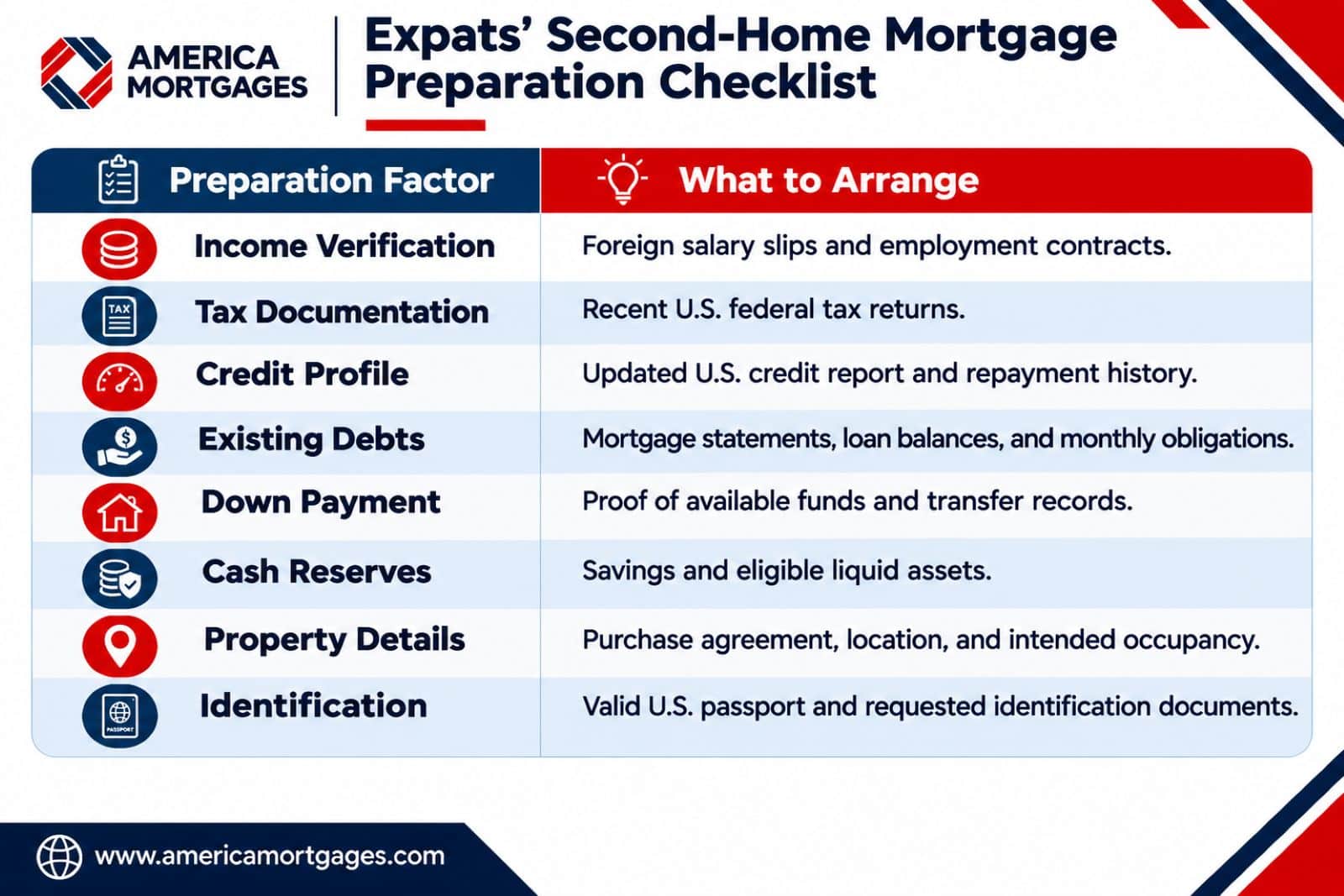
Expats need to prepare records such as income records, credit records, bank statements, and property information before applying. This is because lenders will use these records to analyze the financial stability and ability to repay. Furthermore, checking the debt status and available reserve will help detect application problems.
Credit history is very important in preparing for mortgages. As per FICO, 35% of a credit score is determined by the payment history. On the other hand, outstanding balances make up 30%. Credit history makes up 15% while the new credit and credit mix make up 10% each.
In this case, expatriates need to analyze missed payments and outstanding balances before applying. Lowering credit balances can be useful in managing the credit well. Expatriates should analyze their existing financial obligations, which include personal loans and mortgage payments. Enough funds should be available for the closing cost and emergencies.
Case Study: UK Expat Secures $3.9 Million Miami Condo Bridge Loan
America Mortgages helped the expatriate from the UK to acquire $3.9 million via a unique bridge loan program. The financing was not based on U.S. income and credit, but rather on property valuation. Thus, the borrower could go ahead with purchasing the Miami condominium even with their foreign financial status.
The America Mortgages’s team provided access to alternative financing options for such a borrower. Thus, the transaction showed how innovative financing solutions work for overseas borrowers who have mortgage limitations.
Explore Your Second-Home Financing Options With America Mortgages
Acquiring a second home in America is possible from wherever you may be located outside the USA. America Mortgages provides American expatriates with viable mortgage options. Their professionals will examine foreign income, foreign employment status, foreign credit history, and available funds to help you find the right type of mortgage.
With access to over 150 mortgage programs in America, America Mortgages provides you with various flexible options. The experts at America Mortgages work with clients in all 50 states. Furthermore, you can inquire about mortgages without even coming to America.
Looking for ways to finance your second home? Contact us today! Get in touch with a mortgage specialist to find out what is best for you. Call us at +1 (845) 583-0830. You could also e-mail hello@americamortgages.com.
FAQs
Q1: How much down payment is required for a second home in the USA?
Second homes generally need a minimum down payment of 10%. However, in some cases, the lender may ask for 15% to 20%, based on qualifications. Factors such as credit score, property value, and mortgage programs will determine the amount. Having extra cash on hand is beneficial.
Q2: Can I buy a second home in the USA while living overseas?
Yes, U.S. citizens are allowed to buy property even when living outside the country. The main reason is that lenders will have to confirm your foreign income and financial status. Foreign employment agreements, pay stubs, and tax documents can be provided.
Q3: What credit score is needed for a second-home mortgage in the USA?
The score of 620 may meet some conventional mortgage program criteria. However, having a higher score will increase your chances of loan approval and lower rates. In addition, the lender will consider your payment history, other debts, and mortgages. This is why you should check your credit report before applying.
Q4: Can I use foreign bank statements to qualify for a U.S. mortgage?
Yes, there are lenders who accept foreign bank statements for mortgage purposes. They will assist in proving your salary payments, savings, and money availability. However, requirements may vary depending on whether you use conventional or Non-QM programs. Additional documentation may also be required.
Q5: Are mortgage interest rates higher for U.S. expats buying a second home?
Not always. The interest rate depends on your creditworthiness, type of loan, down payment, and specific requirements of a lender. Nevertheless, it is possible that expatriate or Non-QM financing will be associated with higher rates. Comparison of offers from various lenders will assist you in finding competitive rates.
Share this article
Ready to get started?
Speak with our U.S. mortgage specialists today and discover your options.
Schedule a call