Yes, buying property in Florida to earn rental income is an excellent investment with proper planning. Florida provides options to invest in residential housing as well as vacation properties. But the success will depend on prices of purchase, tenant demand, cost of insurance, property tax and rent rules.
It is advisable that investors compare neighborhoods before selecting the right property to buy. While Orlando is perfect for vacation rentals, the other two cities provide options in long-term housing. One should calculate the rent money against mortgage, maintenance, insurance and vacancy. DSCR Loan would help eligible investors in qualifying by the help of rental income.
America Mortgages helps investors in finding the right type of financing. Our team also helps them in understanding how mortgages work before buying their property.
What Makes Florida Attractive for Rental Property Investors?
Florida is a good place to invest in rental property due to the state’s tourism sector, variety of housing markets, and need for residential accommodations. The state provides opportunities for investment in long-term rental properties and vacation homes. But each type of investment differs in location, property type, and operational expenses. Proper research allows the investors to choose appropriate properties.
| Investment factor | Why it matters |
| Tourism | Visitors create opportunities for short-term accommodation. |
| Employment | Established industries can support long-term housing demand. |
| Property choices | Investors can consider houses, condos, and multifamily properties. |
| Ownership flexibility | Buyers can explore different ownership structures with professional advice. |
| Rental income potential | Rental payments may help cover eligible property expenses. |
Apart from the above-mentioned points, the investors need to take into account regional differences of Florida. Properties located near hospitals, universities, or companies may attract tenants who seek to sign a long-term lease agreement. Places popular among tourists can provide seasonal investment opportunities, yet the occupancy rate can differ at different periods. Hence, it is important to assess the local market rather than the overall state’s one.
Moreover, financing is an important point which needs to be taken into account while evaluating investment opportunities. There are some lenders which allow investors to use rental income assessment when qualifying for the loan. Rental income financing for U.S. real estate investors will help the investors understand how it is done.
Which Florida Locations Offer Different Rental Investment Opportunities?
Orlando offers vacation rental opportunities, while Jacksonville attracts long-term residential tenants. Miami serves diverse renters but often requires higher upfront investment. Florida’s rental markets vary by housing costs, tenant demand, and tourism. Comparing local rental data helps investors identify properties with suitable income potential.
For comparison of the mentioned cities’ rental markets and identification of profitable opportunities, let’s analyze each city and available statistics:
- Orlando: Tourists will provide vacation accommodations while residents and employment will make demand for residential properties. Evaluate occupancy rates and rules for vacation rentals.
- Tampa: There are different industries such as healthcare and education that will generate demand for housing. Compare rents in neighborhoods with cost of purchase and insurance.
- Jacksonville: Wide residential market is available for long-term tenants. Evaluate local rent and cost of similar properties.
- Miami: It has international business, tourists and wide rental market. High costs of acquisition and condominiums should be considered.
- Fort Lauderdale: There are rental possibilities due to the presence of coast and tourism. Evaluate flooding and insurance.
According to the VISIT FLORIDA, as reported by the Executive Office of the Governor, the state’s official tourism marketing corporation, an estimate of 143.3 million visitors arrived in Florida in 2025. It shows 0.2% more visitors than that of 2024. Domestic travelers comprised 131.1 million arrivals, while international arrivals numbered 9.3 million. These numbers reveal how attractive Florida is to travelers and will be helpful in considering vacation rental options for investors.
Additionally, there were 33.5 million visitors in the fourth quarter of 2025, which was an increase of 0.6% from the same quarter of the previous year. It is the largest number of fourth-quarter arrivals ever. However, statewide tourism statistics do not always ensure good occupancy or rental income for all cities. Before making their choice of a vacation rental in Florida, investors need to consider booking statistics, seasonal rates, property prices, and operational costs.
How Can You Calculate the Potential Return on a Florida Rental Property?
You can determine potential returns through rental income versus the total cost of acquisition, running costs, and finance charges. Begin with estimation of the realistic rent per month. Deduct any vacancy provision, insurance, taxes, maintenance, and property management costs. Finally, analyze net operating income, capitalization rate, and cash flow before investment.
Annual Gross Rental Income Calculation
The expected rent multiplied by twelve gives you an estimate of the annual rental income. For instance, if a building rents at $2,200 monthly, the annual rental income is $26,400. However, this may not necessarily be achieved due to tenant defaults.
Determine Operating Costs Per Year
This can include taxes, insurance, repairs, fees, and vacancy allowance. Let’s say these cost $10,400 per year. After deducting that from $26,400, we have $16,000 left, which is NOI. Note that mortgage payments should not be included in this computation.
Determine the Capitalization Rate
Capitalization rate is the ratio of annual operating income to the cost of acquiring the property. If the cost of the property is $250,000 and NOI is $16,000, then the cap rate is 6.4%.
Formula:
Capitalization Rate = (NOI per year ÷ Cost of Buying the Property) × 100
Compute Cash Flow Less Mortgage Payments
To calculate cash flow after mortgage payments, deduct annual mortgage payments from the NOI. For instance, in case annual mortgage payments add up to $12,000, your annual cash flow will be $4,000. Results may vary depending on the conditions of the loans.
Calculate the Cash-on-Cash Return
The cash-on-cash return is used to evaluate annual pretax cash flow against the total cash flow invested. In case you invest $75,000 and make $4,000 each year, your return will be approximately 5.33%. Consider closing costs and repairs as part of your investment.
Formula:
Cash-on-Cash Return = (Pretax Annual Cash Flow / Total Cash Investment) x 100
Before buying, you can analyze different possibilities such as vacancies, higher insurance costs, and unplanned repairs. Remember that these computations offer approximate figures but not guarantees. Evaluate multiple properties using realistic local costs.
What Risks and Hidden Costs Should Investors Consider?
Investors should assess insurance premiums, property taxes, risk of storms, maintenance costs, and rental restrictions when purchasing real estate in Florida. They all can lower your rent revenue. Thus, you must evaluate all this in advance. It is especially true about insurance that differs depending on location, property status, and risk level.
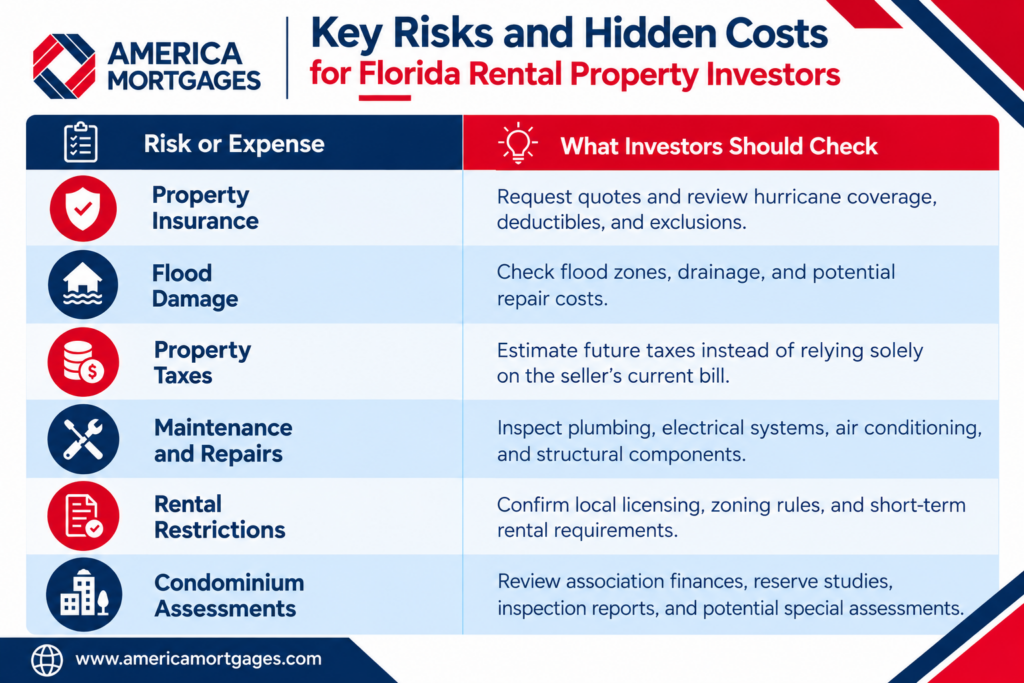
For this reason, you should get a quote for insurance before completing the purchase deal. You must evaluate the ability to cover these costs using rental income. Also, it is necessary to have funds for unexpected expenses.
Flood vulnerability needs individual research. Investors can utilize the Flood Map Service Center of the FEMA to find out about a property’s flood zones prior to buying. However, flood maps are unable to forecast all floods. In addition, buyers need to examine the drainage system, insurance policies, and past experience of flooding in the area.
In case of condominiums, investors should examine structural inspections and reserve studies in accordance with Florida Statutes, Section 718.112.
Case Study: Financing a Florida Rental Property in 2026
An investor from outside the country buys a rental property in Orlando, Florida, for $300,000 in 2026. The investor intends to rent the property out to permanent tenants. Based on similar properties, the expected annual rental income is $30,000 after taking into account the monthly rent of $2,500.
The expected annual expenditure for property taxes, insurance, maintenance, vacancy, and management costs is $8,000, making the expected net operating income $22,000. Therefore, the capitalization rate for the property at the purchase price is 7.3% without including the mortgage and income taxes.
America Mortgages helps the investor in determining the best financing alternatives for the investor based on lender and property requirements. With $75,000 set aside for the down payment and closing costs, the investor will analyze the mortgage payments in addition to rental income.
Make Your Florida Rental Property Investment Decision With America Mortgages
Buying an investment property in Florida requires proper planning of finances as well as getting the right mortgage for the same. To make the best choice, one needs to consider his budget, expected rental income, the amount he will pay as the down payment as well as other expenses that come along.
America Mortgages will assist any buyer who intends to acquire mortgage services for the acquisition of investment properties in America. Getting the right mortgage services will depend on income levels, credit standing and many more factors.
Are you ready to invest in Florida investment property? Contact America Mortgages today to get information about your mortgage needs. For more information about our services contact us on +1 (845) 583-0830 or via email at [email protected].
FAQs
Q1: How do I find profitable rental properties in Florida?
Look for profitable rental properties through comparisons of rent, cost of purchasing the property, and expenses. First, look for areas where there is an established need for tenants. Then, determine what the vacancy rates, insurance, taxes, and maintenance will be. Finally, calculate the net operating income.
Q2: What credit score do I need for an investment property in Florida?
Most conventional investment real estate mortgages need a credit score of 620 or above. The minimum credit score may be higher based on loan conditions. A better credit score will increase the odds of being approved for a loan and getting favorable interest rates.
Q3: Can I use an LLC to buy rental property in Florida?
Yes, an LLC can be used for purchasing rental property in Florida. The LLC might protect your assets from liability associated with business activities. However, there are some restrictions that you need to take into account. Speak with qualified professionals before creating an LLC.
Q4: How are rental property profits taxed in Florida?
Florida does not typically have an individual state income tax for rental income. But, rental income is normally subject to federal income tax after subtracting deductible expenses. Expenses can be deducted, such as repair and maintenance, insurance, and depreciation. Tax implications differ based on the form of business entity, resident status, etc.
Q5: Is it better to buy a condo or a house for rental income in Florida?
Houses give you more control over maintenance and rent. Condos, on the other hand, need fewer outside repairs. Consider fees, special charges, insurance, and rental limitations. Additionally, consider the tenant demand and cost of purchase. It all depends on your financial ability and net income that you are expecting to earn.
Share this article
Ready to get started?
Speak with our U.S. mortgage specialists today and discover your options.
Schedule a call