
Interest-only mortgages provide U.S. expats with an opportunity to make payments on loan interest only for an agreed time. Interest-only mortgages could help to cut down monthly payments and save money to spend on other things. But the borrower should think about the way to repay the principal.
In the case of Americans living abroad, lenders can consider income from abroad, credit rating, saving account, and property-related information. Payments can grow once the principal is due to be repaid. For expats buying rental properties, DSCR loans for U.S. expats is also available the lender considers the qualifying rental income when evaluating the applicant’s qualifications.
America Mortgages helps expats in the U.S. in looking for mortgage solutions for buying properties in America while they are abroad. Talk to America Mortgages now regarding how you can get a suitable financing plan.
What Are the Monthly Payments for an Interest-Only Mortgage?
Monthly payments for an interest-only mortgage cover only the loan’s interest during the agreed period, without reducing the principal. The amount depends on the loan balance and interest rate.
Example of Monthly Interest Payments
Assume a U.S. expate borrows an amount of $600,000 with a fixed annual interest rate of 6%.
| Mortgage detail | Example |
| Loan amount | $600,000 |
| Annual interest rate | 6% |
| Interest-only period | 10 years |
| Monthly interest payment | $3,000 |
| Principal repaid during this period | $0 |
| Remaining principal after 10 years | $600,000 |
Monthly interest calculation:
Monthly Interest = (Loan Amount × Annual Interest Rate) ÷ 12
Monthly Interest = ($600,000 × 6%) ÷ 12
Monthly Interest = $36,000 ÷ 12
Monthly Interest = $3,000
Therefore, the person paying back the loan has to pay back $3,000 each month for the interest portion of the loan as long as there is no change in the balance and rate of the loan.
In the event that the interest-only period ends, the kind of payment plan to follow will depend on the terms of the mortgage. In the event that the principal repayment starts, the monthly payments will definitely go up because the person is expected to pay back the whole amount of money borrowed from the lender.
One needs to evaluate the payment plan and the conditions for refinancing before considering this kind of loan. One should also consider the ability to pay back the principal in the future.
Why Might U.S. Expats Choose an Interest-Only Mortgage?
The U.S. expat is able to go for an interest-only mortgage to minimize his monthly payments and exercise some cash flow flexibility. This could be helpful in meeting living costs, property costs, and other expenditures. It is important for the borrower to get ready for future payments and remaining balance.
A number of advantages would justify the use of such mortgages by U.S. expats:
- Lower payments: By making interest-only payments, one can save money relative to repayments under the same loan amount.
- Flexibility: There is flexibility in keeping cash for relocation, business costs, and other unforeseen expenditures.
- Investment: There is flexibility in saving money for investments in the property.
- Retirement: Expatriates returning to America can afford such lower payments.
- Currency flexibility: One may find it easier to manage different currencies and different economies.
According to Consumer Financial Protection Bureau (CFPB), the example of a payment for a mortgage of $200,000 with a 7% interest rate is $1,167 for the first five years. However, after that, the payments start increasing to $1,414. This is an indication that payment amounts may vary after an interest-only loan period.
While the payments are relatively low in the initial stages, they do not lower the principal amount. As such, U.S. expats must think about their future earnings and repayments before selecting this type of mortgage.
What Do U.S. Expats Need to Qualify for an Interest-Only Mortgage?
For U.S. expats, proof of income, good credit history, enough savings, and proper real estate are essential criteria to become eligible for a negative amortization loan. The eligibility criteria differ from lender to lender. Foreign residents may require further documentation to prove their foreign earnings.
Documents to Prove Income and Employment
Lenders can demand pay slips, employment letter, tax forms, or financial documents of the business. These documents help in verifying the income stability and the ability to make repayments.
Credit Report and Finances
The lender reviews your credit report, any debt you have, and your repayment history while evaluating your application. Some specialized programs take into account an alternate credit record of Americans who reside overseas. But it all depends on the lender’s criteria of evaluation and your total financial condition.
Down Payment and Savings
A considerable down payment and savings are usually required. At times, the lender may ask for additional cash reserves that would be used to make the mortgage payments in the future.
Property Information and Intended Use
Lenders consider the property value, location, and intended use prior to approving the loan. Different requirements apply for primary residence, vacation home, or rental use. It is essential to check whether the intended use of the property is eligible under the selected loan program.
Identity and Documentation
Collect the required identity, bank statement, tax information, and any other document required by your lender. International applicants might require translations or extra authentication of their documents. Clarify the accepted format with your lender. Proper documentation will minimize problems in the approval process.
Fannie Mae’s guide on general income information outlines the methods by which lenders assess and verify income that qualifies. The guide gives information on the importance of accurate income documentation. But it should be noted that the requirements outlined by Fannie Mae do not necessarily apply to all interest-only mortgages. There are specialized lenders who follow their own underwriting procedures when lending to US expats.
How Can U.S. Expats Plan for the End of the Interest-Only Period?
U.S. expats may be ready by considering their future payments, saving money, and formulating a practical plan for repayment. This will help avoid financial stress during the process of repaying the principal.
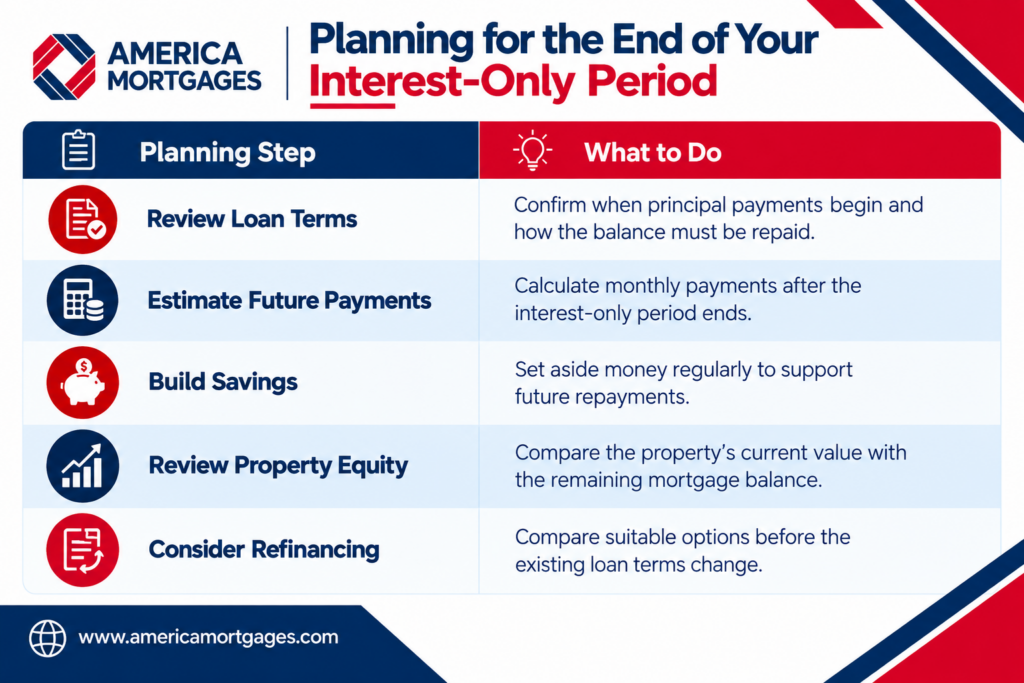
Start preparing a few years before the interest-only period expires, which will give you the opportunity to save more money, evaluate the worth of your house, and see what kind of repayment solutions will be available to you.
Refinancing may provide an opportunity for some borrowers to change the mortgage conditions, though there is no guarantee that your application will be approved. The lender might want to evaluate your income, credit history, property value, and equity. Understanding how to refinance your U.S. mortgage being an expat can be helpful in this situation.
Case Study: A U.S. Expat in Tokyo Secures a Hawaii Home
An American citizen who was an expat living in Tokyo for more than 20 years wished to buy a $1.6 million property in Hawaii before his retirement. His application was turned down by his U.S. based bank since he did not have any credit history within America. This proved to be a problem in spite of him having a well-established credit record abroad.
The American Mortgage helped him in arranging for a $1.12 million mortgage through his existing credit history in Japan. The arrangement was such that there would be a fixed interest-only period of 10 years at the published rate of 8.25% followed by 30 years of repayment.
Explore Your Interest-Only Mortgage Options With America Mortgages
Interest-only mortgages provide an effective solution for expats to cover their immediate costs of living abroad in the U.S. However, it is necessary to carefully select the most appropriate financing in accordance with your income, property objectives, payment method, etc.
You should examine the variety of mortgage schemes in order to be aware of interest rates, conditions of qualification, repayment schedule, etc. Moreover, you should know about potential changes in payments after the period of interest-only.
Looking for your best option? America Mortgages provides financing solutions for American properties to U.S. expats. Do not hesitate to contact us at +1 (845) 583-0830 or [email protected].
FAQs
Q1: Can I Pay Off an Interest-Only Mortgage Early?
Yes, it is possible to pay off your mortgage ahead of schedule if your lender allows for it. There may be prepayment fees attached to some contracts. It is advisable to verify this before paying off your mortgage.
Q2: What Credit Score Is Needed for an Interest-Only Mortgage?
Requirements for the credit score can be different according to the lending institutions and mortgage programs. Some specialty lenders take into account the alternative credit histories. Moreover, they evaluate income, assets, and payment history.
Q3: Can I Use Rental Income to Qualify for an Interest-Only Mortgage?
Yes, some lenders consider rental income while evaluating applications for mortgages. These institutions can also require the submission of the rental agreement and the rent payment history. Vacancy rates and operating costs of the property are considered.
Q4: Can I Refinance an Interest-Only Mortgage Before the Term Ends?
Yes, you can still consider the option of refinancing before the end of your interest-only period. This will depend on creditworthiness, income, value of the property, and the demands of the lender.
Q5: What Happens If I Cannot Repay My Interest-Only Mortgage?
Contact your lender if you have difficulty repaying. In some cases, refinancing, selling the property, or arranging another solution might be an option. It is always better to act sooner rather than later.
Share this article
Ready to get started?
Speak with our U.S. mortgage specialists today and discover your options.
Schedule a call