
Yes, a property in California can be a good investment in 2026 depending on its location, cost, and financial feasibility. Good employment centers and housing needs favor future prospects. However, cost of acquisition, interest rates, and ownership costs must be considered before acquiring such properties.
It is important to compare property values, rent prices, insurance rates, and possible maintenance fees locally. In addition, the correct strategy will depend on whether you are seeking a steady stream of income from rentals or long-term value appreciation. Learn how to buy a property in California when you are not a resident by reading the guide below.
If you need information about financing, America Mortgages can help foreign nationals and U.S. expats explore mortgage options for their U.S. properties.
How Is California’s Housing Market Shaping Investment Opportunities in 2026?
California’s housing market in 2026 offers investment opportunities, though high property prices and expensive financing make it necessary to make good decisions. It is important to consider the current trends in the market, demand and affordability to pick a good property to invest in.
As per the California Association of REALTORS® (C.A.R.), the median price for an existing single-family home stood at $899,720 in September 2026, reflecting an increment of 1.7% from the preceding year. The falling number of sales indicates that people are still facing challenges with affordability of houses.
| Market factor | Current market condition | Impact on investors |
| Property affordability | High purchase prices in many areas | Requires greater initial capital. |
| Buyer competition | Varies by location and property type | Creates different negotiating opportunities. |
| Rental demand | Depends on employment and housing supply | Influences occupancy and achievable rents. |
| Mortgage financing | Borrowing costs affect monthly payments | Changes affordability and cash flow. |
| Housing inventory | Varies across California markets | Affects property choice and negotiating power. |
These will provide various opportunities in the state. The high cost markets on the coast may need higher budgets compared to the selectively picked cheaper markets inland. It is not necessarily true that cheaper properties yield better returns. Investors should consider local rental demand, expenses, and re-sale prospects.
Before buying, check out sales data, rental demand, insurance premiums, and financing conditions in the area. This method allows investors to analyze properties rather than just going by general market conditions in the state.
Which California Markets Offer the Most Suitable Investment Opportunities?
Los Angeles, San Diego, Sacramento, and Inland Empire provide various property investment opportunities due to the differences in prices, demand, and local economy. It is necessary to analyze each market individually because of the advantages that they have and choose a place after making comparison between the cost and tenants’ demand.
The following list includes the most important differences of the considered markets that are worth paying attention to.
- Los Angeles: Large employment base ensures the demand for rentals, but high prices and local regulations should be considered carefully.
- San Diego: Employment in healthcare, education, and military sectors creates the demand for housing. However, high costs may restrict rent possibilities.
- Sacramento: Employment in government and regional development attracts tenants. Price comparison, vacancy rate, and competing rentals should be analyzed.
- Inland Empire: Development of logistics and distribution ensures the demand for housing. Commuting possibility, new construction, and tenants demand should be taken into account.
In addition to the location, it is necessary to pay special attention to the demand for rentals and financing possibilities. It is impossible to rely on prices only while deciding whether an investment will fit your expectations. Explore guide on qualifying for a U.S. investment property mortgage using rental income to understand how rental income may support financing eligibility.
How Can You Calculate Potential Returns From a Property in California?
The potential returns from property investment in California may be assessed using such data as rental income, expenses, interest payments, and the cost of acquiring the real estate asset. Such calculations enable one to estimate the profitability and determine whether the investment meets the investor’s needs.
Calculation of the Gross Rental Yield
The gross rental yield is an indicator that determines the relation between annual rental income and the cost of acquiring the property. To make such a calculation, it is required to divide the annual rental income by the purchase price and multiply by 100.
Calculation of the Net Operating Income
The net operating income indicates the rental income minus operating expenses but not mortgage payments and tax obligations. One needs to subtract insurance expenses, property tax, maintenance expenditures, management fee, and vacancy from the effective rental income.
Monthly Cash Flow Estimation
The monthly cash flow enables you to see the balance when your rental income covers all operating expenses and mortgage payments. However, there may be various unpredictable expenditures that will decrease such income.
Calculate Cash-on-Cash Return
The cash-on-cash return is the ratio of annual pre-tax cash flow to total cash outflow. It should consider your down payment and costs associated with the acquisition. It enables investors to determine the efficiency of fund utilization.
Example of California Property Investment
Let’s assume you are going to buy a California property for $600,000 with an annual rent of $3,500. The annual gross rent will be $42,000. Assuming that annual operating expenses will be $14,000, the property will produce $28,000 annually in the form of NOI. Its yield will be about 4.67% per year, without considering any mortgage payments and income taxes.
It is only an example, but actual returns will depend on many factors. It is advisable to estimate conservative rents, insurance rates, taxes, and repairs before investing in such property.
What Risks Could Affect Your California Property Investment?
The risks that may influence a property investment in California include insurance costs, natural hazards, property taxes, financing costs, and rent control. Being familiar with these threats will allow investors to estimate the cost of property ownership, preserve their investments, and prevent unnecessary financial stress.
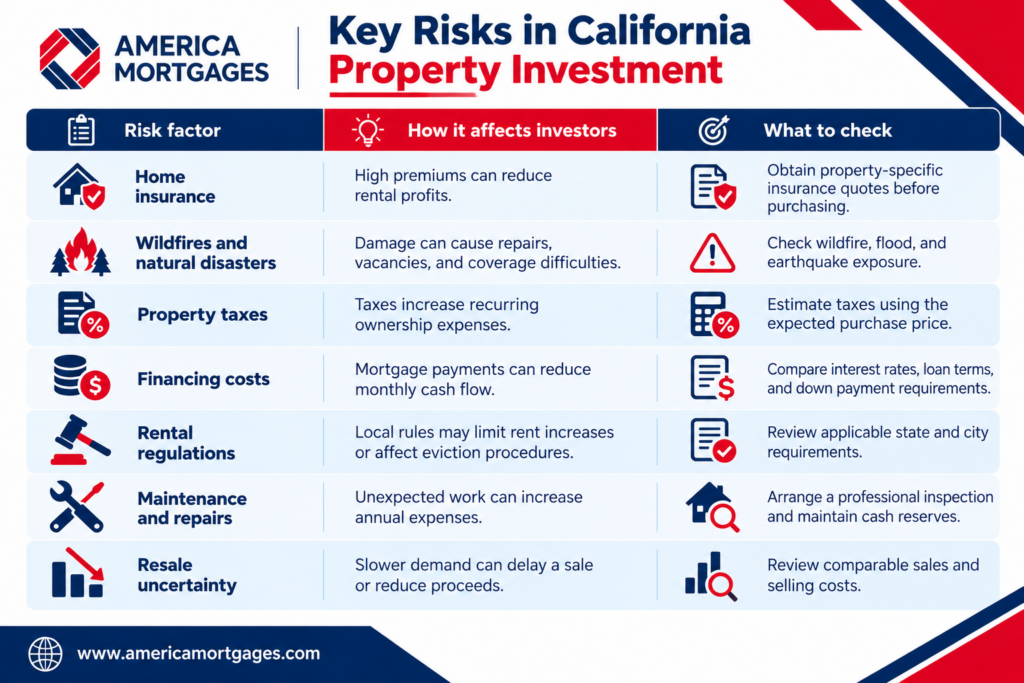
The issue of insurance warrants special consideration since insurance may be available and the costs will differ based on location. The California Fair Access to Insurance Requirements (FAIR) Plan offers the possibility of obtaining last resort property insurance where insurance is otherwise hard to find. As per California Sustainable Insurance Strategy of California Department of Insurance, reforms have been made regarding insurance availability and market stability. Buyers should find out about the possibilities of insurance cover and premium rates.
In the case of property taxes, special consideration is warranted. As per Proposition 13, the assessed value of real estate cannot increase by more than 2% annually. Nonetheless, a property purchase results in reassessment. Thus, estimate the taxes based on the expected price of the property.
Case Study: Financing a California Property Purchase as a Foreign Investor
A foreign buyer wanted to invest in a $2 million residential house in Los Angeles but the approval of the mortgage was taking time due to some extra documentation. America Mortgages provided assistance to the foreign investor regarding possible financing and repayment plans.
It was helpful in identifying financing options that would be available prior to making any purchasing decisions. The bridge loan is a temporary loan that could be used if the mortgage is taking too much time. However, one needs to consider interest rates, repayment deadlines, and exit strategies.
Explore Your California Property Investment Options with America Mortgages
Buying property in California requires thorough planning, particularly for foreign investors. Consider your funding sources, projected income from the rental, and other expenses before buying. This will give you enough insight for better decisions and help you prepare for the property investment.
There may be extra problems for foreign nationals and U.S. expats in getting mortgages in the U.S. Banks have their own conditions regarding income confirmation, size of the down payment, and eligible properties. Comparing eligible mortgage programs will help you in understanding your possibilities prior to making an offer.
Are you ready to know about financing possibilities? Contact America Mortgages right now for personalized information on property financing in the U.S. as a foreign citizen or expatriate. Call us at +1 (845) 583-0830, e-mail us at [email protected], or get in touch with America Mortgages through our contact form.
FAQs
Q1: Can foreigners buy property in California without a U.S. visa?
Yes, foreigners can buy property in California even without a visa in the U.S. However, being the owner of the property does not mean automatic citizenship or immigration privileges. In addition, there are certain regulations that need to be followed.
Q2: How much down payment does a foreign investor need to buy property in California?
Foreign buyers may require a 20% to 40% down payment for buying California property. But the terms differ depending on the lender, type of real estate and personal finances. Comparing mortgages enables buyers to select the right financing choice.
Q3: Do foreign property owners in California have to pay U.S. taxes?
Yes, foreign property owners are subject to taxation on rental incomes and capital gains from the sale of the property in the U.S. However, the extent of the liability varies from one individual to another.
Q4: Can a non-resident open a U.S. bank account to buy property in California?
Yes, some U.S. banks allow non-residents to open accounts. But the requirements for opening an account differ from one bank to another. Some banks require identity proofs and other documents.
Q5: What happens when a foreign owner sells property in California?
Foreign owners may face federal FIRPTA tax withholding and California tax withholding when selling their property. But these withholdings do not represent the total tax owed. There could be additional tax calculations and refund claims for the sellers.
Share this article
Ready to get started?
Speak with our U.S. mortgage specialists today and discover your options.
Schedule a call