
Getting a US mortgage as an expat needs proper preparation and consideration of international loan requirements. The factors that may determine whether you can receive the mortgage include your income, US credit score, down payment, and property objectives. Consequently, it will be helpful to know these five things in advance to make well-informed financing decisions and to avoid delays in the process.
Living abroad does not necessarily mean that you cannot buy a house in the United States. However, you need to think about providing more financial documents and income evidence. It is also necessary to consider possible currency variations, tax issues, and how to conduct a closing remotely.
It will be useful to know how Americans living overseas can use foreign income to qualify for a US mortgage. This will help you prepare for the requirements of lenders and collect all necessary documents.
Check out mortgage loan solutions at America Mortgages. Its experts will help you learn more about mortgage possibilities and application process.
How Do You Find a US Mortgage Lender That Works With Expats?
A proper mortgage lender in the US can be selected by comparing the financial institutions having expertise in lending to Americans residing abroad. Such lenders will have the knowledge of foreign income, international banking, credit profiles of the borrowers from other countries, and remote applications. Such expertise could help to select the best mortgage programs and avoid delays in the application process.
Key Factors to Consider When Comparing Mortgage Lenders:
| Factor | What to Look For |
| Expat Experience | A proven record of financing Americans living abroad |
| Foreign Income | Ability to assess salaries earned in different currencies |
| Documentation | Acceptance of international financial records |
| Credit Requirements | Clear policies for overseas borrowers with limited US credit |
| Loan Programs | Access to different mortgage options |
| Remote Support | Assistance with applications and overseas closing |
As per the Selling Guide of Fannie Mae, there should be certain documentation standards for foreign income that qualify for a conventional mortgage. The lenders require two years of signed federal tax returns indicating income from foreign employment. All the required documents should be translated into English where necessary. Qualifying income should be converted to the US dollar. This highlights the need to select a lender experienced in dealing with international financial documentation.
Traditional banks may not provide suitable products to all overseas borrowers. Hence, compare various lenders on the basis of their experience with the international applicants and evaluation of foreign incomes. Moreover, analyze their documentation policy before applying for a mortgage.
Lastly, inquire about the interest rates, processing costs, qualifications, and time taken for mortgage approval.
How Is Your Overseas Income Calculated for a US Mortgage?
Overseas income can be determined by calculating the earnings in terms of US dollars. Income stability, current debts, and loan repayment ability will be evaluated by mortgage lenders. The final qualifying income is dependent on exchange rates and underwriting requirements.
There are a number of considerations for determining how lenders assess your foreign income:
- Currency Exchange: The foreign salary is exchanged to US dollars using an exchange rate acceptable to the lender.
- Stability of Employment: The lender analyzes your previous employment experience, structure of salary, and future income potential.
- Income Verification: Payslips, employment contracts, bank statements, and tax returns can verify your income.
- Current Debt: Monthly loans and credit card bills impact your borrowing ability.
- Variable Income: Bonus payments, commissions, and income from self-employment will need additional documentation.
Foreign Income Conversion Example
For instance, you earn €8,000 per month while working in Germany. Assume that the exchange rate is €1 = $1.10.
| Calculation | Amount |
| Monthly foreign salary | €8,000 |
| Assumed exchange rate | $1.10 |
| Converted monthly income | $8,800 |
| Converted annual income | $105,600 |
Calculation: €8,000 × $1.10 = $8,800.
It is not about income but currency conversion. Different lenders use different exchange rates and make different adjustments. Lenders take into account your other financial commitments to evaluate the ability to afford the monthly payments.
Your debt payments also can affect the size of the mortgage that you are eligible to receive. Understanding the role of the debt-to-income ratio in getting a mortgage will be helpful in evaluating your possibilities of borrowing.
Can Your US Credit History Affect Your Mortgage Approval?
Yes, your US credit history can affect mortgage eligibility. Lenders assess repayment history, balances, and past borrowing behavior. A good credit history can enhance borrowing opportunities. Yet, residing outside the country and having little credit history in the USA does not mean you cannot get a mortgage.
Key Credit Information Lenders Consider:
US Credit History
A good credit history can be achieved by keeping active credit card accounts or loans. Payments are made to create repayment behavior. Nevertheless, missed payments or high balances can damage your credit history.
Payment History
Your payment history gives lenders insight into how well you can manage your finances. Late payments, defaults, and collection activities could cause lenders to have doubts. Therefore, check your credit history before applying for a mortgage.
Credit Utilization
Credit utilization shows how much revolving credit you use at any given time. Large balances could mean more financial strain on you.
US Credit History Limited
Some US citizens residing outside their country cease using their domestic credit cards. Therefore, the credit history of such individuals may be limited. Some specialty lenders might rely on foreign credit histories or different funding programs.
How America Mortgages Can Help Expats With Limited US Credit History
A US citizen living in Germany is looking to buy a piece of property worth $450,000 in Texas. Unfortunately, the person has not been in the United States for several years and therefore does not have many transactions recorded on their US credit report. America Mortgages evaluates the financial situation of the applicant, considering their international employment, savings, and credit history.
The buyer intends to put down $90,000 from their own pocket and seek the remaining $360,000 in loans. America Mortgages will provide assistance in searching for mortgage options and the documentation necessary for the process. This is a clear example of how specialized mortgage counseling could assist overseas Americans in property financing.
How Much Down Payment Do You Need to Buy US Property?
US property down payment varies based on the mortgage plan, type of property, and the borrower’s eligibility criteria. In some cases, US expatriates will need to contribute between 10% and 25% or more, but some specialized financing plans might even demand more. Several considerations go into deciding how much is necessary as your upfront contribution:
- The Mortgage Plan: Conventional loans may allow lower down payment levels to qualified borrowers; however, some expat-oriented financing plans may demand a greater contribution.
- The Property Class: First homes, second homes, and investment homes may demand different financing amounts.
- The Credit History: Good credit score will make borrowing easier under favorable conditions.
- The Loan-to-Value Ratio (LTV): LTV ratio compares the amount of mortgage with the value of the property.
- The Financial Savings: In some cases, additional funds beyond the down payment are required as a demonstration of ability to repay the loan.
Down Payment and Mortgage Financing Breakdown
Take an example of a home that costs $500,000. The contribution that you pay upfront affects the loan that you borrow.
| Down Payment | Your Contribution | Mortgage Amount | LTV Ratio |
| 10% | $50,000 | $450,000 | 90% |
| 15% | $75,000 | $425,000 | 85% |
| 20% | $100,000 | $400,000 | 80% |
| 25% | $125,000 | $375,000 | 75% |
The median down payment from US home buyers has been 18%, according to the 2026 Profile of Home Buyers and Sellers by the National Association of Realtors (NAR). This is helpful information to understand the initial costs involved in buying a home. However, the rules may be different for US expats based on the mortgage program, financial situation, and the bank lending you money. See NAR 2026 Profile of Home Buyers and Sellers.
A bigger contribution decreases the amount you borrow and increases your LTV. Nonetheless, do not spend all your cash reserves. You may still have to pay other expenses, such as closing costs, taxes, insurance, and maintenance. Thus, plan your budget entirely before choosing a mortgage program.
What Financial and Tax Considerations Should US Expats Know Before Closing?
US expats need to consider tax issues, currency transactions, costs associated with closing, and legal issues prior to finishing the process of buying property. This can impact the overall cost of investment and timing of the purchase. That is why it is important to take these issues into account beforehand in order to avoid additional expenses and delays in closing.
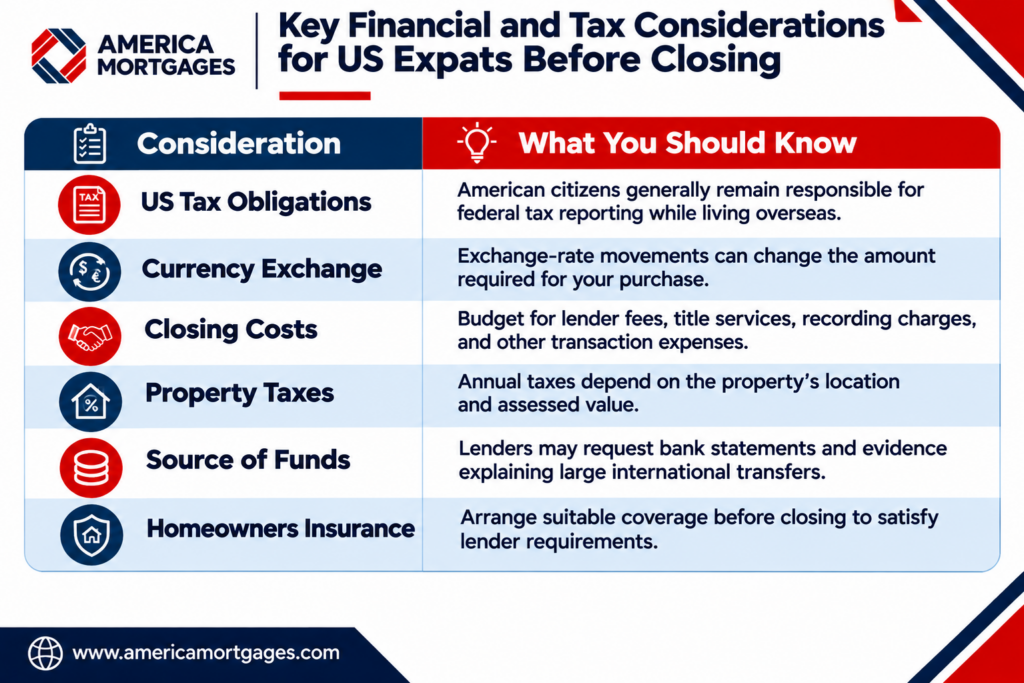
The residents of the USA have to declare their income from all over the world. The rental income from the property located in the USA is another issue that needs attention. But it is possible that there will be certain deductions or credits. Understanding US property ownership and cross-border tax considerations can help you prepare for these responsibilities. Consult a qualified cross-border tax professional before making financial decisions.
It is also necessary to make some preparations in advance in case you choose to close the deal remotely. Some states offer electronic signing, remote notarization, or presence of an authorized person. In addition to this, international transactions are usually subject to compliance and processing issues in the bank.
Explore Your US Expat Mortgage Options with America Mortgages
Buying real estate in US from abroad requires good financial planning. Your income in the country you reside in, your credit score, and your property aspirations could have an effect on the options available. This is why working with an experienced mortgage specialist will simplify this process for you.
America Mortgages specializes in providing mortgages to expatriates and foreigners in the United States. By having access to over 150 lending programs, the specialists in the company help people look into financing options in all 50 states in America. Whether it is a consultation or applying for a mortgage or remote closing, they will guide you through the process.
If you are looking to buy a family house, holiday house or an investment property in America, America Mortgages will help you in looking into the financing options. Contact us now by calling us at +1 (845) 583-0830, or email us at hello@americamortgages.com.
FAQs
Q1: Can I Buy a House in the US While Living and Working Abroad?
Yes, people from America can buy a house while living in another country. Being somewhere else will not prevent you from being a homeowner. However, in order to get the mortgage, you will have to prove your income and be creditworthy. You can consider purchasing either a primary residence, vacation home, or even investment property. There are also special mortgage financing options designed especially for Americans living abroad.
Q2: Do US Expats Have to Pay Higher Mortgage Interest Rates?
No, not always. Living outside America does not automatically mean higher mortgage interest rates. On the contrary, some lenders may provide more expensive loans to finance an expat. Your credit standing, LTV ratio, and overall financial stability will also play an important role.
Q3: Can I Use Foreign Bank Accounts to Pay My US Mortgage?
Yes, it is possible for lenders and mortgage servicers to accept money from foreign bank accounts. But the payment method that the lender accepts is determined by the company’s own bank. The process of international wire transfer will incur more charges and delay in processing. It would be good to inquire if your lender is accepting foreign payments.
Q4: Do US Expats Need to File Taxes on Rental Income From American Property?
Yes, US citizens are supposed to declare rental income from US property for tax purposes. However, there are expenses that can reduce your taxable rental income. These may include mortgage interest, insurance, repairs, and depreciation. There may be additional state taxes that apply. Seek professional advice to find out more about your obligations.
Q5: Can I Get a US Mortgage Without Visiting the United States?
Yes, many US expats do not have to come back to the US in order to fill out their mortgage applications. Banks can assist in filling out paperwork remotely and using digital signatures. There are also certain closing papers that need to be notarized.
Share this article
Ready to get started?
Speak with our U.S. mortgage specialists today and discover your options.
Schedule a call