
Buying a vacation home in Colorado is profitable as long as its location, demand, cost, and financing fit your needs. Tourism in Colorado ensures the demand in this state from tourists. Nonetheless, profits will be determined by occupancy rates, rental rates, costs related to the property, and rules.
Colorado is famous for its tourist attractions such as ski resorts, hiking spots, national parks, and mountain areas. It is great for those wishing to use their vacation home personally as well as rent it out. You should compare the cost of purchase, income, taxes, insurance, maintenance, and management before buying a real estate property in Colorado.
A proper plan will help you select a property that suits your finances. You need to think of the desired location, use, financing plan, and expenses. Then, look through the available loan offers before submitting an offer. America Mortgages will help you finance a vacation home in Colorado.
What Makes a Colorado Vacation Home Attractive to Investors?
Colorado vacation homes have the ability to attract investors because of the need for tourism, seasonal activities, scenic locations, and the ability to rent out. People visit for reasons such as skiing, hiking, outdoor activities, and mountain getaways. Thus, there are many ways that a vacation house can be booked throughout the year. However, each property will still require analysis of its costs, occupancy rate, and location.
| Factor | Why It Matters |
| Year-round attractions | Supports demand across different seasons |
| Mountain destinations | Appeals to leisure and outdoor travelers |
| Rental potential | Can help offset ownership expenses |
| Personal use | Allows owners to enjoy the property |
| Property location | Influences visitor demand and pricing |
| Local amenities | Improves convenience and guest appeal |
One factor that makes the properties attractive is the seasonal variety that exists. During winter, visitors visit for skiing and other activities during the snow season; however, during the warm season, people visit for hiking, fishing, cycling, sightseeing and lake areas to attract families. Consequently, investors can think of attracting guests at different seasons as opposed to one particular season only.
Location is equally crucial when analyzing the potential of buying a property. A property that is located near attractions, eating joints, recreational centers, and facilities can be more appealing to the visitors. Investors should also take into account taxes, insurance, maintenance, HOA, and the renting requirements. Understanding how a second home differs from an investment property can also help buyers select an ownership strategy that matches their intended use.
Which Colorado Locations Can Support Vacation Home Investment?
Vacation homes in Colorado could be developed at places like Breckenridge, Vail, Estes Park, Steamboat Springs, Grand County. There are different levels of property values, accessibility, amenities, and other things in each place. So buyers must evaluate these differences before making the choice.
The following factors should be evaluated in comparing locations for vacation homes:
- Breckenridge: It is an established mountain town with good accessibility to the resorts.
- Vail: This is an expensive location with luxury property and resorts.
- Estes Park: It is an attractive location in the vicinity of the Rocky Mountain National Park.
- Steamboat Springs: Another mountain resort location with resorts, hot springs, and recreation areas.
- Grand County: This is a larger area including different communities and lakes, and mountain locations.
- Aspen: It is an exclusive market with expensive properties.
Next to the destination, one should investigate the services and modes of transport around the area. Accessibility would help in providing convenience to both the owner and customers. Property taxes, HOA policies, zoning issues, and insurance premiums should also be considered. Buyers can evaluate the Denver Colorado real estate market in terms of property conditions in relation to others.
Lastly, do not just choose a popular destination. Prices may differ greatly from one community to another within the vicinity. Properties located far away could also need more maintenance considerations. Comparing these would help the buyers to find the ideal location for them.
How Much Can a Vacation Home Earn in Colorado?
The rental income that can be made from a holiday home in Colorado varies with location, occupancy levels, nightly price, size, and cost. Hence, investors need to do an analysis of the market and operation costs for their estimation of income potential.
Nightly Rental Price
The nightly price will determine how much revenue can be earned from each booking. Popular destinations can afford higher prices when there is much activity going on. However, owners need to consider similar properties while setting the prices.
Occupancy Rates
Occupancy measures how often a property’s nights are booked by guests. Increased occupancy can boost annual income provided the pricing is appropriate. Vacant periods can decrease income. Investors should make conservative estimates for planning purposes and account for slow periods.
Property Size and Amenities
The size of the property may have an impact on what kind of visitors the home will attract. Large property sizes can be preferred by families or groups of friends. Some useful amenities can increase guest satisfaction. Additional features may also increase maintenance costs.
Seasonal Demand
There are certain types of travelers that visit Colorado throughout the year. The winter season is ideal for skiing, while the summer months attract hikers and outdoor enthusiasts. Different booking patterns may occur during shoulder seasons. Pricing flexibility may help the owner accommodate different demands and preferences.
Operating Expenses
The gross rental income of the home is not the same as the investment income. Investors might pay mortgage expenses, taxes, insurance, utility expenses, cleaning expenses, maintenance expenses, management fees, and platform fees. All of these costs can significantly lower the income from the investment.
The Colorado data of AirDNA offers direct information about the vacation rental market till August 2026. The listings in Colorado generate an annual income of $50,600 with an occupancy rate of 56%. Aspen generates a revenue of $190,300 and ADR of $1,410. The annual income of Vail is $109,900 with an occupancy rate of 46% and ADR of $960.
What Risks Should You Consider Before Buying a Colorado Vacation Home?
There are risks related to the rules, insurance, maintenance, financing, and fluctuating tourist demand when purchasing a vacation home in Colorado. These considerations may influence costs and investment returns for a potential buyer. Thus, one needs to understand the financial and legal standing of a property before investing in it.
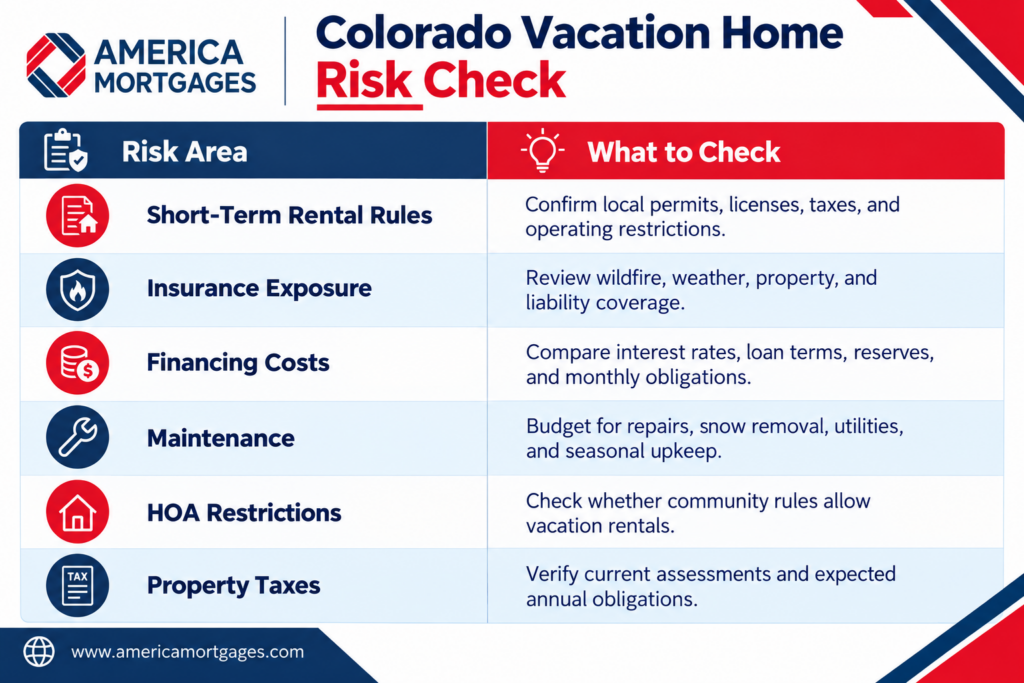
Regulations need special consideration due to the diversity that exists from community to community. There might be some limits on rentals, as well as some requirements regarding approvals in some places. In advance, one needs to be aware of such regulations for the property he or she intends to buy. It is also necessary to consider HOA regulations, which have an impact on the use of a property.
Insurance and maintenance may cause extra strain on the cash flow. Mountain real estate requires additional expenses related to maintenance of exterior, as well as winterizing services. The danger of wildfires also needs to be considered. Such costs should be reviewed prior to financing, along with property taxes.
Case Study: Vail Investment Property
In a more recent America Mortgages scenario, a Singaporean couple had a six-bedroom investment property in Vail, Colorado. The value of the property was estimated to be $1.6 million. Their goal was to unlock $300,000 while increasing cash flow each month.
A $323,000 mortgage, 20% loan-to-value, was arranged for this particular couple. They received financing that comprised a 5.75% interest-only rate with a 10/1 adjustable rate mortgage. Such financing helped to decrease monthly debt service by 13%.
This scenario shows how important it is to find appropriate financing for an investment property based on its rental strategy. At the same time, one should keep in mind that every particular situation depends on the property value, rental income, borrower details, and financing options available.
Build a Smarter Colorado Vacation Home Investment Plan With America Mortgages
Financial planning is very important when buying a vacation house in Colorado. It is vital to consider the cost of the property, rent that the property generates, expenditure, and financing arrangements. Local rental laws must be known before choosing a property.
The next step would be comparing loan choices based on your objectives and financial situation. The correct loan choice will enable you to plan and handle your expenses. Professional advice may also make financing vacation houses and investments easier.
Are you ready to look into the options available for financing your Colorado property? America Mortgages provides financing options for foreigners, Americans living abroad, and investors. Contact us today at +1 (845) 583-0830 or email [email protected].
FAQs
Q1: Can you rent out a vacation home in Colorado?
Yes, you can rent a vacation property in Colorado, but there are local regulations that you need to consider. Permits, licenses, taxes, or occupancy requirements may be imposed by the city or county where the property is located.
Q2: How much down payment do you need for a vacation home in Colorado?
The down payment needed for a vacation home in Colorado is determined by the lender, the type of the property, and the qualifications of the buyer. However, the down payment usually ranges between 10% and 20%. But in some cases, the requirements are higher.
Q3: Do you pay taxes on a vacation home in Colorado?
Yes, owners of vacation homes in Colorado can pay property taxes, and the presence of rent creates more tax liabilities. However, how much is owed will depend on the property value, its location, how often it is used personally, how much rent is received, and tax regulations.
Q4: Can a non-resident buy a vacation home in Colorado?
Yes, a nonresident is able to purchase a vacation property in Colorado. However, a mortgage would demand some extra paperwork, larger reserve funds, or different mortgage terms. For that reason, it is recommended that buyers study all the requirements in connection with owning, taxation, financing, and insuring property in Colorado.
Q5: What is the difference between a vacation home and an investment property?
The vacation property is bought mostly for personal use, whereas the investment property is intended for income generation through renting or returns. The property could serve both functions though. The way the property is financed, taxed, occupied, and what the lenders want may vary depending on its function.
Share this article
Ready to get started?
Speak with our U.S. mortgage specialists today and discover your options.
Schedule a call