
Yes, there can be good investment chances for those interested in the Denver Colorado real estate market. The good employment situation, population growth, and housing needs are enough to attract the investors’ attention. But, the purchase cost, financing, and property choice can make a difference.
There are various sectors in Denver’s economy and the city has well-developed communities. Thus, the investment can consist in purchasing single-family homes, apartments, and rentals. The current conditions can give you some room for bargaining with regard to your choice of property.
Each of them still requires a thorough analysis of finances before purchasing. The buyer needs to check the rental income, taxes, insurance, maintenance, vacancy, and financing expenses. Also, DSCR loans in Colorado might be considered if the rental income is crucial for the financing method used.
America Mortgages can help you in getting financing and mortgages on your Denver investment property.
What Is Driving Denver’s Real Estate Demand in 2026?
The demand for housing in Denver in 2026 is driven by the population growth, diverse employment and the continuous housing demands. They contribute to the demand from both buyers and tenants. However, affordability plays an equally important role in the evaluation of future investment possibilities.
| Demand Driver | Latest Data | Investment Relevance |
| Denver population | 740,613 | Larger local housing base |
| Population growth since 2020 | 3.5% | Continued demographic expansion |
| Metro Denver population | 3.2M+ | Broad regional demand |
| Median household income | $89,048 | Supports housing purchasing power |
As of July 2025, Denver’s population was 740,613. It also experienced a growth of 3.5 percent based on its 2020 population. Growth increases the number of households in the local housing market. In addition, Metro Denver serves a much greater regional population.
Diverse employment also increases the housing demands among the various household groups. Denver currently has activities in healthcare, professional services, finance, technology and other industries. As such, investors can assess demand not only through short term market fluctuations.
The Denver QuickFacts research by the US Census Bureau is quite relevant in this respect. The latest figures include data about population, income, housing and demographics among others.
How Are Denver Neighborhoods Performing Across Different Property Types?
Different performances can be realized based on property type within Denver neighborhoods. Various factors determine such performances, including location, demand for property, property size, and buyer preference. As a result, investors need to make comparisons of different segments before making investments.
The following property types have different investments in different Denver neighborhoods:
- Single family homes: Such property might draw in people who look for privacy and space. The presence of local schools, parks, and services may determine their popularity.
- Multifamily buildings: Several apartment units mean multiple sources of income. Investors need to look into how costly it is to manage such properties.
- Condos: Such properties in the city might draw in professionals looking for a convenient location. Condo fees and restrictions will be factors influencing costs.
- Townhouses: More space than a condo can provide along with access to premium neighborhoods at a lower price point.
- Luxury homes: Premium neighborhoods are likely to draw in wealthy people looking to buy or rent a home. Finances will be different for such property.
On the other hand, neighborhood variables can greatly impact the performance of the investments. Locations close to jobs, transportation, recreation, and existing facilities can generate more interest from investors. However, higher buying prices can have an impact on cash flow as well.
Investors must consider previous sales, rental prices, vacancies, taxes, HOA fees, and maintenance costs. This method will yield more accurate results compared to the average market prices for the entire city.
What Could Change Denver Real Estate Investment Returns?
Return on investment of real estate in Denver may vary depending on such factors as financing costs, rental income, expenses, vacancy rate, taxes, and the state of the market. Each of these elements can influence either cash flow or capital appreciation. Thus, when making an investment, one needs to consider different scenarios.
Financing Costs
High financing costs can decrease cash flow per month and raise the amount of money required for the investment. Investors have to analyze financing cost, down payment, closing cost, etc., before making calculations.
Rental Income
Rental income is a critical element in analyzing the performance of the investment property. Local market demand, quality of the building, size of the apartment, and its location can impact rental income.
Operating Expenses
Maintenance costs, insurance costs, property tax rates, utilities, management fees, and HOA costs might affect the bottom line. These may also vary over time. Including realistic reserves prevents the investor from inflating expectations.
Vacancy Periods
Empty spaces could prevent an income stream while costs are incurred. Even quality investments may see some vacancy periods in between tenants. Investors should consider realistic vacancy periods when calculating the annual cash flow.
Value Fluctuations
Fluctuations in market valuations could impact the equity and even future sale proceeds. Zillow indicated that the average value of homes in Denver was $524,695 in August 2026, 2.1% lower than the previous year.
In addition, Zillow’s Denver housing figures in August 2026 indicate an average asking rent of $1,881. The prices of rents have dropped by 0.4% in a year. Moreover, inventory stood at 4,244 homes. It is clear that an investor should take into account income and market dynamics. A building may experience high demand for rentals, but it may be under pressure in terms of value.
What Can Investors Learn From a Denver Real Estate Case Study?
Denver real estate case study reveals the significance of location, financing, and planning when considering an investment venture. Moreover, it stresses that it is crucial to undertake infrastructure research, calculate the cost of acquisition and financing, and evaluate the future demand before any investment.
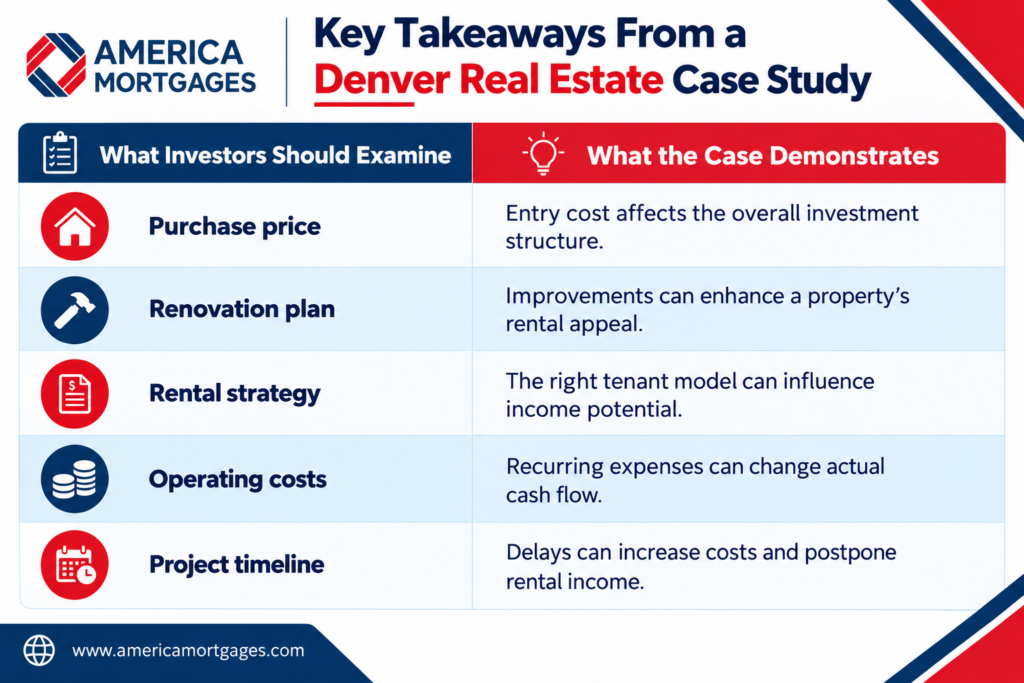
HUD USER case study investigated Walnut Flats development in Denver RiNo Art District. This development includes 66 affordable housing units located near 38th and Blake transit station. The property was purchased in 2011 and took into consideration future improvements of transit stations. The project cost was $18.8 million.
This project exemplifies how nearby infrastructure affects development potential. This particular project received the advantage of having rail improvements nearby. At the same time, financing options made the project possible. Thus, investors should consider future infrastructure, the financing structure, and neighborhood development prior to buying.
However, real estate projects can sometimes incur unplanned expenses and delays. Thus, investors need to have enough reserve funds and realistic schedules. They also need to look carefully at financing details before making an investment decision.
Explore Your Denver Investment with America Mortgages
The correct choice of financing will help you better organize the acquisition of property in Denver. Begin with an analysis of your budget, investment intentions, loan needs, and potential rent from the property.
The team at America Mortgages will assist you in exploring all possibilities of financing that will be suitable for your investment intentions.
Ready to finance your Denver investment? Get in touch with America Mortgages today. Call +1 (845) 583-0830 or e-mail [email protected].
FAQs
Q1: How much money do you need to buy an investment property in Denver?
You may need tens of thousands of dollars for the purchase of an investment property in Denver. Expenses include the deposit, closing costs, inspections, repairs, and reserves. The amount needed depends on the cost of the property, financing, and other factors.
Q2: Can you buy an investment property in Denver with 20% down?
Yes, in some cases, 20% down is sufficient for Denver investment properties. However, different lenders have different requirements. Such factors as credit history, income, reserves, and the type of property may influence one’s ability to qualify.
Q3: What credit score is needed to buy a rental property in Denver?
Credit scores ranging from about 620 are sometimes acceptable for rentals. But there is room for the lender to have more stringent criteria. There are other factors that will determine your approval status.
Q4: How much rent can a Denver investment property generate?
A Denver investment property will produce different rental returns dependent upon its location, size, condition, and nature of the property. Based on current market analysis, an average asking rent is around $1,900 per month. Consequently, an investor must evaluate comparable properties to determine rental returns.
Q5: Can foreigners buy investment property in Denver?
Yes, foreign investors can usually buy real estate in Denver to invest. But financing, taxes, ID checks, and the way of ownership can be different from others. It is recommended that buyers make sure about the policy of their lenders before purchasing property in Denver.
Share this article
Ready to get started?
Speak with our U.S. mortgage specialists today and discover your options.
Schedule a call