
Yes, North Carolina is a good place to look for real estate investment. There are several markets where population increase, migration, employment, and rent demand have created good conditions. However, it is important for investors to consider such factors as income, expenses, financing, and location when evaluating every property.
There are many opportunities in cities like Charlotte, Raleigh, Greensboro, and others in North Carolina. Every market is characterized by different property values and rental rates. In this regard, it is important to evaluate purchasing price in relation to rent income. International investors can also analyze whether rental income will help them with financing.
In addition, financing can affect investor decision making. It is possible for eligible buyers to evaluate different types of loans available for investment property. Evaluating loan payments together with rent income helps investors understand potential property performance.
Looking to buy an investment property in North Carolina? America Mortgages is here to help qualified investors learn about financing choices and the role of rental income for their investment property mortgage.

What Makes North Carolina Attractive for Rental Property Investors?
North Carolina attracts rental property investors through growth in population, migration, employment and number of renters. In 2025, the population in North Carolina stood at 11.2 million people. This means that these conditions can present a chance to potential investors interested in rental properties.
| Market Indicator | North Carolina Data |
| 2025 population | 11,197,968 |
| Population growth since 2020 | 7.2% |
| Net domestic migration in 2025 | 84,064 |
| Renter-occupied units in 2022 | 1,425,628 |
| Renter share of occupied units | 38.1% |
| 12-month building permits, May 2024 | 95,316 |
According to NAR, there were 1,430,000 renter-occupied units in North Carolina in 2022. The percentage of renters is 38.1%. North Carolina has 97,264 net domestic migrants in 2023. All of these numbers show that the rental market has considerable potential for investors.
Population growth is yet another factor that should be taken into account. According to the census data, the population in North Carolina grew by 7.2% from 2020 till 2025. In the period from 2024 till 2025, the population grew by 145,90.
The state data is useful for providing background, but each property should be studied separately. There are different pricing and rental situations in Charlotte, Raleigh, and elsewhere. An investor needs to consider income potential, expenses, and risks of vacancies before concluding that a property is suitable for his or her investments. Additional insight into North Carolina rental property financing will help in making this determination.
Which North Carolina Markets Should Rental Investors Consider?
The markets of Charlotte, Raleigh, and Greensboro are options for investors analyzing rentals in North Carolina. These markets vary in terms of home prices, rent, and other market dynamics. As such, the correct choice is one that factors in cost, expected income, demand, and profitability.
Recent Zillow statistics indicate:
- Charlotte: According to Zillow, the average home value is $392,573. The average rent is $1,744, but year-over-year rents increased by 0.7%.
- Raleigh: The average home value is $428,671 as of August 2026. The average rent is $1,577, and the year-over-year home values decreased by 1.8%.
- Greensboro: According to Zillow, the average home value is $263,264. The average rent is $1,392, and year-over-year rents increased.
These statistics make clear why market selection requires more than just a simple ranking of cities. Both Charlotte and Raleigh feature high rents and valuable real estate. On the other hand, Greensboro demonstrates low home values and increasing rents being asked.
Nonetheless, data from Zillow should be taken to be general information about the markets and not specific forecasts for certain real estate. Investors will need to account for all the factors involved in the process of buying real estate and come up with a reasonable offer.
How Do Rental Property Numbers Work in North Carolina?
Rental property numbers are based on comparing purchase prices, rentals, financing, and operations. Investors can thus compute gross yield, monthly cash flow, and DSCR. Such numbers will indicate whether or not the property will cover the cost of investment.
Calculate Annual Rental Income
Take the monthly rental price. Multiply by 12 to compute the annual rental income. $2,800 per month gives you $33,600 annually. This is gross income without any costs associated with the property.
Calculate Gross Rental Yield
Gross yield will compare annual rental price to the cost of purchase of the property. Let’s say the cost of the house is $400,000 and it generates $33,600 annually. Thus, the gross rental yield will be: $33,600 ÷ $400,000 × 100 = 8.4%
Compute Operating Expenses
Subtract annual operating expenses from annual rental income. It could include taxes, insurance, maintenance, management, HOA fees, and vacancy losses. Using realistic numbers will give you a more realistic cash flow.
Monitor the Cash Flow per Month
After coming up with an estimate for expenses and financing cost, you subtract those from the remaining amount. For instance, after subtracting $2,000 operating cost and $500 finance cost from $2,800, which is the rental cost, we get $300 as the cash flow per month.
Determine the DSCR
The DSCR is an expression that compares the total rental income to the monthly obligation for debts. The calculation would be: $2,800 ÷ $2,500 = 1.12 DSCR. The requirements of different lenders may differ.
For a good calculation, one needs to consider all the financial aspects about the property. It is important to note that the purchase price does not define the performance of the investment.
What Risks Should You Consider Before Buying?
Purchasing rental property in North Carolina is risky because of issues concerning costs, vacancy, finance, condition of the property, and state laws. Investors need to consider all these risks carefully before investing. The strong rental market cannot eliminate financial and operational risks.
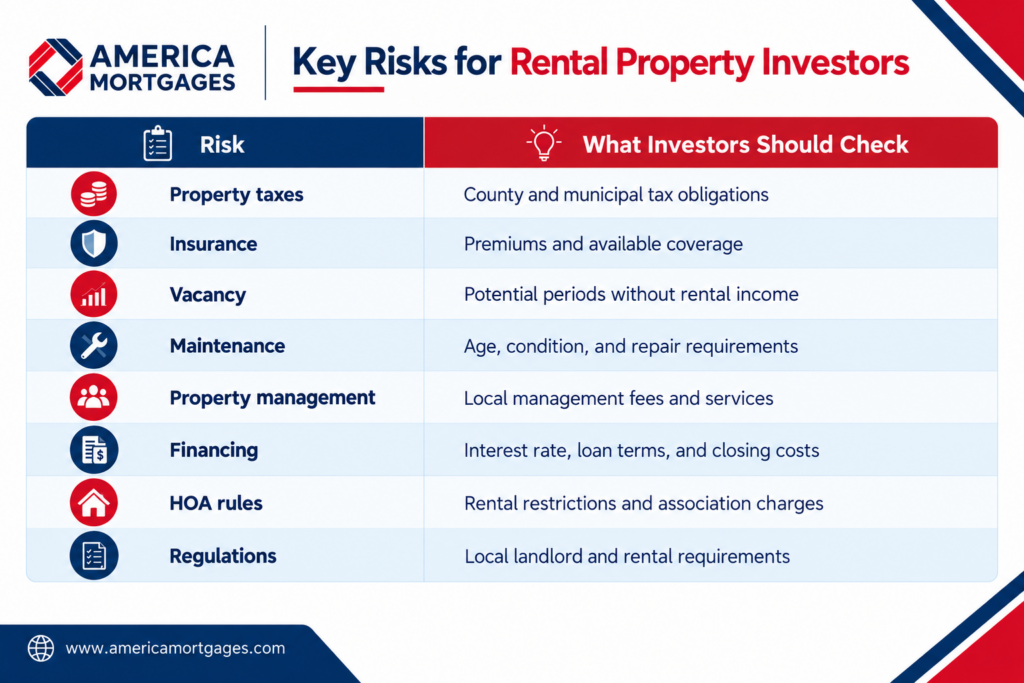
However, insurance should be considered especially because the premiums can impact monthly cash flow. The condition of the property is important as well because the older systems can have higher expenses to fix them. Also, vacancy periods can cut down profits even if the rental price looks good. These expenses need to be accounted for while estimating return on investment.
The financial assumptions of the property need to be reviewed before purchasing against the local conditions. It can be done by using the DSCR ratio. It will be able to demonstrate if the rental payments cover all monthly expenses.
Illustrative Case Study: Buying a Rental Property in North Carolina
Consider an international investor who wants to buy an investment property worth $400,000 in Charlotte. He has a down payment of $100,000 while the remaining $300,000 would be needed through investment property financing. The estimated monthly rental would be around $2,800.
The investor would then examine how the projected earnings from the property will compare with his monthly debt obligations after considering factors such as property taxes, insurance, maintenance costs, vacancy, and management expenses.
America Mortgages can assist qualified foreign investors in looking into DSCR financing based on the projected rental income.
The investor will be able to evaluate possible loan terms and qualifications.
Explore North Carolina Rental Financing With America Mortgages
The type of financing can affect the total costs and cash flow of your rental property investment. This is why it is recommended that you evaluate the loan terms, down payment, reserve requirements, and estimated rental income. Comparing these elements can help you come up with a more informed purchase strategy.
Whether foreign nationals or American expats, you can look into different ways to finance your property purchase depending on your situation. Rental income may also serve as a requirement to qualify for investment-property loans.
Ready to explore financing for a North Carolina rental property? America Mortgages can help you review available options and next steps. Contact us today at +1 (845) 583-0830 or [email protected] to discuss your investment financing needs.
FAQs
Q1: How much money do I need to buy a rental property in North Carolina?
This number changes depending on the value of the home, the loan program selected, and the down payment. Money is also needed for closing costs, reserves, inspections, and any necessary repairs. In this case, calculate the total amount needed before buying the property.
Q2: What credit score do I need to buy a rental property in North Carolina?
The purchase of a rental property in North Carolina does not have any specific requirements regarding the credit score. Each lender establishes its criteria considering the kind of loan, down payments, reserves, the property itself, and the qualification of the applicant.
Q3: How much rental income do I need for a DSCR loan in North Carolina?
Minimum rent is determined by the lender’s DSCR requirement and the monthly property debt. In most cases, lenders compare rental to mortgage payments, including the interest, principal, taxes, insurance, and any other relevant fees.
Q4: Can a foreign national get a rental property loan in North Carolina?
Yes, a foreign national can secure funding for a qualified rental property in North Carolina. However, qualification will depend on lender criteria, property qualification, down payment, creditworthiness, and documentation required. In addition, DSCR programs take into account rental income when evaluating qualifications.
Q5: Are North Carolina rental properties subject to property taxes?
Yes, rental properties in North Carolina pay property taxes. These are calculated according to the valuation of the property in question. It is important to note that different counties and municipalities have their own rates for these taxes.
Share this article
Ready to get started?
Speak with our U.S. mortgage specialists today and discover your options.
Schedule a call