How to Buy a Property in Arizona and Finance It as a Non-Resident | America Mortgages

Property in Arizona
Las Vegas panorama at sunset with mountain, highway, street and luxury hotels.

Arizona has become one of the most attractive real estate markets for international investors due to strong population growth, increasing rental demand, and more accessible pricing compared to major coastal states. Many overseas buyers search for cheap property for sale in Arizona, property for sale in Northern Arizona, or even property for sale in Williams Arizona, as these markets offer a combination of value and long-term appreciation potential. Larger metros such as Phoenix, Scottsdale, and Tucson offer strong tenant pools and continued economic expansion.

Despite the opportunity, financing remains the primary obstacle for many foreign buyers because traditional banks require U.S. credit, U.S. income, or tax returns. America Mortgages solves this problem with specialized Arizona mortgage programs designed for non-U.S. residents. Our financing solutions allow foreign nationals to qualify without U.S. credit or income, making the purchase process smooth and predictable.

Why Arizona Is a Strong Market for Non-Residents

Arizona appeals to non-resident investors because of its affordability, predictable appreciation, and consistent rental market performance. Compared to states like California, New York, or Washington, Arizona offers stronger cash-flow potential and a lower cost of entry. Search interest for commercial property for sale in Arizona and commercial real estate for sale Arizona shows that investors across the world are entering both the residential and commercial sectors.

Northern regions also attract demand due to their scenic landscapes and short-term rental potential. As buyers evaluate long-term opportunities, many also compare tax advantages using searches such as how much is property tax in Arizona, what are property taxes in Arizona and average property tax in Arizona. With an average effective tax rate near 0.56 percent, Arizona remains one of the more tax-efficient states for global investors.


To understand why non-residents continue to invest in the U.S. overall, read Why Investing in U.S. Real Estate as a Non-U.S. Resident Is the Smartest Choice.

How Non-Residents Can Buy a Property in Arizona

The first step for foreign buyers is determining affordability and evaluating mortgage payments. Using tools such as Arizona mortgage calculator helps investors estimate payments, interest, and long-term costs. These tools provide realistic frameworks for buyers planning to hold rental properties, second homes, or future relocation homes.

Next, non-U.S. residents should obtain pre-approval from America Mortgages. Our Arizona home mortgage loan programs offer up to 75 to 80 percent LTV, fixed-rate terms up to 30 years, and underwriting that accommodates foreign income. Pre-approval shows sellers you are a ready buyer, especially important in competitive areas such as Scottsdale, Phoenix, and segments of Northern Arizona. For buyers considering a second home, our guide on Vacation Home Mortgages for Non-Residents is helpful.

How Non-Residents Can Finance a Property in Arizona

Financing a property in Arizona as a non-U.S. resident is more accessible than most investors expect. Traditional banks typically require U.S. credit, U.S. income, Social Security numbers, or tax returns, which excludes many foreign nationals. America Mortgages solves this challenge by offering Arizona mortgage programs designed exclusively for overseas buyers, allowing you to qualify using global income, foreign credit history, or liquid assets.

Underwriting for non-resident loans focuses on financial stability, global income strength, and proof of funds instead of U.S. financial data. Most clients supply only a passport, two months of bank statements, and asset documentation. For second homes, global income can be used to qualify, while investment property loans often rely on property cash flow. Fixed-rate terms up to 30 years ensure predictable payments, regardless of market fluctuations.

Key benefits of financing with America Mortgages

  • Up to 75 to 80 percent LTV for non-residents
  • No U.S. credit score required
  • No U.S. income required for investment properties
  • Global income accepted for second homes
  • Remote underwriting and global borrower support

This structure allows non-residents to compete confidently in Arizona’s market and secure property even without prior U.S. financial history.

Working With a Real Estate Agent in Arizona

Working with a knowledgeable real estate agent in Arizona is essential for non-resident buyers. Agents familiar with international transactions can guide you through local regulations, remote showing processes, escrow timelines, and FIRPTA considerations. Their expertise helps identify desirable neighborhoods and evaluate rental potential in Phoenix, Mesa, Tucson, and vacation markets.

Many foreign nationals also choose to work with an Arizona real estate attorney. While not required by state law for residential closings, attorneys can provide contract review, entity structuring, and clarity on legal protections. This is particularly valuable for commercial buyers entering the commercial real estate for sale Arizona market or those planning long-term U.S. retirement strategies. To learn more about long-term planning, explore Mortgage Options for Foreign Nationals Retiring in the U.S.

Understanding Property Taxes Before Getting an Arizona Mortgage

Understanding Arizona taxes is critical for calculating ROI. According to SmartAsset, the average effective property tax rate is roughly 0.56 percent, placing Arizona well below the national average. This supports stronger rental yields and long-term affordability for non-resident buyers. For those researching statements such as how much is property tax in Arizona or what are property taxes in Arizona, the Arizona Department of Revenue provides county-level details.


For broader U.S. market insights, explore the U.S. Real Estate Market Outlook 2026 or U.S. Luxury Property Investments.

Final Steps and Closing for a Non-Resident Arizona Mortgage

Once your offer is accepted, the final phases include inspection, appraisal, and underwriting. Non-residents typically complete their closings remotely using secure electronic signing methods and title services. Most transactions finalize in thirty to forty days when pre-approval is completed early.

America Mortgages remains involved through every stage of the process, helping clients evaluate financial documentation, prepare for underwriting, and complete the closing process efficiently. For further data on what drives U.S. market movement, review our U.S. Flash Market Update or explore Best U.S. Cities for Foreign Mortgage Borrowers.

Conclusion

With competitive pricing, strong rental demand, and accessible financing, Arizona remains one of the best U.S. real-estate markets for non-resident investors. America Mortgages provides Arizona mortgage solutions specifically designed for global buyers, allowing you to finance U.S. property without U.S. credit or income. With the right guidance and structure, non-residents can invest confidently and successfully in Arizona real estate.

To explore your financing options, contact us here or email our team directly at [email protected].

Frequently Asked Questions

Q1. What documents do non-residents need for an Arizona mortgage?

A: Non-residents typically need a passport, two months of bank statements and proof of down payment funds. America Mortgages does not require U.S. credit or U.S. income for investment properties.

Q2. Are property taxes higher for foreign buyers?

A: No. Arizona property taxes are the same for residents and non-residents. The arizona real estate tax rate averages around 0.56 percent.

Q3. Can foreign buyers purchase commercial property in Arizona?

A: Yes. Non-U.S. residents actively invest in commercial property for sale in Arizona and commercial real estate for sale Arizona using specialized financing options.

Q4. How can I estimate my monthly mortgage payment?

A: You can use an arizona mortgage calculator or mortgage calculator Arizona to estimate monthly payments, interest, and affordability before making an offer.

December Housing Trends Point to a Stronger 2026: Why International Buyers Should Act Now

December Housing Trends

December is usually a quiet month in U.S. real estate, but the December 2026 data shows a market that is behaving very differently. HousingWire and Altos Research reveal that December has effectively become an early preview of the coming year. 

For foreign nationals and U.S. expats looking to invest, these six charts highlight a market that is stabilising, rebalancing and offering conditions far more favourable than what we saw during the volatility of the last several years.

Here’s what the December housing trends actually reveal — and why they matter for America Mortgages clients.

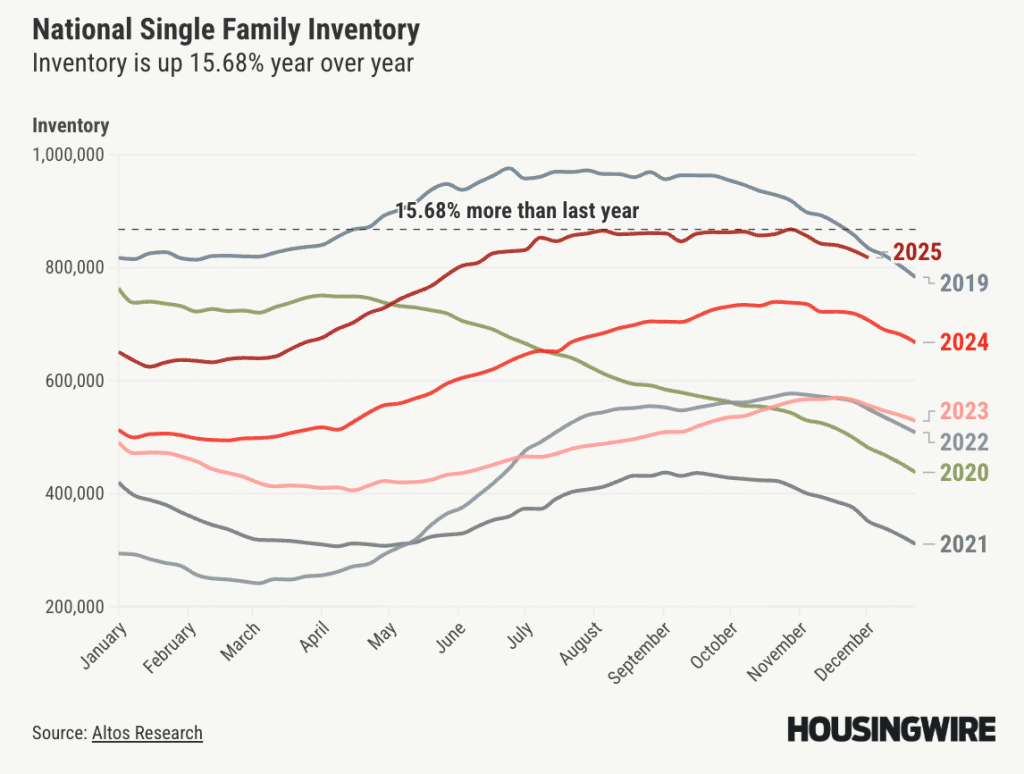
1. National Single-Family Inventory Is Recovering

National Single-Family Inventory

This shows one of the most important improvements in today’s housing environment: inventory is up 15.68% year over year. After years of ultra-tight supply, the market is finally loosening. Higher inventory levels give international buyers considerably more choice, stronger negotiating leverage and the ability to make decisions without the pressure of immediate competition. For those purchasing from abroad, where due diligence often takes more time, this renewed breathing room is particularly valuable.

2. Pending Home Sales Show Buyers Are Returning

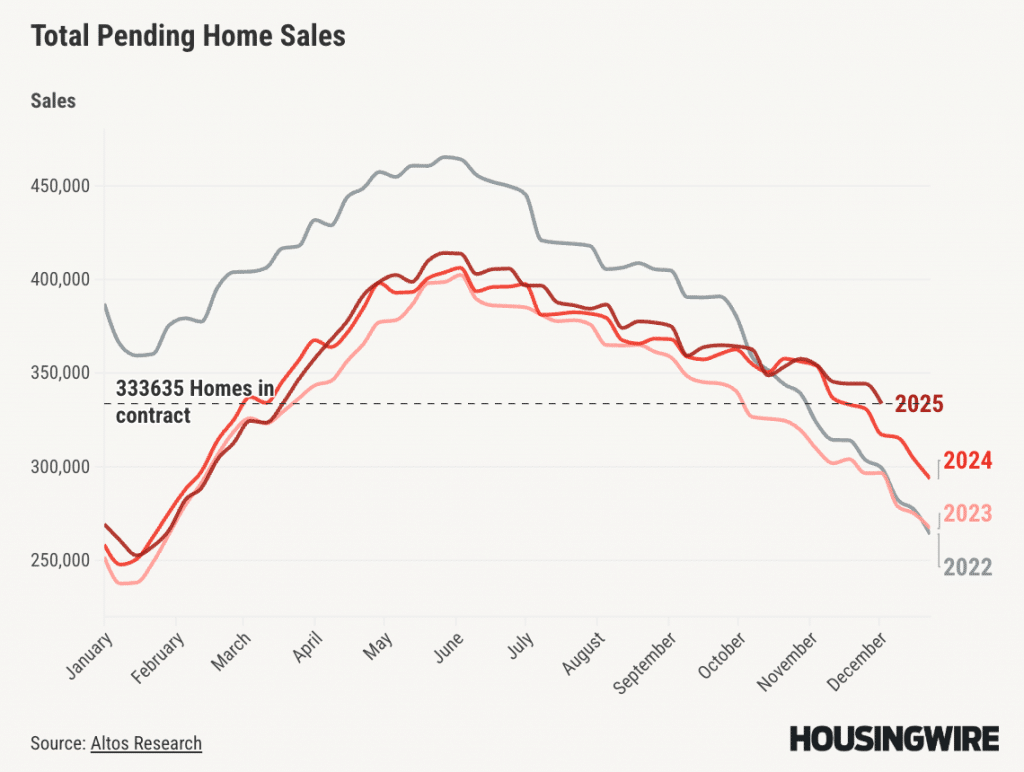
Total Pending Home Sales

Pending sales reached 333,635 homes in contract, a number that exceeds activity seen in 2023 and 2022. Even with higher interest rates, buyers are stepping back into the market earlier and with more confidence. This signals that demand is building beneath the surface and is likely to accelerate as affordability improves. For real estate investors, this trend suggests that early 2026 may be the calm before a much more competitive spring.

3. Purchase Applications Are Climbing Ahead of Peak Season

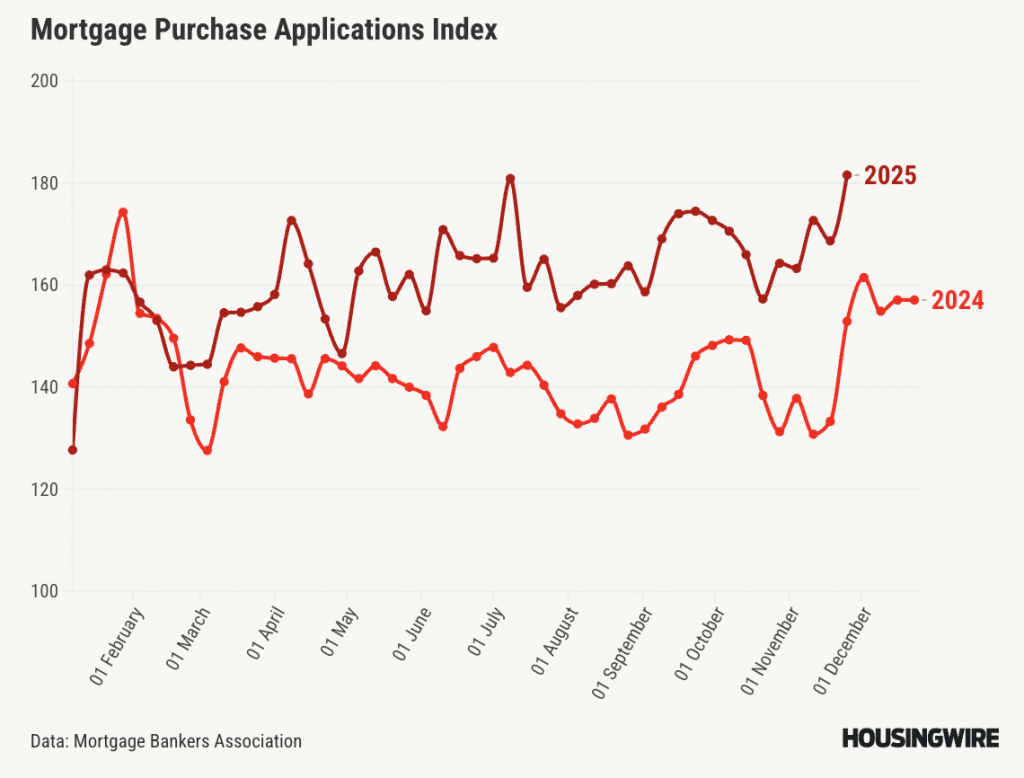
Mortgage Purchase Applications Index

Mortgage Bankers Association data shows a consistent increase in purchase applications throughout 2025 compared to 2024. Applications are one of the earliest indicators of forward demand, and this rise suggests that buyers are preparing for purchases sooner than expected. For buyers, this early upswing highlights the advantage of being proactive. With America Mortgages’ expat and foreign-national loan programs — which do not require U.S. credit, W-2 income, or domestic tax returns — overseas borrowers can move just as quickly as local buyers and position themselves ahead of the competition before activity intensifies.

4. Mortgage Rates Have Finally Stabilised

One of the most encouraging shifts is in rate stability. After several years of unpredictable spikes, mortgage rates in 2024 and 2025 have moved into a stable, flatter range. This allows buyers to plan long-term financing with much greater confidence. For investors who often rely on fixed-rate products to lock in predictable monthly payments, this environment reduces uncertainty and encourages decisive action.

5. Treasury Yields Suggest Further Rate Relief May Be Ahead

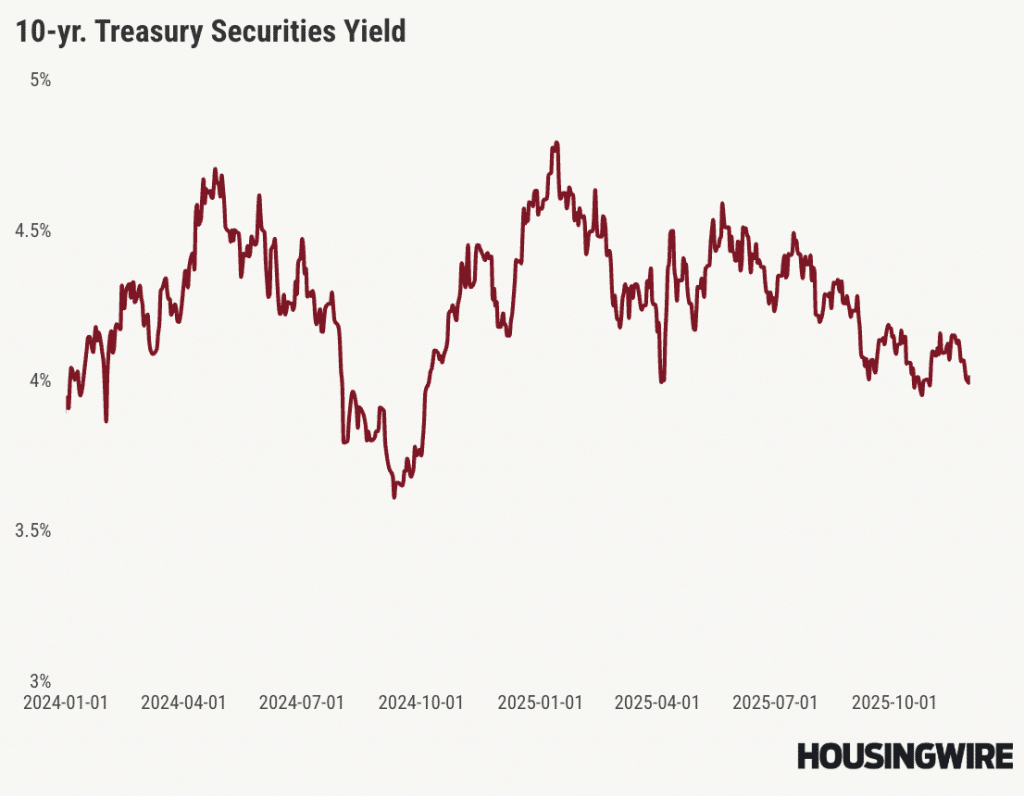
10 yr Treasury Securities Yields

Because mortgage rates are heavily influenced by the 10-year Treasury yield, this chart provides an important signal. The yield saw periods of volatility in early 2024 but began cooling and drifting downward in late 2025. If this pattern continues, borrowing costs may ease further in 2026. For international buyers, entering the market before any major increase in competition — and potentially refinancing later if rates drop — can be a highly favourable strategy.

6. Long-Term Existing Home Sales Show Pent-Up Demand

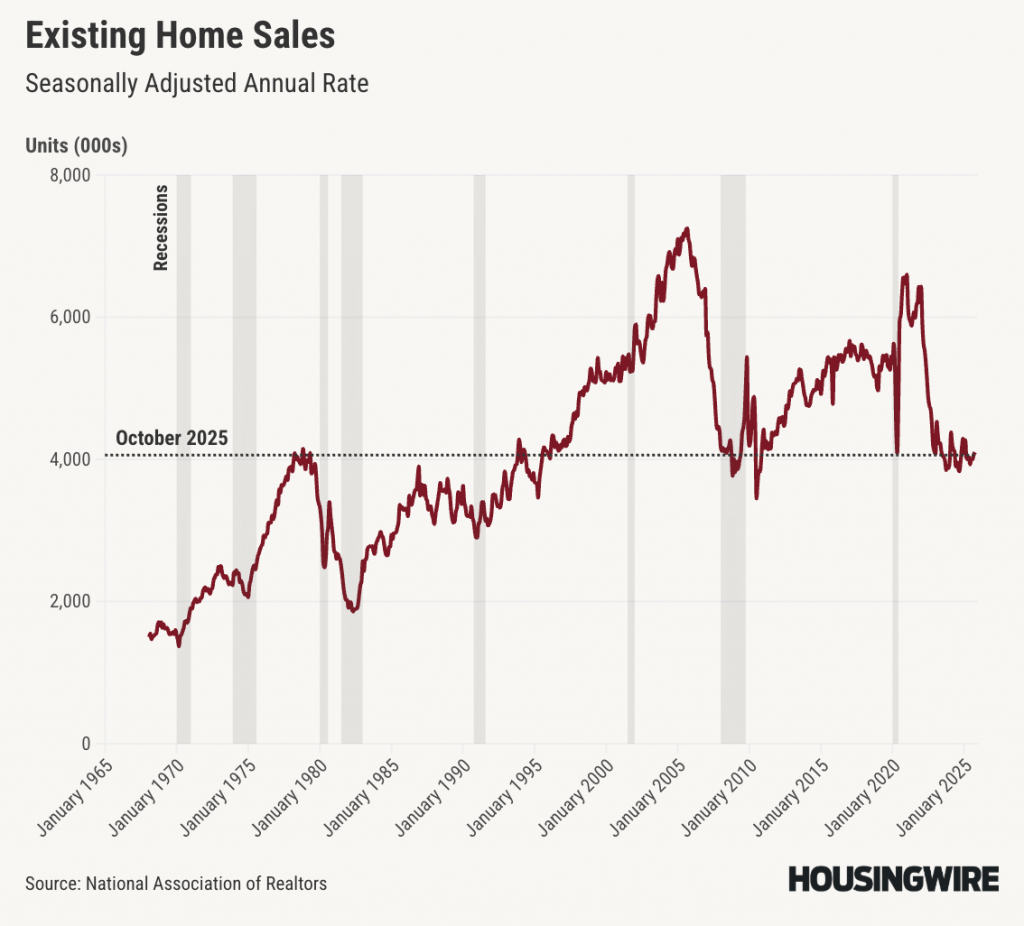
Long-Term Existing Home Sales

The final chart offers valuable historical context. Existing home sales sit near multi-decade lows, a level typically associated with recessionary periods or moments of major affordability strain. Historically, such lows are followed by significant rebounds once conditions improve. This suggests that the market is not weak — it is paused. When affordability and supply continue improving, demand is likely to return quickly and forcefully.

What This Means for America Mortgages Clients

Taken together, these trends show a U.S. housing market in transition. Inventory is improving, demand is reawakening and rates are settling into a predictable range. For foreign nationals and U.S. expats clients of America Mortgages, this creates a rare early-cycle opportunity to buy before the spring market intensifies. Buyers who move now can secure better pricing, better positioning and better financing terms before competition builds.

How America Mortgages Helps You Act Before the Window Closes

If you’re living outside the U.S. but waiting for the right moment to buy property, the market signals suggest that time may be now. This is one of the rare times when the charts line up signaling the time to strike. 

At America Mortgages, we specialise in helping foreign nationals and U.S. expats secure full-term U.S. mortgage financing without the barriers of traditional banks.

You don’t need a U.S. credit score, U.S. residency, or American tax returns.

Our underwriting is designed around your international financial profile, making U.S. homeownership accessible no matter where you live or earn.

Key Highlights

  • No U.S. credit score required
  • Foreign income, assets, and international documentation accepted
  • Up to 80% loan-to-value depending on country and borrower profile
  • Access to 150+ loan programs designed for non-U.S.-resident borrowers
  • 30-year fixed rates, regardless of borrower age
  • Minimum loan amounts starting from US$150,000
  • DSCR investment property loans requiring no personal income to qualify
  • 10-year fixed interest-only loan options for investors
  • No W-2s or U.S. tax returns required for U.S. expats
  • Mortgages available in all 50 U.S. states
  • Remote closings supported worldwide
  • Loan officers working in 12 different countries in your time zone and speaking your language 
  • Residential, commercial, asset backed bridge loans – all available 

Whether you’re purchasing an investment property, refinancing an existing loan, or unlocking equity from your U.S. home, our global lending team ensures a fast, seamless experience built around the unique needs of international borrowers.

This is how America Mortgages empowers buyers abroad to move quickly — before competition rises and the window of opportunity narrows.

Bottom Line

The December data offers a clear signal: the U.S. housing market is stabilising, strengthening and preparing for a potential resurgence. Buyers who act early, before the first wave of spring competition, will be best positioned to take advantage of this rare opportunity of timing.

Ready to explore your options? Our team of America Mortgages specialists is here to guide you, no matter where in the world you’re based.

If a U.S. purchase is on your horizon, this is the ideal moment to start planning. We work with you from the mortgage, to the property, to the tax planning to the holding structure … all under one roof. 

We’ll help you build a clear financing strategy so you’re prepared before market conditions shift.

Speak with a U.S. mortgage expert anytime, 24 hours a day, 7 days a week: +1 845-583-0830

Prefer to book online? Use our 24/7 scheduling tool to arrange a free, no-obligation consultation with a U.S. mortgage advisor at your convenience.

U.S. Home Buying Guide for Parents: Secure Housing for Your Child

Secure Housing for Your Child

What You Will Learn

✔ Why parents are buying U.S. homes early for education
✔ How foreign buyers qualify without U.S. credit or income
✔ Top U.S. cities for education-driven property purchases
✔ Required documents and the mortgage approval timeline
✔ Second-home vs. investment-property financing explained
✔ Long-term benefits of owning U.S. real estate for your child
✔ How to turn a student home into a profitable rental asset
✔ Steps to begin financing a U.S. property from overseas

Why More Parents Are Buying U.S. Homes Early

Every year, thousands of families prepare their children for U.S. education. But as housing costs rise in major American university cities and student accommodation becomes increasingly competitive, parents are rethinking their approach.

Instead of relying on expensive rentals or uncertain dorm availability, many families are now purchasing homes years before their children begin university. This strategy offers stability, cost control, and long-term investment benefits, particularly as U.S. real estate continues to demonstrate resilience, as outlined in the 2026 U.S. market outlook.

What most families don’t realize, however, is that qualifying for a U.S. mortgage is often easier than expected, even without U.S. credit, income, or residency. America Mortgages, recognized globally for foreign-national financing, has helped thousands of Taiwanese parents secure homes in top education hubs.

Why Buying Early Makes Financial and Practical Sense

Families purchasing early, sometimes 1–3 years before enrollment, often cite a combination of financial, logistical, and safety benefits. Key motivations include:

  • Control over housing quality and location near campus
  • Cost savings compared to rising student-rental markets
  • Long-term appreciation in high-demand education cities
  • A stable home for children throughout their study years
  • Flexibility to convert the property into a rental asset later

According to the U.S. Census, housing demand in university-rich regions has remained resilient due to population mobility and long-term domestic migration patterns.

Meanwhile, competitive buyer behavior in education cities is increasing, as highlighted in CNBC’s ranking of America’s strongest housing markets.

For families planning ahead, buying early is now seen as a strategic move, not just a housing decision.

What Most Parents Don’t Know About Eligibility

Many families abroad still assume U.S. financing works like their banking system. In reality, foreign-national mortgage programs are designed for overseas buyers and are far more flexible.

Common misconceptions that do not prevent approval:

  • No U.S. credit score
  • No U.S. income
  • No U.S. residency, address, or visa
  • No U.S. tax returns

Second homes can use foreign income
Investment properties qualify based on rental performance
Many programs do not require foreign or U.S. credit

This is why parents purchasing for education often find approval surprisingly straightforward.

Best Locations for Education-Driven Home Purchases

Families most commonly buy in cities with top-ranking universities and strong rental demand. Popular choices include:

New York

Home to Ivy League institutions and world-class programs, including Columbia University and Cornell University’s Cornell Tech campus in New York City. Families researching Manhattan, Queens, and Brooklyn markets can explore New York property insights.

California

Los Angeles, Irvine, and San José remain top choices due to tech, STEM, and arts programs. The state is home to globally recognized institutions such as UCLA, USC, UC Irvine, UC Berkeley, and Stanford University, all major destinations for students. 

Texas

Affordable, fast-growing, and attractive for engineering and business majors, supported by market behavior seen in 2025 homebuyer trends. Cities such as Austin, Dallas, and Houston host top universities, including UT Austin, Texas A&M, Rice University, and University of Houston, all known for strong academic reputations and industry partnerships.

Massachusetts

Boston and Cambridge remain two of the most competitive academic hubs in the United States, especially for families focused on medicine, biotechnology, research, engineering, and public health. The region is home to globally renowned institutions such as Harvard University, MIT (Massachusetts Institute of Technology), Boston University, Northeastern University, and Tufts University, all top destinations for high-achieving students.

To understand what drives global investors into the best-performing markets, see savvy investor insights.

How Parents Finance a U.S. Home Without U.S. Credit

America Mortgages offers several foreign-national mortgage programs aligned with foreign buyers. Here’s a simple breakdown of how qualification typically works:

Documentation Needed

  • Passport
  • Two months of foreign bank statements
  • Income documents (for second homes)
  • Proof of assets for the down payment

Not Required

  • No U.S. tax returns
  • No U.S. credit score
  • No U.S. income
  • No residency or visa

Typical Timeline

  • Pre-approval: 48–72 hours
  • Underwriting: begins after the offer is accepted
  • Closing: 30–45 days

Parents planning for top-tier universities can also review AM’s Ivy League guide to match housing decisions with academic pathways.

A Smart Investment Beyond Education

Once a child graduates, the home can easily shift into an income-producing rental, especially in cities with strong population inflows.

According to the U.S. Census and CNBC, states like Florida, Texas, and North Carolina continue to show strong rental momentum, benefiting long-term investors.

For broader insights into macro trends influencing U.S. homebuyers, see the 2026 U.S. market outlook and America Mortgages resource hub.

Final Thoughts

Buying a U.S. home for your child’s education is no longer just a housing solution; it’s a strategic financial move that helps families abroad secure stability, build long-term wealth, and gain early access to competitive U.S. markets.

With foreign-friendly underwriting, predictable documentation, and foreign-national mortgage programs designed specifically for overseas buyers, the path to U.S. homeownership has never been clearer.

If you’re preparing for your child’s education abroad or exploring long-term investment opportunities, our America Mortgages team can guide you through every step.

Get Personalized Guidance

Email: [email protected]
Contact: Contact Us

Frequently Asked Questions

Q1. Can parents abroad get a U.S. mortgage without U.S. credit?

A: Yes. Foreign-national programs accept alternative documentation or foreign banking references, allowing first-time overseas buyers to qualify confidently.

Q2. Can I buy a U.S. home even if I live abroad full-time?

A: Absolutely. No U.S. address or residency is needed. Most foreign families complete the entire financing process remotely.

Q3. Can foreign income be used for qualification?

A: Yes, for second homes. Investment properties rely on the rental performance of the property rather than the borrower’s income.

Q4. How much down payment is required?

A: Most parents prepare 25–30%, depending on the loan program. Higher down payments may unlock better interest rates or longer-term benefits.