U.S. Expats: How to Buy Real Estate Back Home Without U.S. Income or Credit

U.S. Expats Buying Property Home
View in Chicago with morning light, USA.

Why U.S. Expats and Green Card Holders Can Still Buy Property Without U.S. Income or Credit

Many U.S. Expats and Green Card holders assume they cannot buy real estate in the U.S. because they no longer earn American income or maintain a domestic credit score. In reality, both groups often qualify through programs designed specifically for Americans living overseas. These programs evaluate foreign income, international assets, and global banking history, allowing borrowers to finance a second home or prepare for future relocation. For a complete breakdown of expat documentation and eligibility, see the Guide to U.S. mortgages for U.S. Expats.

Traditional banks rarely accommodate overseas borrowers because they cannot interpret foreign financial documents. America Mortgages solves this by underwriting using international verification systems and expat-specific criteria. Many programs for U.S. Expats and Green Card holders do not require a U.S. credit score or even a credit score from your home country. Instead, alternatives such as banking references or strong asset history are accepted. For a clear comparison of how Americans overseas qualify differently, see How expats easily secure a U.S. mortgage.

How Americans Overseas Qualify Using Foreign Income and 2-Month Bank Statements

Foreign income can be used to qualify for second homes, holiday homes, and personal-use properties for both U.S. Expats and Green Card holders. These loans rely on salary slips, employer letters, and two months of bank statements, not six months or year-long histories. This structure allows U.S. Expats and Green Card holders to purchase a home for personal use or long-term relocation without needing U.S. tax returns or domestic deposits.

For investment properties, the rules differ. Investment loans do not use foreign income. Instead, they rely on DSCR (Debt Service Coverage Ratio), asset-based underwriting, or rental-cash-flow evaluation. This allows U.S. Expats to purchase investment units without proving employment income at all. For expats buying their first U.S. property, support options are outlined here: Down payment help for first-time expat buyers.

Why 2025–2026 Is an Ideal Window for U.S Expats and Green Card Holders Re-Entering the Market

Market data shows stabilizing prices across multiple U.S. metros, creating a strategic moment for U.S. Expats and Green Card holders to re-enter the market. The U.S. Real Estate Market Outlook 2026 highlights moderating price pressure, improved supply, and buyer activity shifting after years of volatility. These trends make it easier for expats to secure property while competition is still manageable.

In addition, expats are monitoring potential policy shifts, including the proposed 50-year mortgage model, which could reduce payment burdens for long-term buyers. Interest rate momentum explained in Trump vs The Fed may also create a short opportunity where rates steady before new demand returns. External sources such as CNBC and Forbes Real Estate confirm rising interest from overseas buyers when rates stabilize.

Where U.S. Expats and Green Card Holders Are Buying and Why High-Demand Markets Still Perform

U.S. Expats and Green Card holders often purchase homes for future relocation, lifestyle planning, or for family members studying in the U.S. Popular second-home markets include suburban metros with strong schools, warm-weather destinations, and stable, mid-tier cities that offer long-term appreciation. For investment-minded expats, financing depends on DSCR or asset-based lending rather than income, making it accessible even for entrepreneurs or consultants abroad.

Luxury real estate remains a significant driver of expat demand due to resilient pricing, limited supply, and favorable currency moments. A stronger foreign currency versus the U.S. dollar can reduce effective purchase costs, improving long-term returns. For market behavior across luxury segments, review U.S. Luxury Property Investments.

How Americans Overseas Can Time Their Purchase Using Currency and Market Cycles

One strategic advantage U.S. Expats often overlook is currency timing. When the U.S. dollar weakens relative to your local currency, your down payment and long-term mortgage cost can effectively decrease. Some borrowers transfer funds in stages, while others align their purchase timeline with favorable exchange cycles to maximize value.

These currency movements pair closely with broader U.S. market shifts. Trends outlined in the 2026 market outlook suggest that stabilization may give expats a window to secure property before larger pools of buyers re-enter the market. This makes timing both a financial and strategic opportunity.

Second Home or Investment? Choosing the Right Mortgage Path as U.S. Expats and Green Card Holders

Choosing the right structure depends on your purpose. Second homes allow U.S. Expats and Green Card holders to qualify with foreign income, making them ideal for future relocation or family use. These properties can later become rentals, offering flexibility over time. Investment properties, by contrast, are underwritten using DSCR or asset-based formulas, making them independent of employment income.

Expats and Green Card holders planning for long-term residence may benefit from fixed-rate structures, while investors may focus on cash-flow potential and market demand. Future affordability tools, such as the proposed 50-year mortgage program, explained here: Why smart buyers are locking in early may further help expats choose options aligned with long-term goals.

Conclusion: Buying U.S. Real Estate From Overseas Is More Achievable Than Most Expect

U.S. Expats can buy second homes or investment properties without U.S. income, domestic credit, or local tax returns when using expat-focused mortgage programs. America Mortgages evaluates foreign income for second homes and uses DSCR or asset-based underwriting for investments, allowing borrowers to qualify from almost any country. With remote processing, flexible documentation, and expat-tailored mortgage solutions, financing a home in the U.S. is simpler than expected.

If you’re ready to explore options, America Mortgages can prequalify you from anywhere in the world.

Frequently Asked Questions

Q1. Can U.S. Expats qualify for a U.S. mortgage using only foreign income?

A: Yes, but only for second homes or personal-use properties. Investment properties use DSCR or asset-based qualification instead.

Q2. Do I need a U.S. credit score or home-country credit report?

A: No. Many America Mortgages programs do not require credit from the U.S. or your home country. Banking references or asset history are often accepted.

Q3. How many months of bank statements are required?

A: America Mortgages typically requires two months of bank statements for qualifying U.S. Expats, not six months.

December Housing Trends Point to a Stronger 2026: Why International Buyers Should Act Now

December Housing Trends

December is usually a quiet month in U.S. real estate, but the December 2026 data shows a market that is behaving very differently. HousingWire and Altos Research reveal that December has effectively become an early preview of the coming year. 

For foreign nationals and U.S. expats looking to invest, these six charts highlight a market that is stabilising, rebalancing and offering conditions far more favourable than what we saw during the volatility of the last several years.

Here’s what the December housing trends actually reveal — and why they matter for America Mortgages clients.

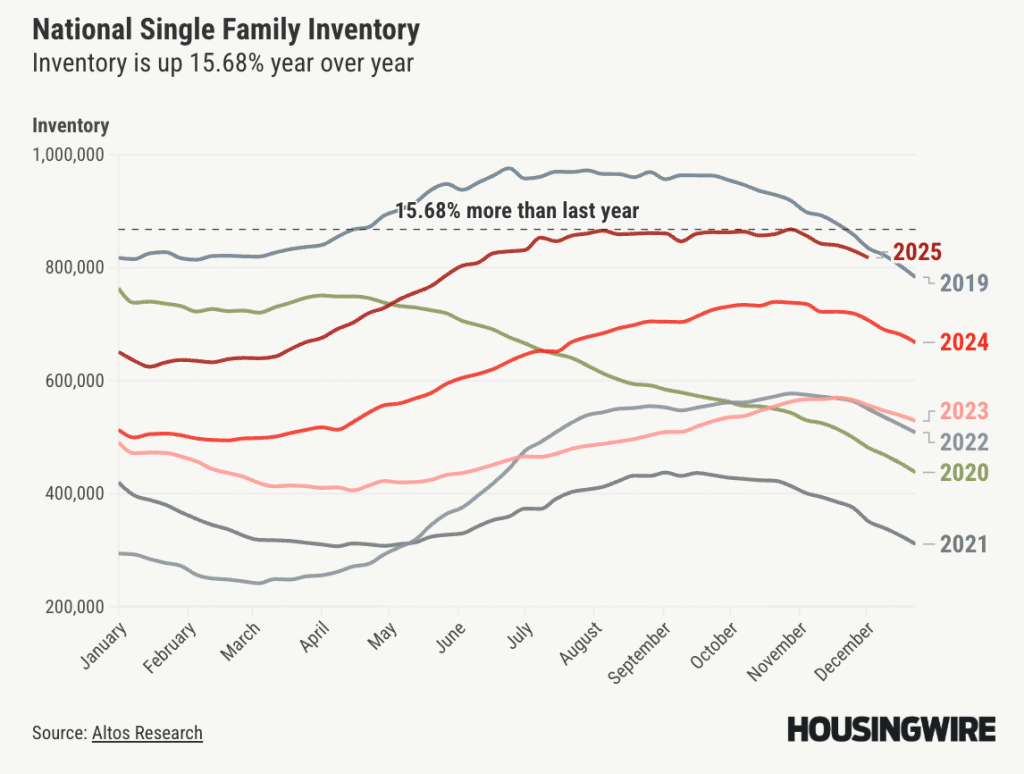
1. National Single-Family Inventory Is Recovering

National Single-Family Inventory

This shows one of the most important improvements in today’s housing environment: inventory is up 15.68% year over year. After years of ultra-tight supply, the market is finally loosening. Higher inventory levels give international buyers considerably more choice, stronger negotiating leverage and the ability to make decisions without the pressure of immediate competition. For those purchasing from abroad, where due diligence often takes more time, this renewed breathing room is particularly valuable.

2. Pending Home Sales Show Buyers Are Returning

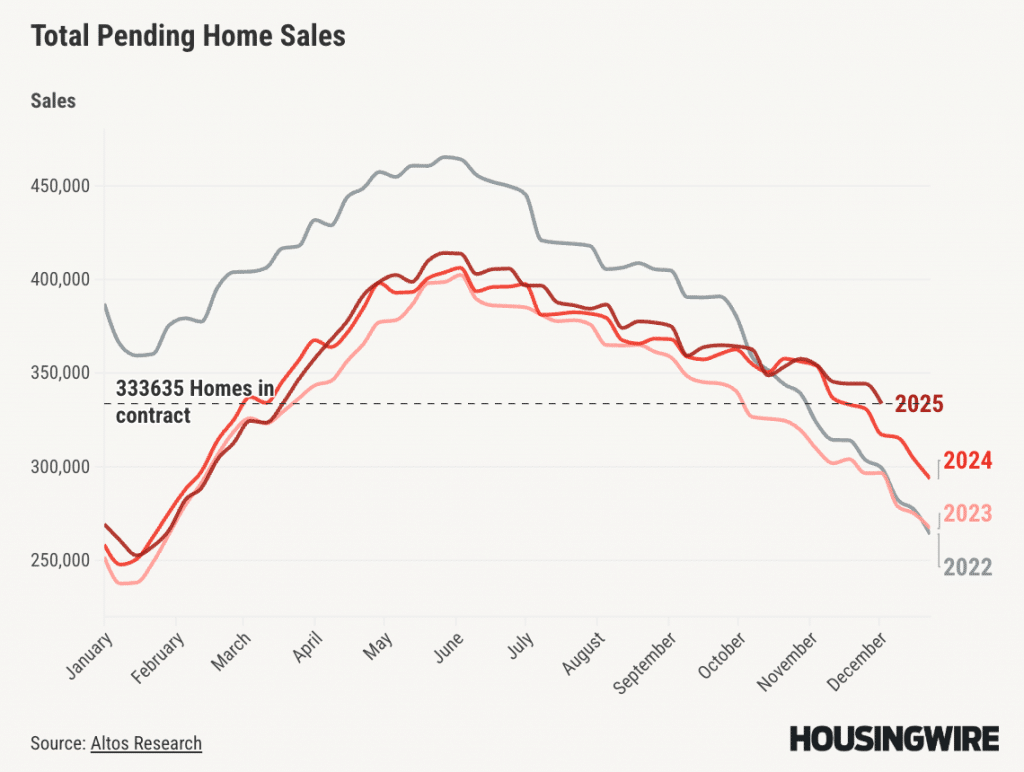
Total Pending Home Sales

Pending sales reached 333,635 homes in contract, a number that exceeds activity seen in 2023 and 2022. Even with higher interest rates, buyers are stepping back into the market earlier and with more confidence. This signals that demand is building beneath the surface and is likely to accelerate as affordability improves. For real estate investors, this trend suggests that early 2026 may be the calm before a much more competitive spring.

3. Purchase Applications Are Climbing Ahead of Peak Season

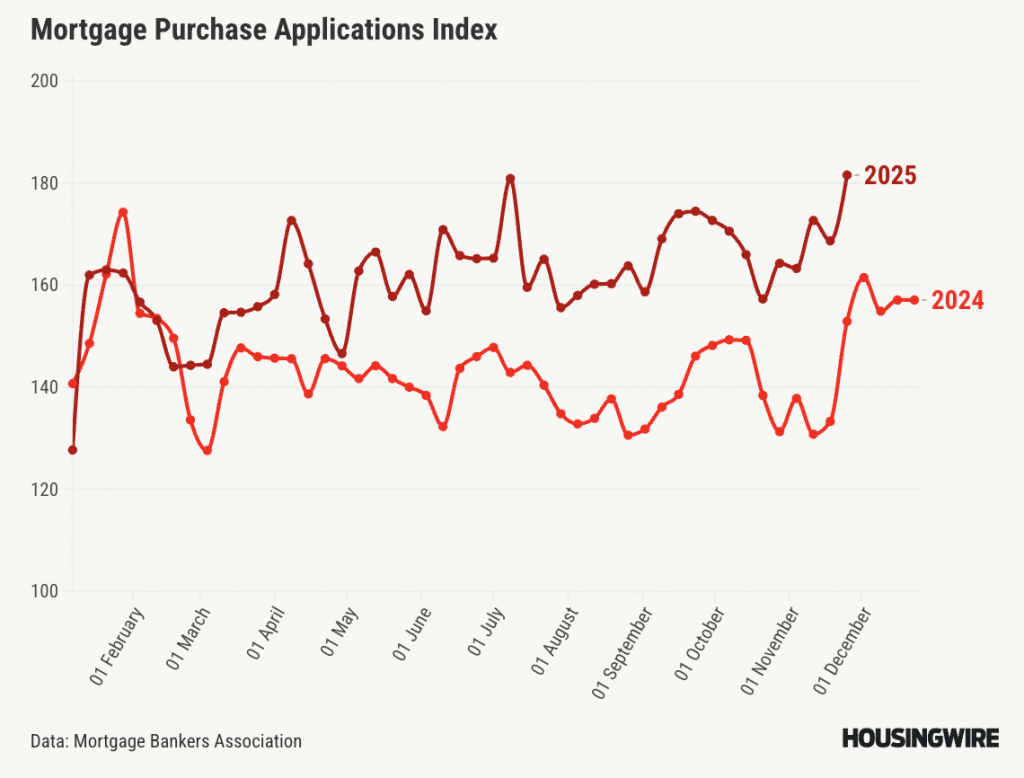
Mortgage Purchase Applications Index

Mortgage Bankers Association data shows a consistent increase in purchase applications throughout 2025 compared to 2024. Applications are one of the earliest indicators of forward demand, and this rise suggests that buyers are preparing for purchases sooner than expected. For buyers, this early upswing highlights the advantage of being proactive. With America Mortgages’ expat and foreign-national loan programs — which do not require U.S. credit, W-2 income, or domestic tax returns — overseas borrowers can move just as quickly as local buyers and position themselves ahead of the competition before activity intensifies.

4. Mortgage Rates Have Finally Stabilised

One of the most encouraging shifts is in rate stability. After several years of unpredictable spikes, mortgage rates in 2024 and 2025 have moved into a stable, flatter range. This allows buyers to plan long-term financing with much greater confidence. For investors who often rely on fixed-rate products to lock in predictable monthly payments, this environment reduces uncertainty and encourages decisive action.

5. Treasury Yields Suggest Further Rate Relief May Be Ahead

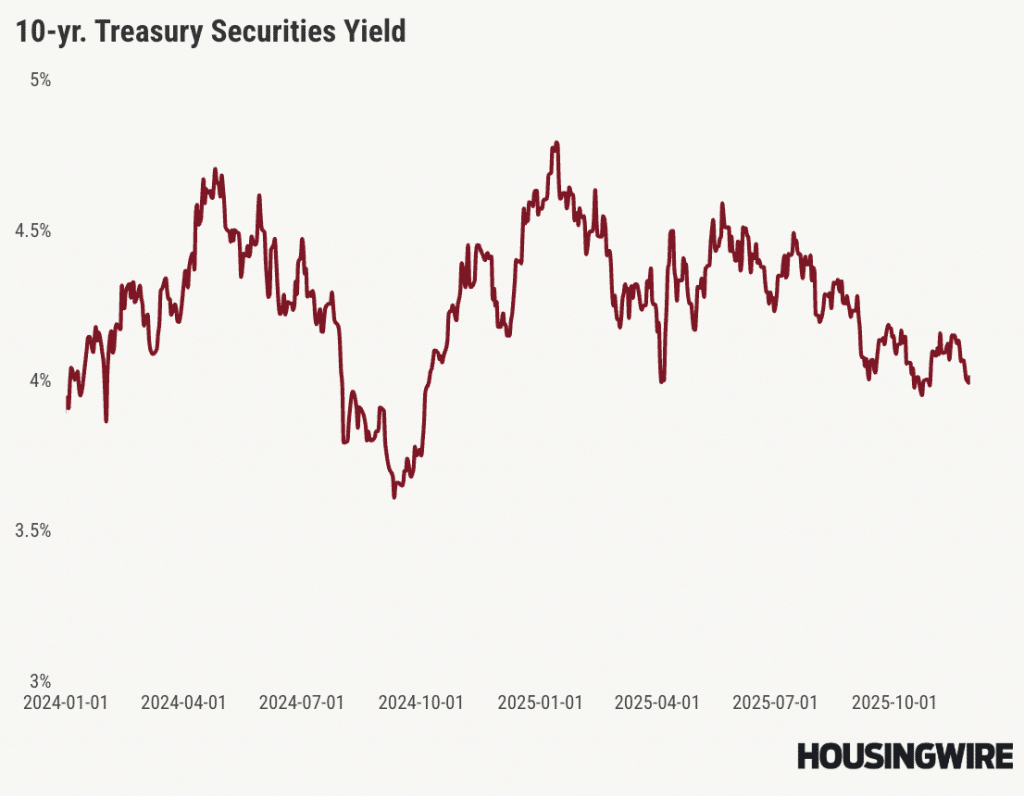
10 yr Treasury Securities Yields

Because mortgage rates are heavily influenced by the 10-year Treasury yield, this chart provides an important signal. The yield saw periods of volatility in early 2024 but began cooling and drifting downward in late 2025. If this pattern continues, borrowing costs may ease further in 2026. For international buyers, entering the market before any major increase in competition — and potentially refinancing later if rates drop — can be a highly favourable strategy.

6. Long-Term Existing Home Sales Show Pent-Up Demand

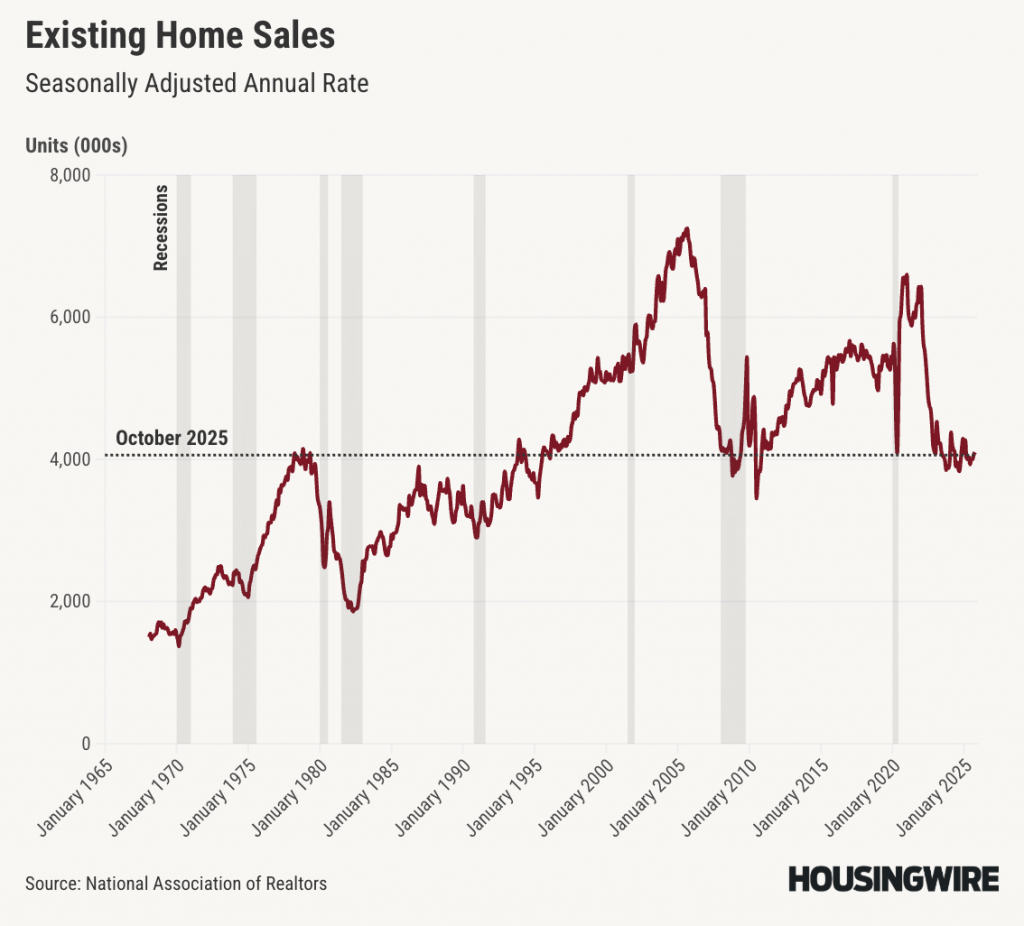
Long-Term Existing Home Sales

The final chart offers valuable historical context. Existing home sales sit near multi-decade lows, a level typically associated with recessionary periods or moments of major affordability strain. Historically, such lows are followed by significant rebounds once conditions improve. This suggests that the market is not weak — it is paused. When affordability and supply continue improving, demand is likely to return quickly and forcefully.

What This Means for America Mortgages Clients

Taken together, these trends show a U.S. housing market in transition. Inventory is improving, demand is reawakening and rates are settling into a predictable range. For foreign nationals and U.S. expats clients of America Mortgages, this creates a rare early-cycle opportunity to buy before the spring market intensifies. Buyers who move now can secure better pricing, better positioning and better financing terms before competition builds.

How America Mortgages Helps You Act Before the Window Closes

If you’re living outside the U.S. but waiting for the right moment to buy property, the market signals suggest that time may be now. This is one of the rare times when the charts line up signaling the time to strike. 

At America Mortgages, we specialise in helping foreign nationals and U.S. expats secure full-term U.S. mortgage financing without the barriers of traditional banks.

You don’t need a U.S. credit score, U.S. residency, or American tax returns.

Our underwriting is designed around your international financial profile, making U.S. homeownership accessible no matter where you live or earn.

Key Highlights

  • No U.S. credit score required
  • Foreign income, assets, and international documentation accepted
  • Up to 80% loan-to-value depending on country and borrower profile
  • Access to 150+ loan programs designed for non-U.S.-resident borrowers
  • 30-year fixed rates, regardless of borrower age
  • Minimum loan amounts starting from US$150,000
  • DSCR investment property loans requiring no personal income to qualify
  • 10-year fixed interest-only loan options for investors
  • No W-2s or U.S. tax returns required for U.S. expats
  • Mortgages available in all 50 U.S. states
  • Remote closings supported worldwide
  • Loan officers working in 12 different countries in your time zone and speaking your language 
  • Residential, commercial, asset backed bridge loans – all available 

Whether you’re purchasing an investment property, refinancing an existing loan, or unlocking equity from your U.S. home, our global lending team ensures a fast, seamless experience built around the unique needs of international borrowers.

This is how America Mortgages empowers buyers abroad to move quickly — before competition rises and the window of opportunity narrows.

Bottom Line

The December data offers a clear signal: the U.S. housing market is stabilising, strengthening and preparing for a potential resurgence. Buyers who act early, before the first wave of spring competition, will be best positioned to take advantage of this rare opportunity of timing.

Ready to explore your options? Our team of America Mortgages specialists is here to guide you, no matter where in the world you’re based.

If a U.S. purchase is on your horizon, this is the ideal moment to start planning. We work with you from the mortgage, to the property, to the tax planning to the holding structure … all under one roof. 

We’ll help you build a clear financing strategy so you’re prepared before market conditions shift.

Speak with a U.S. mortgage expert anytime, 24 hours a day, 7 days a week: +1 845-583-0830

Prefer to book online? Use our 24/7 scheduling tool to arrange a free, no-obligation consultation with a U.S. mortgage advisor at your convenience.

U.S. Mortgage Options for Expats: How to Secure Financing While Living Abroad

U.S. Expat Mortgage Options

U.S. Expats Can Secure a U.S. Mortgage More Easily Than Expected

For many Americans living abroad, buying property in the U.S. still feels out of reach. Most believe they need U.S. credit scores, local tax returns, or domestic income to qualify. In reality, U.S. expat mortgage options are more flexible than ever, especially through America Mortgages, one of the only lenders specializing exclusively in U.S. mortgages for non-residents and overseas Americans. We underwrite global income, accept foreign bank statements, and work with expats who no longer maintain active U.S. credit histories. Our full overview on expat qualification is available in the Guide to U.S. mortgages for U.S. expats.

For expats earning in foreign currencies or living under different tax systems, traditional U.S. banks often decline applications, not because borrowers are unqualified, but because the system isn’t built for them. That’s why solutions like AM PrimeSelect exist. This program evaluates foreign income and assets with far more flexibility, making it one of the strongest mortgage loan options for U.S. expats. Asset-based mortgages, no-U.S.-credit-score programs, and financing options for returning expats ensure nearly every borrower profile has a pathway. For broader eligibility, see how expats qualify with America Mortgages.

What Expats Need to Qualify & How Much Down Payment Is Required

Qualifying for a U.S. mortgage from overseas depends on financial stability, not physical location. Lenders typically review:

  • Global income
  • Foreign bank statements and international assets
  • Alternative credit or foreign credit references

Down payment requirements vary widely. Many expats assume a 20% minimum, but several programs allow lower down payments depending on loan type and property. First-time expat buyers can explore additional support options in Down payment help for first-time expats buying U.S. homes.

Market timing is also important. Recent shifts highlighted in the U.S. Real Estate Market Outlook 2026 suggest improving inventory and moderating prices. With proposals like the 50-year mortgage and Federal Reserve policy changes discussed in Trump vs. The Fed, this may be a rare opportunity window. Insights from CNBC and Forbes Real Estate further indicate that buyer activity tends to surge when rates stabilize or decline.

Where U.S. Expats Are Buying & How to Purchase Completely Remotely

America Mortgages is seeing strong expat demand in education-friendly suburbs, second-home destinations, and rental-focused markets. Luxury properties remain attractive due to global wealth trends and limited supply, as detailed in U.S. Luxury Property Investments.

Buying from overseas is fully remote. The process typically involves:

  • A quick online prequalification using foreign income
  • Secure digital document uploads
  • Remote closing through electronic signatures or local notary services

How Currency Exchange Rates Affect U.S. Expat Mortgage Planning

Currency strength plays a strategic role in buying U.S. real estate from overseas. When the U.S. dollar softens relative to your local currency, your purchasing power increases, reducing your effective property cost. Many expats also choose to lock in exchange rates or use staggered transfers to manage fluctuations during the mortgage process. 

America Mortgages works with borrowers across Asia, the Middle East, Europe, and Latin America, helping expats plan their financing timeline around currency conditions to minimize cost and maximize long-term gains.

Global investors highlighted in several market reports see the U.S. as a long-term stability anchor. Combined with evolving policies, explored in U.S. Real Estate Market Outlook 2026, expats often find it advantageous to act before major monetary shifts occur.

Investment vs. Personal Use: Which U.S. Mortgage Path Is Best for Expats?

U.S. expats typically buy for two main reasons: investment income or personal/future use. Financing structures differ for each. Investment properties rely on rental income potential and may use global debt-servicing ratios, while second homes focus more on borrower stability and liquidity. Programs like PrimeSelect work well for either purpose, especially for expats maintaining strong careers overseas.

Those purchasing for children’s education or future relocation often prefer fixed-rate mortgages, giving long-term predictability even if they plan to move back years later. Investors, on the other hand, may focus on markets that benefit from new policies such as the proposed 50-year mortgage plan or favorable Fed decisions explained in Trump vs. The Fed.

Conclusion: The Simplest Path for Overseas Americans to Buy Back Home

U.S. expats have more U.S. mortgage options than ever. Whether you’re purchasing a second home, planning your return, or investing in U.S. real estate, America Mortgages offers financing built specifically for Americans living abroad. With flexible underwriting, global income acceptance, and fully remote processing, securing an expat U.S. mortgage is simpler than most borrowers expect.

If you’re ready to explore your options, contact America Mortgages today or email us directly at 

[email protected], and get prequalified from anywhere in the world.

Frequently Asked Questions

Q1. Can I get a U.S. mortgage without a U.S. credit score?

A: Yes. Many U.S. expat mortgage programs do not require an active U.S. credit score. America Mortgages accepts foreign credit reports, international banking history, and alternative credit documentation.

Q2. Can my foreign income be used to qualify for a U.S. mortgage?

A: Absolutely. Programs like PrimeSelect are designed specifically for expats who earn income in foreign currencies. Your global income, employment history, and assets can all be used for qualification.

Q3. Do I need to travel to the U.S. to buy a property or close the mortgage?

A: No. The entire process: prequalification, underwriting, and closing, can be completed remotely. Most expat borrowers finalize their closing either electronically or through a local notary.