
What You Will Learn
- What’s really driving the Florida market price drop in 2026
- Why prices usually rise faster than they fall, and what that means for investors
- Why international buyers should get preapproved before demand returns
- Which Florida markets global investors are watching right now
Is the Florida Market Price Drop a Warning Sign or a Buying Window?
The current Florida market price drop is largely driven by increased inventory, higher ownership costs, and condo-sector adjustments, not a nationwide housing downturn.
The recent Florida market price drop has made headlines, but smart investors look deeper than short-term data surrounding the Florida market. According to the latest housing forecast, median prices across Florida’s largest metro areas are expected to decline by around 1.9% in 2026, even as national prices remain slightly positive.
That doesn’t signal a market crash. Instead, it suggests a market reset driven by supply, shifting migration trends, and rising ownership costs.
Historically, U.S. real estate prices tend to climb faster than they fall. That’s why many experienced international investors view a Florida market price drop as a preparation phase, not a retreat.
What’s Actually Causing the Florida Market Price Drop Right Now?
Several structural factors are shaping the current Florida housing cycle:
Growing Supply and Slower Demand
Economists note that increasing inventory alongside slightly softer demand has created price pressure across the state.
More new construction and shifting remote-work trends have reduced the urgency buyers felt during the post-pandemic surge.
Rising Insurance and HOA Costs
Higher insurance premiums and increasing HOA fees, particularly in the condo segment, are weighing on affordability and buyer sentiment.
These costs influence short-term pricing but don’t change Florida’s long-term fundamentals as a global investment destination.
Regional Differences Matter
Not all Florida markets are moving the same way.
Forecasts show projected declines of:
- Cape Coral: –10.2%
- North Port: –8.9%
- Tampa: –3.6%
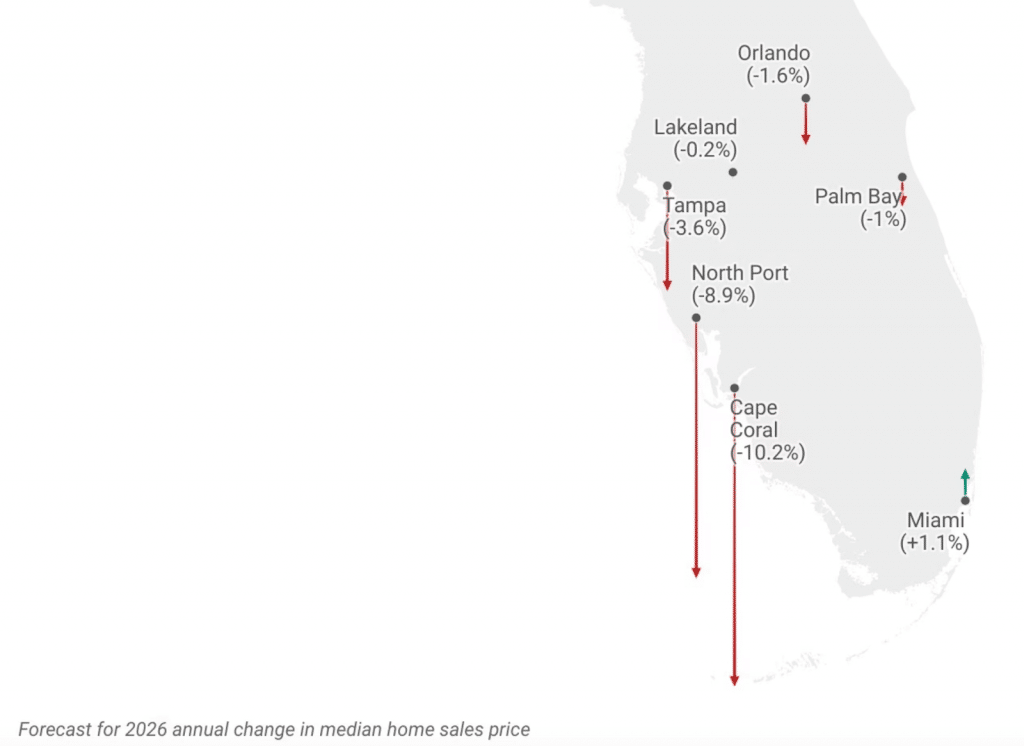
(Source: Realtor)
Meanwhile, Miami is expected to remain relatively resilient with modest growth.
For overseas buyers, this highlights the importance of market selection, something explored in our guide to investing in U.S. real estate as a foreign national.
Are Condos Driving the Florida Market Price Drop More Than Houses?
Yes, and this is one of the most misunderstood parts of the current cycle.
Data shows:
- Condo listing prices fell about 10.8%
- Single-family homes declined only 3.6%
This means the broader Florida market price drop is heavily influenced by the condo sector rather than detached housing.
Even with recent declines, values remain significantly higher than pre-2020 levels:
- Condo prices up roughly 26% since 2020
- Single-family homes up around 34% since 2020
That’s why many investors see the current phase as a rebalancing rather than a downturn.
If you’re exploring long-term strategies, our article on foreign income mortgage approvals for U.S. property explains how global buyers structure financing during market shifts.
Why Do Prices Increase Faster Than They Decrease in Real Estate Cycles?
Real estate cycles rarely move symmetrically.
When demand returns:
- Inventory tightens quickly
- Competition increases
- Prices accelerate faster than they previously declined
Some economists suggest that easing mortgage rates could bring more buyers back into the market, which could stabilize prices again.
This pattern is why experienced investors often act during periods like the current Florida market price drop, before headlines shift back toward growth.
Why International Buyers Should Get Preapproved Before the Market Turns
Preparation matters more than timing headlines.
Many overseas buyers wait until markets “feel safe,” but by then:
- Inventory shrinks
- Competition rises
- Negotiation power decreases
Getting preapproved early allows buyers to move quickly when opportunities appear , especially in off-market or fast-moving listings.
Programs like U.S. Expat Mortgage Loans and Foreign National Mortgage Programs are structured around international underwriting guidelines, helping borrowers qualify using foreign income, liquidity, and alternative credit documentation.
Understanding underwriting guidelines before searching helps global investors respond faster when the right property becomes available.
Which Florida Markets Are Global Investors Watching During the Florida Market Price Drop?
While some Gulf Coast areas face stronger corrections, major international hubs remain attractive:
- Miami continues to show resilience due to global demand and diversified economic drivers.
- Tampa’s moderate adjustment may create entry opportunities for long-term investors.
- Emerging secondary markets may offer improved yield potential as supply expands.
If you’re comparing locations, you might also find insights in our Florida-focused investment strategy overview: A Global Investor’s Guide to Buying U.S. Property
What Should Overseas Investors Do Right Now?
Getting preapproved is often the first step international buyers take before searching on the MLS, where most U.S. properties are listed.
After that, instead of reacting to headlines, focus on preparation:
- Review financing options and underwriting guidelines
- Get preapproved as part of your buying strategy
- Monitor inventory trends rather than daily price headlines
- Work with lenders experienced in cross-border transactions
Preparation during a Florida market price drop often provides stronger negotiating leverage and better long-term positioning.
Speak to a Specialist — Get Preapproved Before Competition Returns
America Mortgages, Leading Experts in Foreign National and U.S. Expat Mortgage Loans, helps overseas buyers structure financing using foreign income, flexible credit profiles, and international lending solutions.
If you’re considering buying during the current Florida market price drop, speaking with a specialist early can help you understand eligibility, timelines, and next steps. You can reach our team directly through the America Mortgages Contact Page, email us at [email protected], or call +1 (845) 583-0830 to get preapproved and prepared before the market shifts again.
Frequently Asked Questions
Q1. Is the Florida market price drop a sign of a housing crash?
A: No, forecasts suggest a modest average decline rather than a collapse. The adjustment is largely tied to supply increases and higher ownership costs, not a fundamental demand breakdown.
Q2. Why are Florida condo prices falling faster than houses?
A: Higher HOA fees, insurance costs, and new regulations have impacted condos more heavily. Single-family homes have experienced much smaller price adjustments compared to the condo sector.
Q3. Should international buyers wait until prices fall further?
A: Timing markets perfectly is difficult. Many investors choose to get preapproved early so they can act when favorable opportunities appear rather than chasing the bottom.
Q4. Will mortgage rates affect the Florida market price drop?
A: Yes. Economists expect that easing mortgage rates could bring more buyers back into the market, which may stabilize or reverse price declines over time.
Q5. Are foreign nationals allowed to buy property in Florida during this market phase?
A: Yes. Foreign nationals can purchase U.S. property, and specialist lenders offer mortgage programs designed for overseas income and non-traditional credit profiles.
Q6. Why do smart investors focus on preparation instead of headlines?
A: Real estate cycles often shift quickly. Investors who prepare financing in advance are positioned to move when supply tightens or competition returns.
Q7. Which Florida cities are expected to remain strong despite price adjustments?
A: Markets like Miami show more resilience due to global demand, while some Gulf Coast markets are projected to see larger price corrections.
Q8. Does a Florida market price drop mean better negotiation opportunities?
A: In many cases, yes. Increased inventory can give buyers more leverage, particularly when sellers adjust expectations after rapid price growth.
Q9. How can overseas buyers get preapproved for U.S. property?
A: International buyers typically provide proof of income, liquidity, and documentation aligned with U.S. mortgage underwriting guidelines. Working with lenders specializing in foreign national and U.S. expat loans can streamline the process.
Share this article
Ready to get started?
Speak with our U.S. mortgage specialists today and discover your options.
Schedule a call